

Consumer Insights
Uncover trends and behaviors shaping consumer choices today
Procurement Insights
Optimize your sourcing strategy with key market data
Industry Stats
Stay ahead with the latest trends and market analysis.
Carbapenem-resistant Enterobacterales (CRE) are Enterobacterales that are resistant to at least one carbapenem antimicrobial, creating infections for which treatment options can be substantially restricted. WHO's 2024 Bacterial Priority Pathogens List places carbapenem-resistant Enterobacterales in the critical-priority category, reflecting their burden, transmissibility and limited treatment options. According to Carbapenem-resistant Enterobacterales (CRE) Epidemiology Forecast by Expert Market Research, CRE contributes to the broader antimicrobial-resistance and infectious-disease therapeutic landscape, particularly through hospital infections requiring advanced antibacterial treatment and susceptibility-guided management.
Base Year
Historical Period
Forecast Period
Read more about this report - Request a Free Sample
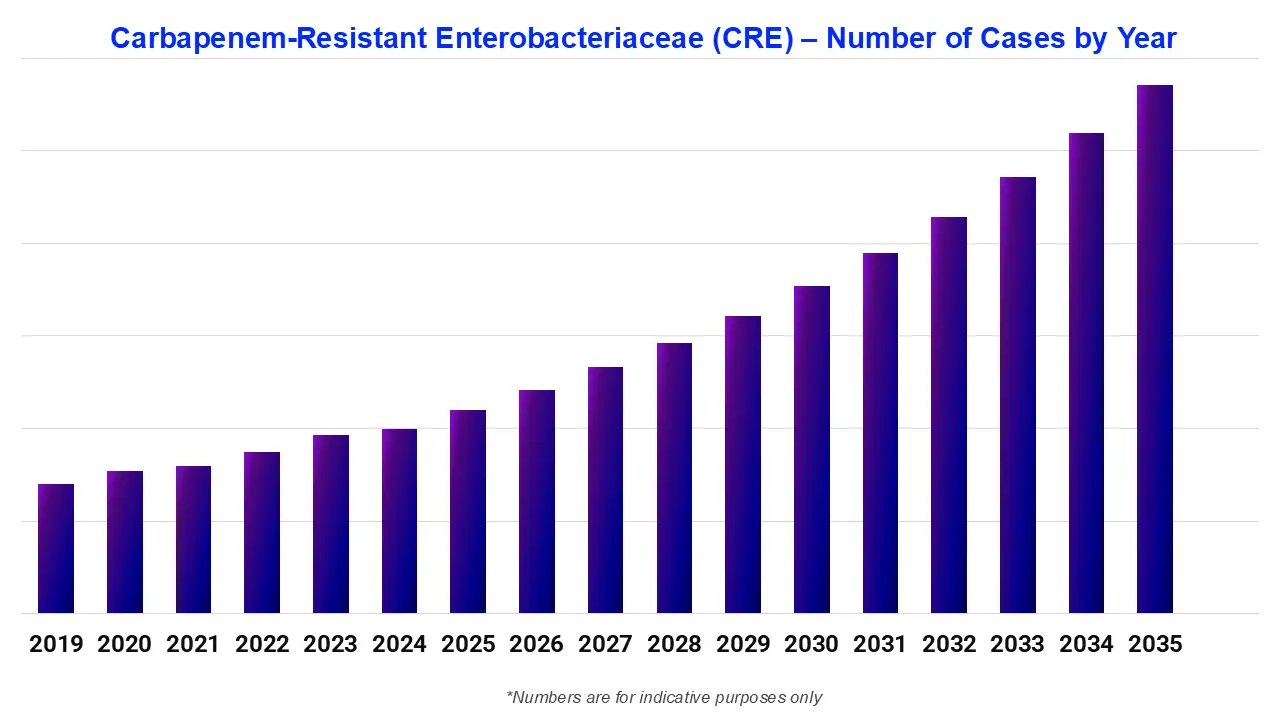
Expert Market Research's “Carbapenem-Resistant Enterobacteriaceae (CRE) Epidemiology Forecast Report 2026-2035” offers comprehensive information on the prevalence and demographics of Carbapenem-Resistant Enterobacteriaceae (CRE). It projects the future incidence and prevalence rates of Carbapenem-Resistant Enterobacteriaceae (CRE) cases across various populations. The study covers age, gender, and type as major determinants of the Carbapenem-Resistant Enterobacteriaceae (CRE) population. The report highlights patterns in the prevalence of Carbapenem-Resistant Enterobacteriaceae (CRE) overtime and projects future trends based on multiple variables.
The report provides a comprehensive overview of the disease, as well as historical and projected data on the epidemiology of Carbapenem-Resistant Enterobacteriaceae (CRE) in the 8 major markets.
Regions Covered
Carbapenem-resistant Enterobacterales (CRE) are Enterobacterales that are resistant to at least one carbapenem antimicrobial, creating infections for which treatment options can be substantially restricted. The group includes clinically important organisms such as Escherichia coli, Klebsiella pneumoniae, Enterobacter cloacae complex, Klebsiella oxytoca and Klebsiella aerogenes. Resistance may arise through carbapenemase production, permeability changes, efflux mechanisms or combinations of β-lactamase production and porin alteration. Carbapenemase-producing CRE are of particular epidemiological concern because enzymes such as KPC, NDM, OXA-48-like, VIM and IMP can mediate resistance to multiple β-lactam agents and facilitate transmission of resistance determinants between bacterial populations. WHO's 2024 Bacterial Priority Pathogens List places carbapenem-resistant Enterobacterales in the critical-priority category, reflecting their burden, transmissibility and limited treatment options.
|
Parameter |
Insight |
|
Largest Patient Pool |
United States |
|
Fastest Growing Country |
United States |
|
High-Risk Population |
Older adults, ICU patients, patients with prolonged healthcare exposure, long-term-care residents, individuals with invasive urinary or central venous devices, dialysis patients, transplant recipients and people with substantial comorbidity. |
|
Key Diagnostic Method |
Phenotypic antimicrobial susceptibility testing followed by carbapenemase detection and molecular characterization when appropriate; major mechanisms include KPC, NDM, OXA-48-like, VIM and IMP. |
|
Major Risk Factor |
Previous healthcare exposure, invasive devices and antimicrobial exposure. In U.S. 2023 surveillance, 64.7% had a healthcare-facility stay during the preceding year and 34.8% had a urinary catheter shortly before specimen collection. |
|
Major gap in the market |
Heterogeneous definitions, incomplete screening of asymptomatic carriers, substantial healthcare-to-healthcare transmission, variable carbapenemase testing and limited population-based surveillance in many countries complicate estimation of true CRE burden. |
The Carbapenem-Resistant Enterobacteriaceae (CRE) epidemiology division offers information on the patient pool from history to the present as well as the projected trend for each of the 8 major markets. Expert Market Research provides both current and predicted trends for the Carbapenem-Resistant Enterobacteriaceae (CRE) epidemiology scenario by examining a wide range of studies. Additionally, the report covers the diagnosed patient pool for Carbapenem-Resistant Enterobacteriaceae (CRE) and their trends. The data is broken down into specific categories, such as total prevalent cases in males and females, and total diagnosed cases across different age groups and patient pools.
|
Epidemiology Segment |
Key Insights |
|
Diagnosed Prevalent Cases of the Disease |
1,773 incident cases were identified in CDC EIP surveillance, corresponding to 7.7 cases per 100,000 population. Urinary infection accounted for 65.1% and bacteremia for 14.8%. EU-wide incidence of carbapenem-resistant K. pneumoniae bloodstream infection was estimated at 3.97 per 100,000 population, with substantial country-level heterogeneity |
|
Gender-Specific Cases of the Disease |
U.S. 2023 incidence was 8.7 per 100,000 in females versus 6.5 in males; females represented 58.0% of reported cases. |
|
Age-Specific Cases of the Disease |
U.S. incidence increased from 0.7 per 100,000 among 0-18-year-olds to 57.5 per 100,000 among people aged ≥80 years in 2023. |
|
Ethnicity-Wise Cases of the Disease |
U.S. 2023 incidence was highest among non-Hispanic American Indian/Alaska Native (14.8 per 100,000) and non-Hispanic Black/African American (10.3 per 100,000) populations. These are population disparities rather than evidence of inherent biological susceptibility. |
|
Mortality and Survival Analysis of the Disease |
CDC recorded 86 deaths within 30 days in 2023, corresponding to 4.9% of all incident cases; mortality reached 17.4% among cases with an incident sterile-site specimen. England reported 24.1% 30-day all-cause mortality among patients with CPOs isolated from sterile sites in 2024. |
Read more about this report - Request a Free Sample
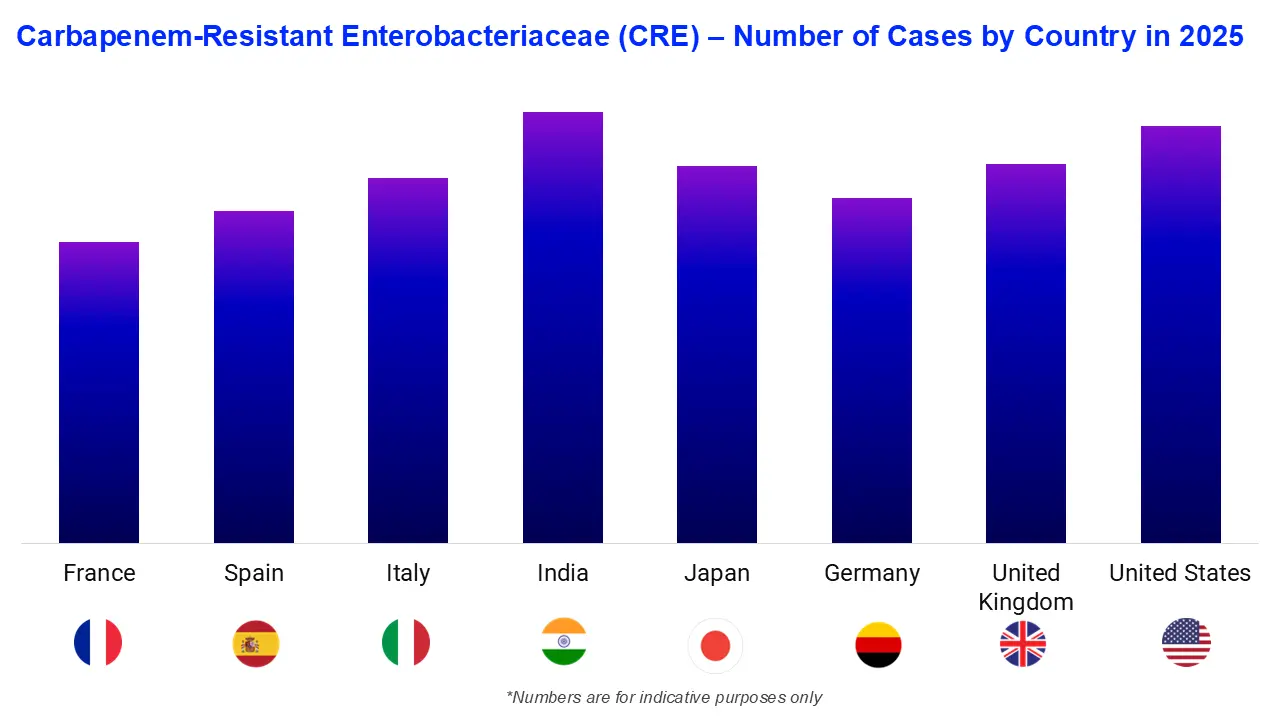
The Carbapenem-Resistant Enterobacteriaceae (CRE) epidemiology data and findings for the United States, Germany, Spain, Italy, France, the United Kingdom, Japan, and India are also provided in the epidemiology section.
|
Country |
Key Insights |
|
United States |
CDC EIP identified 1,773 incident CRE cases in 2023, corresponding to 7.7 cases per 100,000 population. Females had higher incidence than males, and incidence increased substantially with age. Of 666 isolates undergoing molecular characterization, 38.3% were carbapenemase-producing. |
|
Germany |
Germany remains within the European surveillance framework for carbapenem-resistant Enterobacterales. Contemporary ECDC data demonstrate that carbapenem-resistant K. pneumoniae bloodstream infections remain present, although a single nationally comparable all-CRE case count for 2023–2026 was not identified in the reviewed sources. |
|
France |
France is a contemporary European CRE setting with carbapenem-resistant K. pneumoniae bloodstream infections captured through EARS-Net. However, a directly comparable national all-CRE 2023–2026 incidence series was not identified in the reviewed evidence, so no unsupported national CRE total is inserted. |
|
Italy |
Italy represents an important European setting for carbapenem-resistant Enterobacterales, particularly carbapenem-resistant K. pneumoniae. Current EARS-Net surveillance shows substantial carbapenem-resistant bloodstream infection burden, although national CRE totals should not be inferred from the K. pneumoniae bloodstream denominator. |
|
Spain |
Spain participates in EARS-Net surveillance and reports carbapenem-resistant Enterobacterales, including carbapenem-resistant K. pneumoniae bloodstream infection. A directly comparable all-CRE national patient count for 2023–2026 was not identified in the reviewed evidence. |
|
United Kingdom |
England identified 212 first C. auris detections in 2024. Between January 2023 and September 2025, 496 patients were reported, 84% colonized and 14% invasive. London and South East England accounted for approximately 92% of reported cases. |
|
Japan |
Japan's contemporary national response recognizes C. auris as an emerging infection-control concern. The country had identified its first invasive bloodstream infection before the 2023–2026 period, but a nationally comparable 2023–2026 case series sufficient for direct ranking was not identified in the current evidence review. |
|
India |
No nationally representative 2023–2026 C. auris incidence estimate was identified. Contemporary tertiary-care evidence demonstrates a substantial clinical burden in selected hospitals; one South Indian study found 85 of 372 candidemia episodes (22.8%) were caused by C. auris. |
The primary epidemiological gap in CRE is the absence of a universally consistent definition and surveillance framework across countries. CDC's U.S. EIP system defines an incident case using resistance among specified Enterobacterales isolated from urine or normally sterile sites, whereas European surveillance frequently reports resistance within bloodstream isolates of individual species such as K. pneumoniae. England's national reference system focuses heavily on carbapenemase-producing organisms referred for specialized testing. These approaches measure related but non-identical phenomena, making global incidence comparisons intrinsically uncertain.
The management of Carbapenem-Resistant Enterobacterales infection primarily focuses on accurate species and resistance-mechanism identification, severity assessment, susceptibility-guided antimicrobial treatment, source control and prevention of healthcare-associated transmission. Unlike susceptible Enterobacterales infections, CRE management requires particular attention to the carbapenemase mechanism because susceptibility to one newer β-lactam/β-lactamase inhibitor does not necessarily predict activity against organisms carrying another resistance mechanism. Contemporary reviews therefore emphasize individualized treatment based on molecular or phenotypic characterization whenever feasible.


Upto 15% Off
USD
$2699 $2429
$4299 $3869
$5799 $4949
$6999 $5949


*While we strive to always give you current and accurate information, the numbers depicted on the website are indicative and may differ from the actual numbers in the main report. At Expert Market Research, we aim to bring you the latest insights and trends in the market. Using our analyses and forecasts, stakeholders can understand the market dynamics, navigate challenges, and capitalize on opportunities to make data-driven strategic decisions.*
Explore our key highlights of the report and gain a concise overview of key findings, trends, and actionable insights that will empower your strategic decisions.
|
Report Features |
Details |
|
Base Year |
2025 |
|
Historical Period |
2019-2025 |
|
Forecast Period |
2026-2035 |
|
Epidemiology Statistics Provided |
|
|
Segmentation Provided |
|
|
Geographies Covered |
|
Datasheet
One User
USD 2,699
USD 2,429
tax inclusive*
Single User License
One User
USD 4,299
USD 3,869
tax inclusive*
Five User License
Five User
USD 5,799
USD 4,949
tax inclusive*
Corporate License
Unlimited Users
USD 6,999
USD 5,949
tax inclusive*
*Please note that the prices mentioned below are starting prices for each bundle type. Kindly contact our team for further details.*
Flash Bundle
Small Business Bundle
Growth Bundle
Enterprise Bundle
*Please note that the prices mentioned below are starting prices for each bundle type. Kindly contact our team for further details.*
Flash Bundle
Number of Reports: 3
20%
tax inclusive*
Small Business Bundle
Number of Reports: 5
25%
tax inclusive*
Growth Bundle
Number of Reports: 8
30%
tax inclusive*
Enterprise Bundle
Number of Reports: 10
35%
tax inclusive*
How To Order

Select License Type
Choose the right license for your needs and access rights.

Click on ‘Buy Now’
Add the report to your cart with one click and proceed to register.

Select Mode of Payment
Choose a payment option for a secure checkout. You will be redirected accordingly.
Strategic Solutions for Informed Decision-Making
Gain insights to stay ahead and seize opportunities.

Get insights & trends for a competitive edge.

Track prices with detailed trend reports.

Analyse trade data for supply chain insights.

Leverage cost reports for smart savings

Enhance supply chain with partnerships.

Connect For More Information
Our expert team of analysts will offer full support and resolve any queries regarding the report, before and after the purchase.
Our expert team of analysts will offer full support and resolve any queries regarding the report, before and after the purchase.
We employ meticulous research methods, blending advanced analytics and expert insights to deliver accurate, actionable industry intelligence, staying ahead of competitors.
Our skilled analysts offer unparalleled competitive advantage with detailed insights on current and emerging markets, ensuring your strategic edge.
We offer an in-depth yet simplified presentation of industry insights and analysis to meet your specific requirements effectively.




