

Consumer Insights
Uncover trends and behaviors shaping consumer choices today
Procurement Insights
Optimize your sourcing strategy with key market data
Industry Stats
Stay ahead with the latest trends and market analysis.
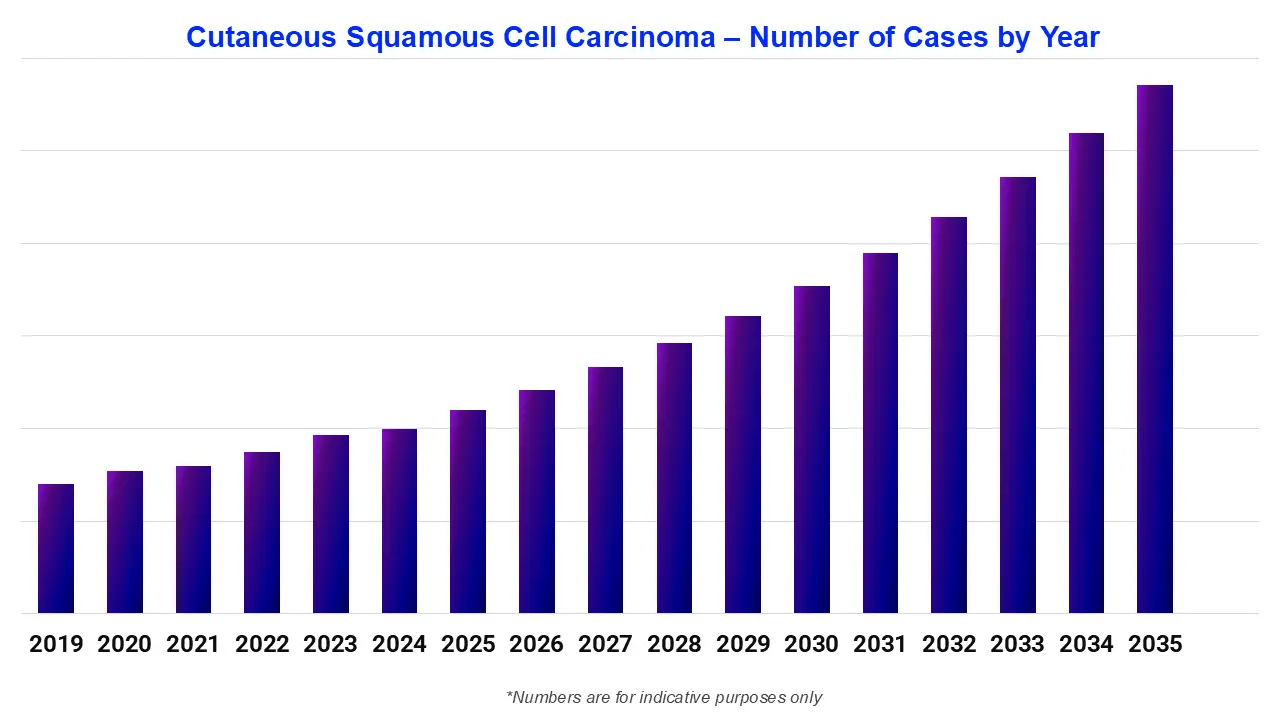
Cutaneous squamous cell carcinoma is a malignant non-melanoma skin cancer arising from epidermal squamous cells. As per Martina Catalano et al. (2024), it is the second most prevalent non-melanoma skin cancer globally, comprising approximately 20% of cutaneous malignancies. According to the cutaneous squamous cell carcinoma epidemiology forecast by Expert Market Research, disease burden remains substantial, supporting continued epidemiological monitoring worldwide.
Base Year
Historical Period
Forecast Period
Read more about this report - Request a Free Sample
Expert Market Research's “Cutaneous Squamous Cell Carcinoma Epidemiology Forecast Report 2026-2035” offers comprehensive information on the prevalence and demographics of cutaneous squamous cell carcinoma. It projects the future incidence and prevalence rates of cutaneous squamous cell carcinoma cases across various populations. The study covers age, gender, and type as major determinants of cutaneous squamous cell carcinoma population. The report highlights patterns in the prevalence of cutaneous squamous cell carcinoma over time and projects future trends based on multiple variables.
The report provides a comprehensive overview of the disease, as well as historical and projected data on the epidemiology of cutaneous squamous cell carcinoma in the 8 major markets.
Regions Covered
Cutaneous squamous cell carcinoma (cSCC) is a common skin cancer that develops from malignant transformation of keratinocytes, particularly after cumulative ultraviolet (UV) radiation-induced DNA damage. It most often occurs in sun-exposed areas such as the head, neck, arms, and hands, although it can develop anywhere on the skin. cSCC may arise from precancerous lesions such as actinic keratosis and can appear as a rough, scaly patch, firm growth, or nonhealing sore. Clinically, it includes invasive squamous cell carcinoma, squamous cell carcinoma in situ, and histologic variants with different levels of differentiation and aggressiveness.
|
Parameter |
Insight |
|
Largest Patient Pool |
United States |
|
Fastest Growing Country |
India |
|
High-Risk Population |
Older adults, immunosuppressed individuals, organ-transplant recipients, and people with substantial cumulative UV exposure |
|
Key Diagnostic Method |
Skin examination and biopsy-Clinical examination followed by histopathologic confirmation is central to diagnosis |
|
Major Risk Factor |
Cumulative ultraviolet (UV) radiation exposure. Chronic exposure is a major etiologic factor in cSCC. |
|
Major gap in the market |
Delayed detection and limited access to specialist dermatologic assessment. These factors can contribute to diagnosis at more advanced stages. |
The cutaneous squamous cell carcinoma epidemiology division offers information on the patient pool from history to the present as well as the projected trend for each of the 8 major markets. Expert Market Research provides both current and predicted trends for the cutaneous squamous cell carcinoma epidemiology scenario by examining a wide range of studies. Additionally, the report covers the diagnosed patient pool for cutaneous squamous cell carcinoma and their trends. The data is broken down into specific categories, such as total prevalent cases in males and females, and total diagnosed cases across different age groups and patient pools.
|
Epidemiology Segment |
Key Insights |
|
Diagnosed Prevalent Cases of the Disease |
According to Martina Catalano et al. (2024), cutaneous squamous cell carcinoma (cSCC) is the second most prevalent non-melanoma skin cancer worldwide, accounting for approximately 20% of cutaneous malignancies. |
|
Gender-Specific Cases of the Disease |
According to Yumeng Pan et al. (2025), males accounted for 56.47% of global squamous cell carcinoma cases, indicating a higher disease burden among males than females. |
|
Age-Specific Cases of the Disease |
As per Yumeng Pan et al. (2025), the global burden of squamous cell carcinoma increased substantially among older adults between 1990 and 2021, with incidence increasing by 322.77%. |
|
Ethnicity-Wise Cases of the Disease |
According to Shehnaz Ahmed et al. (2026), cSCC was substantially more common in White populations in England, with an age-standardized incidence rate of 61.8 per 100,000, compared with 4.55 among Asian and 4.73 among Black populations. |
|
Mortality and Survival Analysis of the Disease |
According to Martina Catalano et al. (2024), 3–7% of patients develop locally advanced or metastatic cSCC, while metastatic disease carries substantial mortality. The reported mortality risk associated with metastasis was 2.8%. |
|
Disease Type |
Prevalence |
|
Conventional cSCC |
Includes the conventional/classic form of cSCC, representing the primary histopathologic presentation. |
|
Verrucous Carcinoma |
A well-differentiated variant of cSCC characterized by a verrucous growth pattern. |
|
Acantholytic Cutaneous Squamous Cell Carcinoma |
A histopathologic variant characterized by acantholysis and associated with distinct microscopic features. |
|
Other |
Includes spindle cell (sarcomatoid), desmoplastic, clear cell, basosquamous, adenosquamous, and metaplastic variants of cSCC. |
Read more about this report - Request a Free Sample
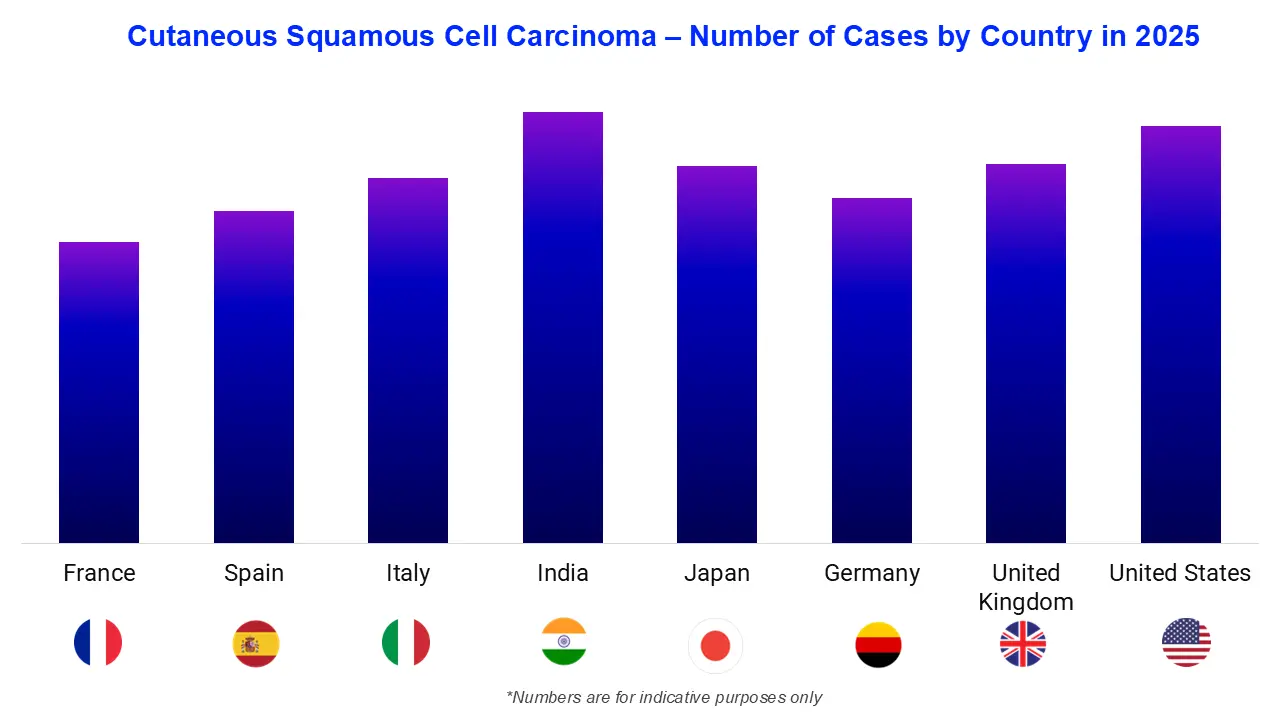
The cutaneous squamous cell carcinoma epidemiology data and findings for the United States, Germany, Spain, Italy, France, the United Kingdom, Japan, and India are also provided in the epidemiology section.
|
Country |
Key Insights |
|
United States |
According to Rina Jiang et al. (2024), the estimated annual incidence of cSCC in the United States exceeds 1 million cases. The reported increase has been associated with cumulative ultraviolet radiation exposure, an aging population, systemic immunosuppression, and expanded skin cancer screening. |
|
Germany |
In Germany, the cSCC burden is influenced by epidemiological factors including advanced age, cumulative lifetime ultraviolet radiation exposure, sun-sensitive skin, and immunosuppression, particularly among individuals with solid organ transplantation. |
|
France |
In France, prevalence is influenced by advanced age, lifetime ultraviolet radiation exposure, sun-sensitive skin, and immunosuppression. Additional factors associated with cSCC development include tobacco smoking, therapeutic ionizing radiation, and certain skin conditions. |
|
Italy |
The epidemiological burden in Italy is influenced by advanced age and cumulative ultraviolet radiation exposure. Immunosuppression, sun-sensitive skin, tobacco smoking, and therapeutic ionizing radiation are additional factors associated with cSCC development. |
|
Spain |
According to N.F. Fernández-Martínez et al. (2026), the age-standardized incidence rate of non-melanoma skin cancer excluding basal cell carcinoma in Spain was estimated at 9.1 cases per 100,000 population in 2022, with most cases corresponding to cSCC. |
|
United Kingdom |
According to Birgitta van Bodegraven et al. (2024), 45,585 cSCC cases were recorded in England in 2020. Among 415,236 first-ever cSCC tumors diagnosed during 2004–2020, the median age at diagnosis was 78 years and 61.7% of patients were male. |
|
Japan |
According to Yasuyoshi Sato et al. (2023), approximately 2,507 cutaneous SCC cases were recorded in Japan during 1987–1991, representing 28.8% of cutaneous malignancies, with an estimated incidence of approximately 2.5 cases per 100,000 people annually. |
|
India |
In India, cSCC epidemiology is influenced by factors such as lifetime ultraviolet radiation exposure, advanced age, sun-sensitive skin, and immunosuppression. Other factors associated with disease development include certain skin conditions, tobacco smoking, and therapeutic ionizing radiation. |
The regional cSCC landscape presents opportunities to improve early detection, risk stratification, and access to specialized dermatologic care across the United States, Germany, France, Italy, Spain, the United Kingdom, Japan, and India. A major unmet need is the timely identification of lesions among older adults, immunosuppressed patients, and individuals with substantial cumulative UV exposure. Expanding dermatologist access, improving awareness of suspicious skin lesions, and strengthening biopsy-based diagnostic pathways could increase case detection. In advanced disease, continued adoption and development of immunotherapies and multidisciplinary treatment approaches represent emerging opportunities.
Cutaneous squamous cell carcinoma treatment depends on tumor size, location, depth, recurrence risk, and whether the cancer has spread. Surgical excision is commonly used for localized tumors, while Mohs micrographic surgery is particularly useful for selected high-risk tumors or anatomically sensitive sites. Curettage and electrodesiccation, cryosurgery, and radiation therapy may be considered for selected tumors when appropriate. Advanced or unresectable cSCC may require systemic immunotherapy, including programmed cell death protein 1 (PD-1) inhibitors. Treatment may involve multidisciplinary care when tumors are locally advanced, recurrent, or metastatic.


Upto 15% Off
USD
$2699 $2429
$4299 $3869
$5799 $4949
$6999 $5949


*While we strive to always give you current and accurate information, the numbers depicted on the website are indicative and may differ from the actual numbers in the main report. At Expert Market Research, we aim to bring you the latest insights and trends in the market. Using our analyses and forecasts, stakeholders can understand the market dynamics, navigate challenges, and capitalize on opportunities to make data-driven strategic decisions.*
Explore our key highlights of the report and gain a concise overview of key findings, trends, and actionable insights that will empower your strategic decisions.
|
Report Features |
Details |
|
Base Year |
2025 |
|
Historical Period |
2019-2025 |
|
Forecast Period |
2026-2035 |
|
Epidemiology Statistics Provided |
|
|
Segmentation Provided |
|
|
Geographies Covered |
|
Datasheet
One User
USD 2,699
USD 2,429
tax inclusive*
Single User License
One User
USD 4,299
USD 3,869
tax inclusive*
Five User License
Five User
USD 5,799
USD 4,949
tax inclusive*
Corporate License
Unlimited Users
USD 6,999
USD 5,949
tax inclusive*
*Please note that the prices mentioned below are starting prices for each bundle type. Kindly contact our team for further details.*
Flash Bundle
Small Business Bundle
Growth Bundle
Enterprise Bundle
*Please note that the prices mentioned below are starting prices for each bundle type. Kindly contact our team for further details.*
Flash Bundle
Number of Reports: 3
20%
tax inclusive*
Small Business Bundle
Number of Reports: 5
25%
tax inclusive*
Growth Bundle
Number of Reports: 8
30%
tax inclusive*
Enterprise Bundle
Number of Reports: 10
35%
tax inclusive*
How To Order

Select License Type
Choose the right license for your needs and access rights.

Click on ‘Buy Now’
Add the report to your cart with one click and proceed to register.

Select Mode of Payment
Choose a payment option for a secure checkout. You will be redirected accordingly.
Strategic Solutions for Informed Decision-Making
Gain insights to stay ahead and seize opportunities.

Get insights & trends for a competitive edge.

Track prices with detailed trend reports.

Analyse trade data for supply chain insights.

Leverage cost reports for smart savings

Enhance supply chain with partnerships.

Connect For More Information
Our expert team of analysts will offer full support and resolve any queries regarding the report, before and after the purchase.
Our expert team of analysts will offer full support and resolve any queries regarding the report, before and after the purchase.
We employ meticulous research methods, blending advanced analytics and expert insights to deliver accurate, actionable industry intelligence, staying ahead of competitors.
Our skilled analysts offer unparalleled competitive advantage with detailed insights on current and emerging markets, ensuring your strategic edge.
We offer an in-depth yet simplified presentation of industry insights and analysis to meet your specific requirements effectively.




