

Consumer Insights
Uncover trends and behaviors shaping consumer choices today
Procurement Insights
Optimize your sourcing strategy with key market data
Industry Stats
Stay ahead with the latest trends and market analysis.
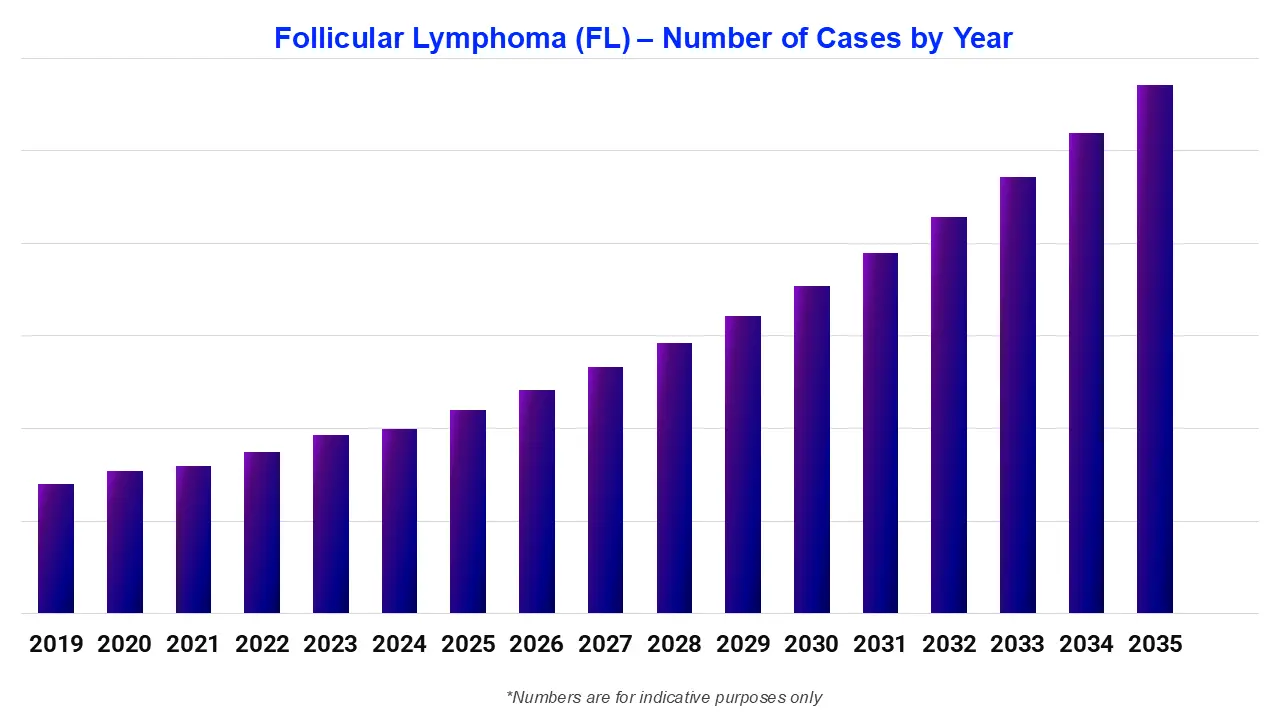
Follicular lymphoma (FL) is an indolent mature B-cell non-Hodgkin lymphoma arising from germinal-centre B cells. A clinically important minority develops progression within 24 months (POD24) or histological transformation, usually to diffuse large B-cell lymphoma. In a 2025 Lymphoma Epidemiology of Outcomes Consortium analysis of 220 patients with POD24, the overall response rate was 64%, median event-free survival was 9.8 months, and five-year overall survival was 71%. According to follicular lymphoma (FL) epidemiology forecast for Expert Market Research, the global follicular lymphoma treatment market is expected to grow during the forecast period, driven by increasing recognition of relapsed and refractory disease, wider adoption of targeted and immune-based therapies, improved molecular classification, and development of treatments for high-risk FL.
Base Year
Historical Period
Forecast Period
Read more about this report - Request a Free Sample
Expert Market Research's “Follicular Lymphoma (FL) Epidemiology Forecast Report 2026-2035” offers comprehensive information on the prevalence and demographics of Follicular Lymphoma (FL). It projects the future incidence and prevalence rates of Follicular Lymphoma (FL) cases across various populations. The study covers age, gender, and type as major determinants of the Follicular Lymphoma (FL) population. The report highlights patterns in the prevalence of Follicular Lymphoma (FL) over time and projects future trends based on multiple variables.
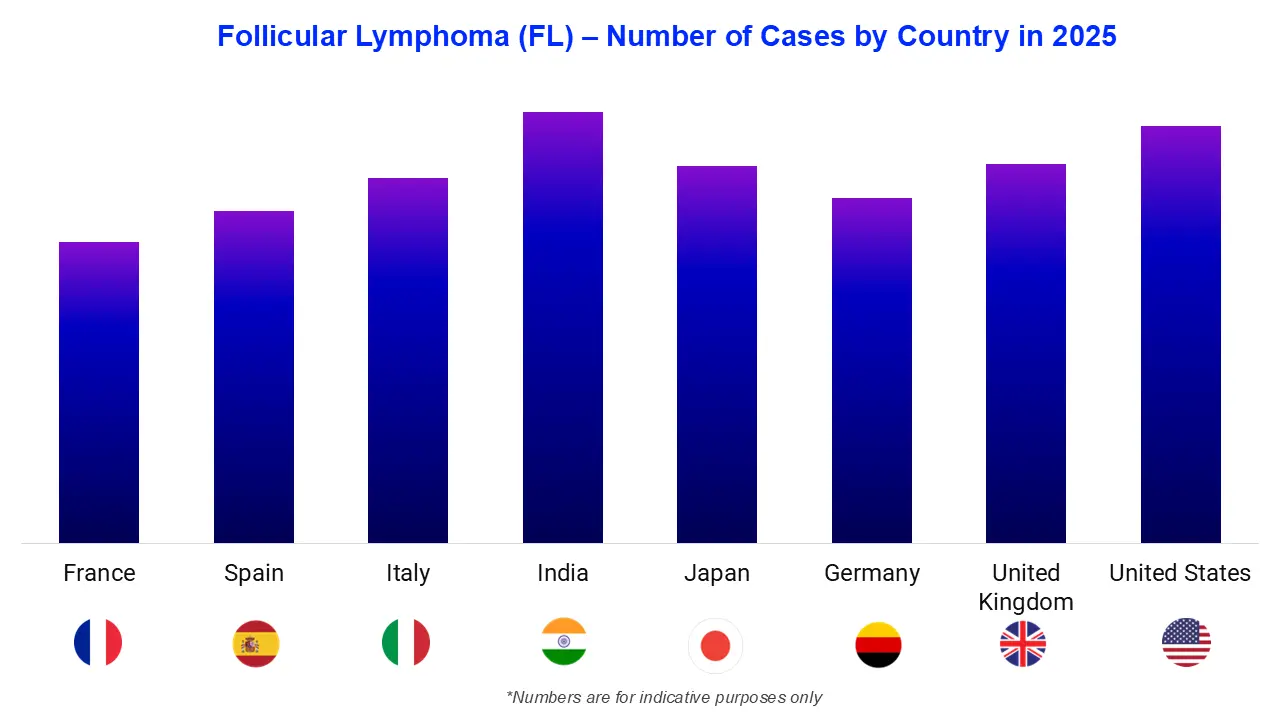
The report provides a comprehensive overview of the disease, as well as historical and projected data on the epidemiology of Follicular Lymphoma (FL) in the 8 major markets.
Regions Covered
Follicular lymphoma (FL) is an indolent mature B-cell non-Hodgkin lymphoma arising from germinal-centre B cells and characterized by a predominantly follicular growth pattern. Most cases are associated with dysregulated BCL2 expression and other molecular abnormalities affecting germinal-centre biology. The disease commonly follows a relapsing and remitting course, although its behaviour is heterogeneous. A clinically important minority develops progression of disease within 24 months (POD24) or histological transformation, usually to diffuse large B-cell lymphoma. Contemporary clinical guidance continues to classify FL grades 1, 2 and 3A as generally indolent disease, while grade 3B is usually managed according to aggressive-lymphoma principles. Diagnosis requires excisional or otherwise adequate tissue biopsy with histopathology and immunophenotyping.
|
Parameter |
Insight |
|
Largest Patient Pool |
United States |
|
Fastest Growing Country |
Germany |
|
High-Risk Population |
Older adults, patients with high tumour burden, advanced-stage disease, B symptoms, high-risk prognostic scores, grade 3B/composite histology and POD24. |
|
Key Diagnostic Method |
Tissue biopsy with immunophenotyping, PET/CT or CT staging, laboratory assessment, and selected molecular/genetic testing. |
|
Major Risk Factor |
Acquired molecular alterations involving germinal-centre B-cell biology, with clinical progression shaped by tumour burden, disease biology and host factors. |
|
Major gap in the market |
Country-level FL incidence and prevalence data are uneven, while differences in registry coding, classification and access to pathology limit direct international comparison. |
The Follicular Lymphoma (FL) epidemiology division offers information on the patient pool from history to the present as well as the projected trend for each of the 8 major markets. Expert Market Research provides both current and predicted trends for the Follicular Lymphoma (FL) epidemiology scenario by examining a wide range of studies. Additionally, the report covers the diagnosed patient pool for Follicular Lymphoma (FL) and their trends. The data is broken down into specific categories, such as total prevalent cases in males and females, and total diagnosed cases across different age groups and patient pools.
|
Epidemiology Segment |
Key Insights |
|
Diagnosed Prevalent Cases of the Disease |
Cancer Research UK reports approximately 2,300 annual follicular lymphoma diagnoses in the UK, representing around 20% of non-Hodgkin lymphoma cases. Across the 8MM, FL remains predominantly an adult malignancy, although national incidence estimates are not consistently reported using comparable contemporary registry classifications. |
|
Gender-Specific Cases of the Disease |
Population-based U.S. SEER data indicate a relatively balanced sex distribution for follicular lymphoma, with a slight female predominance. However, findings vary across individual studies and countries within the 8MM, and available evidence does not demonstrate a consistent or substantial sex-specific difference in FL occurrence. |
|
Age-Specific Cases of the Disease |
Older adulthood represents the predominant age group affected by follicular lymphoma. SEER reports a median diagnosis age of approximately 60 years, while Cancer Research UK states that FL mainly affects adults over 60. Younger-onset disease occurs across the 8MM but constitutes a smaller proportion of diagnosed cases. |
|
Ethnicity-Wise Cases of the Disease |
U.S. SEER registry data demonstrate variation in follicular lymphoma incidence across racial and ethnic groups, with higher incidence reported among White populations than Black and Asian populations. |
|
Mortality and Survival Analysis of the Disease |
Findings from the 2025 Lymphoma Epidemiology of Outcomes Consortium analysis of 220 patients with POD24 showed a 71% five-year overall survival. Older age and high-risk FLIPI scores were associated with poorer outcomes, while lymphoma remained the predominant cause of death among patients experiencing early disease progression. |
|
Disease Type |
Prevalence |
|
Grade 1 Follicular Lymphoma |
Grade 1 FL is a classic indolent germinal-centre B-cell lymphoma and is generally managed within the same clinical framework as grade 2 disease. Many patients have advanced-stage disease at diagnosis but may remain asymptomatic for prolonged periods. Contemporary management is determined more by tumor burden, symptoms, progression risk and patient fitness than by grade 1 histology alone. |
|
Grade 2 Follicular Lymphoma |
Grade 2 FL shares the principal biological and clinical characteristics of grade 1 disease and is generally treated as indolent FL. Patients may undergo observation when tumor burden is low or receive anti-CD20-based therapy when treatment is required. Contemporary guidelines emphasize integrated assessment of clinical stage, symptoms, laboratory findings and prognostic risk rather than using histological grade as the sole determinant of therapy. |
|
Grade 3A Follicular Lymphoma |
Grade 3A FL remains biologically related to conventional indolent FL but may display greater proliferative activity and more heterogeneous clinical behavior. Contemporary guidance generally retains grade 3A within the FL treatment framework, although treatment intensity can be influenced by clinical presentation and pathological features. Accurate pathological review is important because distinctions between grades can affect treatment selection and prognosis. |
|
Grade 3B Follicular Lymphoma |
Grade 3B FL is generally managed as an aggressive B-cell lymphoma rather than conventional indolent FL. Grade 3B has more aggressive biological behavior and is commonly managed using aggressive B-cell lymphoma approaches. In a 2023 international study of 157 patients, 5-year overall survival was 84% and progression-free survival was 66% after immunochemotherapy. |
Read more about this report - Request a Free Sample
The Follicular Lymphoma (FL) epidemiology data and findings for the United States, Germany, Spain, Italy, France, the United Kingdom, Japan, and India are also provided in the epidemiology section.
|
Country |
Key Insights |
|
United States |
Contemporary U.S. registry systems continue to identify FL as a major indolent lymphoma and provide detailed demographic stratification by age, sex and race. However, the most readily available subtype-specific national rates aggregate diagnosis years before 2023 and are therefore not used as current numerical estimates. Current U.S. practice is increasingly influenced by cellular and bispecific therapies for relapsed disease. |
|
Germany |
A 2025 German population-based study reported FL prevalence of 32 per 100,000 in 2020, up from 26 per 100,000 in 2015. The mean age was 67 years, with an approximately equal sex distribution. A comparable national FL estimate for 2023–2026 was not identified. |
|
France |
Contemporary French FL epidemiology remains centered on specialist lymphoma networks and genetic characterization. A directly comparable national 2023-2026 incidence or prevalence estimate specific to FL was not identified, but current European guidance reflects broad adoption of molecular classification and novel immunotherapies. |
|
Italy |
Contemporary Italian population-based lymphoma research continues to document FL among the principal indolent B-cell lymphomas, but a directly comparable national 2023-2026 subtype-specific incidence estimate was not identified. Current clinical management increasingly incorporates anti-CD20 combinations and newer targeted therapies. |
|
Spain |
The 2025 GELTAMO clinical guideline provides contemporary national guidance and describes FL as a major indolent lymphoma requiring individualized management. A standardized national 2023-2026 incidence estimate was not identified. |
|
United Kingdom |
Cancer Research UK estimates approximately 2,300 new follicular lymphoma cases annually in the UK, representing around 20% of non-Hodgkin lymphoma cases. The disease predominantly affects older adults, particularly those aged over 60 years. |
|
Japan |
The 2024 Japanese Society of Hematology guideline identifies FL as a principal indolent B-cell lymphoma and notes increasing recognition. A recent population-based FL incidence estimate restricted to 2023–2026 was not identified. |
|
India |
Contemporary Indian epidemiological literature indicates that FL represents an important but less frequently quantified B-cell lymphoma subtype. A standardized national 2023-2026 incidence or prevalence estimate was not identified, and differences in pathology access and registry coverage remain important limitations. |
The principal epidemiological gap is incomplete contemporary incidence measurement. FL is captured within lymphoma registries, but subtype definitions, coding practices and pathology classification differ across countries, limiting direct comparison of current national burden. A second gap is incomplete identification of high-risk disease. Standard clinical staging does not fully explain the biological heterogeneity of FL. POD24, transformation and molecular abnormalities can identify patients whose outcomes differ substantially from those predicted by conventional clinical staging. A third gap is recognition of transformation. Patients with apparently indolent FL may develop rapidly progressive disease or histological transformation. Contemporary population-based research shows that transformation is associated with significantly poorer survival, creating a continuing need for prompt biopsy of clinically discordant lesions.
Management begins with adequate tissue diagnosis because FL grading and differentiation from other B-cell lymphomas directly influence treatment. Contemporary guidance supports histology, immunophenotyping and appropriate molecular studies before initiating therapy. Staging generally incorporates PET/CT or contrast-enhanced CT together with clinical, laboratory and prognostic assessment. Baseline evaluation determines tumor burden, extranodal disease, possible transformation and whether treatment is immediately required. Observation remains appropriate for selected patients with asymptomatic, low-tumor-burden disease. The objective is to avoid treatment-related toxicity when immediate systemic therapy is unlikely to provide a clinically meaningful advantage. When treatment is required, anti-CD20-based immunochemotherapy remains a major therapeutic backbone.


Upto 15% Off
USD
$2699 $2429
$4299 $3869
$5799 $4949
$6999 $5949


*While we strive to always give you current and accurate information, the numbers depicted on the website are indicative and may differ from the actual numbers in the main report. At Expert Market Research, we aim to bring you the latest insights and trends in the market. Using our analyses and forecasts, stakeholders can understand the market dynamics, navigate challenges, and capitalize on opportunities to make data-driven strategic decisions.*
Explore our key highlights of the report and gain a concise overview of key findings, trends, and actionable insights that will empower your strategic decisions.
|
Report Features |
Details |
|
Base Year |
2025 |
|
Historical Period |
2019-2025 |
|
Forecast Period |
2026-2035 |
|
Epidemiology Statistics Provided |
|
|
Segmentation Provided |
|
|
Geographies Covered |
|
Datasheet
One User
USD 2,699
USD 2,429
tax inclusive*
Single User License
One User
USD 4,299
USD 3,869
tax inclusive*
Five User License
Five User
USD 5,799
USD 4,949
tax inclusive*
Corporate License
Unlimited Users
USD 6,999
USD 5,949
tax inclusive*
*Please note that the prices mentioned below are starting prices for each bundle type. Kindly contact our team for further details.*
Flash Bundle
Small Business Bundle
Growth Bundle
Enterprise Bundle
*Please note that the prices mentioned below are starting prices for each bundle type. Kindly contact our team for further details.*
Flash Bundle
Number of Reports: 3
20%
tax inclusive*
Small Business Bundle
Number of Reports: 5
25%
tax inclusive*
Growth Bundle
Number of Reports: 8
30%
tax inclusive*
Enterprise Bundle
Number of Reports: 10
35%
tax inclusive*
How To Order

Select License Type
Choose the right license for your needs and access rights.

Click on ‘Buy Now’
Add the report to your cart with one click and proceed to register.

Select Mode of Payment
Choose a payment option for a secure checkout. You will be redirected accordingly.
Strategic Solutions for Informed Decision-Making
Gain insights to stay ahead and seize opportunities.

Get insights & trends for a competitive edge.

Track prices with detailed trend reports.

Analyse trade data for supply chain insights.

Leverage cost reports for smart savings

Enhance supply chain with partnerships.

Connect For More Information
Our expert team of analysts will offer full support and resolve any queries regarding the report, before and after the purchase.
Our expert team of analysts will offer full support and resolve any queries regarding the report, before and after the purchase.
We employ meticulous research methods, blending advanced analytics and expert insights to deliver accurate, actionable industry intelligence, staying ahead of competitors.
Our skilled analysts offer unparalleled competitive advantage with detailed insights on current and emerging markets, ensuring your strategic edge.
We offer an in-depth yet simplified presentation of industry insights and analysis to meet your specific requirements effectively.




