

Consumer Insights
Uncover trends and behaviors shaping consumer choices today
Procurement Insights
Optimize your sourcing strategy with key market data
Industry Stats
Stay ahead with the latest trends and market analysis.
KRAS G12C and KRAS G12D are recurrent activating substitutions at codon 12 of the KRAS oncogene and represent distinct molecularly defined populations across multiple solid tumors. Large-scale U.S. genomic profiling established KRAS G12C as approximately 9% of NSCLC, 3.2% of CRC and 1.3% of pancreatic cancer in the profiled population. According to KRAS G12C / G12D solid tumors epidemiology forecast by Expert Market Research (EMR), KRAS alterations occur most frequently in PDAC, CRC and non-squamous NSCLC. Large-scale genomic profiling has estimated KRAS mutations in approximately 92% of PDAC, 49% of CRC and 35% of non-squamous NSCLC.
Base Year
Historical Period
Forecast Period
Read more about this report - Request a Free Sample
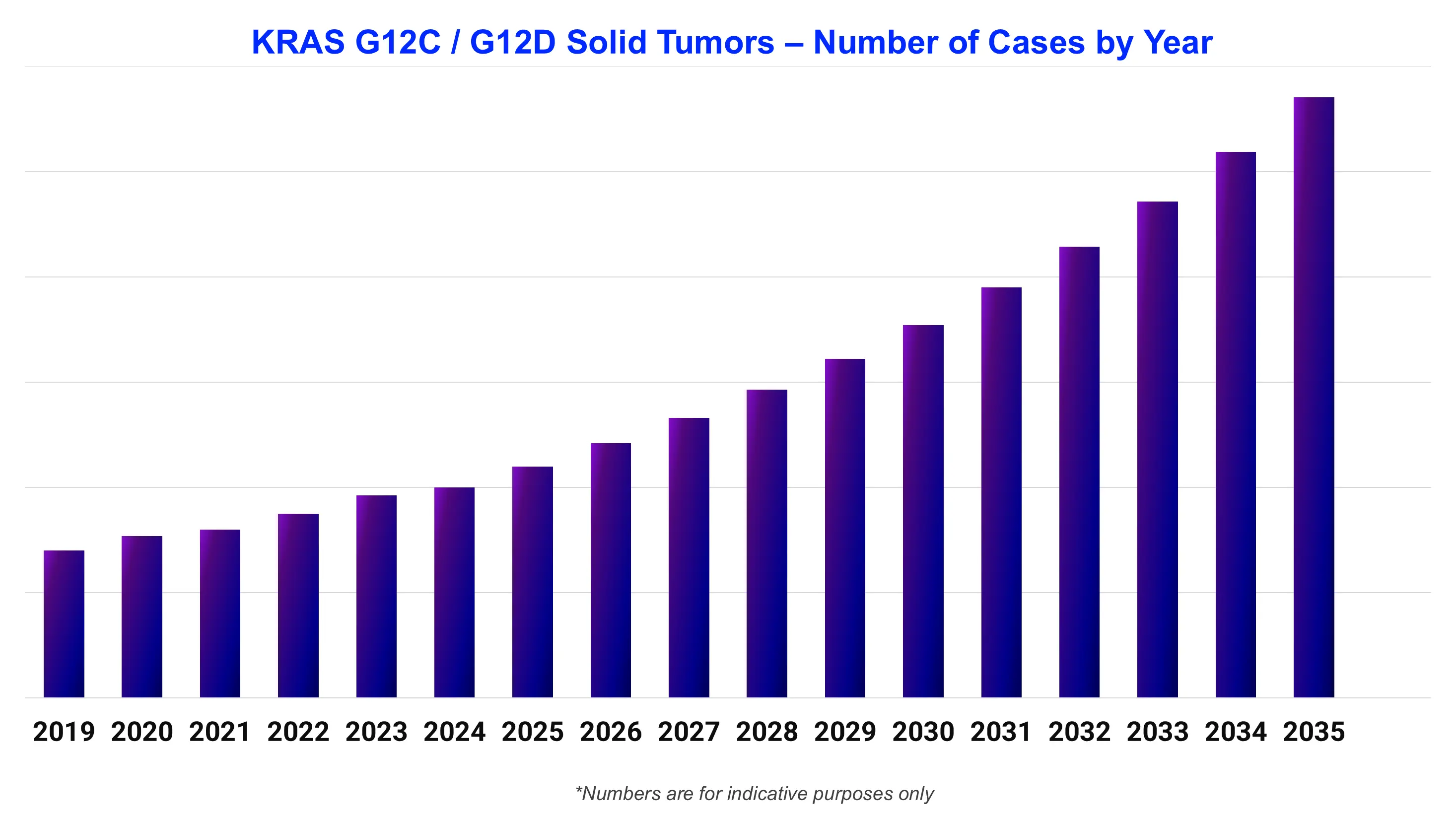
Expert Market Research's “KRAS G12C / G12D Solid Tumors Epidemiology Forecast Report 2026-2035” offers comprehensive information on the prevalence and demographics of KRAS G12C / G12D Solid Tumors. It projects the future incidence and prevalence rates of KRAS G12C / G12D Solid Tumors cases across various populations. The study covers age, gender, and type as major determinants of the KRAS G12C / G12D Solid Tumors population. The report highlights patterns in the prevalence of KRAS G12C / G12D Solid Tumors over time and projects future trends based on multiple variables.
The report provides a comprehensive overview of the disease, as well as historical and projected data on the epidemiology of KRAS G12C / G12D Solid Tumors in the 8 major markets.
Regions Covered
KRAS G12C and KRAS G12D are recurrent activating substitutions at codon 12 of the KRAS oncogene and represent distinct molecularly defined populations across multiple solid tumors. KRAS G12C is particularly enriched in non-small-cell lung cancer (NSCLC), where it represents a substantial proportion of KRAS-mutated tumors, and occurs at lower frequencies in colorectal cancer (CRC) and pancreatic ductal adenocarcinoma (PDAC). KRAS G12D has a different distribution, being particularly prominent in PDAC and CRC and also occurring in NSCLC. A 2025 AACR Project GENIE analysis of 191,239 patients found KRAS G12D in 5% of all profiled patients, with mutation frequencies of 33.26% in pancreatic cancer and 13% in CRC. Contemporary genomic studies continue to establish G12D as one of the most frequent KRAS alleles across gastrointestinal malignancies.
|
Parameter |
Insight |
|
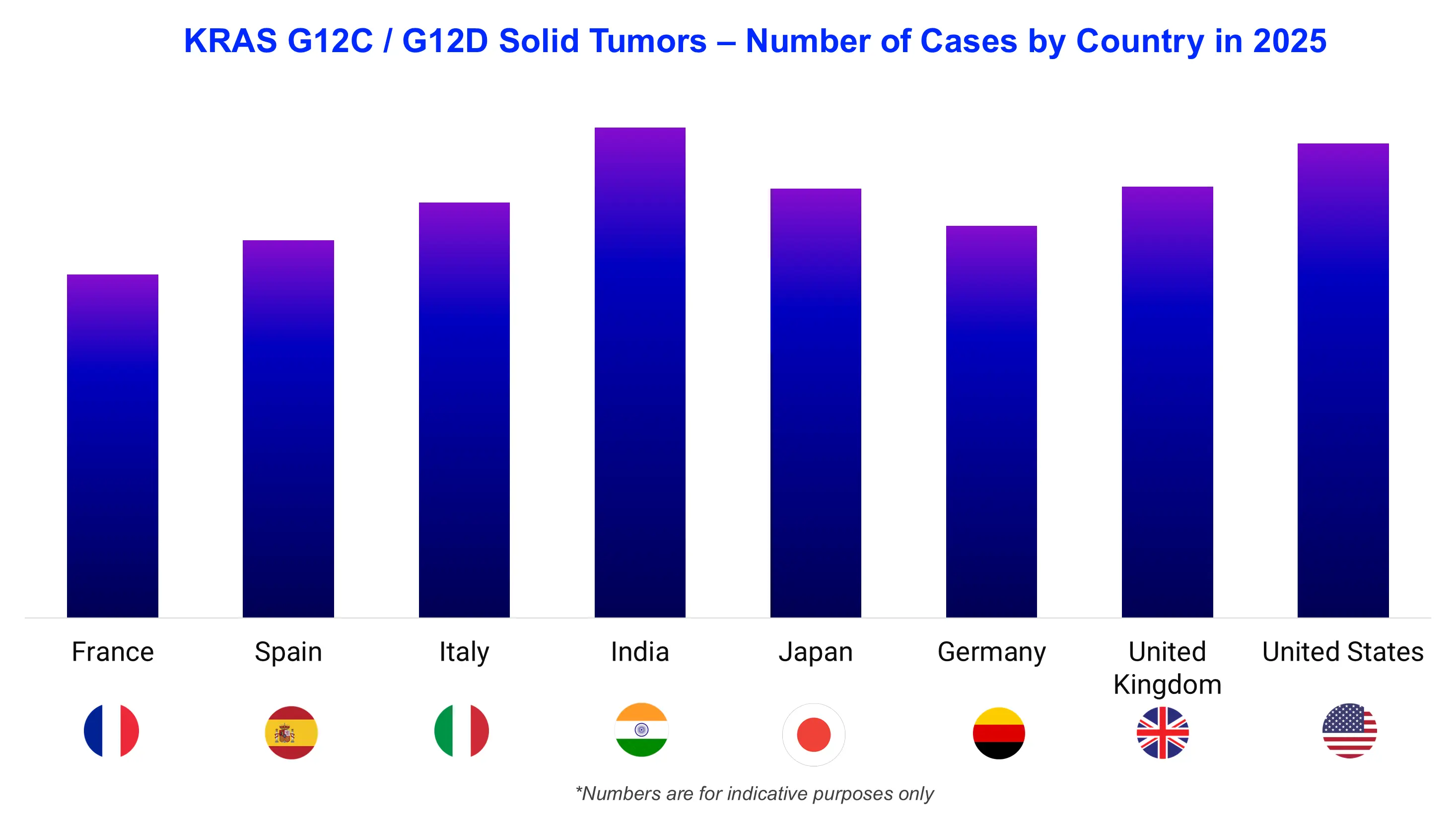
Largest Patient Pool |
United States |
|
Fastest Growing Country |
United Kingdom |
|
High-Risk Population |
Patients with advanced or metastatic NSCLC, CRC or PDAC whose tumors carry a confirmed KRAS G12C or G12D alteration; smoking is strongly associated with G12C-positive NSCLC. |
|
Key Diagnostic Method |
Tumor or liquid-biopsy next-generation sequencing (NGS), validated PCR-based assays or other molecular companion diagnostics capable of identifying the specific KRAS amino-acid substitution. |
|
Major Risk Factor |
The principal determinant is the underlying solid tumor and its molecular profile; smoking is particularly associated with KRAS G12C NSCLC, whereas G12D is strongly represented in PDAC independent of smoking history. |
|
Major gap in the market |
The principal determinant is the underlying solid tumor and its molecular profile; smoking is particularly associated with KRAS G12C NSCLC, whereas G12D is strongly represented in PDAC independent of smoking history. |
The KRAS G12C / G12D Solid Tumors epidemiology division offers information on the patient pool from history to the present as well as the projected trend for each of the 8 major markets. Expert Market Research provides both current and predicted trends for the KRAS G12C / G12D Solid Tumors epidemiology scenario by examining a wide range of studies. Additionally, the report covers the diagnosed patient pool for KRAS G12C / G12D Solid Tumors and their trends. The data is broken down into specific categories, such as total prevalent cases in males and females, and total diagnosed cases across different age groups and patient pools.
|
Epidemiology Segment |
Key Insights |
|
Diagnosed Prevalent Cases of the Disease |
A conventional prevalence figure is not appropriate because KRAS G12C/G12D are molecular subgroups distributed across several solid tumors. The principal measurable populations are patients with NSCLC, CRC and PDAC whose tumors have confirmed G12C or G12D alteration. |
|
Gender-Specific Cases of the Disease |
KRAS G12C is associated with smoking and has been reported more frequently among females than other KRAS-mutated tumors in large pan-cancer sequencing datasets, although the sex distribution varies substantially by tumor type. In the 2026 GENIE G12D analysis, males represented 52.8% of patients with KRAS G12D overall. |
|
Age-Specific Cases of the Disease |
KRAS G12C is predominantly observed in older adults with solid tumors; 73% of G12C-positive patients in a large genomic dataset were older than 60 years. The 2025 G12D GENIE analysis reported a median age at sequencing of approximately 66 years among patients with pancreatic cancer carrying G12D. |
|
Ethnicity-Wise Cases of the Disease |
Mutation prevalence differs geographically and by ancestry, particularly for G12C NSCLC. Asian NSCLC cohorts generally show lower G12C frequencies than Western cohorts. No harmonized ethnicity-specific G12C/G12D dataset covering all 8MM countries is available. |
|
Mortality and Survival Analysis of the Disease |
Mortality is primarily determined by the underlying advanced solid tumor and treatment response rather than the mutation alone. In previously treated KRAS G12D-mutated disease, the 2026 setidegrasib study reported median overall survival of 10.3 months in 21 patients with metastatic PDAC and an estimated 12-month overall survival of 59% among 45 NSCLC patients treated at the selected dose. |
Read more about this report - Request a Free Sample
The KRAS G12C / G12D Solid Tumors epidemiology data and findings for the United States, Germany, Spain, Italy, France, the United Kingdom, Japan, and India are also provided in the epidemiology section.
|
Country |
Key Insights |
|
United States |
Large-scale U.S. genomic profiling established KRAS G12C as approximately 9% of NSCLC, 3.2% of CRC and 1.3% of pancreatic cancer in the profiled population. The U.S. has the most mature targeted-treatment environment, with FDA-approved G12C inhibitors in NSCLC and approved G12C/EGFR combinations in previously treated metastatic CRC. G12D remains investigational. |
|
Germany |
Contemporary European NSCLC data show KRAS positivity among KRAS-tested advanced NSCLC patients ranging from 12-17% through Q3 2024. Among KRAS-positive German NSCLC patients, G12C represented approximately 33-68% across the reported quarterly observations. This indicates substantial G12C identification but also considerable temporal variation associated with testing patterns. |
|
France |
Among KRAS-tested advanced NSCLC patients, KRAS positivity ranged from 12-22% during 2018-2024, while G12C represented approximately 49-68% of KRAS-positive cases during the reported period. A contemporary French multicenter PDAC cohort of 916 interpretable resected tumors found KRAS mutations in 90.6%; among KRAS-mutated tumors with specified subtype, G12D represented 38% and G12C 1.9%. |
|
Italy |
European real-world NSCLC data showed KRAS positivity of approximately 7-21% among tested patients through 2024, with G12C representing 34-61% of KRAS-positive cases across reported observations. Italy has also contributed substantially to the molecular characterization of KRAS-mutated CRC, although historical mutation studies should not be interpreted as contemporary national prevalence estimates. |
|
Spain |
Among KRAS-tested advanced NSCLC patients, KRAS positivity ranged from approximately 7-18% through Q3 2024, while G12C represented 37-56% of KRAS-positive cases. Spain has also participated in multinational molecular and clinical-development programmes for KRAS-targeted therapy. A national population-based G12D prevalence estimate across all solid tumors is not currently established. |
|
United Kingdom |
KRAS positivity among tested advanced NSCLC patients ranged from approximately 8-18% through Q3 2024, with G12C accounting for 51-74% of KRAS-positive cases in the reported observations. The UK therefore has a substantial identifiable G12C NSCLC population, supported by increasing molecular testing and availability of targeted treatment. National G12D prevalence across solid tumors is not yet established. |
|
Japan |
Japanese/Asian NSCLC cohorts generally demonstrate lower G12C frequency than Western cohorts. In the large LC-SCRUM-Asia cohort, KRAS mutations occurred in 14% of 10,023 NSCLC patients, including G12C in 4.0% and G12D in 3.1%. Contemporary Japanese pancreatic-cancer guidance recognizes KRAS as the dominant molecular alteration in PDAC, while G12D-directed therapies remain investigational. |
|
India |
A 2025 Indian real-world NSCLC cohort of 1,065 patients, including 991 with comprehensive NGS, found KRAS mutations in 14.6%; G12C, G12D and G12V together represented approximately 70% of KRAS-mutated NSCLC. An earlier Indian CRC cohort found KRAS mutations in 15.4% of successfully tested tumors, with G12D comprising 35.7% of KRAS mutations and G12C 11.9%. These are institutional cohorts rather than national prevalence estimates and should not be extrapolated directly to India's entire cancer population. |
The major epidemiological challenge is that KRAS G12C and G12D are molecular subgroups rather than independent diseases. National cancer registries generally report NSCLC, CRC, and PDAC incidence but rarely provide mutation-specific incidence or prevalence. Therefore, allele-specific patient numbers must usually be estimated from molecular testing cohorts, which vary in methodology, patient selection, and disease stage. Geographic distribution also differs substantially: G12C is relatively enriched in Western NSCLC populations, whereas G12D represents a larger proportion of KRAS-mutant PDAC and is important in CRC. LC-SCRUM-Asia reported G12C in 4.0% of NSCLC, while an Indian cohort identified KRAS mutations in 14.6%, highlighting the need for country-specific molecular profiling.
Management of KRAS G12C/G12D solid tumors depends on tumor type, stage, prior treatment, and co-molecular alterations. For advanced KRAS G12C-mutated NSCLC, sotorasib and adagrasib provide targeted options after prior systemic therapy in relevant jurisdictions. The EMA authorizes sotorasib monotherapy for adults with advanced KRAS G12C-mutated NSCLC after at least one prior systemic treatment. In metastatic KRAS G12C-mutated CRC, EGFR inhibition is important because of pathway feedback. The FDA approved sotorasib plus panitumumab in January 2025. CodeBreaK 300 reported median progression-free survival of 5.6 months versus 2.0 months with standard care. Adagrasib plus cetuximab received accelerated FDA approval based on KRYSTAL-1.


Upto 15% Off
USD
$2699 $2429
$4299 $3869
$5799 $4949
$6999 $5949


*While we strive to always give you current and accurate information, the numbers depicted on the website are indicative and may differ from the actual numbers in the main report. At Expert Market Research, we aim to bring you the latest insights and trends in the market. Using our analyses and forecasts, stakeholders can understand the market dynamics, navigate challenges, and capitalize on opportunities to make data-driven strategic decisions.*
Explore our key highlights of the report and gain a concise overview of key findings, trends, and actionable insights that will empower your strategic decisions.
|
Report Features |
Details |
|
Base Year |
2025 |
|
Historical Period |
2019-2025 |
|
Forecast Period |
2026-2035 |
|
Epidemiology Statistics Provided |
|
|
Segmentation Provided |
|
|
Geographies Covered |
|
Datasheet
One User
USD 2,699
USD 2,429
tax inclusive*
Single User License
One User
USD 4,299
USD 3,869
tax inclusive*
Five User License
Five User
USD 5,799
USD 4,949
tax inclusive*
Corporate License
Unlimited Users
USD 6,999
USD 5,949
tax inclusive*
*Please note that the prices mentioned below are starting prices for each bundle type. Kindly contact our team for further details.*
Flash Bundle
Small Business Bundle
Growth Bundle
Enterprise Bundle
*Please note that the prices mentioned below are starting prices for each bundle type. Kindly contact our team for further details.*
Flash Bundle
Number of Reports: 3
20%
tax inclusive*
Small Business Bundle
Number of Reports: 5
25%
tax inclusive*
Growth Bundle
Number of Reports: 8
30%
tax inclusive*
Enterprise Bundle
Number of Reports: 10
35%
tax inclusive*
How To Order

Select License Type
Choose the right license for your needs and access rights.

Click on ‘Buy Now’
Add the report to your cart with one click and proceed to register.

Select Mode of Payment
Choose a payment option for a secure checkout. You will be redirected accordingly.
Strategic Solutions for Informed Decision-Making
Gain insights to stay ahead and seize opportunities.

Get insights & trends for a competitive edge.

Track prices with detailed trend reports.

Analyse trade data for supply chain insights.

Leverage cost reports for smart savings

Enhance supply chain with partnerships.

Connect For More Information
Our expert team of analysts will offer full support and resolve any queries regarding the report, before and after the purchase.
Our expert team of analysts will offer full support and resolve any queries regarding the report, before and after the purchase.
We employ meticulous research methods, blending advanced analytics and expert insights to deliver accurate, actionable industry intelligence, staying ahead of competitors.
Our skilled analysts offer unparalleled competitive advantage with detailed insights on current and emerging markets, ensuring your strategic edge.
We offer an in-depth yet simplified presentation of industry insights and analysis to meet your specific requirements effectively.




