

Consumer Insights
Uncover trends and behaviors shaping consumer choices today
Procurement Insights
Optimize your sourcing strategy with key market data
Industry Stats
Stay ahead with the latest trends and market analysis.
Small cell lung cancer (SCLC) is a highly aggressive neuroendocrine lung malignancy marked by rapid growth, early spread, treatment resistance, and relapse. It is strongly associated with tobacco exposure, although a small proportion of patients are never smokers. According to Petrelli et al., in a 2026 narrative review, SCLC accounts for approximately 13–15% of lung-cancer diagnoses but nearly one quarter of lung-cancer-related deaths, reflecting its disproportionately aggressive clinical course. According to the small cell lung cancer epidemiology forecast by Expert Market Research, SCLC continues to represent a major oncology burden because of its rapid progression, high frequency of extensive-stage presentation, early development of distant and brain metastases, substantial treatment-related morbidity, and historically limited improvement in long-term survival.
Base Year
Historical Period
Forecast Period
Read more about this report - Request a Free Sample
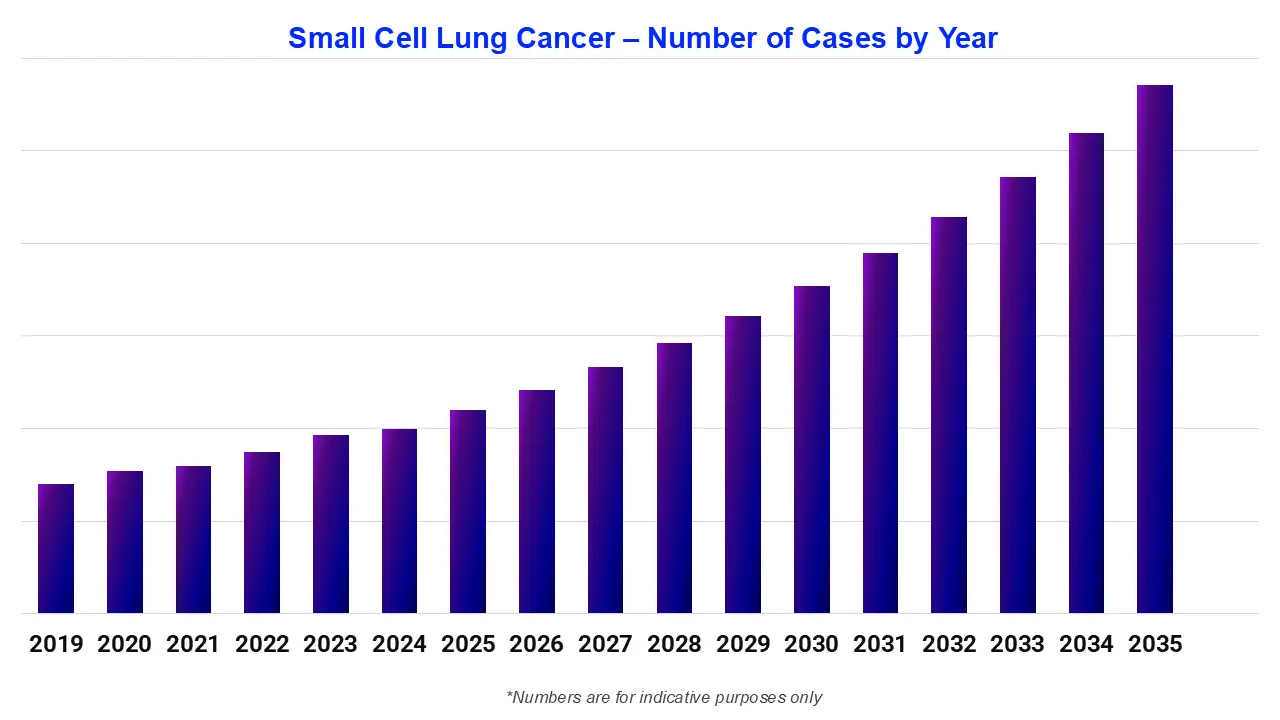
Expert Market Research's “Small Cell Lung Cancer Epidemiology Forecast Report 2026-2035” offers comprehensive information on the prevalence and demographics of Small Cell Lung Cancer. It projects the future incidence and prevalence rates of Small Cell Lung Cancer cases across various populations. The study covers age, gender, and type as major determinants of the Small Cell Lung Cancer population. The report highlights patterns in the prevalence of Small Cell Lung Cancer overtime and projects future trends based on multiple variables.
The report provides a comprehensive overview of the disease, as well as historical and projected data on the epidemiology of Small Cell Lung Cancer in the 8 major markets.
Regions Covered
Small cell lung cancer (SCLC) remains a highly aggressive high-grade neuroendocrine malignancy of the lung characterized by rapid proliferation, early hematogenous dissemination, extensive genomic instability, and a high propensity for treatment resistance and relapse. SCLC is biologically distinct from non-small-cell lung cancer and is strongly associated with tobacco exposure, although a small proportion of patients are never smokers. Contemporary molecular studies increasingly demonstrate that SCLC is not a biologically homogeneous entity, with transcription-factor-defined states involving ASCL1, NEUROD1, POU2F3 and YAP1, together with an immune-enriched SCLC-I phenotype. These molecular states exhibit different neuroendocrine characteristics, tumor-microenvironment profiles and potential therapeutic vulnerabilities.
|
Parameter |
Insight |
|
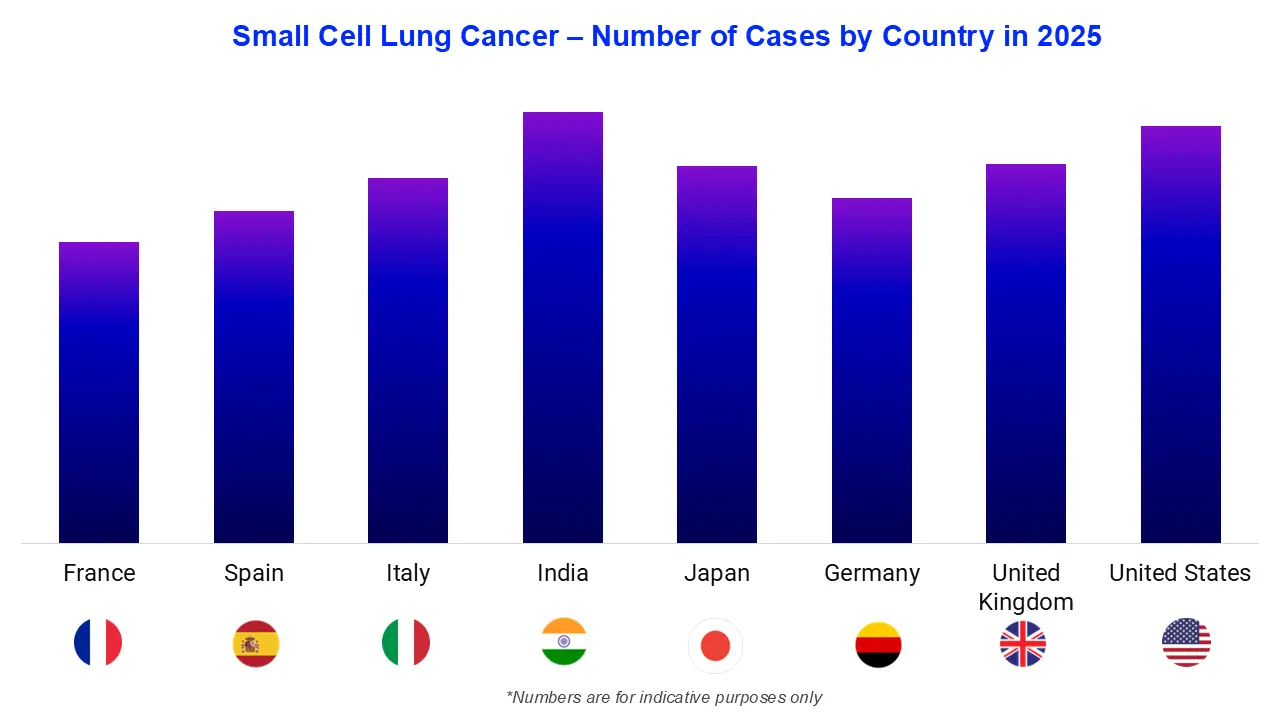
Largest Patient Pool |
United States |
|
Fastest Growing Country |
India |
|
High-Risk Population |
Current and former smokers, older adults, individuals with substantial cumulative tobacco exposure, and patients with occupational or environmental carcinogenic exposures |
|
Key Diagnostic Method |
Histopathological confirmation with immunohistochemistry |
|
Major Risk Factor |
Cigarette smoking |
|
Major gap in the market |
High rates of extensive-stage presentation, rapid relapse after platinum-based therapy, treatment resistance, limited validated predictive biomarkers, brain-metastatic propensity, and insufficiently effective subsequent-line treatments |
The Small Cell Lung Cancer epidemiology division offers information on the patient pool from history to the present as well as the projected trend for each of the 8 major markets. Expert Market Research provides both current and predicted trends for the Small Cell Lung Cancer epidemiology scenario by examining a wide range of studies. Additionally, the report covers the diagnosed patient pool for Small Cell Lung Cancer and their trends. The data is broken down into specific categories, such as total prevalent cases in males and females, and total diagnosed cases across different age groups and patient pools.
|
Epidemiology Segment |
Key Insights |
|
Diagnosed Prevalent Cases of the Disease |
According to Petrelli et al., the 2026 literature places SCLC at approximately 13–15% of all lung-cancer diagnoses, while its contribution to lung-cancer mortality is disproportionately high because of aggressive biological behaviour. Unlike chronic infectious diseases, prevalence is not routinely reported as a single global stock estimate because SCLC has a comparatively short survival duration and high incidence-to-prevalence turnover. |
|
Gender-Specific Cases of the Disease |
Contemporary evidence demonstrates an increasingly narrow sex differential compared with historical SCLC populations. The 2026 Spanish Thoracic Tumor Registry included 4,920 SCLC patients, of whom 78.9% were men and 21.1% were women. Women demonstrated better survival than men after accounting for tobacco-use categories. |
|
Age-Specific Cases of the Disease |
SCLC predominantly affects older adults, reflecting the cumulative latency between tobacco exposure and malignant transformation. In the 2026 Spanish registry, the median age at diagnosis was 66 years. Older age was independently associated with poorer survival, with mortality increasing by approximately 3% per additional year in the multivariable analysis. |
|
Ethnicity-Wise Cases of the Disease |
Contemporary evidence indicates that SCLC incidence and outcomes differ among racial and ethnic populations, but these differences are strongly intertwined with tobacco exposure, socioeconomic factors, access to screening and oncology treatment, stage at diagnosis, and healthcare utilization. Recent U.S. registry analyses demonstrate continuing racial heterogeneity in SCLC incidence trends. |
|
Mortality and Survival Analysis of the Disease |
SCLC remains associated with high mortality and poor long-term survival, particularly in extensive-stage disease. In the 2026 Spanish registry, overall five-year survival was 9.4%, with survival of 15.4% among never smokers, 10.8% among former smokers and 8.2% among current smokers. Extensive-stage disease was associated with substantially higher mortality, with a multivariable hazard ratio of 2.96 compared with more limited disease. |
|
Disease Type |
Prevalence |
|
Limited-Stage Small Cell Lung Cancer (LS-SCLC) |
LS-SCLC describes disease confined sufficiently to a thoracic region that can be encompassed within a tolerable radiation field. Concurrent platinum-based chemotherapy and thoracic radiotherapy remain the central curative-intent approach. A major therapeutic change occurred in 2024 when the ADRIATIC phase 3 study demonstrated significantly longer overall and progression-free survival with consolidation durvalumab after chemoradiotherapy. |
|
Extensive-Stage Small Cell Lung Cancer (ES-SCLC) |
ES-SCLC represents the predominant presentation in contemporary real-world cohorts and is characterized by metastatic disease not amenable to a definitive thoracic radiation field. First-line treatment has evolved toward platinum-etoposide chemotherapy combined with an immune checkpoint inhibitor, followed by maintenance immunotherapy. The 2026 Spanish registry found 68.2% of patients presenting with extensive-stage disease. |
|
Relapsed / Refractory SCLC |
Relapsed SCLC remains a major therapeutic challenge because most patients eventually develop disease progression after platinum-based therapy. Tarlatamab has become an important therapeutic development in this setting. In the randomized DeLLphi-304 trial, median overall survival was 13.6 months with tarlatamab versus 8.3 months with investigator-choice chemotherapy, corresponding to a hazard ratio for death of 0.60. |
|
Molecularly Defined SCLC Subtypes |
Contemporary molecular profiling identifies distinct transcription-factor-associated states involving ASCL1, NEUROD1, POU2F3 and YAP1, with an additional immune-enriched SCLC-I phenotype. ASCL1 and NEUROD1 generally characterize neuroendocrine-high disease, whereas POU2F3 and YAP1 are associated with less neuroendocrine differentiation. The SCLC-I phenotype is characterized by inflammatory and immune-related gene expression and is of particular interest for immunotherapy development. |
Read more about this report - Request a Free Sample
The Small Cell Lung Cancer epidemiology data and findings for the United States, Germany, Spain, Italy, France, the United Kingdom, Japan, and India are also provided in the epidemiology section.
|
Country |
Key Insights |
|
United States |
Contemporary U.S. population research confirms a continuing decline in SCLC incidence, although the disease remains highly lethal. A 2025 SEER-based analysis identified 188,426 SCLC patients diagnosed from 2000–2020 and found a decline in age-adjusted incidence from 9.0 to 4.6 per 100,000 over that historical observation period. |
|
Germany |
Germany remains an important European SCLC market because of its large population, established thoracic-oncology infrastructure and continuing burden of tobacco-associated lung cancer. Contemporary European SCLC evidence emphasizes the predominance of extensive-stage presentation and increasing incorporation of immunotherapy. A robust nationally representative German SCLC incidence estimate based exclusively on 2023–2026 observations was not identified in the reviewed literature; therefore, an older incidence figure has deliberately not been inserted. |
|
France |
France has particularly strong contemporary real-world evidence. A nationwide study reported 1,137 SCLC patients within the 2020 national lung-cancer cohort, while a separate national-health-system analysis evaluated 8,612 ES-SCLC patients who initiated atezolizumab or durvalumab and were followed through 2024. Because the larger epidemiological cohort includes historical diagnostic years, its numerical incidence estimates are not treated as 2023–2026 incidence. |
|
Italy |
Italy remains a clinically important SCLC market because of its substantial lung-cancer burden and mature thoracic-oncology infrastructure. A 2025 analysis of lung-cancer trends in Northern Italy documented continuing sex-specific shifts in lung-cancer histology, including changing SCLC incidence patterns among women. A 2026 Italian lung-cancer screening analysis found that SCLC represented 28 of 396 screen-detected lung cancers, although the investigators emphasized that low-dose CT screening had limited impact on SCLC outcomes; median survival from SCLC diagnosis in that screened cohort was 1.5 years. |
|
Spain |
Spain has one of the strongest recent country-specific SCLC datasets. The 2026 Thoracic Tumor Registry analysis included 4,920 SCLC patients, of whom 78.9% were men, the median age was 66 years, 68.2% had extensive-stage disease and 60.1% were current smokers. Five-year overall survival was 9.4%. Current smoking and extensive-stage disease were associated with poorer survival, whereas women demonstrated better outcomes. Contemporary Spanish real-world treatment data also demonstrate use of atezolizumab plus platinum-etoposide in metastatic disease. |
|
United Kingdom |
The United Kingdom represents a mature SCLC treatment market with established access to systemic chemotherapy, radiotherapy and immunotherapy. However, a sufficiently recent nationally representative SCLC-specific incidence estimate based solely on 2023–2026 observations was not identified in the reviewed literature. Therefore, older registry percentages have not been presented. The current market is characterized by continued adoption of contemporary systemic therapy and increasing interest in biomarker-defined and DLL3-directed approaches. |
|
Japan |
Japan remains a major SCLC market because of its large ageing population and established thoracic oncology system. Contemporary Asian evidence from DeLLphi-301 demonstrates clinically meaningful activity of tarlatamab in Asian patients with previously treated SCLC: objective response was 46.3%, median progression-free survival was 5.4 months and median overall survival was 19.0 months. A uniform national SCLC incidence estimate based solely on 2023–2026 observations was not identified, so no historical national incidence figure has been substituted. |
|
India |
India has a substantial clinical SCLC burden within its broader lung-cancer population, but contemporary nationwide SCLC-specific surveillance remains limited. A 2024 prospective North Indian tertiary-centre study reported that SCLC represented 13.04% of the lung-cancer cases evaluated, although the underlying recruitment period extended from 2014 to 2022; consequently, this percentage is not treated as a 2023–2026 national prevalence estimate. Recent Indian population-level SCLC incidence data meeting the strict 2023–2026 criterion were not identified in the reviewed evidence. |
According to contemporary studies, significant gaps remain in the epidemiological characterization, early detection, molecular stratification and long-term management of small cell lung cancer, particularly because the disease progresses rapidly and frequently presents after metastatic dissemination. The 2026 literature estimates that SCLC represents approximately 13–15% of lung-cancer diagnoses but nearly one quarter of lung-cancer deaths, demonstrating a disproportionate mortality burden relative to its incidence. Unlike many solid tumours in which screening has substantially shifted diagnosis toward earlier-stage disease, contemporary evidence indicates that low-dose CT screening has only a limited effect on SCLC outcomes. A 2026 Italian screening analysis identified 28 SCLC cases among 396 lung cancers detected within the evaluated screening population, with overall mortality remaining high despite screen detection.
The management of small cell lung cancer primarily focuses on rapid disease control, prevention of early progression, prolongation of survival, reduction of cancer-related symptoms, preservation of functional status, and management of treatment-related toxicity. Contemporary management is fundamentally determined by whether disease is classified as limited-stage or extensive-stage, together with performance status, comorbidities, metastatic distribution, brain involvement and treatment history. For limited-stage SCLC, concurrent platinum-based chemotherapy and thoracic radiotherapy remains the central curative-intent treatment strategy. A major therapeutic advance occurred in 2024 following publication of the ADRIATIC phase 3 trial, in which consolidation durvalumab after chemoradiotherapy significantly improved both overall survival and progression-free survival. Median overall survival was 55.9 months with durvalumab versus 33.4 months with placebo, and median progression-free survival was 16.6 versus 9.2 months.


Upto 15% Off
USD
$2699 $2429
$4299 $3869
$5799 $4949
$6999 $5949


*While we strive to always give you current and accurate information, the numbers depicted on the website are indicative and may differ from the actual numbers in the main report. At Expert Market Research, we aim to bring you the latest insights and trends in the market. Using our analyses and forecasts, stakeholders can understand the market dynamics, navigate challenges, and capitalize on opportunities to make data-driven strategic decisions.*
Explore our key highlights of the report and gain a concise overview of key findings, trends, and actionable insights that will empower your strategic decisions.
|
Report Features |
Details |
|
Base Year |
2025 |
|
Historical Period |
2019-2025 |
|
Forecast Period |
2026-2035 |
|
Epidemiology Statistics Provided |
|
|
Segmentation Provided |
|
|
Geographies Covered |
|
Datasheet
One User
USD 2,699
USD 2,429
tax inclusive*
Single User License
One User
USD 4,299
USD 3,869
tax inclusive*
Five User License
Five User
USD 5,799
USD 4,949
tax inclusive*
Corporate License
Unlimited Users
USD 6,999
USD 5,949
tax inclusive*
*Please note that the prices mentioned below are starting prices for each bundle type. Kindly contact our team for further details.*
Flash Bundle
Small Business Bundle
Growth Bundle
Enterprise Bundle
*Please note that the prices mentioned below are starting prices for each bundle type. Kindly contact our team for further details.*
Flash Bundle
Number of Reports: 3
20%
tax inclusive*
Small Business Bundle
Number of Reports: 5
25%
tax inclusive*
Growth Bundle
Number of Reports: 8
30%
tax inclusive*
Enterprise Bundle
Number of Reports: 10
35%
tax inclusive*
How To Order

Select License Type
Choose the right license for your needs and access rights.

Click on ‘Buy Now’
Add the report to your cart with one click and proceed to register.

Select Mode of Payment
Choose a payment option for a secure checkout. You will be redirected accordingly.
Strategic Solutions for Informed Decision-Making
Gain insights to stay ahead and seize opportunities.

Get insights & trends for a competitive edge.

Track prices with detailed trend reports.

Analyse trade data for supply chain insights.

Leverage cost reports for smart savings

Enhance supply chain with partnerships.

Connect For More Information
Our expert team of analysts will offer full support and resolve any queries regarding the report, before and after the purchase.
Our expert team of analysts will offer full support and resolve any queries regarding the report, before and after the purchase.
We employ meticulous research methods, blending advanced analytics and expert insights to deliver accurate, actionable industry intelligence, staying ahead of competitors.
Our skilled analysts offer unparalleled competitive advantage with detailed insights on current and emerging markets, ensuring your strategic edge.
We offer an in-depth yet simplified presentation of industry insights and analysis to meet your specific requirements effectively.




