Will New Farming Technologies and Farm Reforms Help the Global Abaca Supply Chain Come Back?
The future of any natural-fiber industry is not only dependent on demand but also on the ability to produce reliably, at a large scale, and with consistent quality. Abaca has been suffering from supply-chain issues that result from its susceptibility to diseases and inefficient harvesting, thus, its potential has been limited for a long time. However, the industry is getting reshaped by recent breakthroughs in cultivation, hybrid breeding, cooperative farming, and better processing.
The State of Abaca Cultivation Today
Musa textilis, more commonly known as abaca or Manila hemp, is still one of the major sources of natural fiber globally. The Philippines is the leading global supplier and the Fiber Industry Development Authority (PhilFIDA) is the agency under whose auspices the country delivers most of the global abaca output. In the past, abaca farms were mostly small, scattered, and individually-managed farmers or indigenous communities in the remote or mountainous areas.
As per the industry reports, more than 180,000 hectares have been planted over the years, but the concentration has still been relatively small compared to the total arable land because abaca grows better under certain agro-climatic conditions. On the other hand, farming is challenged with several structural problems such as poor quality of planting materials, susceptibility to diseases (for example, the very harmful ABTV, abaca bunchy-top virus), the low level of modern technologies usage, and inadequate infrastructures for processing and transport. All these problems have slowly but surely led to situations in which production has been going downward in some areas, while at the same time global demand for natural fiber has been on the rise.
Hybrid Abaca Varieties and Yield Improvements
The major turning point was when researchers from the University of the Philippines Los Baños (UPLB) together with other academic institutions developed high-yielding and ABTV-resistant abaca hybrids. These hybrids, according to the news, can yield approximately 1.56 metric tons per hectare per year with fibrous portion recovery being 20–30% more than the old varieties. Such significant improvements, by raising fiber yield per hectare and lessening the chance of disease attack, hybrid varieties deliver a more reliable supply of high-quality raw materials, very essential to those manufacturers and exporters who abaca is their source for textiles, paper, composites, and more. This is one part of a vast R&D effort guided by the Industry Strategic S&T Plans for Abaca that involves the research institutions in the production provinces and is coordinated with the stakeholders in the locality.
Community & Cooperative-Led Expansion, Processing Support
Apart from genetics, institutional and infrastructural support is becoming a major factor in the revival of abaca cultivation. Under the program of the Philippine Rural Development Project (PRDP), farmer cooperatives, mainly those from the indigenous, rural, or remote communities, are being organized, trained, and supported for scaling up production and processing.
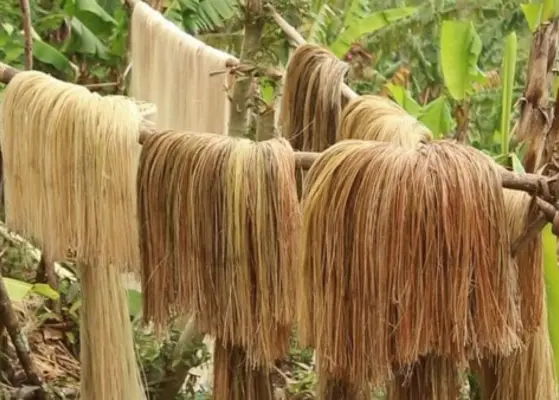
In a cooperative project for instance, farmers shifted from traditional modest yields (≈ 500 kg per hectare) to a target of 2,200 kg per hectare, more than quadruple, by adopting better planting, harvesting, and processing methods. Furthermore, the PRDP is facilitating the establishment of processing centers, farm-to-market roads, decorticating machines (for stripping fibers), and storage facilities that will enable the various stages of fiber extraction, drying, and shipping to be done in an efficient manner. The support package also contains training in new production technologies, weaving, and fiber handling. Such a cooperative system helps small-scale farmers to get over the logistical and technical difficulties that they would have faced if they had continued the fragmented, individual production with low yield and inconsistent quality. And as a result, they are now able to work together so as to produce commercially viable volumes of high-quality fiber which are suitable for export or industrial use.
Reviving Abaca’s Global Competitiveness
The abaca sector is once again becoming competitive with the help of improved hybrids, good agronomic practices, and supportive infrastructures. The unique characteristics of the fiber (its strength, salt-water resistance, and durability) and the increasing demand for eco-friendly fibers have made the market even more attractive.
In the case that such improvements are put into effect on a large scale, that is to say, if hybrid varieties are used in more farms, more cooperatives come into being, and processing capacity increases, then the world would be witnessing a revived abaca fiber supply. This means a lot for industries such as textile-manufacturing, composite-material production, paper & packaging, and sustainable-design markets. Besides that, as farmer incomes are improved, supply is stabilized, and fiber quality is assured, such reforms are economically, socially and environmentally beneficial because they provide a sustainable fiber agriculture model in developing countries.
Challenges and Ongoing Risks
Even with hybrids, abaca is still a target for pests, diseases and climate stress. Due to the natural calamities (typhoons, heavy rains) in a number of growing regions, mainly in island countries, the output and fiber quality can be greatly affected. Additionally, although there has been an increase in cooperative and institutional support, not every farmer has access to resources, training or capital, and as a result, the pace of adoption may be slow. There are still some infrastructure gaps, like transport, drying, processing of abaca, in the areas that are remote, mountainous, or rural. The global market demand for abaca has to remain stable or increase, otherwise, even if there is an increase in supply, profitability will not be guaranteed for farmers and processors. Oversupply may lead to lower prices, thus diminishing the incentives for the adoption of sustainable practices.
The Future of Abaca Supply Chain
The advances in hybrid breeding, cooperative farming, infrastructure support, and processing capacity are signs that the difficulties of the abaca supply side can be solved. If these alterations are taken to scale, they can make supply stable, raise the quality and ensure that there will be no shortage of abaca in the long run as a global natural fiber. For the industries that are dependent on fibers, namely, textiles, composites, paper, packaging, a stable supply of abaca that is of high quality means that they can confidently make new investments, innovate, and broaden their product lines. This, for farmers and rural communities, can be equated to better living conditions that come as a result of sustainable agriculture.
For a detailed view of global abaca demand, supply trends, and market forecasts, refer to the Abaca Fibre Market
From Fields to Global Markets
Abaca, presently, has surpassed being just the traditional fiber for making ropes and sacks. With scientific breeding, institutional support, and the renewed interest in sustainability, it can be a globally competitive high-quality supply for various industries. The change depends on the coordinated effort of the farmers, researchers, and global buyers, but the signs already indicate that abaca has a strong and sustainable future ahead of it.











Share