In a rapidly evolving socio-cultural state such as India, knowing and understanding the government policies and actions becomes essential for the citizens to make an informed decision. This becomes essential for policy formulation and community engagement.
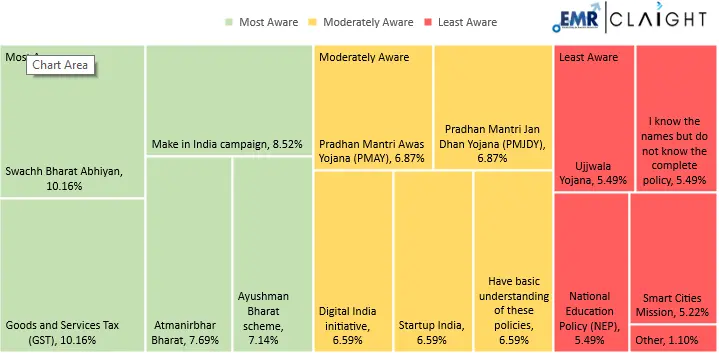
Awareness Regarding Government Policies
The survey indicates that Swachh Bharat Abhiyan and the Goods and Services Tax (GST) each capture the highest awareness, with 10.16% of respondents claiming full awareness of these policies. These initiatives are closely followed by the Make in India campaign, recognized by 8.52% of participants, reflecting significant public engagement with economic growth and cleanliness drives. Atmanirbhar Bharat and Ayushman Bharat scheme, aimed at self-reliance and healthcare respectively, also show considerable awareness levels at 7.69% and 7.14%. Slightly lower yet substantial, housing and financial inclusion initiatives like the Pradhan Mantri Awas Yojana (PMAY) and Pradhan Mantri Jan Dhan Yojana (PMJDY) are known to about 6.87% each. Digital India and Startup India both stand at 6.59%, highlighting a growing interest in digital transformation and entrepreneurial development. Lesser-known policies include Ujjwala Yojana and the National Education Policy (NEP), each at 5.49%, showing that there are areas where public awareness could be improved.

Strong Public Inclination Towards Understanding Policies
Current trends suggest a strong public inclination towards understanding policies directly impacting economic and personal wellbeing. This interest is complemented by an increasing curiosity about digital and educational reforms, aligning with global shifts towards technological adaptation and skill enhancement. To improve understanding and engagement, there is a critical need for targeted communication strategies that not only inform but also involve the public in meaningful dialogue. Utilizing digital platforms could be instrumental, particularly for younger demographics and urban populations who are already attuned to technological innovations, as evidenced by the interest in the Digital India and Startup India initiatives. Prime Minister Modi's approach to integrating real-life examples and ongoing dialogue in his addresses could serve as a model for policy promotion, ensuring that information is not only disseminated widely but is also relatable and transparent, fostering a deeper public connection with governmental efforts and their outcomes in society.
Greater Public Engagement With Policies in India among Gen Z
This study not only highlights the levels of awareness regarding various government policies but also underscores the need for more targeted communication strategies to enhance understanding across lesser-known areas. By exploring these disparities, the study provides valuable insights into how future informational campaigns could be structured to better disseminate knowledge about critical reforms, ensuring that the public remains well-informed and engaged in the nation's developmental journey. The study looks into how a greater public engagement with policies directly impacting economic growth and personal wellbeing, such as the Make in India and Atmanirbhar Bharat campaigns, highlighted by Prime Minister Narendra Modi's emphasis on self-reliance and national competence in global markets.











Share