How IoT Is Powering Smart Cities and Connected Infrastructure?
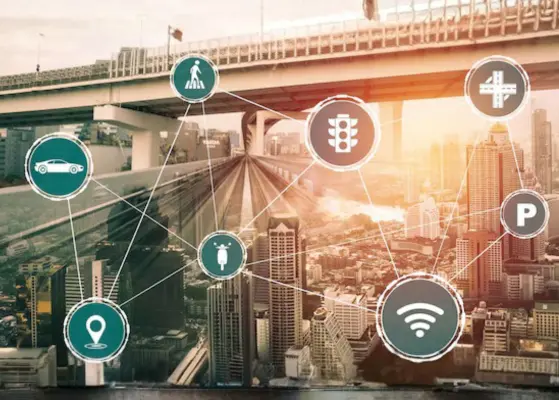
Various cities all over the globe are dealing with increasing population pressure, outdated infrastructure, and escalating demands for efficient services. To tackle these issues, governments and planners are utilizing Internet of Things (IoT) technology to create connected systems that enhance the efficiency of operations. IoT is the digital backbone connecting intelligent street lighting, water management automation, etc., enabling a city to get real-time data and respond quickly.
Smart sensors installed on roads, buildings, and public spaces help law enforcement to identify usage patterns and locate problems at an early stage. This results in an improvement of emergency response times as well as a reduction in operational expenditures. Furthermore, connected infrastructure facilitates sustainability by enabling the efficient use of energy and the reduction of waste. With the growth of urban areas, IoT is becoming more indispensable in creating cities that are safer, cleaner, and healthier to live in.
Smarter Mobility and Traffic Management
Transport is one of the most conspicuous aspects of urban life where IoT brings benefits. Traffic congestion is still one of the major problems faced by many metropolitan cities. IoT-enabled traffic lights, surveillance cameras, and in-vehicle sensors collect continuous information about the conditions of roads and the flow of vehicles. Such data enables the adjustment of signal timings without human intervention, and thus, traffic can be redirected automatically when congestion occurs.
Public transport is one of the sectors that can also take advantage of the connected tracking system. Live location updates of buses and trains can be shared with the commuters, thus improving reliability and passenger experience. Parking systems that are IoT sensor-equipped can help drivers find available spaces, thus saving fuel and reducing emissions. These three changes can help cities become more efficient at moving people while being environmentally friendly. Eventually, these connected mobility solutions will create millennia of data. Using the information, city planners design better roads, optimize transit routes, and plan future infrastructure investments more precisely.
Intelligent Utilities and Energy Optimization
Utilities are essential to the very existence of a city, and IoT is revolutionizing their functioning. Smart meters allow for instant real-time monitoring of electricity, gas, and water consumption. This enables providers to locate leaks, cut down on losses, and forecast demand with increased accuracy. At the same time, users get a clear picture of their consumption, thus promoting the conservation of resources.
Energy management systems based on IoT technology adjust the lighting, heating, and cooling of public buildings. Streetlights with motion-sensing technology dim when there is no activity and brighten when someone is coming. This seemingly insignificant alteration provides substantial energy savings in the long run.
Integration of renewable energy is another upsurge application that IoT is involved in. IoT platforms, through real-time monitoring of solar and wind power generation levels, help to balance supply from these sources by adjusting distribution. These features enable cleaner energy transitions without compromising grid stability.
Public Safety and Urban Services Get a Digital Upgrade
IoT technology is a key facilitator of safety and public service improvements. Networked video surveillance and environmental monitoring devices assist the local authorities in identifying the occurrence of emergencies, such as the outbreak of fire, flood, or sudden deterioration of air quality. The notification is immediately sent via the system to the response team, thus allowing them to act promptly.
Fear of waste overflowing in the vicinity of waste bins is no longer an issue since smart bins that can communicate when they are full are being widely used. The waste collection routes schedule is decided based on the actual demand rather than on a fixed timetable, which, in turn, causes the mileage to be reduced, thus leading to less consumption of fuel and a drop in labor costs. On the other hand, the streets remain clean.
The adoption of IoT tools goes further into healthcare and social services. IoT medical devices, such as wearables and remote monitoring systems, keep track of the health status of the elderly and patients who live with chronic diseases. By evaluating the data on service usage patterns, the city officials would be able to more effectively distribute the resources. Through these examples, it is evident that IoT technology unites infrastructure with human welfare and helps to improve the quality of life of city residents to a significant extent.
Challenges and the Road Ahead
Although there are many benefits, smart city adoption is confronted with several difficulties. First, data security remains the main concern as the number of connected devices increases, thereby enlarging the ways for cyberattacks. Cities, therefore, need to make hefty investments in cybersecurity frameworks that are capable of withstanding attacks as well as in governance policies that are very clear on what is allowed and what is not to protect sensitive information. Interoperability is another problem. Most cities have legacy systems that are not easily compatible with the new IoT platforms. However, standardization efforts and open architectures are mitigating this problem, and the degree of progress is dependent on the region.
Funds also have an influence. Large-scale deployments demand considerable initial capital. That said, many local governments are utilizing public-private partnerships to share the expenses and quicken the implementation. Future advances in artificial intelligence and edge computing will further augment the capabilities of smart cities. There will be less lag and a better response when real-time analytics are done right on the device. Furthermore, with the rollout of 5G networks, data transmission will be quicker and more dependable. Thus, new use cases will be emerging in urban settings.
Explore the Global IoT Market Report for insights on connected urban ecosystems and adoption trends.
Where Connected Cities Are Headed
Smart cities are not just experiments anymore. They're being seen as genuine solutions to the problems of urban expansion and sustainable development. IoT equips cities with a higher level of intelligence, efficiency, and openness in their operations. Everything from road traffic to energy use can be managed more effectively thanks to the connected infrastructure that enables decision-making to be carried out at all levels.
IoT-based urban solutions will be used by more places as technology advances and costs decrease. Those cities that are the pioneers in making smart city investments would probably be the ones that reap the benefits, over the long term, in terms of their resilience, quality of life, and economic competitiveness. The transition towards a connected infrastructure is the main story of the next phase of the development of modern cities.











Share