Advancements in Material Technology Shaping the Performance of Fire-Resistant Glass
The determination of the fire-resistance glass performance is primarily a result of advanced material engineering, multilayer structures, and stringent testing regimes. Technology of materials has emerged as the main differentiator for manufacturers in a market where merely complying with regulations is no longer enough. Nowadays, developers and specifiers demand that fire-resistant glass should not only be able to resist fire but also be durable, clear, and reliable even under severe conditions.
This change has driven substantial investments into research and development work by the leading firms. Buyers are also considering the thermal behavior, impact performance, and long, term stability. Material innovation is becoming an important deciding factor about how fire-resistant glass is used in commercial, healthcare and infrastructure projects. In September 2023, Asahi India Glass (AIS) commenced production of fire-resistant glass at the company’s Roorkee Plant. This facility manufactures fire resistant glass, based on gel-filled technology.
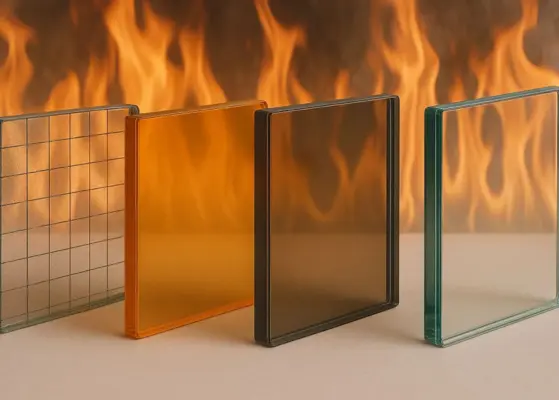
Evolution from Wired to Advanced Laminated Glass
Traditional wired glass once dominated fire protection applications, but despite its ability to slow flame spread, it offered poor impact resistance and often failed to meet modern safety standards. As building codes tightened, demand shifted toward laminated fire-resistant glass systems that combine fire performance with occupant safety.
Manufacturers are developing multi-layer glass assemblies using specialized interlayers that react to heat exposure. These interlayers expand during a fire, creating an insulating barrier that blocks heat and smoke transfer. Companies such as Schott and Vetrotech are refining these technologies to improve consistency and optical quality.
For B2B buyers, laminated fire-resistant glass reduces liability risks. It aligns with both fire and safety glazing standards, which simplifies specification and approval. This evolution has effectively phased out wired glass in many commercial projects.
Thermal Insulation and Heat Control Performance
Fire resistance is not only about flame containment. Heat transmission also plays a critical role in protecting occupants and structural elements. Modern fire-resistant glass is engineered to limit radiant heat, a key requirement in many fire safety codes.
For thermal insulation, manufacturers are placing greater emphasis on interlayer composition and optimized glass thickness. Some products are now achieving fire ratings while contributing to the overall building energy performance. This dual functionality is particularly attractive in regions with strict energy efficiency regulations.
Impact Resistance and Structural Integrity
Technological advancements in material technology have resulted in advancements in impact resistance of fire safety glass. The laminated structure with interlayers provides safety from breakages in situations of emergencies in evacuation paths or high-occupancy zones.
Suppliers are now increasingly emphasizing the results of impact tests along with fire ratings. For contractors and regulatory agencies, this is an added assurance that products will function as required under practical circumstances.
Material Testing and Certification as a Performance Driver
Material performance claims must be supported by rigorous testing. Fire resistant glass products undergo extensive fire exposure, impact, and durability tests before certification. Maintaining consistency across production batches is a major challenge.
To address this, large manufacturers invest in controlled production environments and continuous quality monitoring. Some operate their own testing facilities to accelerate product development and certification updates. This capability allows faster response to regulatory changes.
For B2B customers, certified performance reduces project risk. Products backed by recognized standards are easier to approve and insure. This reinforces the preference for established suppliers with proven testing infrastructure.
Interlayer Innovation and Long-Term Stability
The interlayer is a critical component in fire resistant glass performance. It determines how the glass reacts during fire exposure and how it ages over time. Material scientists are focusing on interlayer formulations that maintain performance under humidity, UV exposure, and temperature fluctuations.
Improved interlayer stability extends product lifespan and reduces maintenance concerns. This is particularly important in public buildings where replacement cycles are long and costly. Manufacturers that can demonstrate long-term performance data gain credibility with asset owners.
These innovations also support broader adoption in challenging environments such as transportation hubs and industrial facilities.
Performance Expectations Influencing Procurement
Procurement teams are becoming more technically informed. They are comparing performance metrics rather than relying solely on fire rating labels. This has raised the bar for product documentation and transparency.
Suppliers now provide detailed performance data sheets and digital resources to support specification decisions. This level of detail is increasingly expected in large commercial projects. It also favors companies with strong technical teams and standardized product portfolios.
Access the Fire Resistant Glass (FRG) Market Report for insights on material technologies, performance benchmarks & strategies.
Technology-Led Market Outlook
Material technology will remain central to the evolution of the fire-resistant glass market over the forecast period. Performance, durability, and adaptability will define supplier success.
Manufacturers that invest in interlayer science, testing capabilities, and product consistency are expected to strengthen their position across commercial and institutional segments. Fire resistant glass is becoming a high-performance building material. Its future will be shaped by how well it performs under pressure, both technical and regulatory.











Share