Material Selection Trends in Industrial Hoses Across North America
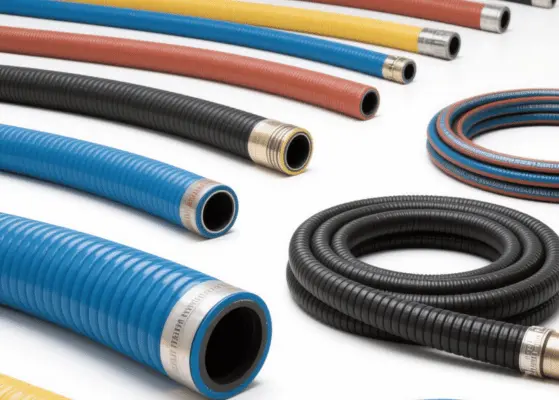
Material choice has become one of the most important points of consideration in the North America industrial hose market. Pressure exposure, chemical compatibility, hygiene standards, and lifecycle cost are now tightly linked to material performance. Hose manufacturers are responding to this trend by shifting away from broad, one-size-fits-all offerings toward tightly engineered material platforms designed around specific operating realities. This evolution is changing how procurement teams evaluate suppliers and how manufacturers position new product lines.
Rubber Hoses Remain Dominant but Are Being Reengineered
Rubber remains the leading segment in terms of industrial hose materials in the North America regions. Rubber is quite adaptable, cost-effective, and abrasion-resistant, and hence, it is hard to replace in heavy-duty applications. The oil & gas industry, mining companies, and bulk material handlers want rubber industrial hoses that can withstand higher pressure cycles and harsh chemicals with a longer lifespan before they need replacement.
Thermoplastic Hoses Gain Ground in Precision Applications
Thermoplastic hoses are seeing accelerated adoption across manufacturing, automation, and food processing applications. Their cleaner internal surfaces, lighter weight, and tighter dimensional tolerances make them attractive where precision flow and hygiene matter. North American food processors and pharmaceutical plants are particularly driving this shift.
Companies like Parker Hannifin and Gates Industrial have expanded thermoplastic hose portfolios that meet FDA and NSF requirements while offering improved flex fatigue performance. Unlike rubber, thermoplastics maintain consistency across temperature ranges, which helps automated systems operate more predictably. Thermoplastics are no longer niche products, they are becoming default choices in regulated environments. Buyers have also become willing to pay a premium when material consistency reduces quality risks and audit exposure.
Silicone Materials Support High-Purity and Temperature-Sensitive Uses
Silicone hoses’ strength lies in high-temperature stability and inert behavior. In North America, silicone is increasingly used in dairy processing, beverage production, and biotechnology facilities as these industries cannot tolerate odor transfer or chemical interaction.
Companies like Trelleborg and Saint-Gobain are introducing platinum-cured silicone hoses that support clean-in-place and steam sterilization processes. These products target processors scaling output while maintaining strict hygiene controls. While these are more expensive than rubber or thermoplastics, silicone is mostly favored by compliance-driven buyers.
Reinforcement Materials Shape Pressure and Safety Performance
Apart from liner materials, reinforcement layers are becoming a major focus of product development. Steel wire, textile braids, and hybrid reinforcements each play distinct roles depending on application pressure and flexibility needs. High-pressure hydraulic and oil transfer hoses continue to rely heavily on steel wire reinforcement. However, weight and handling concerns are pushing suppliers to rethink traditional designs.
Firms like Eaton and Alfagomma are launching hose series using high-tensile synthetic fibers that reduce weight without sacrificing pressure ratings. Lighter hoses improve worker safety and reduce installation time.
Abrasion-Resistant Materials Target Harsh Environments
Abrasion remains one of the leading causes of hose failure in mining, construction, and bulk material handling. Material selection trends in these sectors are increasingly being focused on external cover compounds rather than internal liners alone. Thicker covers, wear-resistant polymers, and layered constructions are becoming standard requirements.
Companies are launching abrasion-resistant hoses designed specifically for slurry and aggregate movement. These hoses feature visual wear indicators that signal replacement timing. This feature aligns well with predictive maintenance strategies adopted by large mining operators. From a procurement standpoint, predictable replacement schedules reduce emergency purchasing and unplanned downtime. Material innovation here is tightly linked to operational planning rather than just performance metrics.
For a detailed breakdown of supplier strategies, innovations & regional demand, explore the North America Industrial Hose Market
Material Strategy Is Now a Competitive Differentiator
Material selection has become a competitive lever that influences safety, compliance, and lifecycle economics. Buyers are paying closer attention to what hoses are made of, not just how much they cost. Suppliers that invest in material science, application testing, and OEM collaboration are gaining an edge in the current competitive landscape. As industrial operations grow more complex, material-driven differentiation is expected to continue to shape purchasing behavior and supplier positioning across the region.











Share