PRECISION FERMENTED LACTOFERRIN: A 2026 VIEW
In 2026, lactoferrin transitioned from being considered just “pink gold” for a select few premium infant formulas to becoming a pivotal case study for how precision fermentation can transform the early-life nutrition supply chain. Within a few months, the Australian startup All G obtained an FDA “no questions” GRAS letter for its precision-fermented lactoferrin. Meanwhile, the Dutch ingredients company Vivici introduced its fermentation-derived product, Vivitein LF, in the U.S. market, supporting it with self-affirmed GRAS status. These milestones signify a move from proof-of-concept to commercial deployment, compelling players in the infant nutrition sector to consider not if precision-fermented lactoferrin will be significant, but rather how swiftly and where it will make its initial impact.
Why lactoferrin is the perfect test case
Lactoferrin is a multifunctional, iron-binding glycoprotein that is abundant in human milk. It supports iron absorption, modulates the immune system, and helps shape the infant gut microbiome. In contrast, bovine milk contains only trace amounts of lactoferrin, which necessitates large volumes of milk and energy-intensive processes to isolate small quantities. Industry sources indicate that producing 1 kg of purified bovine lactoferrin can require at least 10,000 liters of milk, driving prices into the hundreds or thousands of dollars per kilogram. This makes it one of the costliest bioactive compounds derived from dairy.
As a result, lactoferrin has primarily been reserved for high-end infant formulas, specialized medical nutrition, and premium supplements, despite its broader potential benefits. Market analyses suggest that the demand for lactoferrin in infant nutrition represents a significant share of the global market, with projections indicating that this segment could exceed one billion dollars over the next decade. This creates a challenge due to the limited supply of bovine whey and the expanding applications for lactoferrin. Given its high value, constrained supply, and clear importance in early-life nutrition, lactoferrin is an ideal candidate for precision fermentation.
What is Precision Fermented Lactoferrin?
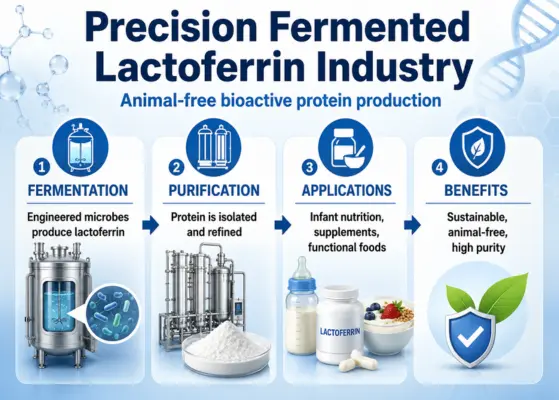
Precision fermentation leverages biotechnology to insert carefully selected DNA sequences into safe, food-grade microbes, instructing them to produce specific proteins, such as lactoferrin, when cultivated in a fermenter. Instead of milking cows and extracting small amounts of lactoferrin from whey, producers "brew" the protein directly and then purify it from the fermentation broth.
Since the genetic sequence is defined at the outset, precision fermentation can yield lactoferrin that is structurally identical to bovine or human versions, or can be adjusted for properties like iron saturation levels. For example, All G's LFX achieves a purity of over 99.5% with a consistently low-iron (apo) profile similar to that found in human milk. In contrast, Vivici's Vivitein LF is marketed as a high-purity, multifunctional ingredient beneficial for gut health and iron utilization. This level of control and consistency between batches is challenging to achieve when depending on variable dairy streams and multi-step fractionation processes.
All G: from self affirmed GRAS to FDA “no questions”
All G, based in Sydney, showcases a significant shift in the regulatory landscape as of 2026. After self-affirming its LFX ingredient as Generally Recognized as Safe (GRAS), the company received an official “no questions” letter from the U.S. Food and Drug Administration (FDA) in early 2026, indicating that the agency has no safety objections to its GRAS conclusion. This approval allows LFX to be used in a wide range of foods, beverages, nutritional products, and dietary supplements in the U.S., with All G anticipating its first commercial launches within months.
All G employs microbial precision fermentation to produce both bovine-sequence and human-sequence lactoferrin. The company argues that its apo-lactoferrin offers higher bioactivity and better iron regulation compared to many animal-derived mixtures. They emphasize not only purity and functionality but also the sustainability benefits of separating production from dairy herds, which typically results in significant milk volumes and greenhouse gas emissions. For early-life nutrition, All G positions LFX as a key ingredient for future infant formula applications once the necessary regulatory notifications are completed.
A growing ecosystem: Vivici, TurtleTree, PFx and PFerrinX
All G is part of a broader movement in the market. Vivici launched its Vivitein LF in the U.S. in February 2026, also self-affirming it as GRAS and calling it “pink gold,” while highlighting its gut-health and iron-mobilization benefits. Vivici plans to showcase Vivitein LF alongside precision-fermented beta-lactoglobulin at Expo West 2026 to appeal to health and wellness brands.
In 2025, TurtleTree received an FDA “no questions” letter for its LF+ lactoferrin, making it the world's first precision-fermented lactoferrin approved for food use and emphasizing sustainable, large-scale production. In Europe, PFx Biotech is developing human-identical lactoferrin through the HuMiLAF project, specifically targeting infant formula and children with cow’s milk protein allergies. PFerrinX claims it can precisely adjust lactoferrin’s iron-saturation state, producing apo-, native-, and holo-forms for various applications and aims to become a large-scale, low-cost producer through dedicated fermentation facilities.
How infant nutrition players are responding
While infant formula brands have not yet prominently featured “precision-fermented lactoferrin” on their products, their ingredient suppliers are moving swiftly. FrieslandCampina Ingredients, a leading lactoferrin supplier, has partnered with U.S. biotech firm Triplebar to develop precision-fermented lactoferrin, highlighting the need for a sustainable and scalable supply beyond traditional dairy extraction. French bioactives specialist Armor Protéines has formed a joint venture with All G to commercialize bovine and human lactoferrin produced via precision fermentation, leveraging its relationships with global formula manufacturers. Additionally, Australian dairy group Noumi is collaborating with the University of Queensland on fermented bovine lactoferrin, demonstrating that established dairy players view fermentation as a complement to, rather than a replacement for, conventional whey.
From a strategic standpoint, precision-fermented lactoferrin offers three advantages to infant-nutrition companies: supply resilience, sustainability, and design flexibility. It provides an independent supply chain that is insulated from milk price volatility and herd shocks, can lower carbon intensity per kilogram compared to extraction methods, and facilitates tailored proteins, ranging from allergen-free human lactoferrin formulas to condition-specific early-life or maternal nutrition blends.
Looking beyond 2026
By the end of 2026, precision-fermented lactoferrin is expected to become most visible in functional foods, beverages, and supplements aimed at immunity, gut health, and iron support, while infant formulas will proceed more cautiously through regulatory pathways and clinical validations. However, the trend is clear: as more companies secure GRAS or equivalent approvals and as costs decrease, there will be increasing pressure to incorporate fermentation-derived lactoferrin into premium infant powders, especially in markets like North America and parts of Asia, where there is already a trend toward adopting human milk oligosaccharides and other novel ingredients.
In many ways, lactoferrin represents the forefront of a broader transition in infant nutrition. If regulators, brands, and parents become comfortable with a “brewed” version of one of human milk’s most cherished proteins, it will pave the way for a full range of precision-fermented human milk proteins to follow. Viewed from the perspective of 2026, precision-fermented lactoferrin is no longer a technical curiosity but rather a critical element in the re-engineering of how we produce and perceive the essential elements in infant nutrition.











Share