Sustainable Aviation Fuel Adoption Barriers and Cost Structures
Sustainable aviation fuel has become a key priority for airlines, fuel producers, and airport operators. On the one hand, leading carriers publicly lay down net, zero targets, and on the other, fuel suppliers herald pilot plants and offtake agreements. Nevertheless, SAF adoption continues to be uneven and primarily limited by the economy. The current market scenario presents a reflection of a unique balance where businesses seek green goals without breaking their operating margins or their supply chain's reliability.
Production Capacity and Feedstock Limitations
Limited production capacity is one of the main obstacles that prevent people from switching to SAF. The current global production of SAF covers less than 1% of the total aviation fuel consumption. Although the capacity could be multiplied several times before 2030 if the projects that have been announced are taken into consideration. Most of the SAF production in the present day is based on hydro processed esters and fatty acids (HEFA) pathways, which are highly dependent on waste oils and agricultural byproducts. These feedstocks are limited and are already being used by renewable diesel producers and chemical manufacturers.
To meet the challenge, fuel producers are changing their feedstock strategies. A number of refiners are investing in alcohol-to-jet and synthetic fuel routes, which use municipal solid waste, ethanol or captured carbon, respectively. These technologies are capable of being scaled up. However, their commercial use is slow because of the high capital costs and the long approval time periods. To that end, suppliers are choosing to set up regional hubs where policy incentives make the economics of the projects more attractive, rather than trying to achieve a uniform global expansion.
Cost Structure and Pricing Pressures
Cost is still the main factor limiting the use of SAF. On average, the price of SAF is from two to five times that of regular jet fuel, depending on the source of the raw material, the way it is made, and policy support. Airlines are finding it difficult covering these costs even if there are blending mandates and tax credits. Fuel procurement departments usually think of SAF as a more expensive specialty product and therefore only allocate restricted budgets for a few specific routes or flagship sustainability programs.
Manufacturers maintain that expenses will go down when they build more plants and technology gets matured. However, the current profitability of producing a product remains a huge challenge. Suppliers are increasingly seeking airlines to commit to multi-year purchase agreements before they make the final investment decision. Thus, part of the risk is shifted to the front end and hence, adoption is reliant on the financial strength of the airline.
Airline Commitments and Procurement Strategy
Airlines are cautiously and strategically planning their transition to SAF. Instead of setting up a firm commitment to using a certain percentage of SAF, they are setting targets for blending, fleet renewal and route profitability. For instance, long-haul flights which produce a majority of emissions are usually the first to get SAF tests even though here the fuel volumes are larger and replacements more expensive.
Purchasing teams are now closely collaborating with the sustainability and finance departments. Typically, these contracts have clauses for flexible volume and price adjustment mechanisms that depend on the policy incentives. Airlines are also tending to share the SAF expenses with their corporate travel clients through voluntary surcharge schemes. Such developments represent a wider trend of shared responsibility between airlines and their clients.
Infrastructure and Logistics Constraints
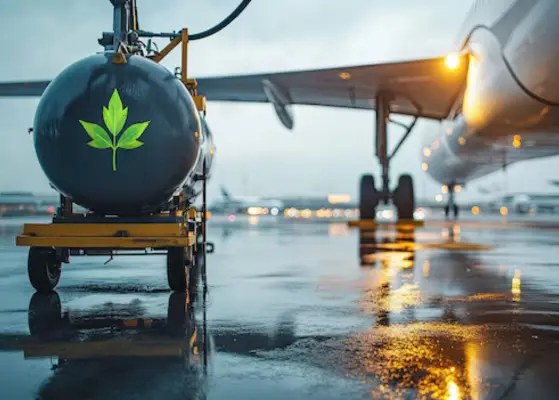
Beyond production and price, the uptake of SAF is also limited by the readiness of the infrastructure. The equipment for blending, storage, and distribution at airports was initially set up for conventional jet fuel only and therefore in many cases needs to be changed to accommodate SAF blends. Such changes entail extra expenses and the need for better coordination between airports, fuel providers, and regulators.
Several airports have chosen to invest early in SAF-compatible storage and blending infrastructure, positioning themselves as preferred green hubs for leading airlines. Others remain cautious, delaying capital commitments until demand visibility improves. This uneven level of preparedness has led to SAF availability being concentrated in a limited number of locations, which narrows airline deployment flexibility. As a result, fuel suppliers are prioritizing regional SAF clusters where infrastructure and offtake align.
Detailed analysis on SAF volumes, fuel type segmentation, and long-term adoption trends is covered in the Aviation Fuel Market Report.
Outlook for Commercial Adoption
SAF adoption is set to be widely growing but slower than initially expected due to cost control and policy clarity. Without better economic conditions, airlines would hardly replace large quantities of conventional fuel with SAF. Thus, adoption will be through setting specific targets, signing long-term contracts, and making gradual infrastructure changes.
In the B2B context, the challenge is to make this transition possible without causing a disturbance to the business flow. Fuel producers are looking for pathways that can be scaled and offtake agreements that are secured. Airlines are looking for flexibility and cost transparency. Airports make selective investments only where the demand is sufficient. These trends together shape a market where sustainability moves forward through pragmatism rather than sheer speed.











Share