Shift Toward Sustainable Vanilla Farming Practices in the Global Flavor Industry
With flavor and fragrance manufacturers increasingly developing their portfolios of natural ingredients, sourcing vanilla beans has become a strategic compulsion for them. While F&B companies have always been acutely aware of the challenge of securing an ethical and stable supply chain of vanilla beans, their focus has intensified, especially after several price shocks between 2017 and 2021 when vanilla prices reached approximately USD 600 per kg in Madagascar. The market notices a significant push toward sustainable farming models driven by business investments to secure product development pipelines and long-term procurement risk.
In recent years, leading companies like Symrise, International Flavors & Fragrances (IFF), Kerry Group, and Givaudan have expanded their sustainability programming into vanilla-growing regions, primarily Madagascar, Uganda, and Indonesia. These sustainability programs include farmer training, transparent sourcing frameworks, and investments in agroforestry practices that improve bean quality while reducing volatility.
Rising Importance of Traceable and Stable Sourcing
One of the biggest challenges for global flavor houses is securing traceable vanilla supply that meets the quality standards for high-value items like ice cream, premium baked goods, beverages, and personal care. The shortages due to climate disruptions and cyclones in Madagascar prompted companies to rethink vanilla sourcing.
Companies such as Symrise have utilized a long-term model through its Integrated Education Program, which supports farmers with finances, drying structures, and training in agronomy. This not only stabilizes the gourmet-grade vanilla supply, but also offers forecasting prices so that they can be managed during multi-year contracts with companies in the FMCG space.
Firms like Nielsen-Massey and ADM, similarly, have broadened partnerships with cooperatives and supply chains in order to secure traceable vanilla with certifications like Rainforest Alliance and Fair Trade. The emphasis is not solely centered on traceability for regulation and brand transparency reasons, but also to ensure that the bean characteristics can support consistency across flavor notes in ordered product batches.
Agroforestry Models Strengthening Farmer Livelihoods
Vanilla cultivation is widely considered to be extremely labor-intensive which includes activities such as pollination, curing, and drying. These require a high degree of manual expertise, and farmers universally have to rely on the arbitrage of intermediaries, which hampers income stability. In recent years, global flavor companies have piloted agroforestry models seeking diversified income streams and resilience.
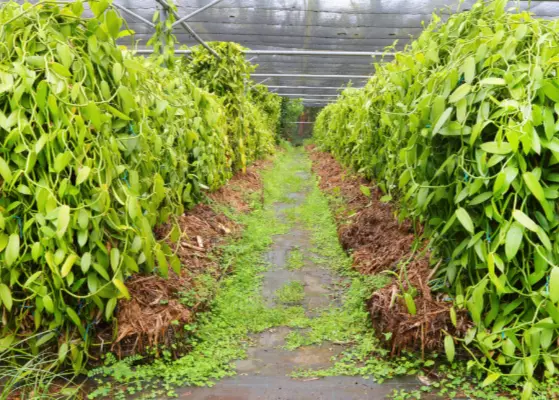
One example is the Kerry Group, which has supported agroforestry pilots in Madagascar which integrated shade trees, tropical fruits, and vanilla vines, purportedly improving soil health and reducing crop loss.
Givaudan’s Sourcing4Good program also adopts agroforestry and regenerative farming to stabilize supply. According to Givaudan, farms included in the program showed notable improvements in bean moisture control and vanillin concentration, increasing the usable extraction output for industrial clients. This ultimately translates to predictable supply planning for manufacturers that rely on natural vanilla extracts.
How Sustainability is Shaping R&D and Product Innovation Strategies?
As food and beverage (F&B) companies expand their clean-label product lines, the demand for sustainably sourced vanilla keeps increasing. The Flavor and Extract Manufacturers Association (FEMA) estimated that clean-label and natural flavors increased considerably in 2024, reflecting a trend away from synthetics in premium product categories.
Flavor companies are also now touting sustainability as a value proposition in B2B procurement deals. For example, when Symrise pitches vanilla solutions to multinational dairy and beverage clients, they highlight metrics related to income transparency and carbon-footprint reductions. Similarly, Kerry employs data measures on soil health and regenerative outcomes to use as a differentiator in support of major fortune consumer packaged goods (CPG) clients' sustainability commitments robustly in their environmental, social, and governance (ESG) reports.
More importantly, companies are now using sustainably sourced vanilla as a basis for creating new flavor formats such as cold brew-compatible vanilla extracts, high-solubility concentrates to use in many ready-to-drink beverages (RTD), and low-ethanol formulations for confection glazes. These examples illustrate how sustainability continues to influence research and development (R&D) pipelines directly.
For a detailed view of sourcing models, innovation, and market dynamics, check the Global Vanilla and Vanillin Market
The Evolution of Sustainable Vanilla Sourcing
The move towards sustainable vanilla farming is more than a trend; it is becoming a new business model for the global flavor industry. With increasing climate risks and growing consumer demand for natural ingredients, companies are utilizing deeper partnerships with farmers, agroforestry-based sourcing models, and technology-supported supply chain processes to stabilize vanilla supply channels. These approaches not only aid in business continuity, but they also support product innovation pipelines that are dependent on quality inputs of vanilla.











Share