Expanding Role of Virtual Mirrors in the Retail Sector
Retail has reached a point where digital experience is nearly as important as the physical product itself. One of the technologies continuously drawing the attention of brands and tech players is the virtual mirror. These AI-driven machines enable customers to try products digitally, usually through augmented reality or smart mirror interfaces, without even touching the items. For those retailer groups who are struggling to compete with e-commerce channels, this technology is becoming a significant tool for enhancing customer engagement and prompting purchase decisions more quickly.
By the integration of computer vision, artificial intelligence, and augmented reality, these mirrors have the capacity to offer live images that portray the customer with the product. Retailers are increasingly convinced that these types of solutions make the shopping process less intimidating for customers.
Major retail chains have started introducing virtual mirror technology not only in their physical stores but also in their e-commerce sites. Retailers that adopt virtual try-on solutions generally experience significant enhancement in their online interaction metrics. Such a transformation demonstrates that the use of immersive retail technologies is no longer just a pilot project, but a full-fledged rollout on a large scale.
Technology Companies Collaborate with Beauty and Fashion Brands
The growth of the virtual mirror ecosystem is mostly caused by the joint efforts of technology companies and consumer brands. Beauty brands were the early adopters of this technology as they understood how much customers would benefit from product testing through the virtual mirror. For example, ModiFace’s virtual mirror utilizes a facial recognition system to precisely superimpose makeup shades.
On the other hand, Sephora and other similar retailers have also added a virtual try-on feature to their mobile apps and even in-store display points. The shoppers can virtually try different cosmetic products through the use of augmented reality filters. The company disclosed that the customers using these virtual try-on tools become more interested in product exploration, and they also have a higher average purchase rate compared with the ones who are using traditional methods for browsing. Another set of fashion brands is also adopting a similar strategy. For instance, some apparel retailers have installed smart mirrors in their fitting rooms to let customers request different sizes or colors without stepping out of the room.
Improving Customer Confidence and Reducing Product Returns
Online stores have to deal with a major challenge hindering market growth which is the high number of product returns, especially in the apparel and beauty categories. Customers tend to return items because of the wrong sizes, color mismatches, and unrealistic expectations of the product. This challenge is being partly resolved by virtual mirror technology as it allows customers to see the product more realistically before they make the purchase.
Web-based surveys on retail technologies have revealed that digital try-on tools may even result in lowering product return rates by as much as 30% in some categories. For the e-commerce companies that are already struggling with the increasing expenses of logistics and reverse shipments, this reduction in their return rates can have a major impact on their profit margins.
Moreover, companies are producing body-scanning technologies that utilize users' smartphone cameras to get their measurements. Such systems not only get the height and range of the person but also take the shape and proportions of the body to suggest the fitting size of the clothes. Additionally, when these technologies are combined with virtual mirrors, the interaction becomes much closer to reality as customers can visually try on the clothes. In fact, this kind of detailed customization would be a major selling point to retailers who want to enhance the buyers' online shopping experiences.
Smart Mirrors Are Reshaping the In-Store Experience
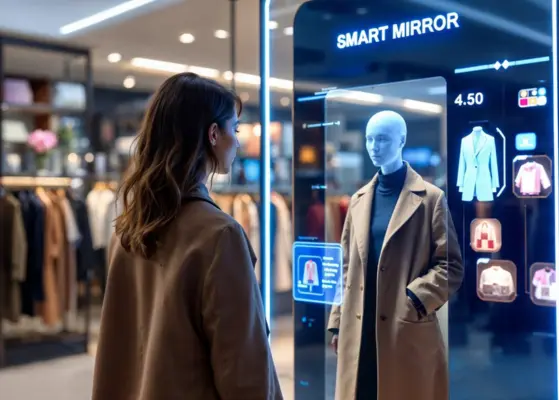
Virtual mirrors have become a standard feature among stae-commerce platforms, however, physical retail stores are equally exploring the potential of smart mirrors. Such mirrors combine advanced technologies such as touchscreens, augmented reality (AR), and data analytics to create a highly interactive shopping experience.
Leading technology companies like MemoMi have created sophisticated smart mirror solutions. With the help of these mirrors, customers can easily take videos of themselves in different clothes and at the same time send the videos to their friends or family for their comments. Retail technology studies indicate that shops adopting similar interactive mirror technologies have seen their customers spending more time in the fitting rooms, which in most cases, leads to an increase in sales.
Explore detailed insights and industry trends in the Virtual Mirror Market Report.
Competitive Landscape and Future Growth Opportunities
The competitive landscape of the virtual mirror market is getting more intense. Firms working on AI, AR, and computer vision are competing with each other to power up the accuracy of visualizations and improve user experience. Realistic rendering is one of the most critical elements that influence customer trust in technology to the extent that they use it for making purchase decisions.
Companies including Perfect Corp. ModiFace, and MemoMi keep pushing their boundaries in the field of research and development of deep learning techniques aimed at producing effects of natural lighting conditions, accurate reproduction of skin tones, and fabric textures. This type of improvement in AI, especially in terms of interpreting the nuances of the physical world, is fundamental to the digital experience creation that corresponds to the real-life product touch and feel scenario.











Share