Chocolate in a Cocoa Crisis: How R&D Is Redefining the Scenario
Cocoa prices surged to record highs in 2024 and 2025 due to poor harvests in West Africa, climate stress, and disease, which significantly reduced yields in the world’s primary cocoa-producing regions. Although prices have started to stabilize, analysts and manufacturers agree that this situation represents a structural shock rather than a temporary spike, compelling the chocolate industry to reconsider what constitutes “chocolate.”
From cocoa-free bars fermented from grains and beans to cell-cultured cocoa grown in steel tanks, alongside engineered fat systems designed to maximize the use of cocoa, 2026 promises to be a pivotal year for cocoa alternatives.
Why Cocoa Prices Are Suddenly Volatile
Over 60% of the world’s cocoa is sourced from West Africa, where farmers face challenges such as erratic weather, aging trees, disease, and stricter deforestation regulations. A series of poor harvests in 2024 and 2025 revealed the fragility of this supply chain, driving cocoa prices to unprecedented highs.
As a result, global manufacturers are starting to view cocoa supply instability and price volatility as strategic risks rather than mere background noise. Market analysts have noted a significant rise in interest for "cacao alternatives" and cocoa-reduction strategies. These range from hybrid recipes that incorporate less cocoa to entirely cocoa-free chocolate alternatives. The market for cocoa butter alternatives is also expected to soar with increase in the price of cocoa butter, as brands adopt cocoa butter equivalents and substitutes to manage costs and supply issues.
Strategy 1: Making “Chocolate” Without Cocoa
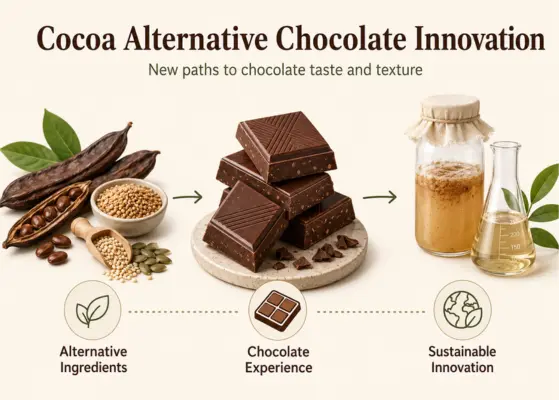
The most noticeable response to the cocoa crisis has been the creation of chocolate-like products that contain no cocoa but still strive to deliver a recognizable chocolate experience. These alternatives often utilize combinations of grains, legumes, and seeds that are fermented, roasted, and refined in ways similar to traditional cocoa processing.
Nestlé’s 2026 Cocoa-Free Launch
In early 2026, Nestlé became the first major global confectionery company to make a significant move in the cocoa-free chocolate space with the launch of Choco Crossies “Snack Vibes” in Germany. Instead of cocoa, these products utilize ChoViva, a cocoa-free chocolate alternative developed by the German startup Planet A Foods. This alternative is made from ingredients like oats, sunflower seeds, and shea.
Fermented Fava Beans, Grains, and Seeds
Nestlé is not alone in this innovation. Several startups are reimagining chocolate using other crops. Some examples are:
- Nukoko (UK): This company ferments fava beans using a process that closely mimics cocoa fermentation. The beans are then roasted and refined into a chocolate-like mass. Ingredient giant Döhler has partnered with Nukoko to scale production in 10,000-liter fermenters, aiming for industrial-scale production of cocoa-free chocolate with a carbon footprint potentially 90% lower than traditional chocolate.
- Planet A Foods: The company behind ChoViva uses controlled fermentation and roasting processes on oats and sunflower seeds to create cocoa-like flavor precursors and color, before adding plant-based fats to achieve a texture similar to chocolate.
- Prefer (Singapore):They produce “PreferChoc”, a cocoa-free powder made from fermented and roasted seeds and grains. Manufacturers are testing it as a partial replacement for regular cocoa powder at 30-50% inclusion levels without significant flavor loss, with broader commercial rollout expected in 2026.
- Voyage Foods (US):This company utilizes upcycled grape and other fruit seeds to make cocoa-free chocolate. They have partnered with Cargill to cut carbon emissions by as much as 67%, reduce land use by 90%, and lower water use by 95% compared to conventional chocolate.
Market analysts emphasize that cocoa-free chocolate is not only a remedy for the supply crisis; it also offers an opportunity to incorporate additional protein, fiber, and lower sugar content, while appealing to consumers interested in sustainability and lower environmental footprints.
Strategy 2: Engineering New Fat Systems and Hybrid Chocolates
Chocolate relies heavily on fat as well as flavor. Cocoa butter provides chocolate with its glossy finish and precise melting properties, yet it is also one of the most expensive and volatile components of the recipe. Consequently, a second wave of innovation is focusing on cocoa butter alternatives (CBAs) and hybrid formulations that stretch cocoa without entirely eliminating it.
Cocoa Butter Alternatives Go Mainstream
Cocoa butter equivalents, replacers, and substitutes made from other plant oils such as palm, shea, and kokum are not new, but they are rapidly being refined. Advances in fat-modification technologies, such as interesterification, are enabling these alternative fats to more closely mimic cocoa butter’s melting and crystallization behavior, enhancing the texture and stability of chocolate coatings and fillings.
Additionally, consumer demands for clean-label and trans-fat-free products are pushing suppliers to develop more sophisticated blends rather than relying on older, chemically hardened fats.
Cargill’s 2026 Edison Award for Cocoa-Free Chocolate
A notable example of innovation in the chocolate industry is NextCoa, a cocoa-free chocolate alternative developed by Cargill in collaboration with Voyage Foods. In 2026, NextCoa won an Edison Award in the Consumer Food Innovations category, recognizing its ability to replicate a chocolate-like taste and experience while reducing dependence on constrained cocoa supply chains.
NextCoa is marketed as a modular confectionery ingredient, allowing manufacturers to use it as a direct substitute in applications where consumers prioritize price and "chocolatey" flavor over origin. When combined with traditional cocoa in hybrid recipes, it offers brands a way to manage costs and supply risks without needing to overhaul their entire product lines.
Hybrid "Cocoa-Reduced" Formulations
Many manufacturers are not prepared to eliminate cocoa completely. Instead, they are exploring cocoa-reduced formulations that blend traditional cocoa with flavor enhancers or alternative ingredients. For example, yeast extracts can intensify chocolate flavor, allowing for a reduced cocoa requirement; roasted grains and legume fractions can provide color and bitterness; and powders like PreferChoc can partially replace cocoa in bakery and confectionery products.
This hybrid approach is appealing as it can lower cost exposure while keeping products within the existing regulatory definitions of “chocolate” in many markets.
Strategy 3: Growing Cocoa in Bioreactors (Cell-Based Chocolate)
In addition to cocoa-free and hybrid approaches, a third frontier is emerging: cell-cultured cocoa, grown in bioreactors rather than on trees.
Puratos and California Cultured: The First Commercial Cell-Based Chocolate
The Belgian ingredients group Puratos has partnered with US startup California Cultured to launch what is promoted as the world’s first chocolate containing cell-based cocoa for professional use in the US in 2026. California Cultured grows cocoa plant cells in nutrient media inside bioreactors and then processes the resulting biomass into cocoa ingredients. This method promises faster production (days instead of months) and significantly lower land use.
Puratos plans to initially make this cell-based chocolate available to chefs, chocolatiers, and food manufacturers, allowing them to experiment before any eventual retail rollout. The startup has built a 12,000-square-foot facility in West Sacramento and is pursuing regulatory approvals, such as “Generally Recognized as Safe” (GRAS) status from the US Food and Drug Administration.
Celleste Bio: Aiming for Supermarket-Ready by 2027
Meanwhile, Israeli startup Celleste Bio, backed by Mondelēz, has developed a process for growing cocoa butter from cocoa cells in bioreactors. Company data reported in May 2026 indicates that a single cocoa bean could ultimately yield around 2 tonnes of cocoa butter per year, compared to the approximately 4 tonnes of cocoa pods and 10,000 square meters of land required to produce the same amount through traditional farming. Celleste Bio claims it is on track to produce one tonne of cocoa butter annually using a 1,000-liter bioreactor, and industry commentators expect lab-grown chocolate ingredients to be supermarket-ready by around 2027. However, analysts note that regulatory approvals, cost trajectories, and consumer acceptance will all play critical roles in determining how quickly cell-cultured cocoa moves from niche to mainstream.
What began as an urgent response to record cocoa prices is quickly transforming into a strategic redesign of the chocolate supply chain. By 2026, cocoa-free chocolate is less about replacing traditional chocolate and more about enhancing the resilience of the entire chocolate market in the face of climate and cost pressures. If these technologies succeed, the chocolate aisle of the 2030s may feature a broader and more diverse range of products, relying on a portfolio of crops, ferments, and bioreactors rather than solely on cocoa trees.









Share