Antimicrobial resistance is already a 4.7-million-death global challenge
Antimicrobial resistance (AMR) occurs when bacteria, viruses, fungi or parasites no longer respond to antimicrobial medicines designed to treat the infections they cause. This makes infections harder to treat and increases the risk of disease spread, severe illness and death. The consequences extend beyond individual treatment: effective antimicrobials are also essential to surgery, cancer care, transplantation, neonatal care and many other medical interventions.
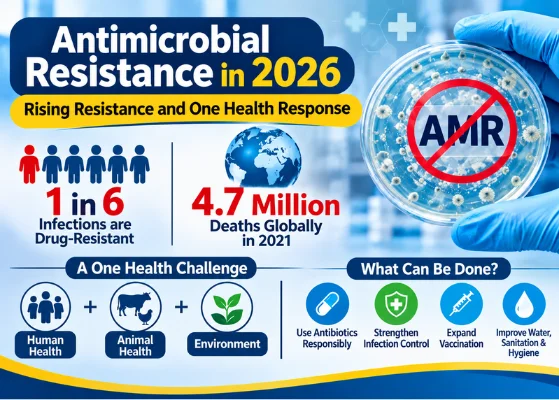
The latest comprehensive global burden estimates remain based on 2021 data. A systematic analysis published in The Lancet estimated that bacterial AMR was associated with 4.71 million deaths worldwide in 2021, including 1.14 million deaths attributable to bacterial AMR. These measures are different: associated deaths include deaths involving resistant infections, while attributable deaths estimate the additional mortality burden compared with a counterfactual scenario involving drug-susceptible infections.
The same analysis projected that, under its reference scenario, annual deaths could reach 8.22 million associated with bacterial AMR and 1.91 million attributable to bacterial AMR by 2050. These are modeled projections, not observed outcomes. They nevertheless underline the potential consequences of inaction.
One in six laboratory-confirmed bacterial infections was resistant to antibiotics in 2023
The World Health Organization's Global Antibiotic Resistance Surveillance Report 2025 found that approximately one in six laboratory-confirmed bacterial infections worldwide in 2023 was resistant to antibiotics. The report analysed more than 23 million bacteriologically confirmed cases reported through surveillance systems. This is a finding about reported, laboratory-confirmed infections, not a claim that one in six people or one in six infections in the general population is resistant.
The burden is uneven. Resistance patterns and the ability to detect them vary with access to healthcare, laboratory capacity, infection prevention, antimicrobial use and the coverage of surveillance systems. Countries and communities with weaker diagnostic and health-system infrastructure may face both greater risks and less complete evidence about the scale of the problem.
AMR could generate USD 855 billion in annual treatment and productivity costs by 2035
AMR also creates substantial economic pressure. WHO has cited estimates of around USD 412 billion in annual treatment costs and USD 443 billion in annual productivity losses associated with resistant bacterial infections under current conditions, with these costs projected to reach these levels annually by 2035. These projections illustrate the wider effects of longer hospital stays, more complex treatment, additional diagnostics, lost working time and pressure on health-system resources.
For pharmaceutical and biotechnology companies, resistance raises questions about antibiotic research and development, the clinical and commercial sustainability of new treatments, equitable access to essential medicines, and responsible procurement practices. For health systems, it reinforces the need to make effective diagnostics and appropriate treatment available while reducing avoidable infections and unnecessary antimicrobial exposure.
Five interconnected factors make AMR a One Health challenge
Inappropriate antimicrobial use is a major driver of resistance, but it is not the only one. AMR is shaped by how infections are prevented, diagnosed and treated, as well as by practices in animal health, food production and environmental management.
Inappropriate antimicrobial use increases selection pressure, while limited access can delay appropriate treatment
Unnecessary prescriptions, antibiotic use for viral infections, incorrect drug selection or dosing, self-medication and antimicrobial use without qualified medical or veterinary guidance can accelerate the selection of resistant microorganisms. However, the response must not focus only on reducing use. People also need timely access to qualified care, appropriate diagnostics and effective medicines. Where these are unavailable or unaffordable, treatment may be delayed, incomplete or poorly targeted.
Diagnostic gaps make targeted treatment and effective surveillance more difficult
Without timely microbiological testing and antimicrobial susceptibility testing, clinicians may need to begin empirical treatment without identifying the causative pathogen or determining its antimicrobial susceptibility profile. This can contribute to broad-spectrum antibiotic use and delay recognition of resistant infections. Stronger laboratory networks, affordable diagnostics and the integration of test results into clinical decisions are therefore central to stewardship and surveillance.
Infection prevention, vaccination, water, sanitation, and hygiene reduce the need for antibiotics
Preventing infections is one of the most direct ways to reduce antimicrobial demand. Hand hygiene, sterilisation, environmental cleaning, vaccination, safe water, sanitation and hygiene, and effective infection prevention and control in healthcare facilities can reduce transmission and the need for treatment. These measures are important in hospitals, communities and settings where overcrowding or inadequate infrastructure increases infection risk.
Animal health, food systems and environmental pathways also matter
Antimicrobials are used to treat infections in livestock and aquaculture, and inappropriate or excessive use can contribute to resistance. Responsible veterinary oversight, disease prevention, vaccination, improved animal husbandry and effective regulation are important safeguards. Resistant microorganisms and antimicrobial residues can also spread through food systems, wastewater, and other environmental pathways. The relative contribution of these routes varies by setting, making local evidence and cross-sector monitoring essential.
These connections explain why AMR is not only a clinical and pharmaceutical challenge but also a broader development concern. Household income, education, health literacy, access to qualified providers, sanitation and local service availability all influence infection risk and antimicrobial use. Interventions are more likely to work when they reflect the circumstances of patients, healthcare workers, pharmacists, farmers and communities.
Global AMR policy has advanced, but implementation remains the key challenge
The 2026–2036 Global Action Plan builds on a decade of international commitments
In May 2026, Member States at the 79th World Health Assembly adopted the updated Global Action Plan on Antimicrobial Resistance (GAP-AMR) for 2026–2036. Developed through the Quadripartite partnership of WHO, FAO, UNEP and the World Organisation for Animal Health, the updated plan builds on the original 2015 Global Action Plan and the commitments made in the 2024 UN Political Declaration on AMR.
The updated framework emphasises prevention, responsible antimicrobial use, surveillance, sustainable agrifood systems, innovation and environmental action. It also recognises that national plans need sustainable financing, accountability and measurable implementation. Prevention through vaccination, infection control, water and sanitation, biosecurity and environmental management can reduce infections and the demand for antimicrobials.
The 2024 UN declaration sets 2030 targets for mortality and antibiotic use
The UN Political Declaration on AMR commits countries to work toward a 10% reduction in global deaths associated with bacterial AMR by 2030, against the 2019 baseline of 4.95 million deaths. It also sets a target for at least 70% of global human antibiotic use to come from the WHO Access category of the AWaRe classification, which includes antibiotics recommended as first- or second-choice treatments for many common infections. Other commitments address infection prevention and control, diagnostics, surveillance and antimicrobial use in agrifood systems.
Only 22% of countries report fully funded and implemented AMR action plans
WHO's 2026 Tracking Antimicrobial Resistance Country Self-assessment Survey (TrACSS), released on 16 November 2026, shows the gap between adopting plans and delivering them. Although 173 countries reported having national AMR action plans, only 22% reported that their plans were both funded and fully implemented. Only 36% reported having a national reference laboratory with the specified capacity to test selected bacteria and fungi, compared with a global target of 80% by 2030. The assessment also identified gaps in appropriate-use guidelines and systems to monitor antibiotic use and AMR.
These are country-reported self-assessment findings, not direct measurements of patient-level access or laboratory performance. They nevertheless provide a current indication of implementation constraints. WHO also released a prioritized catalogue of diagnostic tests and a toolkit of standard operating procedures for clinical laboratories under its AMR Diagnostic Initiative.
India's 2026 AMR surveillance and policy developments highlight implementation priorities
NAP-AMR 2.0 establishes a multisectoral framework for 2025–2029
India's second National Action Plan on AMR, covering 2025–2029, adopts a One Health approach involving human health, animal health, agriculture, the environment and research. It includes action plans for key ministries and departments, with goals, timelines and budgets. Priorities include awareness and training, laboratory capacity, infection prevention and control, responsible antimicrobial use and stronger cross-sector coordination. The critical test is whether these commitments translate into funded activities, clear institutional responsibilities and measurable progress across states and sectors.
During India's World AMR Awareness Week observance on 18 November 2026, the Ministry of Health and Family Welfare highlighted concerns that more than half of antimicrobial sales in India occur without prescriptions, while nearly half of outpatient antibiotic prescriptions are inappropriate. The statement called for responsible dispensing, action against self-prescription, appropriate antimicrobial use in veterinary medicine, and stronger quality standards in healthcare facilities.
NCDC's 2026 bulletin analyzed 150,081 isolates from 102 laboratories
The latest NCDC Semi-Annual AMR Surveillance Bulletin identified for this article covers the period from January through June 2026. It reports 150,081 isolates corresponding to 150,071 unique patients across 102 laboratories, comprising 62 National AMR Surveillance Network (NARS-Net) sites and 40 laboratories across six State AMR Surveillance Networks.
Among the reported findings, Methicillin-resistant Staphylococcus Aureus (MRSA) accounted for 60% of blood isolates, compared with 56% in the previous six-month period. Vancomycin resistance among Enterococcus blood isolates increased to 23%, compared with 21% in the previous six-month period. Ciprofloxacin resistance among Shigella stool isolates was 87%, broadly similar to 88% in the preceding bulletin.
These percentages describe isolates tested within participating surveillance facilities, not population-wide prevalence. The types of patients and specimens tested, clinical decisions about when to request cultures, and changes in the participating laboratory mix can influence the results. Cultures may be more likely to be requested for severe infections or when initial treatment has not worked. The figures should therefore be interpreted as surveillance findings rather than estimates of resistance prevalence among the general population of India.
Four implementation priorities connect surveillance with action
First, improve the coverage, quality and representativeness of surveillance by linking resistance patterns with antimicrobial consumption data and treatment outcomes. Second, embed stewardship in healthcare through evidence-based prescribing, antibiotic review, staff training and access to microbiological testing. Third, use social and behavioral research to understand self-medication, prescribing expectations, health-seeking practices and differences in awareness and access. Fourth, extend implementation beyond hospitals through veterinary services, food-system safeguards, wastewater management and environmental monitoring.
An effective AMR response requires clinical, health-system and community-level evidence
AMR cannot be addressed through a single intervention. Epidemiological research helps define the disease burden, affected populations, pathogen profiles, and treatment outcomes. Diagnostic and pharmaceutical landscape assessments can examine testing capacity, treatment availability, innovation and access. Procurement and supply-chain intelligence can help identify vulnerabilities in the availability of essential medicines and diagnostics.
At the same time, social and development research can examine knowledge, attitudes and practices; healthcare-seeking and medicine-use behaviors; community access barriers; institutional readiness; and coordination between government, providers, farmers and other stakeholders. Health-system assessments can identify gaps in infrastructure, workforce, financing, laboratory networks and implementation capacity.
At Claight, healthcare and pharmaceutical research spans epidemiology, healthcare market intelligence, diagnostic and pharmaceutical landscape assessments, procurement intelligence and health-system analysis. Social and development research complements this through stakeholder consultations, community-level research, knowledge and behaviour assessments, institutional capacity assessments and implementation studies. Together, these capabilities can generate evidence on resistance burden, access to interventions, antimicrobial-use drivers and the institutional and community conditions that influence AMR containment.
The global and Indian policy frameworks now provide a direction for action. Progress will depend on whether surveillance informs decisions, diagnostics support appropriate treatment, medicines remain accessible and responsibly used, and prevention extends across healthcare facilities, communities, animal health, agriculture and the environment. The next phase of the AMR response must turn evidence and commitments into coordinated, measurable action across the One Health ecosystem.









Share