35.1% Report Stress Across 131 Countries: The Wider Implications for Physical and Mental Health
Stress is often seen as an inevitable part of modern life. It is the body's response to situations perceived as demanding or threatening. In the short term, this response is adaptive, increasing alertness, mobilising energy and preparing the body to act.
However, persistent or recurrent stress can affect sleep, emotional regulation, metabolism and cardiovascular functioning. Over time, it may contribute to broader health risks, particularly alongside pre-existing conditions, socioeconomic disadvantage and limited healthcare access.
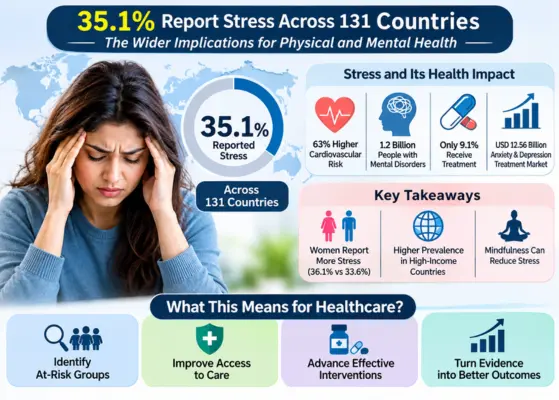
A 2025 study published in the Journal of Affective Disorders, covering more than 300,000 respondents across 131 countries, found that 35.1% reported experiencing stress. The findings highlight its widespread prevalence and variations across gender, income and health-related circumstances.
The implications extend beyond individual well-being. Stress intersects with non-communicable diseases, mental health conditions, healthcare utilisation and demand for preventive interventions. This raises important questions for pharmaceutical companies, healthcare providers, digital health businesses and policymakers: how can risks be identified earlier, which interventions deliver measurable benefits, and where are the biggest gaps in care?
Observed from 2 to 6 November 2026, International Stress Awareness Week provides an opportunity to examine these questions through the lens of healthcare evidence and market intelligence.
| Evidence point |
What the evidence indicates |
| 35.1% reported stress |
Multinational survey of 300,000+ respondents across 131 countries. |
| RR 1.63 for cardiovascular disease |
Higher stress hormone levels were associated with higher relative risk in a meta-analysis. |
| 1.2bn people with mental disorders |
Global mental health burden in 2023, including anxiety and depressive disorders. |
| 9.1% treatment coverage |
Share of people with major depressive disorder receiving minimally adequate treatment in 2021. |
| USD 12.56bn treatment market |
EMR estimate for anxiety and depression treatment across eight major markets in 2025. |
Taken together, the evidence points to three connected priorities: identify populations at risk, strengthen access to appropriate care, and evaluate interventions against measurable clinical and patient outcomes.
Women Reported More Stress Than Men, While Socioeconomic and Health Factors Also Shape Exposure
The 35.1% prevalence estimate reported by Smith and Wesselbaum provides a useful indication of the scale of self-reported stress across countries. The study identified differences across demographic and socioeconomic groups. Women reported higher levels of stress than men, at 36.1% compared with 33.6%. The difference was statistically significant, although relatively modest in absolute terms. Stress was also reported more frequently in high-income countries, at approximately 36%, compared with low- and middle-income countries.
The study identified income instability, health issues and food insecurity as significant correlates of reported stress. These factors are particularly relevant because they often interact. Financial uncertainty can affect access to nutritious food and healthcare, while an existing health condition may increase household expenditure and reduce an individual's capacity to manage other pressures.
The gender difference also deserves attention. A population-level difference in reported stress does not, by itself, establish the underlying reasons. Differences in social roles, exposure to adverse circumstances, health conditions and reporting patterns may all contribute. More granular research is needed to identify how these factors vary across age groups, geographies and socioeconomic categories.
For healthcare research, the central implication is that stress should not be treated as a uniform population characteristic. Prevalence estimates become more useful when disaggregated by demographic profile, socioeconomic position, health status and geography. Such segmentation can help identify populations with greater exposure, understand differences in health-seeking behaviour and assess the potential reach of preventive and clinical interventions.
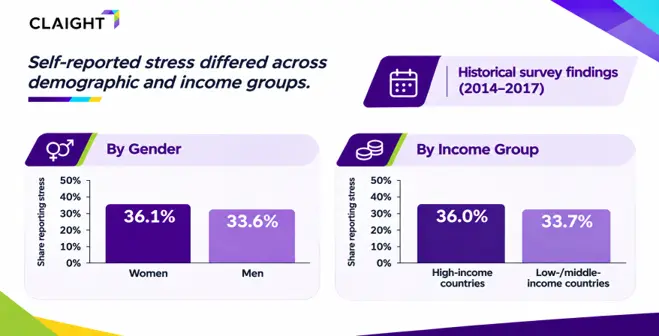
Self-reported stress differed across demographic and income groups
Stress Hormone Levels Were Associated with 63% Higher Cardiovascular Risk: Understanding the Biological Pathways
The relationship between stress and physical health is rooted in the body's neuroendocrine and autonomic response systems. When a threat or challenge is perceived, the hypothalamic-pituitary-adrenal (HPA) axis and sympathetic nervous system are activated.
The HPA axis regulates cortisol release, while sympathetic activation triggers the release of catecholamines such as adrenaline and noradrenaline. These hormones support the immediate response by influencing heart rate, blood pressure and energy availability.
While adaptive in the short term, repeated or prolonged activation with insufficient recovery may affect cardiovascular regulation, sleep, immune and inflammatory processes, and metabolic functioning.
The relationship between stress hormones and cardiovascular disease is an important area of research. A 2024 systematic review and meta-analysis published in the *International Journal of Cardiology: Cardiovascular Risk and Prevention*, covering 33 studies and 43,641 participants, found a 63% higher relative risk of cardiovascular disease among individuals with higher stress hormone levels. The pooled risk ratio was 1.63 (95% CI: 1.36–1.97).
For pharmaceutical and medical technology research, this raises questions around stress-related biomarkers, monitoring technologies and the role of stress-management interventions in cardiovascular risk reduction.
The focus is not to treat stress as a standalone cause of cardiovascular disease, but to understand how identifying and managing stress-related risk factors could strengthen existing prevention and care pathways.
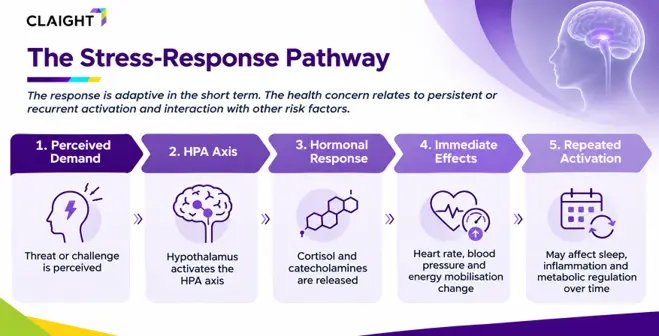
The Stress-Response Pathway
1.2 Billion People Live with Mental Disorders: Where Persistent Stress Fits Within the Global Mental Health Burden
Stress and mental health are closely linked, but they are not interchangeable. Stress is a response to perceived demands or challenges, while anxiety and depressive disorders are clinically recognised conditions with defined diagnostic criteria and functional impacts.
Prolonged or severe stress may increase vulnerability to mental health difficulties or worsen existing symptoms. However, mental disorders have multiple biological, psychological and social determinants and cannot be attributed to stress alone.
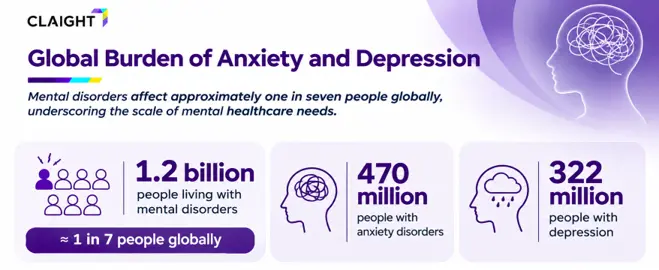
According to the World Health Organization, approximately 1.2 billion people were living with a mental disorder in 2023, nearly one in seven people globally. This included an estimated 470 million people with anxiety disorders and 322 million with depression.
Persistent stress can affect sleep, concentration and emotional regulation. It may also influence behaviours such as physical activity, eating patterns and substance use, with further implications for mental and physical health.
The relationship is also bidirectional. People experiencing anxiety or depression may report higher perceived stress, while ongoing stressful circumstances can complicate symptom management and recovery. These factors can reinforce one another over time.
For healthcare systems, this has implications for screening, diagnosis and continuity of care. Symptoms such as sleep disturbances, persistent fatigue and cardiovascular complaints may involve overlapping physical and psychological needs. Appropriate clinical assessment is therefore essential, rather than assuming stress is the underlying cause.
Mindfulness-Based Interventions Reduced Perceived Stress in 17 Trials Involving 1,641 Adults
Growing recognition of stress-related health risks has increased interest in interventions that reduce perceived stress and strengthen coping capacity. These include structured psychological approaches, mindfulness-based programmes, digital interventions and clinical support for individuals with co-existing mental health conditions.
A 2026 systematic review and meta-analysis published in *npj Mental Health Research* assessed mindfulness-based interventions among non-clinical adults. It included 17 randomised controlled trials involving 1,641 participants.
The pooled analysis found a statistically significant reduction in perceived stress among participants receiving mindfulness-based interventions compared with control groups. Despite variations in populations, formats and delivery approaches, the findings suggest that these interventions can help reduce perceived stress across non-clinical adult populations.
Further research is needed to assess the durability of benefits, identify which groups respond best, and determine whether reduced perceived stress translates into measurable improvements in physiological markers or healthcare outcomes.
For healthcare companies, this highlights the distinction between intervention efficacy and real-world effectiveness. Beyond positive trial results, routine performance depends on user engagement, adherence, accessibility, cost and delivery models.
These factors are particularly relevant to digital mental health solutions. While digital formats can expand access to guided programmes and self-management tools, their effectiveness depends on clinical validation, appropriate user segmentation, sustained engagement and clear escalation pathways.
Only 9.1% of People with Major Depression Received Minimally Adequate Treatment: The Global Access Gap
The burden of mental health conditions is compounded by significant gaps in diagnosis, treatment and service availability. Even where effective interventions exist, access remains uneven across countries and population groups.
A global analysis of major depressive disorder estimated that only 9.1% of people with the condition received minimally adequate treatment in 2021, based on data from 204 countries and territories. Coverage varied considerably across regions and income groups, with particularly low access in several low- and middle-income settings.
These gaps reflect limited availability of trained professionals, inadequate financing, geographical barriers, affordability constraints, stigma and low awareness. The challenge is not simply whether treatment exists, but whether patients can access appropriate care and remain within treatment pathways.
The WHO Mental Health Atlas 2024, published in September 2025 and based on data from 144 countries, highlights these structural constraints. It reported a global median of 13.5 specialised mental health workers per 100,000 people, while mental health accounted for just 2.1% of government health expenditure.
Addressing these gaps requires stronger integration of mental health into primary care, better referral systems, expanded workforce capacity and digital tools that complement existing services.
For healthcare providers, the priority is to improve access without compromising assessment and treatment quality. For pharmaceutical companies, the treatment gap highlights the need to understand barriers across diagnosis, treatment initiation, adherence, affordability and specialist access, all of which influence the effective addressable patient population.
For digital health businesses, opportunities exist in screening, patient engagement, remote consultations and symptom monitoring. However, solutions must be supported by clinical validation and positioned according to their intended role, rather than as substitutes for professional assessment or evidence-based treatment.
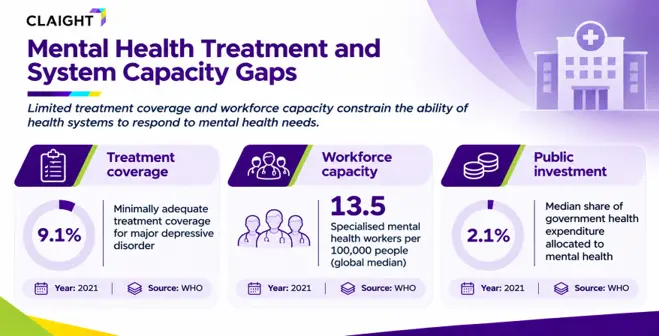
Mental healthcare access and system capacity
Anxiety and Depression Treatment Is a USD 12 Billion Market: Distinct Opportunities Across Pharma, Digital Health and Care
Growing evidence on the health impacts of stress has implications for several healthcare markets. However, these represent connected but distinct segments, not a single stress-related healthcare market. Market estimates from Expert Market Research (EMR) indicate the commercial scale of selected treatment categories.
1. Pharmaceutical therapeutics. Therapeutics for clinically diagnosed anxiety and depressive disorders address established patient populations. EMR estimates the anxiety and depression treatment market across eight major markets at USD 12.56 billion in 2025, reaching USD 17.04 billion by 2035 (3.1% CAGR). Its estimates for generalised anxiety disorder (GAD) and major depressive disorder (MDD) are USD 1.81 billion and USD 6.42 billion, respectively, in 2025, with forecast CAGRs of 5.4% and 5.3%. Assessment should consider diagnosed populations, prescribing patterns, treatment guidelines, access and reimbursement.
2. Digital mental health solutions. This segment includes digital therapeutics, guided psychological programmes, remote consultations and self-management applications. Commercial potential depends on clinical validation, regulatory requirements, reimbursement, user adoption and sustained engagement. Evidence supporting mindfulness-based interventions provides a basis for further assessment, but individual products require separate validation.
3. Mental healthcare services. Psychiatric consultations, psychological therapy, counselling and integrated care models are shaped by workforce availability, healthcare expenditure, insurance coverage, service capacity and unmet need.
4. Diagnostics and monitoring technologies. Relevant applications include cardiovascular risk assessment, physiological monitoring and digital patient tracking. However, stress-related biomarkers should not be treated as standalone diagnostic tests for psychological stress or mental health disorders without appropriate clinical validation.
These segments differ in their customers, purchasing processes, regulatory environments and evidence requirements. Pharmaceutical markets depend on prescribing and reimbursement, digital solutions on user engagement and institutional adoption, and healthcare services on provider capacity and funding.
Market assessment should therefore begin with the specific product or service, defining its target population, clinical indication, care pathway, competitive alternatives and purchasing environment before estimating market size and growth.
How the opportunity breaks down across healthcare markets
| Market segment |
Examples |
Key commercial considerations |
| Pharmaceutical therapeutics |
Medicines for diagnosed anxiety and depressive disorders |
Patient pool, treatment lines, prescribing, access and reimbursement |
| Digital mental health |
Guided programmes, digital therapeutics, remote consultations |
Clinical validation, engagement, regulation and payment model |
| Mental healthcare services |
Psychiatry, psychology, counselling and integrated care |
Workforce, provider capacity, funding and patient access |
| Diagnostics and monitoring |
Physiological monitoring and patient tracking |
Clinical utility, validation, intended use and care integration |
Five Evidence Gaps Shaping the Next Generation of Stress and Mental Health Research
As the evidence base evolves, several research priorities are becoming increasingly important for healthcare and pharmaceutical stakeholders.
1. Better epidemiological segmentation. Global stress estimates indicate prevalence but reveal less about differences across countries, age groups, socioeconomic groups and disease populations. Country-specific research can help identify variations in exposure, associated health conditions and healthcare access.
2. Longitudinal evidence. Research following individuals over time is needed to understand how persistent stress relates to disease development and progression. Cross-sectional surveys and observational studies offer useful insights but cannot establish temporal relationships or causality on their own.
3. Patient journey research. Understanding how individuals move from experiencing symptoms to seeking help, receiving a diagnosis and accessing treatment can reveal gaps in care. Referral patterns, treatment delays, adherence and discontinuation are particularly important where symptoms overlap across physical and psychological conditions.
4. Stronger intervention evidence. Trials need to look beyond short-term outcomes to assess lasting benefits, real-world adherence, patient-reported outcomes and effects on healthcare utilisation. Comparative evidence can also help identify which delivery approaches suit different populations.
5. Market research linked to clinical evidence. A large population reporting stress does not automatically translate into an addressable market for medicines, digital therapeutics or healthcare services. Market sizing requires a defensible progression from the total population to those with relevant symptoms, clinically eligible patients, diagnosed and treated populations, and those realistically able to access and adopt an intervention.
Addressing these gaps requires epidemiology, clinical research, patient insights and market intelligence to work together. Each provides a distinct part of the evidence needed to assess healthcare needs and commercial opportunities.
From Stress Prevalence to Patient Outcomes: Turning Evidence into Better Healthcare Decisions
Stress is widespread and has important public health implications, but its significance extends beyond prevalence figures. Evidence points to links between stress exposure, physiological pathways, cardiovascular risk and mental health vulnerability. It also highlights the value of effective interventions and persistent gaps in access to care.
The research challenge is to understand who is affected, which health outcomes matter, what interventions work and where healthcare systems are falling short.
What this means for healthcare decision-makers
For pharmaceutical companies, this means understanding risk factors, diagnosed patient populations, treatment patterns and unmet needs. For healthcare providers, it means improving identification, referral and continuity of care. For digital health businesses, it means demonstrating clinical credibility, accessibility and sustained user engagement.
The opportunity is not to treat stress as a single disease category or standalone pharmaceutical market, but to understand its links with established healthcare needs and emerging models of prevention, diagnosis and treatment.
As physical and mental healthcare become increasingly integrated, robust epidemiological evidence, patient insights and market intelligence will be essential to guide investment and innovation.
The key question for healthcare stakeholders is no longer simply how common stress is, but how effectively its associated health risks can be identified, addressed and translated into measurable improvements in patient outcomes.
TURN HEALTHCARE EVIDENCE INTO STRATEGIC ACTION
Understanding the health effects of stress requires more than prevalence estimates. It calls for robust epidemiology, clinical evidence, patient insights and market intelligence. Claight supports healthcare and pharmaceutical organisations with research that informs portfolio decisions, market entry, patient strategy and service development. Connect with our team to discuss a research requirement or explore how evidence-led analysis can support your next healthcare decision.
EPIDEMIOLOGY & PATIENT RESEARCH
Disease burden, patient segmentation, patient journeys and unmet needs |
CLINICAL & TREATMENT INTELLIGENCE
Treatment patterns, clinical evidence, therapy landscape and access analysis |
HEALTHCARE MARKET INTELLIGENCE
Market sizing, forecasting, competitive benchmarking and opportunity assessment |
Related Reports
Generalized Anxiety Disorder Market
Major Depressive Disorder Market
Mindfulness & Stress Management Services.







Share