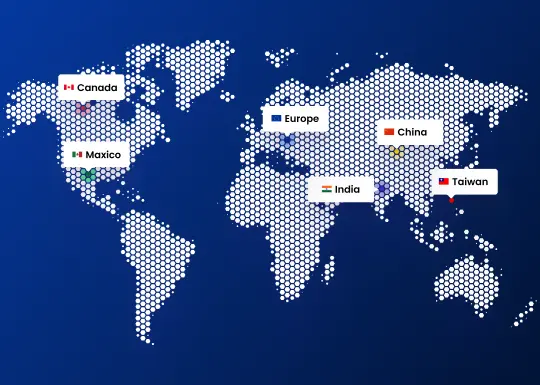
President Donald Trump's new tariff proposals have piqued significant attention and interest in the global trade markets. On February 1st, 2025, the Trump administration imposed new tariffs on their key trade partners including China, Canada, Mexico and India. With a 25% tariff on imports from Canada and Mexico and an additional 10% on those from China, the markets are expected to witness significant adjustments. What will these changes mean for global healthcare and the pharmaceutical industry? Let us find out.
New U.S. Tariffs Could Affect Canada’s Pharmaceutical Trade and Drug Prices
Sharing boundaries with Canada, the Trump government has decided to levy a 25% tariff on imports from the nation. According to the United Nations COMTRADE database, the United States imported USD 5.34 billion worth of pharmaceutical products from Canada in 2024. Out of this, human or animal blood, antisera and other blood fractions, vaccinations and toxins accounted for a major share (approximately USD 727.06 million). Additionally, pharmaceutical goods were valued at USD 190.76 million. These figures reflect a deep trade relationship between the two countries.
| United States Imports of Pharmaceutical Products from Canada |
Value |
Year |
| Medicaments |
USD 4.37B |
2024 |
| Human or Animal Blood, Antisera and Other Blood Fractions, Vaccines, Toxins |
USD 727.06M |
2024 |
| Pharmaceutical Goods |
USD 190.76M |
2024 |
In response, Canada also announced a list of counter-tariffs on the United States. Interestingly, pharmaceuticals are not on that list. With a heavy reliance on imports for active pharmaceutical ingredients from countries like the United States, India, and the European Union, Canada aims to protect essential medications from the turmoil of the trade war. The goal is to ensure that patients continue to receive the medicines they need without any delay or major hike in the prices.
In Canada, the federal government controls drug prices through bodies like the Patented Medicine Prices Review Board (PMPRB) and the Pan-Canadian Pharmaceutical Alliance (pCPA). These authorities are responsible for managing the cost of branded drugs and negotiating prices for provincial and federal governments. Any interference, like increased tariffs, could push drug prices higher, affecting the affordability and accessibility of life-saving medications. Their focus is on keeping the flow of essential medicines steady, even in the face of economic uncertainty.
China Issues Counter-Tariffs on United States
The trade relationship between China and the United States has been interesting to follow. According to the U.S. trade data, in 2023, the country imported USD 6 billion worth of pharmaceutical products from China. Declaring a national emergency under the International Emergency Economic Powers Act (IEEPA), the Trump administration is majorly targeting a ban on Fentanyl imports from China. The order aims to interrupt the flow of contraband drugs like fentanyl to the United States, which are particularly being distributed through illicit networks.
Despite constant efforts to develop a domestic supply chain, the U.S. healthcare system is still very much reliant on sources from foreign countries. Nearly one-third of disposable face masks and all plastic gloves are imported from China. Accounting for nearly 30% of the raw material imports, including several cancers and heart disease treatment drugs, along with common antibiotics like amoxicillin and penicillin, the decision to increase the current tariffs by 10% (totaling 20%) is facing backlash from the American Hospital Association. On February 4th 2025, the association wrote a letter to President Trump presenting their concern over possible drug shortages in the future.
Indian Market Outlook Under the New Tariff Regime
In the last fiscal year, Indian pharmaceutical exports witnessed a sales hike, reaching around USD 9 billion. India exports around 65 % of their generic drugs to the U.S., wherein most of the exports involve generic drugs which are 50% to 90% cheaper than branded ones. Currently, India levies approximately 10% tariff on pharmaceutical exports from the United States, without paying any hefty tariff on country exports. Consequently, the decision to levy 25% could have a significant impact on the Indian markets. However, the Indian drug industry is hopeful that the bilateral talks will turn in their favor (although Trump has ruled out all concessions).
They also believe that Trump’s decision will majorly impact high-cost patented drugs instead of generic drugs. The uncertainties around tariff plans may be cleared at the BioAsia conference, which is planned in the coming weeks and will be attended by the executives of leading Indian and international companies like Eli Lilly, Novo Nordisk, Sun Pharma, Cipla, Zydus Lifesciences and others.
How will the U.S. Pharma Landscape be Impacted?
In the United States, prescription drugs cost around 2.78 times more in comparison to other countries. With a heavy dependence on imports from international sources, the tariff changes will likely increase the cost of medicines in the country. Although the United States boasts a well-developed domestic manufacturing ecosystem, the changes may add extra pressure on manufacturing units in the region. This may lead to essential neurological and cardiovascular medications becoming harder to access.
What is the Pharma Industry’s Take on the New Tariff Plans?
Healthcare giants like Pfizer and Merck indicated their inclination towards local production. Pfizer CEO Albert Bourla said “We have all the capabilities here, and the manufacturing sites are operating in good capacity right now,” While referring to tariffs, he said, “if something happens, we will try to mitigate by transferring from manufacturing sites outside, to manufacturing sites here.” His insight reflects that the company may move their foreign manufacturing operations within the United States to ease any financial repercussions. Merck also has a significant presence in the United States with 10 facilities in major cities. The company has already invested over USD 12 billion since 2018 and expects a further investment of USD 8 billion in the coming years.
In September 2024, the US House of Representatives passed the Biosecure Act. This act restricted the United States government from using any equipment or services offered by five Chinese companies, namely BGI, MGI, WuXi Biologics, WuXi AppTec and Complete Genomics. Following this, many companies are focusing on the use of local resources, yet the ties between companies are still going strong. Leading pharmaceutical companies like AbbVie Inc., and Bristol-Myers Squibb are in partnerships with Chinese companies in Shanghai. Pfizer plans to invest around USD 1 billion in China over the next five years. Roche, Bayer, and Eli Lilly have opened or plan to open incubators with Chinese startups in the coming years.
Future Outlook and Trends
In the wake of new tariffs, the decisions of policymakers and industry advocacy groups will play a significant role in shaping the future of the pharmaceutical industry. While companies like Merck and Pfizer have already shown their commitment to bolstering domestic production, a trend towards self-sufficiency can be observed. Companies are likely to adjust their strategies by increasing foreign direct investment to strengthen local production and reduce dependence on volatile international markets. Ultimately, these changes will require a delicate balance between national interests and global cooperation, all while ensuring patients' needs are met without disruption.







Share