

Consumer Insights
Uncover trends and behaviors shaping consumer choices today
Procurement Insights
Optimize your sourcing strategy with key market data
Industry Stats
Stay ahead with the latest trends and market analysis.
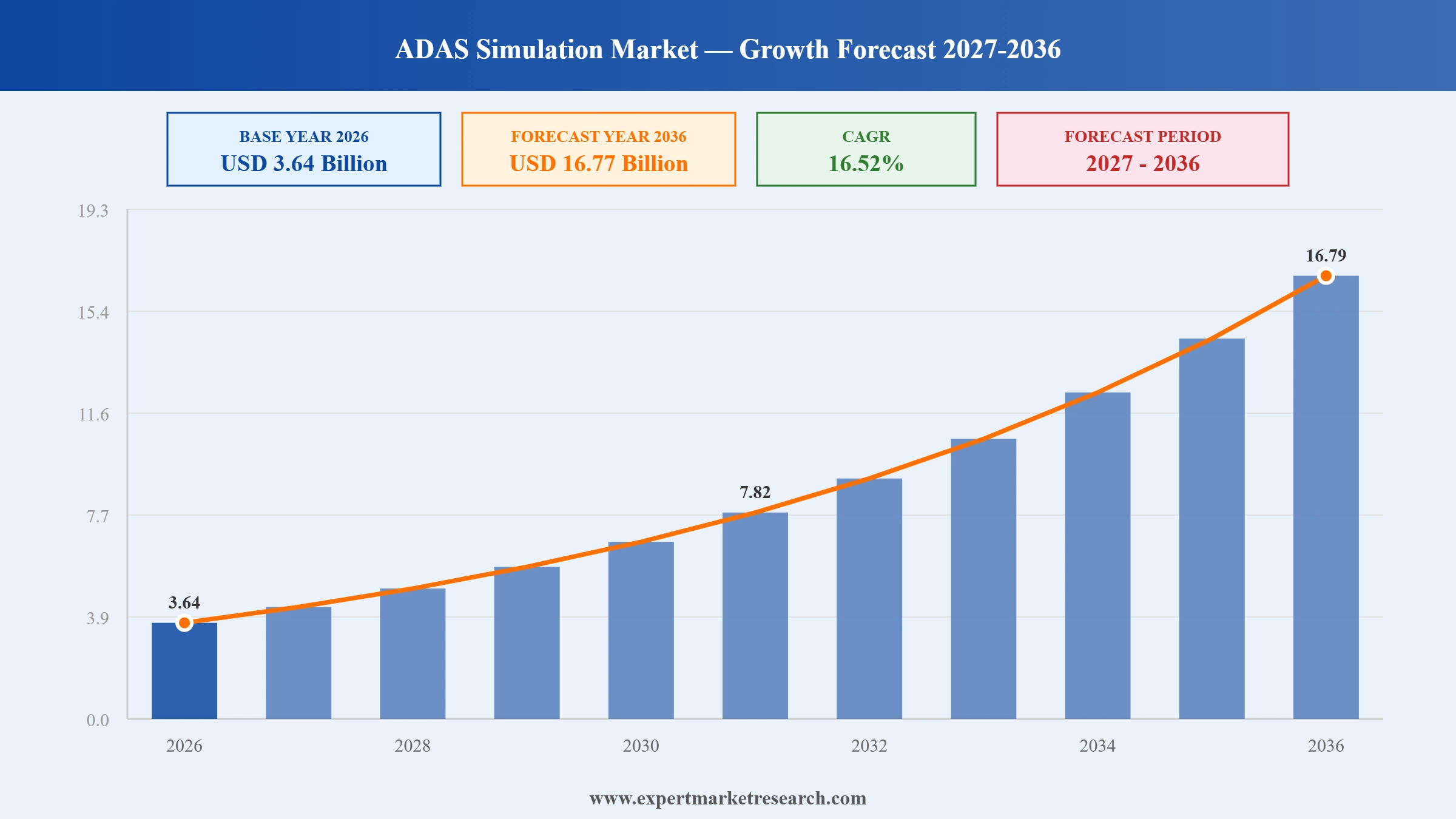
The ADAS simulation market was valued at USD 3.12 Billion in 2025. The market is expected to grow at a CAGR of 16.52% during the forecast period of 2026-2035 to reach a value of USD 14.39 Billion by 2035. Rising integration of advanced driver assistance systems across passenger and commercial vehicles, growing investment in autonomous vehicle development, and increasing reliance on virtual validation to reduce physical testing costs are collectively driving market growth.
The ADAS simulation market is shaped by escalating adoption of advanced driver assistance features and growing reliance on virtual validation to manage the complexity and cost of modern vehicle safety testing. Asia Pacific held the largest share of the market in 2025, supported by strong vehicle production volumes, rapid EV adoption, and increasing regional investment in autonomous driving technologies. Software accounts for the largest share by component, reflecting its critical role in enabling scenario generation, algorithm testing, and system validation within virtual environments.
Established simulation providers are reinforcing their market presence through continued platform innovation, strategic partnerships, and targeted acquisitions rather than relying on a single growth lever. This multi-pronged approach is helping leading providers stay ahead of increasingly complex validation requirements even as vehicle autonomy levels continue to advance, with platform interoperability and sensor fidelity emerging as key competitive differentiators across the industry.
The competitive landscape remains moderately consolidated, with supply concentrated among established simulation software providers such as ANSYS, Siemens, dSPACE, and Applied Intuition that maintain deep engineering expertise across scenario generation, sensor modeling, and real-time hardware-in-the-loop testing. Participation requires sustained investment in AI-driven simulation capabilities, sensor fidelity, and interoperability across model-in-the-loop, software-in-the-loop, and hardware-in-the-loop environments, creating meaningful entry barriers and reinforcing the position of long-established players across the automotive validation ecosystem.
Read more about this report - REQUEST FREE SAMPLE COPY IN PDF
|
ADAS Simulation Market Report Summary |
Description |
Value |
|
Base Year |
USD Billion |
2025 |
|
Historical Period |
USD Billion |
2019-2025 |
|
Forecast Period |
USD Billion |
2026-2035 |
|
Market Size 2025 |
USD Billion |
3.12 |
|
Market Size 2035 |
USD Billion |
14.39 |
|
CAGR 2019-2025 |
Percentage |
XX% |
|
CAGR 2026-2035 |
Percentage |
16.52% |
|
CAGR 2026-2035 - Market by Region |
Asia Pacific |
22% |
|
CAGR 2026-2035 - Market by Component |
Services |
18.4% |
|
CAGR 2026-2035 - Market by Simulation Type |
Hardware-in-the-Loop |
15.9% |
|
2025 Market Share by Region |
North America |
38% |
The ADAS simulation market is being reshaped by AI-enhanced simulation platforms, expanding sensor modeling partnerships, and strategic acquisitions aimed at broadening autonomous testing capabilities. Growing consolidation among simulation software providers is further reshaping the competitive landscape.
Siemens released the June 2026 update to its Simcenter portfolio, bringing former Altair simulation products into the Simcenter family for the first time and adding multi-GPU support for training AI models from CFD simulations. The merger broadened Siemens' combined simulation coverage across mechanical, electromagnetics, fluids, and data science domains. Other companies can pursue similar platform consolidations to offer customers a more comprehensive simulation toolchain under one roof.
Synopsys released Ansys 2026 R1, integrating Omniverse access and AI-enhanced tools that expand sensor simulation and agentic workflows for ADAS validation. The release positioned simulation closer to production by streamlining data preparation and improving perception fidelity. Other companies can integrate similar AI-enhanced workflows to reduce the gap between virtual validation and real-world deployment.
dSPACE announced a collaboration with OMNIVISION to integrate realistic image sensor models into its AURELION physics-based simulation platform, enhancing camera and perception testing in virtual environments. The partnership improved simulation fidelity for camera-based ADAS functions. Other companies can pursue similar sensor manufacturer partnerships to improve the realism of their virtual testing environments.
Cadence Design Systems agreed to acquire Hexagon's Design and Engineering business, which includes multiphysics simulation software used across the automotive and aerospace sectors, for approximately $3.18 billion. The deal expanded Cadence's simulation and digital twin portfolio. Other companies can pursue similar business unit acquisitions to broaden their simulation capabilities into adjacent engineering domains.
Growing regulatory attention on autonomous vehicle safety is prompting simulation and technology providers to build formal, independently accredited testing infrastructure rather than relying solely on internal validation processes. This is helping automotive partners navigate evolving industry standards for functional safety and cybersecurity. In January 2025, for example, NVIDIA launched its DRIVE AI Systems Inspection Lab, accredited by the ANSI National Accreditation Board, to inspect and verify that partner software meets automotive safety and cybersecurity standards.
Growing computational demands of high-fidelity scenario testing are driving simulation providers toward cloud-native architectures that offer greater scalability than traditional on-premises installations. This shift is enabling automotive engineering teams to run substantially more test cases in parallel. In January 2025, for example, Hexagon launched Virtual Test Drive X, a cloud-native ADAS simulation platform enabling automated testing across thousands of real-world scenarios.
Rising vehicle autonomy levels are pushing simulation providers to continuously upgrade sensor modeling and scenario realism to keep pace with the complexity of real-world driving conditions. This ongoing refinement is becoming a key competitive differentiator among established platforms. In November 2025, for example, IPG Automotive released CarMaker 15.0, streamlining virtual electronic control unit integration to enable software and system testing at much earlier development stages.
Simulation providers are increasingly extending their platforms beyond core ADAS validation into adjacent domains such as power electronics and EV powertrain testing, reflecting the growing overlap between autonomy and electrification programs. This is broadening the addressable use cases for existing hardware-in-the-loop infrastructure. In March 2025, for example, dSPACE launched XSG Power Electronics Systems software, enabling high-frequency simulation for power electronics and accelerating development of electric vehicle powertrain components.
Rising sensor complexity is pushing semiconductor manufacturers to partner with simulation providers to validate next-generation image sensor technology under realistic, repeatable virtual conditions ahead of automotive customer adoption. This is helping chipmakers demonstrate sensor performance without relying solely on physical prototype testing. In March 2026, for example, Sony Semiconductor Solutions became a customer of rFpro's AV Elevate simulation platform, using it to showcase and validate its next-generation image sensor technology for ADAS and autonomous vehicle applications.
The Expert Market Research's report titled "ADAS Simulation Market Report and Forecast 2026-2035" offers a detailed analysis of the market based on the following segments:
Market Breakup by Component
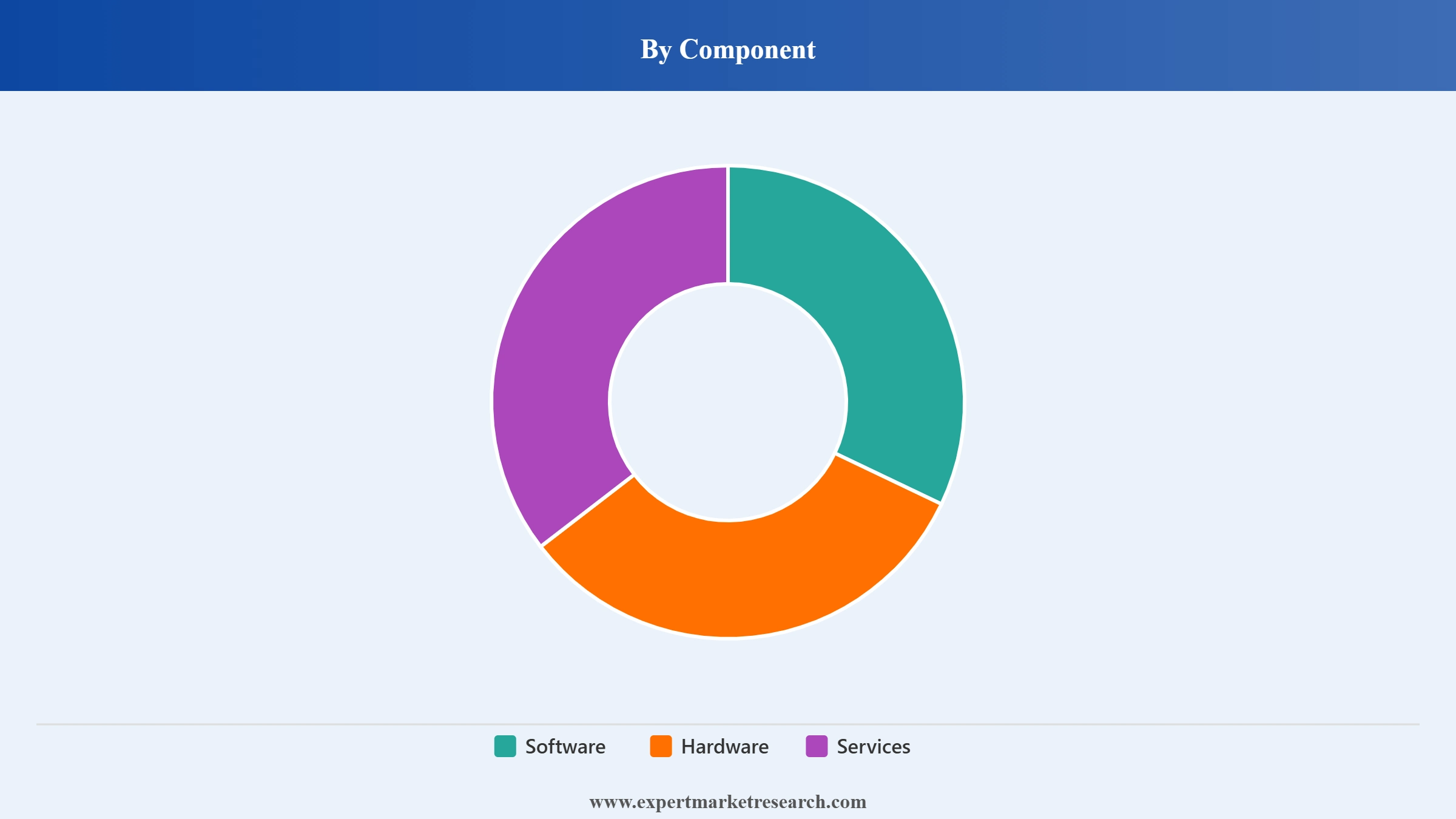
Key Insight: Software accounts for the largest share of the market by component, reflecting its critical role in enabling scenario generation, algorithm testing, and system validation within virtual environments. Cloud-enabled and AI-powered software tools provide unmatched scalability, allowing engineering teams to execute millions of test cases without proportional increases in physical testing infrastructure. In August 2025, for example, Cognata integrated AMD's Radeon PRO V710 GPUs into its simulation toolchain to enhance simulation realism, scalability, and efficiency across its OneSim platform. Hardware continues to see steady demand as hardware-in-the-loop rigs remain essential for validating real-time electronic control unit behavior under realistic operating conditions. Services, including consulting, scenario libraries, and integration support, round out the offering as automakers increasingly outsource specialized validation expertise.
Market Breakup by Simulation Type
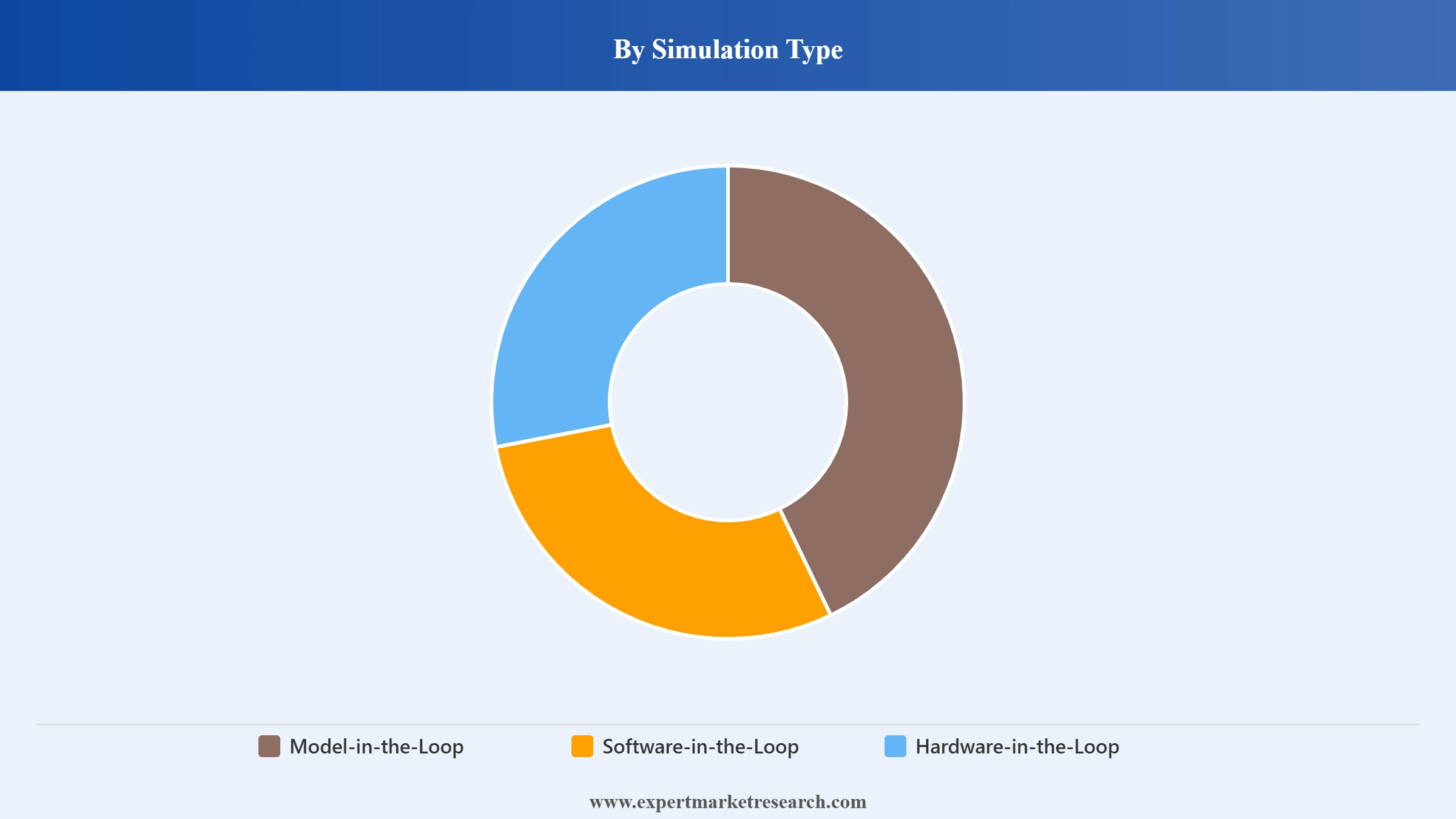
Key Insight: Software-in-the-loop accounts for approximately 39% of the market by simulation type, allowing developers to evaluate software algorithms and control logic in a virtual environment before hardware integration, making it a cost-effective method for early-stage validation. Model-in-the-loop continues to serve early design-phase validation where control algorithms are tested against mathematical vehicle models before physical implementation. Hardware-in-the-loop is a fast-growing simulation type as increasing levels of vehicle autonomy require rigorous, real-time validation of complex electronic control units before production deployment. In November 2025, for example, AVL released its Simulation Software 2025 R2, adding Driver-in-the-Loop (DiL) hardware support and expanded Software-in-the-Loop co-simulation capabilities. Others, including driver-in-the-loop configurations, provide human-in-the-loop realism for evaluating driver interaction with automated systems.
Market Breakup by End User
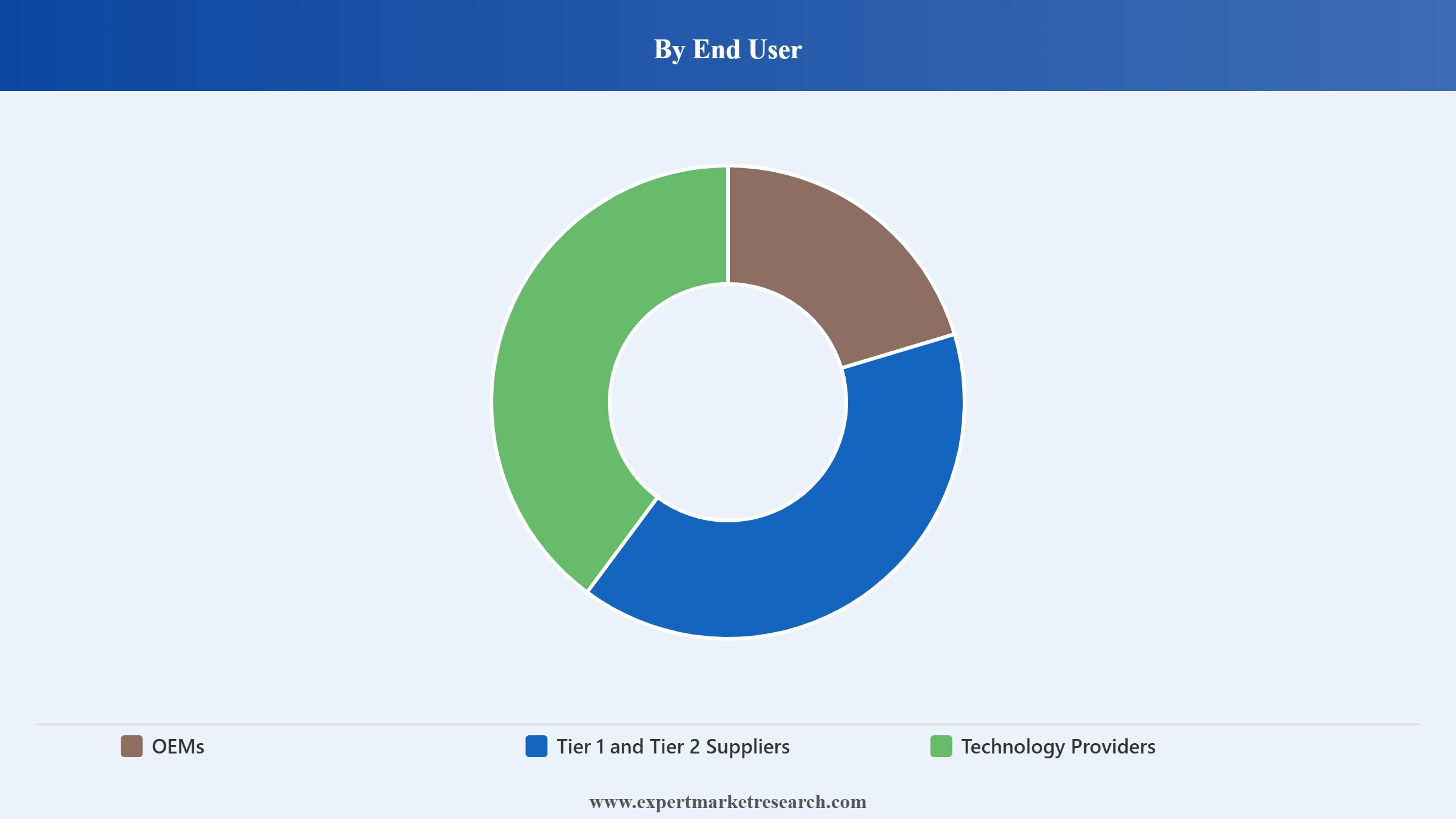
Key Insight: OEMs account for the largest share of the market by end user, reflecting their central role in validating ADAS features across entire vehicle platforms before commercial launch to meet increasingly stringent safety and regulatory requirements. Tier 1 and Tier 2 suppliers continue to see strong adoption as component-level validation becomes a prerequisite for OEM qualification, particularly for sensor and perception subsystems. Technology providers, including software and semiconductor companies, represent a fast-growing end-user category; in February 2025, for example, Ansys integrated its AVxcelerate Sensors simulation software into the Automated Driving Perception Hub, a collaboration with Cognata and Microsoft focused on ADAS and autonomous vehicle sensor testing. Others, including research institutions and regulatory bodies, use simulation platforms for independent safety assessment and standards development.
Market Breakup by Region
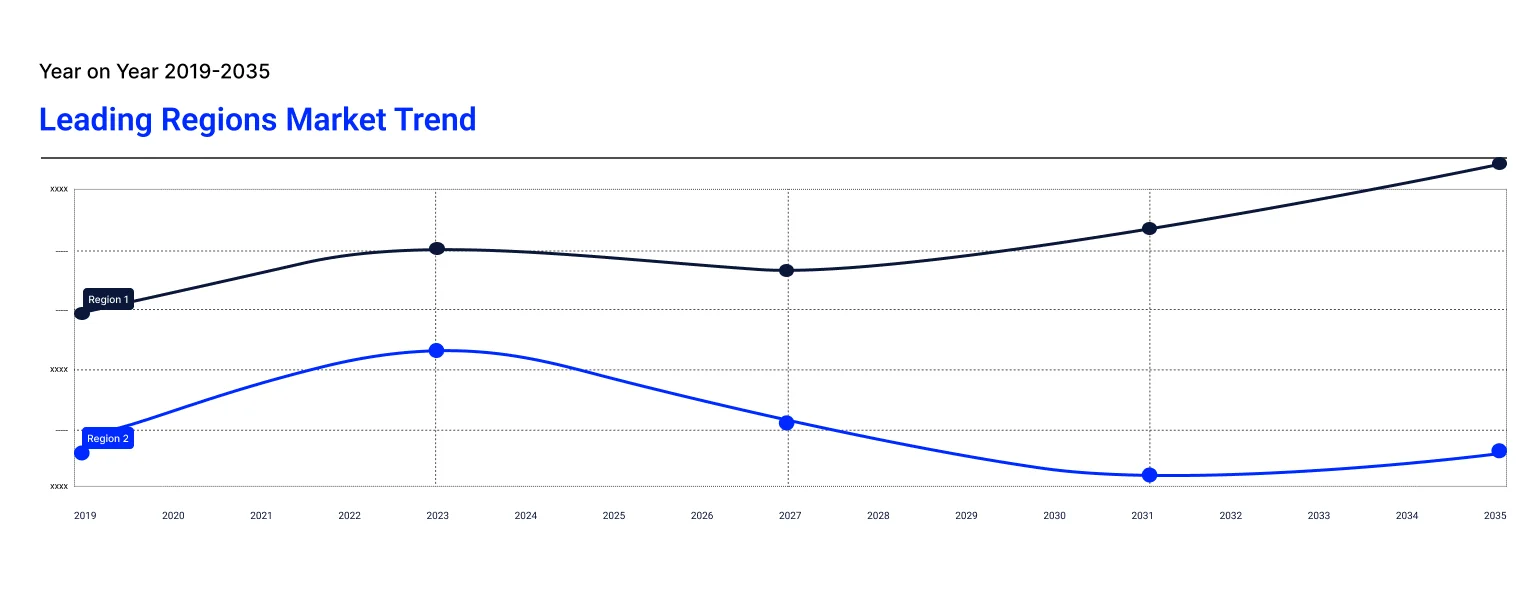
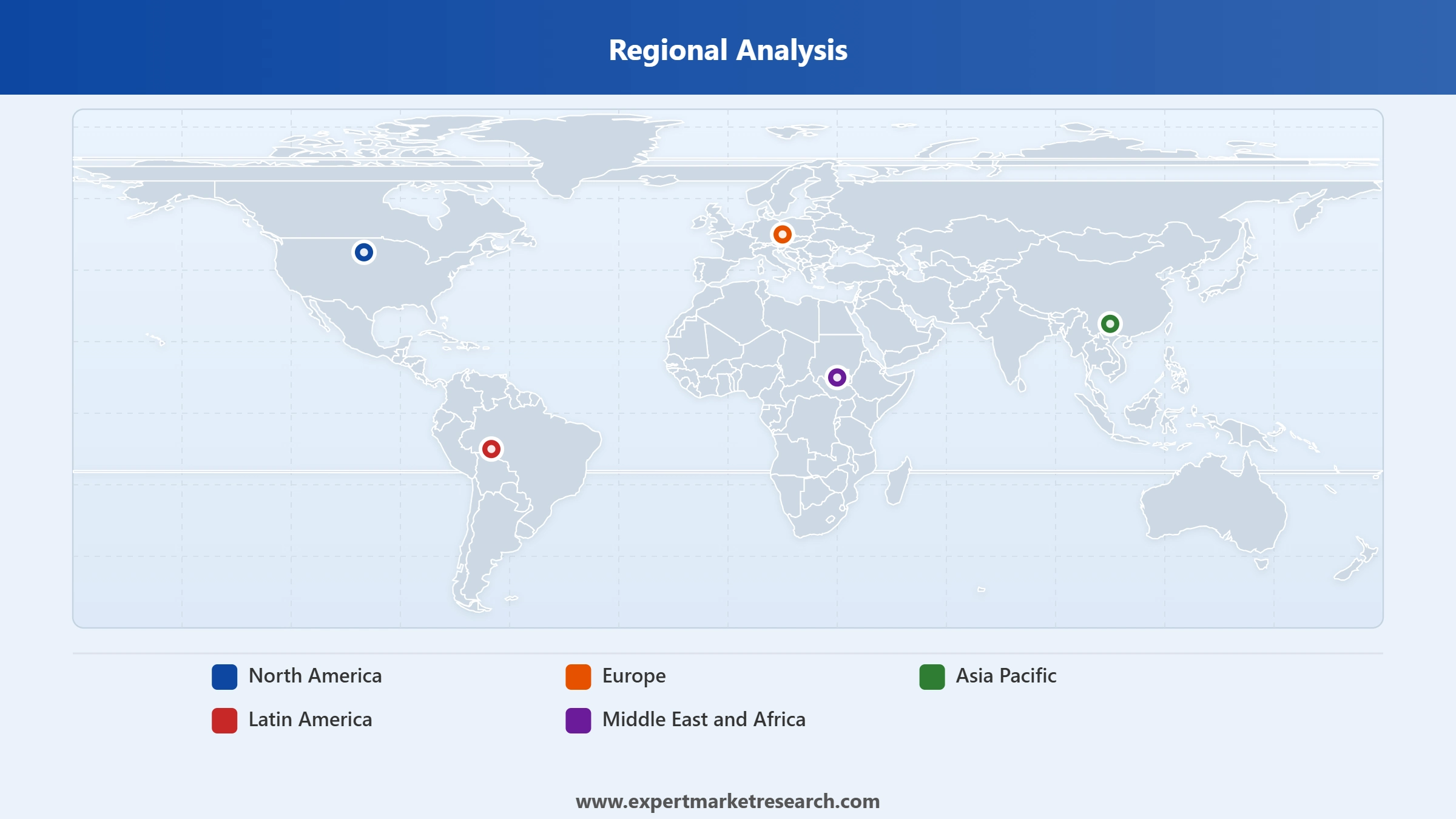
Key Insight: North America dominates the ADAS simulation market, supported by stringent vehicle safety frameworks, expanding connected vehicle initiatives, and the strong presence of automotive OEMs, semiconductor innovators, and autonomous mobility startups. Asia Pacific is the fastest-growing region, driven by strong vehicle production volumes, rapid EV adoption, and increasing regional investment in autonomous driving technologies across China, Japan, and South Korea. Europe remains a significant market supported by stringent emission standards, advanced safety mandates, and the strong presence of premium OEMs, while Latin America and the Middle East and Africa continue to see steadier growth tied to expanding automotive manufacturing and regulatory modernization.
Read more about this report - REQUEST FREE SAMPLE COPY IN PDF
By component, software dominates the market due to its critical role in scenario generation and system validation
Software accounts for the largest share of the market by component, reflecting its critical role in enabling scenario generation, algorithm testing, and system validation within virtual environments. In March 2026, for example, Applied Intuition partnered with LG Innotek to integrate digital versions of its camera, lidar, and radar sensors into Applied Intuition's simulation environment, expediting OEMs' path to production-ready autonomy systems.
Read more about this report - REQUEST FREE SAMPLE COPY IN PDF
Hardware is a steady-growth component category as hardware-in-the-loop rigs remain essential for validating real-time electronic control unit behavior under realistic operating conditions. In December 2025, for example, Cognata announced a major expansion of its AVBox autonomy product line ahead of CES 2026, broadening its hardware-integrated testing capabilities.
By simulation type, software-in-the-loop leads the market due to cost-effective early-stage algorithm validation
Software-in-the-loop accounts for approximately 39% of the market by simulation type, allowing developers to evaluate software algorithms and control logic in a virtual environment before hardware integration. At CES 2026, for example, dSPACE demonstrated a GitHub Copilot-based concept enabling developers to generate virtual ECUs directly within their development environment, illustrating how AI is beginning to accelerate SIL validation pipelines. This cost-effective method for early-stage validation continues to anchor the majority of scenario-based testing conducted across ADAS development programs.
Read more about this report - REQUEST FREE SAMPLE COPY IN PDF
Hardware-in-the-loop is the fastest-growing simulation type as increasing levels of vehicle autonomy require rigorous, real-time validation of complex electronic control units before production deployment. McLaren Applied, for example, was selected to supply the FIA's new Standard ECU for all Formula 1 teams across the 2026 through 2030 seasons, using Speedgoat HIL test systems to rigorously and continuously validate the unit throughout its development and operational life.
By end user, OEMs lead the market due to their central role in validating ADAS features across entire vehicle platforms
OEMs account for the largest share of the market by end user, reflecting their central role in validating ADAS features across entire vehicle platforms before commercial launch to meet increasingly stringent global safety and regulatory requirements. In May 2026, for example, Stellantis extended its partnership with Applied Intuition, continuing to use the company's Vehicle OS platform to shorten development cycles across its vehicle lineup.
Read more about this report - REQUEST FREE SAMPLE COPY IN PDF
Technology providers are the fastest-growing end-user category as software and semiconductor companies increasingly build in-house simulation capabilities to validate AI-driven perception and control systems, reducing dependence on third-party validation timelines for proprietary chip and sensor development programs.
North America dominates the market due to stringent safety frameworks and a strong automotive OEM and semiconductor base
North America dominates the ADAS Simulation market, supported by stringent vehicle safety frameworks, expanding connected vehicle initiatives, and the strong presence of automotive OEMs, semiconductor innovators, and autonomous mobility startups. In February 2026, for example, Waymo closed a $16 billion funding round valuing the company at $126 billion post-money, underscoring continued investor confidence in autonomous mobility validation and deployment infrastructure. High-speed road networks and diverse mobility environments continue to prompt manufacturers to intensify validation of advanced automation features across the region.
Read more about this report - REQUEST FREE SAMPLE COPY IN PDF
Asia Pacific is the fastest-growing region as strong vehicle production volumes, rapid EV adoption, and increasing investment in autonomous driving technologies accelerate demand across China, Japan, and South Korea. Companies including Toyota, Hyundai, and Volkswagen continue expanding investment in the region, testing sensor and control system behavior across large virtual environments to complement physical road trials; Hyundai Motor Group, for example, unveiled a new Driving Simulator at its Namyang R&D Center in South Korea, built from a precise 1-millimeter-increment scan of its physical test track to compress years of track testing into hours of simulation.
|
CAGR 2026-2035 - Market by |
Region |
|
North America |
14% |
|
Europe |
13% |
|
Asia Pacific |
22% |
|
Latin America |
17% |
|
Middle East and Africa |
16% |
The global market features a moderately consolidated competitive structure led by established engineering software providers alongside specialized autonomous vehicle simulation companies. ADAS Simulation companies like ANSYS, dSPACE, and Hexagon are competing primarily through platform breadth and sensor fidelity, while Applied Intuition and other manufacturers focus on AI-driven scenario generation and autonomy-specific testing workflows.
Leading ADAS Simulation market players are focusing on AI-enhanced simulation capabilities, sensor modeling partnerships, and platform interoperability to strengthen their competitive position. Increasing emphasis on cloud-native architectures and cross-domain safety validation is also enabling providers to diversify their customer base while supporting long-term market growth.
ANSYS, headquartered in Canonsburg, Pennsylvania, and founded in 1970, is a global leader in engineering simulation software, offering multiphysics, sensor, and functional safety validation tools used extensively across automotive, aerospace, and semiconductor industries. Now operating as part of Synopsys, the company's AVxcelerate suite supports sensor-level and system-level validation for ADAS and autonomous driving applications.
dSPACE, headquartered in Paderborn, Germany, and founded in 1988, is a leading global provider of simulation and validation solutions for networked, autonomous, and electrically powered vehicles. The company's hardware-in-the-loop systems and AURELION simulation platform are widely used by automotive manufacturers and suppliers to test software and hardware components before vehicle production.
Hexagon, headquartered in Stockholm, Sweden, and founded in 1975, is a global technology group specializing in precision measurement, positioning, and autonomous solutions across manufacturing, automotive, and infrastructure sectors. The company's Virtual Test Drive platform supports cloud-native ADAS simulation, enabling automated testing across large volumes of real-world driving scenarios.
Applied Intuition, headquartered in Mountain View, California, and founded in 2017, provides simulation and vehicle software platforms used by automotive OEMs, defense contractors, and autonomy developers to accelerate ADAS and autonomous vehicle validation. The company's simulation toolchain supports scenario generation, closed-loop testing, and safety case development across commercial and defense applications.
Other key players in the market report include Siemens Digital Industries Software, IPG Automotive GmbH, AVL List GmbH, Cognata Ltd., and rFpro Ltd., among others.
*Please note that this is only a partial list; the complete list of key players is available in the full report. Additionally, the list of key players can be customized to better suit your needs.*
Explore the latest trends shaping the ADAS simulation market 2026-2035 with our in-depth report. Gain strategic insights, future forecasts, and key market developments that can help you stay competitive. Download a free sample report or contact our team for customized consultation on the market trends 2026.


Upto 15% Off
USD
$2499 $2249
$3999 $3599
$4999 $4249
$5999 $5099


*While we strive to always give you current and accurate information, the numbers depicted on the website are indicative and may differ from the actual numbers in the main report. At Expert Market Research, we aim to bring you the latest insights and trends in the market. Using our analyses and forecasts, stakeholders can understand the market dynamics, navigate challenges, and capitalize on opportunities to make data-driven strategic decisions.*
In 2025, the ADAS simulation market reached an approximate value of USD 3.12 Billion.
The market is projected to grow at a CAGR of 16.52% between 2026 and 2035.
The key players in the market include dSPACE GmbH, ANSYS, Inc., Siemens Digital Industries Software, IPG Automotive GmbH, Hexagon AB, AVL List GmbH, Cognata Ltd., Applied Intuition, Inc., and rFpro Ltd., among others.
Leading providers are pursuing AI-enhanced simulation development, sensor modeling partnerships, cloud-native platform expansion, and strategic acquisitions to strengthen market position.
Key challenges include high platform development costs, the complexity of achieving realistic sensor fidelity, and interoperability gaps across simulation environments.
Explore our key highlights of the report and gain a concise overview of key findings, trends, and actionable insights that will empower your strategic decisions.
|
Report Features |
Details |
|
Base Year |
2025 |
|
Historical Period |
2019-2025 |
|
Forecast Period |
2026-2035 |
|
Scope of the Report |
Historical and Forecast Trends, Industry Drivers and Constraints, Historical and Forecast Market Analysis by Segment:
|
|
Breakup by Component |
|
|
Breakup by Simulation Type |
|
|
Breakup by End User |
|
|
Breakup by Region |
|
|
Market Dynamics |
|
|
Competitive Landscape |
|
|
Companies Covered |
|
Datasheet
One User
USD 2,499
USD 2,249
tax inclusive*
Single User License
One User
USD 3,999
USD 3,599
tax inclusive*
Five User License
Five User
USD 4,999
USD 4,249
tax inclusive*
Corporate License
Unlimited Users
USD 5,999
USD 5,099
tax inclusive*
*Please note that the prices mentioned below are starting prices for each bundle type. Kindly contact our team for further details.*
Flash Bundle
Small Business Bundle
Growth Bundle
Enterprise Bundle
*Please note that the prices mentioned below are starting prices for each bundle type. Kindly contact our team for further details.*
Flash Bundle
Number of Reports: 3
20%
tax inclusive*
Small Business Bundle
Number of Reports: 5
25%
tax inclusive*
Growth Bundle
Number of Reports: 8
30%
tax inclusive*
Enterprise Bundle
Number of Reports: 10
35%
tax inclusive*
How To Order

Select License Type
Choose the right license for your needs and access rights.

Click on ‘Buy Now’
Add the report to your cart with one click and proceed to register.

Select Mode of Payment
Choose a payment option for a secure checkout. You will be redirected accordingly.
Strategic Solutions for Informed Decision-Making
Gain insights to stay ahead and seize opportunities.

Get insights & trends for a competitive edge.

Track prices with detailed trend reports.

Analyse trade data for supply chain insights.

Leverage cost reports for smart savings

Enhance supply chain with partnerships.

Connect For More Information
Our expert team of analysts will offer full support and resolve any queries regarding the report, before and after the purchase.
Our expert team of analysts will offer full support and resolve any queries regarding the report, before and after the purchase.
We employ meticulous research methods, blending advanced analytics and expert insights to deliver accurate, actionable industry intelligence, staying ahead of competitors.
Our skilled analysts offer unparalleled competitive advantage with detailed insights on current and emerging markets, ensuring your strategic edge.
We offer an in-depth yet simplified presentation of industry insights and analysis to meet your specific requirements effectively.




