

Consumer Insights
Uncover trends and behaviors shaping consumer choices today
Procurement Insights
Optimize your sourcing strategy with key market data
Industry Stats
Stay ahead with the latest trends and market analysis.
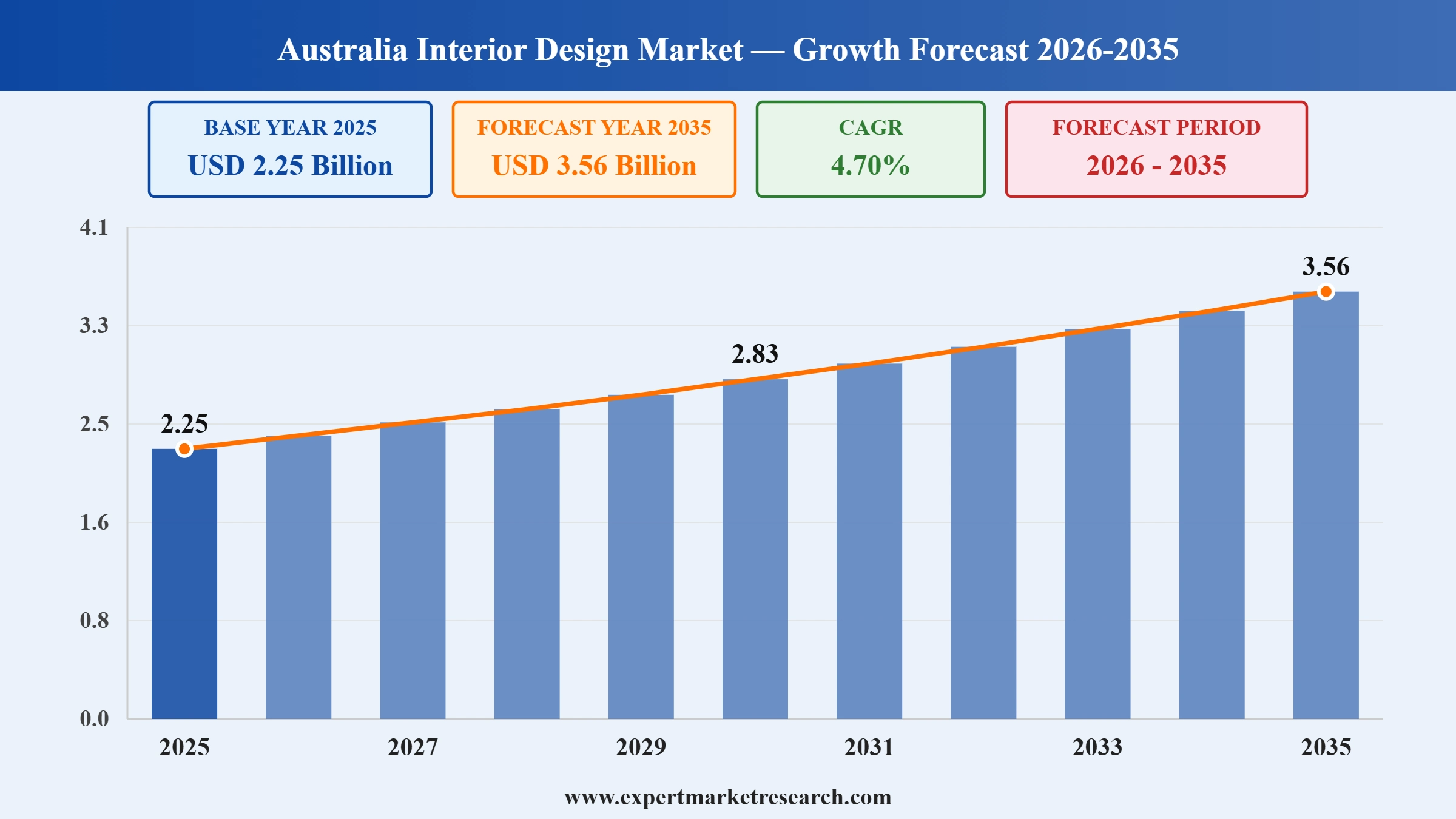
The Australia interior design market reached a value of USD 2.25 Billion at 2025 and is projected to expand at a CAGR of around 4.70% to 2035. With growing sustainability mandates, accelerating build-to-rent completions, rising smart-home adoption, and record national housing targets, the market is expected to reach USD 3.56 Billion by 2035.
Read more about this report - REQUEST FREE SAMPLE COPY IN PDF
Australia's interior design market is expanding in step with one of the world's most ambitious housing pushes. The sector reached USD 2.25 Billion in 2025 and is forecast to grow at a 4.70% CAGR through 2035. Growth is anchored in the National Housing Accord, under which National Cabinet agreed in August 2023 to deliver 1.2 million new well-located homes over five years from 1 July 2024, backed by AUD 3.5 billion in Commonwealth payments to states and territories. This pipeline is translating into billions of dollars of new fit-out, specification and furnishing demand each quarter.
A second engine is sustainability policy. In January 2024, the value of non-residential building approvals surged 12.4% to AUD 4.92 billion according to the Australian Bureau of Statistics, and December 2025 building activity data showed total building work done reaching AUD 43.9 billion. Designers are responding with biophilic layouts, low-embodied-carbon materials, and Green Star and NABERS-aligned specifications. With 7.6 million Australian households now owning at least one smart device, according to Telsyte, interior designers are also embedding IoT, automated lighting and circadian systems into both residential and commercial briefs, reinforcing long-run demand for professional interior services.
Marubeni Corporation, with AsheMorgan, Haseko and Mizuho Leasing, joined the District Living Project in Melbourne's Docklands, one of the largest build-to-rent developments in Australia. Phase 1 comprises 626 residential units, with approval for 925 units including Phase 2. The development targets net-zero carbon emissions through high-specification architecture and interiors, and signals continued foreign capital appetite for premium Australian BTR and mixed-use schemes, all of which demand large-scale, institutional-grade interior design services.
The Housing Australia Future Fund delivered its largest project yet, Swift Walk in Kensington, Victoria, providing 362 new homes, including 272 social and affordable homes, through Assemble, Housing Choices Australia and HESTA. The Albanese Government confirmed that the HAFF, now backing around 29,000 jobs annually, is on track to reach 40,000 new social and affordable homes through Round 3. Each new unit unlocks a fresh layer of interior specification, fixtures, finishes and furniture demand, reinforcing a multi-year pipeline for Australian interior designers.
Carr, one of Australia's leading architecture and interior design studios, completed the new Melbourne headquarters for publisher Hardie Grant. The interior design was tailored around diverse creative talents, with adaptable workspaces, tailorable features and material-led craftsmanship that enable staff to make the workplace feel like a second home. The project reinforces a strong design-led workplace fit-out trend in Australian CBDs, where employers are using premium interiors to attract employees back to offices post-pandemic.
SJB Sydney completed the interiors for the Eve Hotel and Bar Julius, a new lifestyle hotel in Sydney's Surry Hills precinct. The project, which opened in March 2025, features tactile material palettes that reference Australian landscapes, with joinery, lighting and furniture all custom-specified by SJB's in-house interiors team. It extends SJB's deep hospitality portfolio and underscores Sydney's role as the premium anchor for Australia's commercial interior design market, which is increasingly driven by hotel, food and beverage, and workplace fit-out activity.
Hassell completed the First Building at Bradfield City Centre in Western Sydney, housing Stage 1 of the Advanced Manufacturing Readiness Facility and delivering the inaugural structure for Australia's first new city in a century. Hassell led the architecture, interior design and landscape design, working with First Nations research agency Djinjama. The modular, demountable design uses Australian hardwoods, European CLT, rammed earth, recycled Green Ceramic tiles and a 14,000-plant native green roof, setting a new benchmark for circular interiors and achieving a 30% embodied-carbon reduction.
Australia's interior design market is being reshaped by the National Housing Accord target of 1.2 million new well-located homes between mid-2024 and mid-2029. NSW alone committed to 377,000 new homes, with Victoria targeting 800,000 over the decade and Queensland planning one million by 2046. Even with early-stage shortfalls flagged by the National Housing Supply and Affordability Council, delivery is expanding the residential fit-out and specification base. This tailwind is boosting the Australia interior design market growth and embedding specialist residential expertise as a critical capability across all leading studios.
Sustainability has shifted from a value-add to a baseline expectation in Australian interiors. In October 2025, Hassell's First Building at Bradfield City Centre won the Australian Good Design Award for Sustainability, with its modular kit-of-parts interior, rammed earth, bamboo, reclaimed timber and green roof showcasing circular design in action. Commercial interiors are now aligning with Green Star and NABERS targets, while residential designers are sourcing hemp, stone, bamboo, cork and low-VOC finishes. This transition is rewarding firms with deep sustainability consulting capabilities, including Woods Bagot's Global Impact Group arm.
The build-to-rent sector has rapidly professionalised apartment interior design in Australia. According to Knight Frank, 6,000 new BTR units are on track for completion in 2025, up from 4,660 in 2024, with Franklin St. tracking a 65,575-unit national pipeline, up 26% year on year. Victoria holds 40% of the pipeline, NSW 29% and Queensland 23%. Bates Smart's Indi Sydney, the first purpose-built market-housing BTR in the Sydney CBD, and the Marubeni consortium's 925-unit Docklands scheme illustrate the emerging institutional standard for amenity-rich, professionally managed rental interiors.
Smart-home systems are moving from optional upgrade to core specification. Telsyte's 2024 market study found 7.6 million Australian households own at least one smart device, with nearly 24 connected devices per home, and the smart home market crossing AUD 2.5 billion. New housing developments are increasingly marketed as smart-ready, with pre-wired infrastructure, automated lighting, circadian systems, and integrated security sensors. Interior designers are collaborating earlier with integrators to future-proof homes, and workplace projects are embedding IoT-enabled acoustic, climate and occupancy controls, reinforcing higher-value scopes per project.
The Expert Market Research’s report titled “Australia Interior Design Market Report and Forecast 2026-2035” offers a detailed analysis of the market based on the following segments:
Market Breakup by Type
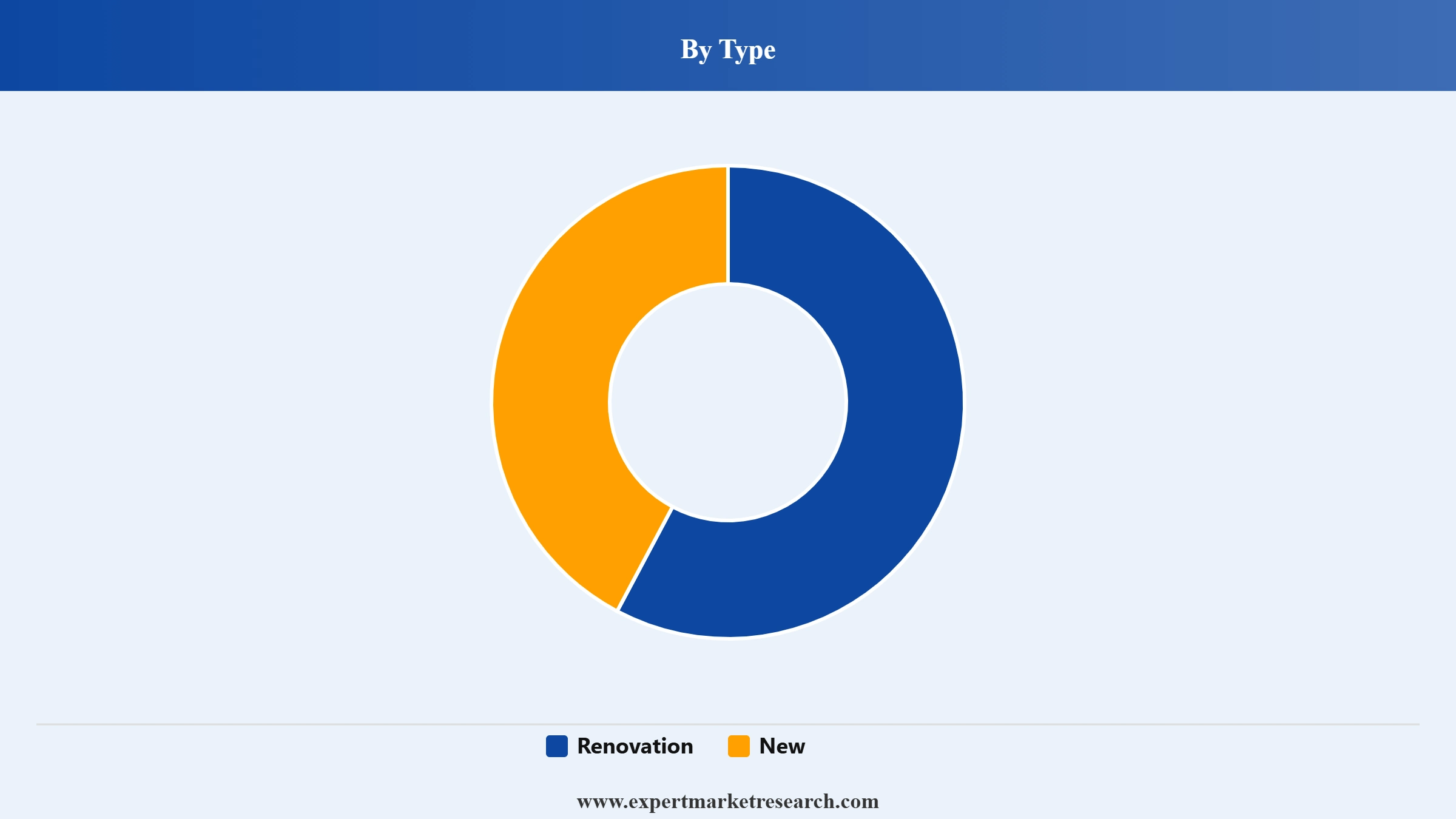
Key Insight: The new construction segment is led by the National Housing Accord pipeline and a record residential approvals run-rate. ABS data shows total dwellings approved reached 18,406 in November 2025, with residential building approvals worth AUD 11.34 billion in that month, and 236,858 total dwellings under construction at the end of December 2025. The renovation segment is supported by ageing residential stock, adaptive reuse of heritage commercial buildings, and post-pandemic hybrid-work retrofits. Alterations and additions to residential buildings alone represented AUD 3.7 billion of work done in the December 2025 quarter. Major studios such as Bates Smart, Woods Bagot and Hassell are active across both segments, with residential developers like Lendlease and community housing providers under HAFF driving steady new-build volumes.
Market Breakup by End Use
Key Insight: Residential is the dominant end-use, supported by strong population growth, surging build-to-rent supply, and the Housing Australia Future Fund, which had committed 279 projects and 18,650 homes across its first two funding rounds by late 2025. Commercial end-use is led by workplace, hospitality, retail and public infrastructure, with Sydney Metro projects, Bradfield City, major hospitals such as Frankston (now Peninsula University Hospital), and hotel openings such as the Eve Hotel Sydney anchoring large-scale fit-out demand. Workplace fit-out activity is being driven by employers repositioning offices to attract talent, with Carr's Hardie Grant HQ and Bates Smart's 120 Balmain at Cremorne indicative of premium commercial interiors.
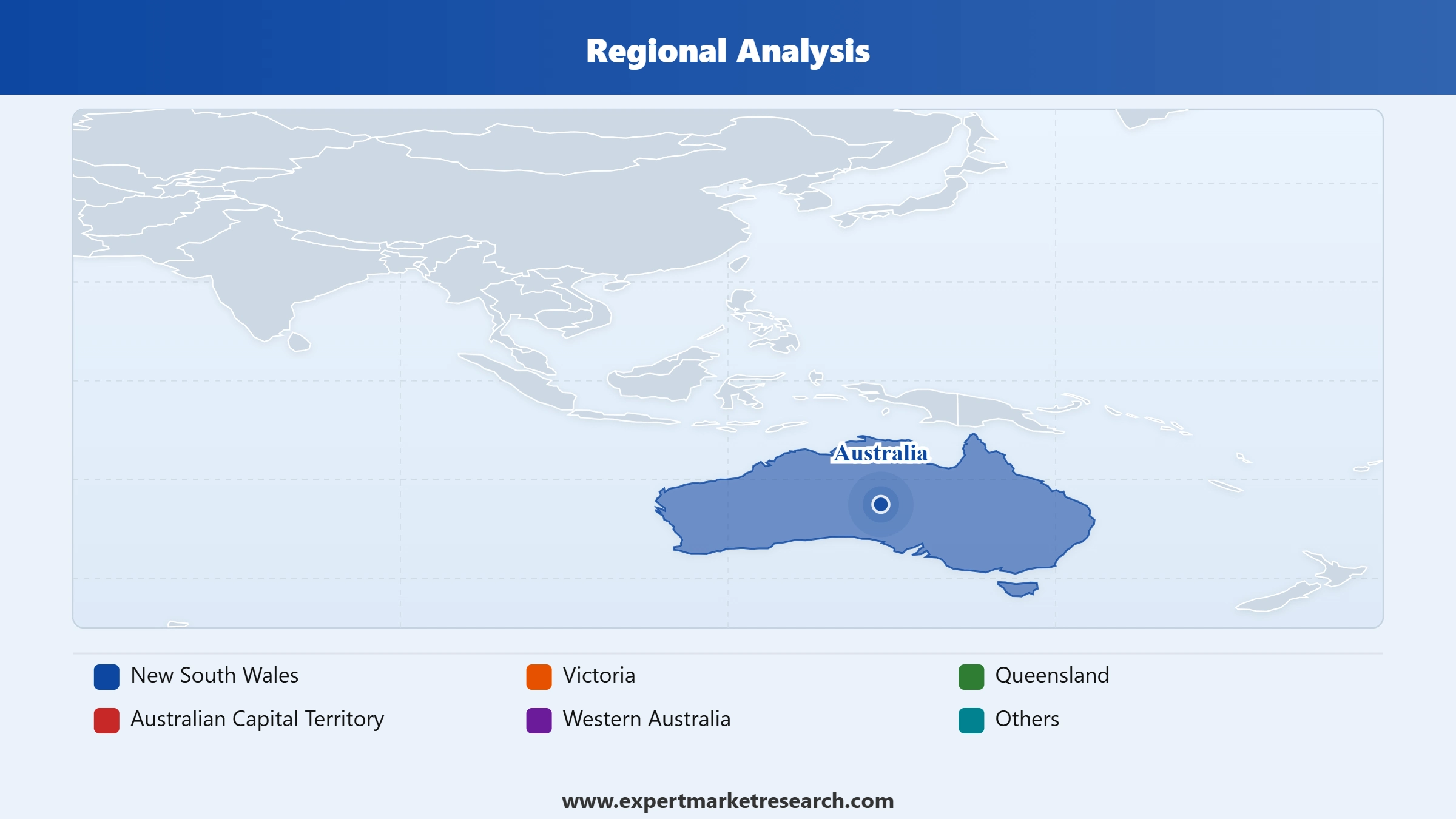
Market Breakup by Region
Key Insight: NSW leads with the largest state-based commitment of 377,000 homes under the National Housing Accord and a population of over 8.5 million as of September 2025. Victoria is a major hub for build-to-rent, holding 40% of the national BTR pipeline, while Western Australia is posting the country's fastest state population growth at 2.2% annually. Queensland is being boosted by the 2032 Olympic Games pipeline and a 1 million home target by 2046. Smaller regions such as the Australian Capital Territory and Northern Territory are seeing targeted government-led commercial and institutional projects, including UNSW's new Canberra City campus led by Hassell.
Read more about this report - REQUEST FREE SAMPLE COPY IN PDF
By Type, the new-build segment holds the larger revenue share of the Australia interior design market, underpinned by a structural undersupply of housing and a commitment to build 1.2 million homes over five years from 2024. Australian Bureau of Statistics data shows dwellings approved at 15,832 in October 2025 and 17,019 in September 2025, with new residential building value exceeding AUD 8 billion each month at peak. This segment matters because every new multi-residential or commercial structure generates fresh specification, joinery, lighting and furniture demand, creating long-duration contracts for design studios and product suppliers. The Marubeni-AsheMorgan Docklands BTR project, with 925 approved units targeting net-zero carbon, is a clear example of new-build scale. The renovation segment, while smaller, is growing as heritage, commercial retrofit and residential alterations gain traction in capital cities.
Read more about this report - REQUEST FREE SAMPLE COPY IN PDF
By End Use, the residential segment holds the dominant market share, supported by population growth of 1.6% annually and 7.6 million smart-home-enabled households. Residential demand is amplified by the Housing Australia Future Fund's AUD 10 billion investment, which is funding 40,000 new social and affordable homes. The Swift Walk project in Kensington, Victoria, delivered 362 homes including 272 social and affordable units in late 2025, each requiring interior specification and fit-out. Commercial remains the higher-margin end-use, with hospitality, workplace and civic projects such as Hassell's First Building at Bradfield, SJB's Eve Hotel and Bates Smart's hospital and embassy work setting premium benchmarks. Commercial interior briefs are increasingly Green Star or NABERS-aligned, rewarding larger multidisciplinary firms that combine architecture, interiors and ESG consulting under one roof.
Read more about this report - REQUEST FREE SAMPLE COPY IN PDF
New South Wales is the largest regional contributor to the Australia interior design market, underpinned by Sydney's role as the nation's commercial and hospitality capital. NSW has committed to 377,000 new well-located homes under the National Housing Accord, the highest of any state. Major projects anchoring interior design demand include Bradfield City Centre, where Hassell completed the Advanced Manufacturing Readiness Facility in 2025, and Sydney Metro, delivered by Woods Bagot, Cox Architecture, Grimshaw, Hassell and Architectus. Sydney is also home to large-scale BTR activity, with Bates Smart's Indi Sydney over Gadigal Station adding 234 apartments. Private sector house approvals across NSW trended positively into late 2025, supporting a continued residential design pipeline.
Read more about this report - REQUEST FREE SAMPLE COPY IN PDF
Victoria is the second-largest regional market, with Melbourne serving as the epicentre of Australia's build-to-rent sector. Franklin St. data shows Victoria holds 40% of the national BTR pipeline, with Greystar's 617-unit South Yarra scheme and the Marubeni consortium's 925-unit Docklands District Living project exemplifying scale. Melbourne had the largest absolute population increase of any capital at 105,000 in 2024-25. Bates Smart and Carr, both headquartered in Melbourne, lead commercial and high-end residential fit-outs, while the state's build target of 800,000 new homes over the decade is creating multi-year residential interior demand. Lendlease's three BTR projects, totalling around 1,700 apartments, further extend the state's pipeline into 2026 and beyond.
The Australia interior design market is moderately fragmented, with a small group of large multidisciplinary firms holding leadership in commercial, institutional and high-end residential interiors, while thousands of boutique studios serve the bespoke residential and hospitality segments.
Leading players compete on integrated offerings that combine architecture, interiors, urban design, and increasingly sustainability consulting. Strategic priorities include international expansion, investment in proprietary sustainability brands, First Nations engagement, and early-stage BIM and AI adoption. Boutique operators compete on craftsmanship, local narrative and hospitality sector specialism.
Founded in 1971 and headquartered in Melbourne, Victoria, Carr is an architecture and interior design practice that operates across residential, workplace and hospitality sectors in Australia. Its capabilities include bespoke residential, commercial fit-out and product design, with notable projects such as 116 Rokeby and the Hardie Grant headquarters. In 2024, Carr expanded with a new Brisbane studio and promoted Richard Beel, David Brooks and Stephen McGarry to directors.
Founded in 1853 and headquartered in Melbourne, Bates Smart is one of Australia's oldest design practices, with over 250 staff across Melbourne, Sydney and Brisbane studios. It delivers integrated architecture, interior design and urban design across residential, commercial, hospitality, health and civic sectors. Recent work includes Indi Sydney BTR, Peninsula University Hospital, and the Embassy of Australia in Washington DC, with interior projects shortlisted at the 2025 IIDA awards.
Hassell is an international design practice with Australian roots and studios in Adelaide, Brisbane, Melbourne, Perth and Sydney. It provides architecture, interior design and landscape design across workplace, urban, education, health, transport and hospitality sectors. In 2025, Hassell completed the Bradfield City Centre First Building, won the Australian Good Design Award for Sustainability and was named Premier's Prize winner at the NSW Architecture Awards.
Founded in 1869 and headquartered in Melbourne, Woods Bagot operates 18 studios across Australasia, Asia, Europe, the Middle East and North America, including six Australian offices. It offers architecture, interior design and master planning, with specialist brands including Customs Bureau for hospitality and Global Impact Group for sustainability consulting. In July 2024, the firm appointed Sarah Kay as its first female CEO, signalling a renewed push into larger global markets from its strong Australian base.
*Please note that this is only a partial list; the complete list of key players is available in the full report. Additionally, the list of key players can be customized to better suit your needs.*
Other key players in the market are SJB Architecture NSW Pty Ltd., IA Group, and Others.
Discover the latest insights on the Australia interior design market 2026 with our comprehensive report. Stay ahead of the competition with on-point data covering residential, renovation, commercial, and build-to-rent trends, as well as the leading regions powering national design demand. Whether you are launching a new studio, entering the Australian market, or expanding your product specification pipeline, this report equips you with the clarity and evidence you need. Download your free sample now and unlock the key opportunities across the thriving Australia Interior Design.


Upto 15% Off
USD
$2499 $2249
$3999 $3599
$4999 $4249
$5999 $5099


*While we strive to always give you current and accurate information, the numbers depicted on the website are indicative and may differ from the actual numbers in the main report. At Expert Market Research, we aim to bring you the latest insights and trends in the market. Using our analyses and forecasts, stakeholders can understand the market dynamics, navigate challenges, and capitalize on opportunities to make data-driven strategic decisions.*
The market was valued at USD 2.25 Billion in 2025.
The market is projected to grow at a CAGR of 4.70% between 2026 and 2035.
The revenue generated from the market is expected to reach USD 3.56 Billion in 2035.
The interior designs market is categorised according to flesh colour type, which includes renovation and new.
The key players are Carr, Bates Smart Architects, Hassell Limited, Woods Bagot, SJB Architecture NSW Pty Ltd. and IA Group among others.
Based on the end use, the market is divided into residential and commercial.
The market is broken down into New South Wales, Victoria, Queensland, Australian Capital Territory, Western Australia, and others.
Explore our key highlights of the report and gain a concise overview of key findings, trends, and actionable insights that will empower your strategic decisions.
| REPORT FEATURES | DETAILS |
| Base Year | 2025 |
| Historical Period | 2019-2025 |
| Forecast Period | 2026-2035 |
| Scope of the Report |
Historical and Forecast Trends, Industry Drivers and Constraints, Historical and Forecast Market Analysis by Segment:
|
| Breakup by Type |
|
| Breakup by End Use |
|
| Breakup by Region |
|
| Market Dynamics |
|
| Competitive Landscape |
|
| Companies Covered |
|
Datasheet
One User
USD 2,499
USD 2,249
tax inclusive*
Single User License
One User
USD 3,999
USD 3,599
tax inclusive*
Five User License
Five User
USD 4,999
USD 4,249
tax inclusive*
Corporate License
Unlimited Users
USD 5,999
USD 5,099
tax inclusive*
*Please note that the prices mentioned below are starting prices for each bundle type. Kindly contact our team for further details.*
Flash Bundle
Small Business Bundle
Growth Bundle
Enterprise Bundle
*Please note that the prices mentioned below are starting prices for each bundle type. Kindly contact our team for further details.*
Flash Bundle
Number of Reports: 3
20%
tax inclusive*
Small Business Bundle
Number of Reports: 5
25%
tax inclusive*
Growth Bundle
Number of Reports: 8
30%
tax inclusive*
Enterprise Bundle
Number of Reports: 10
35%
tax inclusive*
How To Order

Select License Type
Choose the right license for your needs and access rights.

Click on ‘Buy Now’
Add the report to your cart with one click and proceed to register.

Select Mode of Payment
Choose a payment option for a secure checkout. You will be redirected accordingly.
Strategic Solutions for Informed Decision-Making
Gain insights to stay ahead and seize opportunities.

Get insights & trends for a competitive edge.

Track prices with detailed trend reports.

Analyse trade data for supply chain insights.

Leverage cost reports for smart savings

Enhance supply chain with partnerships.

Connect For More Information
Our expert team of analysts will offer full support and resolve any queries regarding the report, before and after the purchase.
Our expert team of analysts will offer full support and resolve any queries regarding the report, before and after the purchase.
We employ meticulous research methods, blending advanced analytics and expert insights to deliver accurate, actionable industry intelligence, staying ahead of competitors.
Our skilled analysts offer unparalleled competitive advantage with detailed insights on current and emerging markets, ensuring your strategic edge.
We offer an in-depth yet simplified presentation of industry insights and analysis to meet your specific requirements effectively.




