

Consumer Insights
Uncover trends and behaviors shaping consumer choices today
Procurement Insights
Optimize your sourcing strategy with key market data
Industry Stats
Stay ahead with the latest trends and market analysis.
The Brazil natural rubber market is projected to grow at a CAGR of 2.60% between 2026 and 2035.
Compound Annual Growth Rate
2.6%
2026-2035
Read more about this report - REQUEST FREE SAMPLE COPY IN PDF
| Brazil Natural Rubber Market Report Summary | Description | Value |
| Base Year | USD Million | 2025 |
| Historical Period | USD Million | 2019-2025 |
| Forecast Period | USD Million | 2026-2035 |
| Market Size 2025 | USD Million | XX |
| Market Size 2035 | USD Million | XX |
| CAGR 2019-2025 | Percentage | XX% |
| CAGR 2026-2035 | Percentage | 2.60% |
| CAGR 2026-2035 - Market by Region | São Paulo | 3.0% |
| CAGR 2026-2035 - Market by Region | Minas Gerais | 2.8% |
| CAGR 2026-2035 - Market by Type | Latex Concentrate | 2.9% |
| CAGR 2026-2035 - Market by Distribution Channel | Online | 4.4% |
| 2025 Market Share by Region | Rio Grande do Sul | 17.2% |
The Brazilian Footwear Industries Association predicts that the production of footwear in Brazil will see a growth rate, ranging from 0.9% to 2.2% year-on-year in 2024, primarily fuelled by an increase in local demand. Footwear consumption within Brazil is also projected to rise between 2.4% and 3.8% in the same year. Natural rubber plays a crucial role in the footwear sector, offering exceptional performance attributes, versatility, and sustainability. Its incorporation in outsoles, midsoles, and other components not only enhances the functionality but also the comfort of the footwear. With a shift in consumer preferences towards sustainable and eco-friendly products, the significance of natural rubber in the footwear sector is anticipated to expand, supported by ongoing innovations and advancements in materials and production techniques.
According to the US Agency for International Development (USAID), natural rubber production is present in numerous Latin American countries, with Brazil leading the market at 185,000 tons, followed by Guatemala at 96,000 tons, Mexico at 15,000 tons, and Colombia at 14,000 tons. The market in Brazil is influenced by a combination of domestic and international factors, such as agricultural expansion, increasing demand for natural rubber from key sectors, and supportive government policies. With Brazil's ongoing investments in sustainability and technological advancements, the market is expected to experience growth, presenting significant opportunities in both domestic and global markets. Emphasis on environmental considerations and infrastructure development further reinforces the sector's long-term potential.
The Association of São Paulo Rubber Producers and Processors (APABOR) received the CPL Consolidada recognition for São Paulo’s natural rubber productive chain from the São Paulo State Department of Economic Development through the SP Produz programme. The association was accredited as the representative entity for the state’s natural rubber chain for 2025-2027. The recognition can facilitate access to programmes focused on business development, innovation, training and sector strengthening, supporting closer coordination among rubber producers, processors and public institutions. The development is relevant to Brazil’s natural rubber market because São Paulo is a major production hub and institutional support can strengthen the organisation and competitiveness of its horticulture supply chain.
The Confederation of Agriculture and Livestock of Brazil (CNA), together with São Paulo’s Institute of Agricultural Economics (IEA), reported that the reference import price for natural rubber increased 7.5% in June 2026, reaching R$16.38/kg, compared with R$15.24/kg in May. The increase reflected a 2.7% rise in Singapore rubber contracts, a 2.9% increase in the US dollar, and a 33.7% jump in international maritime freight on the reference route. The development highlights the sensitivity of Brazil’s natural rubber supply chain to international commodity prices, currency movements and logistics costs, thereby augmenting the trends of the Brazil natural rubber market.
Brazil’s National Supply Company (CONAB) announced public Pepro and PEP auctions covering 21,900 tonnes of natural rubber from the 2025/26 crop. The operations covered producers across nine states: Bahia, Espírito Santo, Goiás, Mato Grosso, Mato Grosso do Sul, Minas Gerais, Paraná, São Paulo and Tocantins. CONAB set the minimum price for cultivated natural rubber at R$4.56/kg for the 2025/26 crop. The measure provides a mechanism to support commercialisation and product movement when market prices make sales conditions difficult for producers, making government-backed price-support operations an important factor in Brazil’s natural rubber supply chain.
CNA reported in April 2026 that Brazil’s natural rubber import reference price increased 4.6% in March, reaching R$13.87/kg, compared with R$13.26/kg in February. Singapore rubber contracts increased 3.3%, while the average US dollar value against the Brazilian real rose 0.6%. International maritime freight on the reference route increased 25.1%, while domestic freight rose 2.0%, partly due to higher diesel prices. The development demonstrates how international rubber quotations and transportation costs were feeding directly into Brazil’s raw-material cost structure, with implications for processors and downstream rubber-product manufacturers.
Brazil is strengthening formal price-support mechanisms for cultivated natural rubber. In March 2026, an interministerial regulation established parameters for price-equalisation subsidies for the 2025/26 natural-rubber crop, covering virgin coagulum with 53% Dry Rubber Content (DRC) and field latex with 31% DRC. It employs PEPRO and PEP public auctions and thus allows the cooperatives and farmers to take part. This will ensure protection of producer income in case of low market prices and will allow the commercialization of locally made rubber. For Brazil’s natural rubber industry, the development indicates a greater role for structured government intervention in supporting producer economics and maintaining the viability of the domestic rubber supply chain.
The supply chain of natural rubber of Brazil is witnessing a decrease in its dependence on sources from outside. The foreign trade statistics show that the imports of latex, natural rubber, and other natural gums totalled $205.43 million for the period from January to August, 2026, down from $288.93 million for the same period in 2025, a fall of 28.9%. Lower import expenditure increases the relative importance of domestic collection, processing and distribution networks for Brazilian buyers. For rubber processors, tyre manufacturers and other downstream users, the development makes the reliability and availability of locally produced material increasingly relevant when planning procurement, particularly as companies balance domestic supply against imported grades and specifications.
There is increasing focus on rubber plants that are resistant to disease pathogens of Hevea brasiliensis in Brazil. Embrapa Acre, in 2026, conducted research on rubber tree clones in the state of Acre with respect to their biological resistance to South American leaf blight caused by Pseudocercospora ulei. Biological resistance is also measured along with natural rubber yield. Disease-resistant planting material will decrease the vulnerability of the plantations to loss of production and decrease the strain involved in disease control operations. For Brazilian producers, the development supports a longer-term shift toward genetically improved planting material, particularly in regions where climatic conditions and disease incidence can influence plantation productivity and the commercial viability of rubber cultivation, thus resulting in the growth of the Brazil natural rubber market.
Brazil continues to have an extractive natural rubber sub-sector running parallel to plantation cultivation of rubber. The country’s forestry department reported a total of 463,401 tonnes of production of coagulated rubber in 2023 as against 420,134 tonnes in 2022. The numbers are indicative of rubber produced by the non-timber forest product production system in Brazil. This segment links natural-rubber production with forest-based economic activity and provides an alternative sourcing model for downstream users interested in traceable forest-derived materials. For processors and sustainability-oriented buyers, extractive rubber can therefore complement plantation-based procurement while connecting commercial demand with rural and forest economies across Brazil.
Brazilian rubber buyers remain exposed to international market conditions because domestic procurement operates alongside global supply chains. The Association of Natural Rubber Producing Countries projects 15.279 million tonnes of global natural-rubber production in 2026, against 15.356 million tonnes of consumption, indicating projected consumption above production. International prices have also moved differently across rubber grades. In July 2026, SMR-20 declined 4.38% month-on-month to US$2.22/kg, while STR-20 fell 7.84% to US$2.35/kg. Such international movements influence import-parity calculations, supplier negotiations and procurement planning for Brazilian processors, particularly when companies compare domestic availability with overseas sourcing options.
The economic growth and industrial advancement in Brazil are significantly increasing the demand for natural rubber within key sectors. The automotive sector stands out as a primary consumer of natural rubber. This is largely due to the essential role that rubber plays in the production of tires, which are critical for vehicle performance and safety.
The manufacturing sector also contributes to the rising demand for natural rubber. Additionally, sectors such as consumer goods, electronics, and machinery utilise rubber in a wide range of applications, from protective casings to vibration-dampening components. As Brazil continues to develop its infrastructure and industrial base, the reliance on natural rubber is expected to increase, presenting both challenges.
Brazil Natural Rubber Market Report and Forecast 2026-2035 offers a detailed analysis of the market based on the following segments:
Market Breakup by Type
Market Breakup by Application
Market Breakup by Distribution Channel
Market Breakup by Region
Read more about this report - REQUEST FREE SAMPLE COPY IN PDF
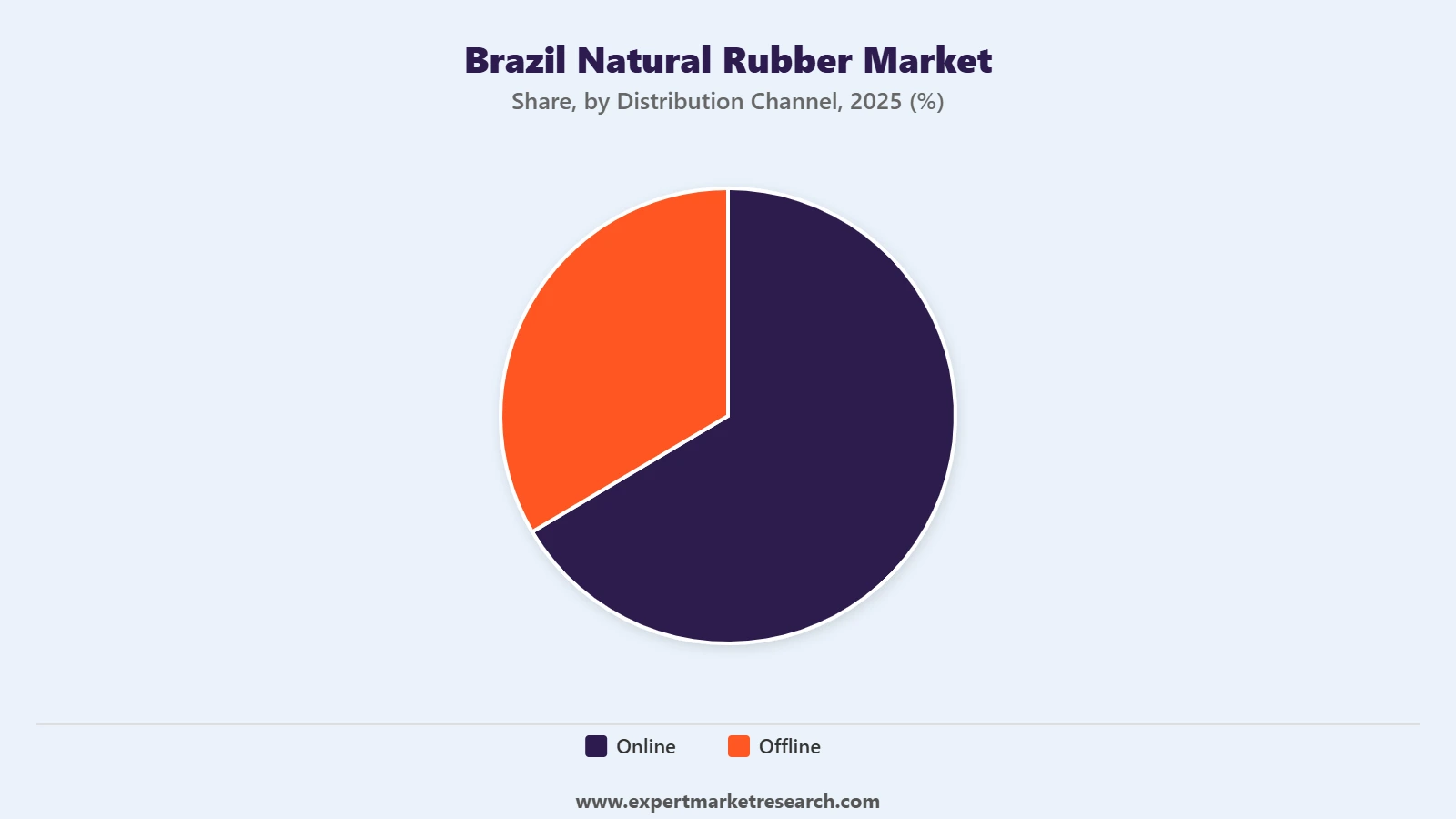
Based on the distribution channel, the market is segmented into online and offline. The online sector is projected to grow at a CAGR of 4.4% during the forecast period of 2026-2035. The increasing demand for natural rubber is fuelled by the expansion of online sales channels, which heightens the requirement for resilient rubber products utilised in packaging, automotive components, and consumer goods, thereby enhancing overall market consumption.
Read more about this report - REQUEST FREE SAMPLE COPY IN PDF
Major players are focusing on technological advancements and increasing focus on research and development to gain a competitive edge in the market.
The comprehensive report looks into the macro and micro aspects of the market. The EMR report gives an in-depth insight into the market by providing a SWOT analysis as well as an analysis of Porter’s Five Forces model.


Upto 15% Off
USD
$2499 $2249
$3999 $3599
$4999 $4249
$5999 $5099


*While we strive to always give you current and accurate information, the numbers depicted on the website are indicative and may differ from the actual numbers in the main report. At Expert Market Research, we aim to bring you the latest insights and trends in the market. Using our analyses and forecasts, stakeholders can understand the market dynamics, navigate challenges, and capitalize on opportunities to make data-driven strategic decisions.*
The market is assessed to grow at a CAGR of 2.60% between 2026 and 2035.
The market is being driven by the growing automotive tyre sector and the wide application of natural rubber in the footwear sector.
The key trends aiding the market expansion include rising environmental awareness and the use of natural rubber in advanced agricultural practices.
The major regions considered in the market are São Paulo, Minas Gerais, Rio de Janeiro, Bahia, and Rio Grande do Sul.
The different types of natural rubbers in the market are RSS grade, latex concentrate, and solid block rubber, among others.
Explore our key highlights of the report and gain a concise overview of key findings, trends, and actionable insights that will empower your strategic decisions.
| REPORT FEATURES | DETAILS |
| Base Year | 2025 |
| Historical Period | 2019-2025 |
| Forecast Period | 2026-2035 |
| Scope of the Report |
Historical and Forecast Trends, Industry Drivers and Constraints, Historical and Forecast Market Analysis by Segment
|
| Breakup by Type |
|
| Breakup by Application |
|
| Breakup by Distribution Channel |
|
| Breakup by Region |
|
| Market Dynamics |
|
| Competitive Landscape |
|
| Companies Covered |
|
Datasheet
One User
USD 2,499
USD 2,249
tax inclusive*
Single User License
One User
USD 3,999
USD 3,599
tax inclusive*
Five User License
Five User
USD 4,999
USD 4,249
tax inclusive*
Corporate License
Unlimited Users
USD 5,999
USD 5,099
tax inclusive*
*Please note that the prices mentioned below are starting prices for each bundle type. Kindly contact our team for further details.*
Flash Bundle
Small Business Bundle
Growth Bundle
Enterprise Bundle
*Please note that the prices mentioned below are starting prices for each bundle type. Kindly contact our team for further details.*
Flash Bundle
Number of Reports: 3
20%
tax inclusive*
Small Business Bundle
Number of Reports: 5
25%
tax inclusive*
Growth Bundle
Number of Reports: 8
30%
tax inclusive*
Enterprise Bundle
Number of Reports: 10
35%
tax inclusive*
How To Order

Select License Type
Choose the right license for your needs and access rights.

Click on ‘Buy Now’
Add the report to your cart with one click and proceed to register.

Select Mode of Payment
Choose a payment option for a secure checkout. You will be redirected accordingly.
Strategic Solutions for Informed Decision-Making
Gain insights to stay ahead and seize opportunities.

Get insights & trends for a competitive edge.

Track prices with detailed trend reports.

Analyse trade data for supply chain insights.

Leverage cost reports for smart savings

Enhance supply chain with partnerships.

Connect For More Information
Our expert team of analysts will offer full support and resolve any queries regarding the report, before and after the purchase.
Our expert team of analysts will offer full support and resolve any queries regarding the report, before and after the purchase.
We employ meticulous research methods, blending advanced analytics and expert insights to deliver accurate, actionable industry intelligence, staying ahead of competitors.
Our skilled analysts offer unparalleled competitive advantage with detailed insights on current and emerging markets, ensuring your strategic edge.
We offer an in-depth yet simplified presentation of industry insights and analysis to meet your specific requirements effectively.




