

Consumer Insights
Uncover trends and behaviors shaping consumer choices today
Procurement Insights
Optimize your sourcing strategy with key market data
Industry Stats
Stay ahead with the latest trends and market analysis.
The global cheddar cheese market attained a value of USD 3.78 Billion in 2025 and is projected to expand at a CAGR of 4.50% through 2035. The market is further expected to achieve USD 5.87 Billion by 2035. The need for consistent melt, controlled portions, and distinct flavors within the foodservice industry is pushing cheddar manufacturers to introduce product offerings tailored to each application.
Innovations in the cheddar cheese market include formats that enhance flavors, increase convenience, and improve foodservice performance. Tillamook County Creamery Association introduced four cheese varieties in May 2025, among which there were Extra Sharp Triple White Cheddar Shreds and Smoked Medium Cheddar Slices. Other innovations from the firm include layered cheddar profiles, smoked cheese with real wood smoke, and spices for flavor systems. Companies are providing cheddar cheeses in a variety of formats such as blocks, chunks, shreds, slices, snacks, and specialty cheddars for foodservice operators.
Operational improvements and shelf-life economics are the major driving factors propelling product development trends in the cheddar cheese market. For example, Kerry launched a cheddar flavored sauce in Brazil in May 2025 as a replacement for the refrigerated cheddar. Such developments suggest that there is an opportunity for suppliers to develop cheddar flavor into sauces and prepared foods where refrigeration, handling, and consistency of the product are challenging the procurement process. Furthermore, Cabot is offering 8-ounce dairy bars with 30% post-consumer recycled packaging.
Further, the ongoing demand in the cheddar cheese market is backed by foodservice companies interested in products with consistent melt performance in hamburgers, sandwiches, sauces, and ready meals, while retail consumers prefer portioned and resealable packaging to cut down on loss. Shreds, slices, snacks, and specially formulated cheddars targeting each commercial application are being made available from manufacturers in order to provide consistent performance and easy procurement through various distribution channels.
Compound Annual Growth Rate
4.5%
Value in USD Billion
2026-2035
Read more about this report - REQUEST FREE SAMPLE COPY IN PDF
| Global Cheddar Cheese Market Report Summary | Description | Value |
| Base Year | USD Billion | 2025 |
| Historical Period | USD Billion | 2019-2025 |
| Forecast Period | USD Billion | 2026-2035 |
| Market Size 2025 | USD Billion | 3.78 |
| Market Size 2035 | USD Billion | 5.87 |
| CAGR 2019-2025 | Percentage | XX% |
| CAGR 2026-2035 | Percentage | 4.50% |
| CAGR 2026-2035- Market by Region | Asia Pacific | 5.0% |
| CAGR 2026-2035 - Market by Country | India | 5.1% |
| CAGR 2026-2035 - Market by Country | China | 4.8% |
| CAGR 2026-2035 - Market by By Source | Goat Milk | 5.4% |
| CAGR 2026-2035 - Market by By Type | Processed | 5.5% |
| Market Share by Country 2025 | Mexico | 2.1% |
Land O'Lakes introduced bite-sized cheese snacks, offering a convenient and portable option that appeals to consumers seeking protein-rich snacks. Other companies can produce portion-controlled and portable cheddar snacks catering to the increasing consumer demands for convenience and protein-based foods.
Heler Foods announced plans for an innovative facility to boost cheddar production, supporting greater manufacturing capacity and advanced processing capabilities. Companies can therefore invest in modern production facilities to improve efficiency, scale output, and meet rising demand in the cheddar cheese market.
Kraft Natural Cheese included lactose-free cheese items in its collection of products in order to cater to special needs as well as enhance access to the category. Other firms can also launch lactose-free variants of cheddar to target health-oriented individuals.
High-protein Marble Cheddar was launched by Armstrong that offered the attributes of cheese along with additional nutrition in order to target health-focused customers. Firms can include protein-packed Cheddar products in their portfolios, widening the cheddar cheese market scope.
Processors of cheddar cheeses are diversifying their range of mild and sharp varieties by offering smoked, spicy, aged and blended variants to provide for segmentation by flavor and value-added application in retail and foodservice markets. In August 2026, Brazi Bites launched Bacon Cheddar Brazilian Cheese Bread, combining sharp cheddar and bacon in a convenient gluten-free frozen snack. Thus, processors in the cheddar cheese market leverage their formulation and aging capabilities to produce high-value cheddar cheeses for particular culinary events.
Players in the cheddar cheese market are developing products that are convenient to be used in foodservice and food manufacturing industries to save on cooking and packaging time. Tillamook offers a range of cheddars including farmstyle thick-cut shreds, fine-cut shreds, slices, baby loaves, portions and cracker cuts to allow food manufacturers and foodservice establishments to choose cheddars depending on melt properties, coverage and ease of use. In August 2026, BioCheese added pea protein to its dairy-free Cheddar Shred, delivering enhanced nutrition while maintaining meltability, flavor, and convenience. Such innovations help processors to standardize cheddar cheese performance while saving on cutting and portioning labor.
An expansion in cheddar production is ensuring more cheese availability for subsequent food manufacturers, restaurants, and prepared food producers. In May 2026, Kraft Natural Cheese launched a lactose-free product line, expanding accessibility for consumers with lactose intolerance and dietary preferences, accelerating opportunities in the cheddar cheese market. Greater manufacturing volume means that food processors will have more amounts of cheddar for shredded cheese, sauces, frozen meals, sandwiches, and other food products. Expanding production volumes also means more opportunities for cheddar suppliers to improve their plant utilization, develop aging programs, and secure significant contracts with food manufacturers who require cheddar cheese.
Manufacturers are focusing on developing ready-to-use cheddar sauces that would make food preparation easier, provide consistency in flavoring, and reduce cold chain dependency. Companies like Kerrymaid are coming up with a new product called Cheddalicious that is a cheddar cheese sauce which is made with real cheddar cheese and can be kept ambient before usage, and can be used in hospitality applications like nachos, loaded fries, macaroni and cheese, and more. Aligning with such trends in the cheddar cheese market, June 2026, Ilchester expanded its Mexicana range with Cholula-flavored Cheddar slices, targeting consumers seeking bold flavors and convenient meal options.
The maturation process for long-aged cheddar cheese is becoming strategic in the sense that cheese manufacturers employ the maturation process to create unique flavor profiles and thereby justify the premium positioning of the product. For example, in June 2026, Old Quebec Aged Cheddar unveiled redesigned packaging, modernizing its shelf appeal while emphasizing heritage, premium quality, and product maturity. This maturation strategy in the cheddar cheese market makes producers engage in longer inventory and stricter quality control processes but allows differentiation via maturation history.
Read more about this report - REQUEST FREE SAMPLE COPY IN PDF
The Expert Market Research's report titled “Cheddar Cheese Market Report and Forecast 2026-2035” offers a detailed analysis of the market based on the following segments:
Market Breakup by Source
Key Insight: The milk of cattle continues to be important due to the existing collection facilities, reliable composition, and manufacturing setup for the production of cheddar cheese. The goat-milk cheddar cheese market is becoming more relevant as a result of premiumization, unique sensory properties, and a desire for alternatives to traditional dairy products. In November 2024, Montchevre launched Cold Brew & Donuts and Mild Gouda-Style goat cheeses, expanding adventurous flavors and versatile snacking occasions. The milk of sheep enables niche positioning owing to its higher solids content and unique flavors that make it suitable for producing specialty cheeses. Other types of milk find their use in experiments and differentiation, where manufacturers look for new sensory properties.
Market Breakup by Type
Key Insight: As per the cheddar cheese market report, natural cheddar relies on its age, taste, and texture as well as on versatility for use in any cuisine. In June 2026, Back to Nature expanded its Cheezy Cracker line, introducing new flavors that combine bold cheesy taste with wholesome ingredients. Processed cheddar depends on producers looking for meltability, texture, portion control, and functionality. Natural cheddar can be distinguished by age and origin, but the processed cheddar allows a wider choice for formulations. Together, both segments satisfy various needs of procurement. The natural cheddar provides premium positioning while the processed cheddar satisfies consistency and functionality requirements for convenience foods.
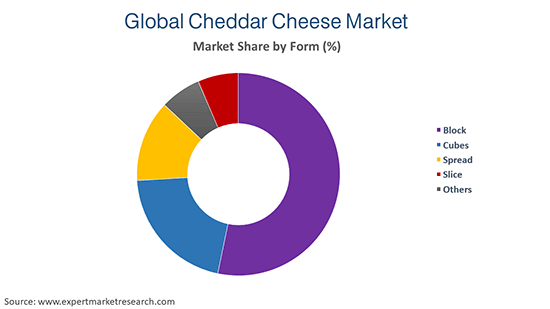
Market Breakup by Form
Key Insight: Blocks continue to hold relevance in bulk processing, aging, slicing, and flexible food preparation while cubes are used in snacking, salads, meals-in-a-box, and cheese board applications. Meanwhile, spreads are used to cater to convenience-based consumption as well as those who need smooth cheese that is easy to apply. Slices are also designed to help make quick preparations for sandwiches and burgers. The other forms considered in the cheddar cheese market report are designed to suit specialized applications where manufacturers need custom-made dimensions, textures, and packaging formats.
Market Breakup by Distribution Channel
Key Insight: Supermarkets and hypermarkets offer a wide range of varieties, refrigerated facilities, and customer traffic which helps well-known cheddar cheese varieties and private labels, boosting the cheddar cheese market opportunities. Convenience stores cater to small-sized packages, sliced, snacking and ready-to-eat varieties which suit quick purchase decisions. Specialist stores assist artisanal, aged, foreign, and premium varieties of cheddar. The online channel caters to the availability of specialty cheeses along with direct contact between manufacturer and customer. Other distribution channels such as food service and institutional buyers continue to play an important role in bulk purchases based on product specifications and requirements.
Market Breakup by Region
Key Insight: North America enjoys advantages owing to the presence of an already existing culture of cheddar consumption, advanced dairy manufacturing, and application in foodservice. Europe enjoys the advantage of having an existing culture of cheese consumption, premium positioning, specialty aging, and existing retail infrastructure. In July 2026, Kerrygold launched a premium cheese range featuring 15 varieties, including Mature, Vintage, and flavored Cheddar options for Irish consumers. The cheddar cheese market in Asia Pacific derives its strength from urbanization, expansion of foodservices in a Western style, modern retail, and increased familiarity with cheese-based products. Latin America leverages the advantage of expansion of foodservices, convenience foods, and refrigerated distribution. The Middle East and Africa benefit from the growing availability of premium foodservices, modern retail formats, and convenient cheese-based products.
By source, cattle milk dominates the market due to established supply chains and familiar cheddar characteristics
Cow's milk is the predominant ingredient across the cheddar cheese market scope due to the consistency of fat, protein and casein found in this type of milk, which ensures consistency of coagulation process, aging, texture and taste development. Moreover, dairy collection systems ensure reliable access to raw materials of consistent quality and availability. This allows cheddar manufacturers to have consistent production of cheese in the form of blocks, slices, and foodservice formats. For example, in January 2025, Specialities Inc. introduced Isle of Man Cheddar cheese in seven varieties, expanding its specialty portfolio with grass-fed, premium offerings.
Goat milk is gaining popularity in cheddar manufacturing and in the production of other types of cheese due to the differentiating potential that goat milk cheese offers. The goat-milk cheddar cheese market is supported by distinct sensory characteristics compared to cow-milk cheddar cheese. Thus, goat-milk cheese provides an opportunity for manufacturers to differentiate themselves from the competition through offering unique product experience. The demand for goat milk cheese is driven by the increasing trend toward artisanal and specific-origin cheese. Manufacturers are producing their cheese through aging and smaller batch processing to create unique, sharp, and nutty tastes.
By type, natural cheddar accounts for the leading share of the market due to authentic flavor and traditional cheese-making attributes
Natural cheddar is becoming the prevailing category in the cheddar cheese market owing to continued consumer and manufacturing appreciation of genuine cheese attributes such as natural aging, taste development, texture, and melt properties. Producers have numerous ways of differentiating their natural cheddar cheese based on milk origin, aging time, taste strength, and cheese-making methods while preserving universal suitability. Natural cheddar is used by foodservice companies and packaged food producers in situations when the recognizable taste of cheese is critical for their products. Versatility of natural cheddar as a product in burgers, sandwiches, snacks, sauces, pre-prepared meals, and cheese platters stimulates demand and offers manufacturers several possibilities for differentiation.
The processed cheddar cheese market is becoming more popular as an ingredient in applications where manufacturers need cheese that will perform consistently in terms of melting, texture stability, longevity, and ease of preparation. Processed cheeses can be designed specifically for certain applications such as sauces, sandwiches, frozen meals, snack products, and ready-to-eat meals. Controlled composition allows food manufacturers to provide consistent taste and properties in their products. This feature is especially useful for large-scale processors and foodservice operators. Convenience of processed cheddar is another opportunity that food manufacturers are currently using in their products. In July 2023, Fonterra launched Anchor Cheddar Cheese, offering a rich, creamy taste and encouraging consumers to share enjoyable meals together.
Block cheddar dominates the market due to versatile processing, aging, storage, and foodservice applications
Block is the leading form since it offers the necessary flexibility to processors, retailers and foodservice operators in slicing, shredding, portioning, and further processing. Blocks allow various aging periods and cheese varieties as well as efficiency in processing and handling, widening the cheddar cheese market scope. Food processors can easily transform blocks into application-specific forms based on their manufacturing needs and offer more options to consumers for determining the final product attributes. In August 2023, Violife launched Cheddarton, a vegan Cheddar alternative offering creamy texture, versatility, and significantly lower emissions than dairy cheese. Retail consumers are also accepting block cheddar as the traditional form of cheese, while food service operations need large blocks for high volume preparation.
Sliced cheddar is growing in popularity due to the fact that food manufacturers and foodservice operators want such forms which will minimize the preparation time and allow portion control. The pre-sliced cheese can be directly applied to burgers, sandwiches, wraps, breakfast items and prepared meals, thus helping to save labor and offer portion control. Manufacturers produce different slices depending on their melting and packaging properties for certain applications. Sliced cheddar also helps to satisfy the retail consumer demand for re-sealable packs and portion-controlled forms.
Supermarkets and hypermarkets dominate distribution due to broad assortment and established refrigerated infrastructure
Supermarkets and hypermarkets remain the dominating distribution channels that are contributing to the cheddar cheese market revenue. They offer wide consumer reach, refrigerated storage facilities, and various shelf positions in both mainstream and premium cheese categories. Retailers have the ability to carry blocks, slices, cubes, spreads, shredded products, and other kinds of specialty cheddar products in one single procurement environment. Manufacturers can also use promotional offers, private labeling, and premium products to appeal to different types of consumers. In August 2026, BioCheese launched a protein-fortified vegan Cheddar at Coles, combining plant-based nutrition, improved protein content, and accessible retail distribution.
E-commerce channels are also gaining share in the cheddar cheese market since consumers are increasingly using digital channels to purchase specialty cheeses, premium cheddar products, subscription products, and hard-to-carry forms of cheddar. E-commerce provides manufacturers with an opportunity to display more details about the aging, origin, ingredients, taste, and applications of products which might be provided with limited shelf space in physical stores. For premium cheddar products, this distribution channel provides manufacturers the ability to expand their reach geographically without expanding into physical retail environments.




Read more about this report - REQUEST FREE SAMPLE COPY IN PDF
North America accounts for the dominant share of the market due to mature dairy infrastructure and strong cheddar consumption
North America emerges as the key regional cheddar cheese market due to the presence of cheddar in households, in foodservice applications and in processed foods applications with the help of efficient processing and distribution networks within the dairy sector. Manufacturers are establishing a robust network of production facilities that are capable of delivering blocks, slices, shreds, sauces and specialty varieties to a wide range of customers. In June 2026, Kraft Natural Cheese launched lactose-free Mild Cheddar, expanding dairy accessibility while maintaining familiar taste, quality, versatility, and convenience.
Demand in the Asia Pacific cheddar cheese market is witnessing rapid growth due to expansion of the foodservice menu and packaged food offerings based on Western cuisine comprising burgers, pizzas, sandwiches, bakery products, and cheese snacks. Urban consumer segments are increasingly becoming aware of the high-end and specialty cheese formats leading to localization of cheddar cheese varieties by producers according to regional palates and application requirements. The introduction of smaller packs, slices, shreds, and processed cheddar varieties is being carried out by manufacturers to cater to new application segments. In September 2024, RELCO partnered with Milky Mist to establish India’s largest cheddar cheese plant, enhancing production capacity, precision, consistency, and efficiency.
Competition is being driven by differentiation, foodservice capabilities, manufacturing process efficiencies, and premiumization rather than volume. Leading cheddar cheese market players are introducing their ranges of aged, sharp, smoked, organic, sliced, shredded, and application-specific cheddar lines while achieving consistency on a larger scale in manufacturing. Innovation in the foodservice channel is increasing, with suppliers creating cheese formulations for burgers, pizzas, sauces, prepared foods, and high throughput kitchens.
Cheddar cheese companies also find opportunities within the specialty and regional market segments that rely on unique aging, grass-fed milk sourcing, and traceability for premiumization. Sustainability is another competitive strategy through reduced packaging, efficient milk usage, reduced waste, and responsible sourcing. Acquisitions, increased manufacturing capacity, and digital customer relationship management are making it possible for the leading participants to broaden geographic markets as well as customize products to changing needs in retail and foodservice procurement.
Arla Foods amba was established in 2000, with the company’s headquarters located in Denmark. The agricultural cooperative offers its customers Arla Cheddar produced from raw materials and milk, stressing consistency of quality. The company’s cheese line covers retail and foodservice customers, while agricultural ownership ensures reliable procurement.
The global cheese manufacturer Lactalis Group was established in 1999 in Laval, France. The company caters to the rising consumer demand via Kraft natural and shredded cheeses and Black Diamond cheddar in North America. The company’s production capacity helps to cover the needs of retail, foodservice, and industrial customers.
Fonterra Co-operative Group, which was established in 2001, has its headquarters in New Zealand. This firm targets cheddar consumers through Anchor Food Professionals. The brand provides three varieties of cheddar including Sharp, Vintage, and Organic Cheddar. Its strategy is based on differentiation that focuses on unique taste and specifications.
Saputo Inc., which was established in 1954, has its headquarters in Montréal, Canada. The firm produces and distributes cheddar and other cheeses. Its capabilities include various types of cheddar including blocks of cheddar, aged cheddar, curds, shredded cheese, and foodservice cuts.
Other key players in the market include Dairy Farmers of America, and Gujarat Cooperative Milk Marketing Federation Ltd, among others.
*Please note that this is only a partial list; the complete list of key players is available in the full report. Additionally, the list of key players can be customized to better suit your needs.*
Unlock the latest insights with our cheddar cheese market trends 2026 report. Discover regional growth patterns, consumer preferences, and key industry players. Stay ahead of competition with trusted data and expert analysis. Download your free sample report today and drive informed decisions in the market.


Upto 15% Off
USD
$2499 $2249
$3999 $3599
$4999 $4249
$5999 $5099


*While we strive to always give you current and accurate information, the numbers depicted on the website are indicative and may differ from the actual numbers in the main report. At Expert Market Research, we aim to bring you the latest insights and trends in the market. Using our analyses and forecasts, stakeholders can understand the market dynamics, navigate challenges, and capitalize on opportunities to make data-driven strategic decisions.*
The market is projected to grow at a CAGR of 4.50% between 2026-2035.
Stakeholders are expanding aged and flavored portfolios, developing application-specific formats, improving sustainable packaging, strengthening foodservice partnerships, optimizing cold chains, targeting premium regional opportunities, and increasing product customization for industrial buyers.
The expansion of the foodservice sector, the growing disposable incomes of consumers, and the rising applications of natural cheese in exotic dishes are the key trends guiding the market growth.
The major regions in the market are North America, Latin America, Europe, the Middle East and Africa, and the Asia Pacific.
Cattle milk, goat milk, and sheep milk, among others, are the major sources of cheddar cheese.
The significant types of cheddar cheese are natural and processed.
Block, cubes, spread, and slice, among others, are the various segments based on the form of the product considered in the market report.
The different distribution channels in the market are supermarkets/hypermarkets, convenience stores, specialist retailers, and online channels, among others.
The major players in the market are Arla Foods amba, Lactalis Group, Fonterra Co-operative Group, Saputo Inc, Dairy Farmers of America, and Gujarat Cooperative Milk Marketing Federation Ltd, among others.
In 2025, the market reached an approximate value of USD 3.78 Billion.
Companies face volatile milk and energy costs, quality requirements, cold-chain complexity, sustainability pressures, aging inventory risks, intense private-label competition, and difficulty balancing premiumization with affordable cheddar offerings across global channels.
Explore our key highlights of the report and gain a concise overview of key findings, trends, and actionable insights that will empower your strategic decisions.
| REPORT FEATURES | DETAILS |
| Base Year | 2025 |
| Historical Period | 2019-2025 |
| Forecast Period | 2026-2035 |
| Scope of the Report |
Historical and Forecast Trends, Industry Drivers and Constraints, Historical and Forecast Market Analysis by Segment:
|
| Breakup by Source |
|
| Breakup by Type |
|
| Breakup by Form |
|
| Breakup by Distribution Channel |
|
| Breakup by Region |
|
| Market Dynamics |
|
| Competitive Landscape |
|
| Companies Covered |
|
| Report Price and Purchase Option | Explore our purchase options that are best suited to your resources and industry needs. |
| Delivery Format | Delivered as an attached PDF and Excel through email, with an option of receiving an editable PPT, according to the purchase option. |
Datasheet
One User
USD 2,499
USD 2,249
tax inclusive*
Single User License
One User
USD 3,999
USD 3,599
tax inclusive*
Five User License
Five User
USD 4,999
USD 4,249
tax inclusive*
Corporate License
Unlimited Users
USD 5,999
USD 5,099
tax inclusive*
*Please note that the prices mentioned below are starting prices for each bundle type. Kindly contact our team for further details.*
Flash Bundle
Small Business Bundle
Growth Bundle
Enterprise Bundle
*Please note that the prices mentioned below are starting prices for each bundle type. Kindly contact our team for further details.*
Flash Bundle
Number of Reports: 3
20%
tax inclusive*
Small Business Bundle
Number of Reports: 5
25%
tax inclusive*
Growth Bundle
Number of Reports: 8
30%
tax inclusive*
Enterprise Bundle
Number of Reports: 10
35%
tax inclusive*
How To Order

Select License Type
Choose the right license for your needs and access rights.

Click on ‘Buy Now’
Add the report to your cart with one click and proceed to register.

Select Mode of Payment
Choose a payment option for a secure checkout. You will be redirected accordingly.
Strategic Solutions for Informed Decision-Making
Gain insights to stay ahead and seize opportunities.

Get insights & trends for a competitive edge.

Track prices with detailed trend reports.

Analyse trade data for supply chain insights.

Leverage cost reports for smart savings

Enhance supply chain with partnerships.

Connect For More Information
Our expert team of analysts will offer full support and resolve any queries regarding the report, before and after the purchase.
Our expert team of analysts will offer full support and resolve any queries regarding the report, before and after the purchase.
We employ meticulous research methods, blending advanced analytics and expert insights to deliver accurate, actionable industry intelligence, staying ahead of competitors.
Our skilled analysts offer unparalleled competitive advantage with detailed insights on current and emerging markets, ensuring your strategic edge.
We offer an in-depth yet simplified presentation of industry insights and analysis to meet your specific requirements effectively.




