

Consumer Insights
Uncover trends and behaviors shaping consumer choices today
Procurement Insights
Optimize your sourcing strategy with key market data
Industry Stats
Stay ahead with the latest trends and market analysis.
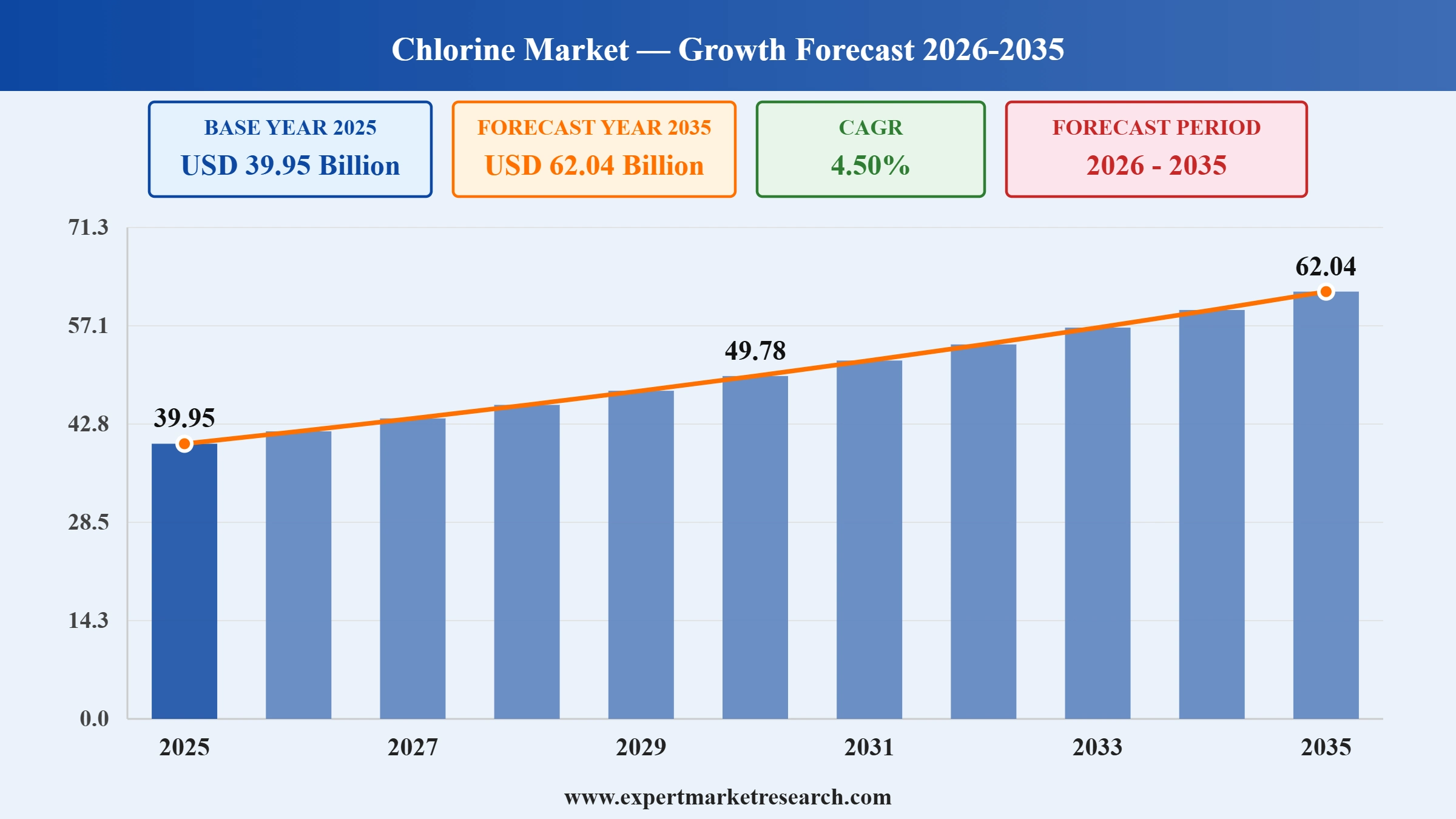
The chlorine market attained a value of USD 39.95 Billion in 2025 and is projected to expand at a CAGR of 4.50% through 2035. The market is further expected to achieve USD 62.04 Billion by 2035. Increased investments in chlor-alkali plants are leading to more robust chlorine supplies. On the other hand, modern membrane electrolysis technology allows chlor-alkali manufacturers to save energy and ensure reliable supply while manufacturing products in a more environmentally friendly way.
There are two factors that are stimulating demand in the chlorine market. The first one is increasing the construction of facilities to treat water because of higher water quality standards, which might lead to increased demand for chlorine for disinfecting purposes. Another factor driving demand is vinyl and specialty chemicals production. In order to produce ethylene dichloride, PVC intermediates, hydrochloric acid, and other derivatives, companies need chlorine, which will encourage them to create integrated businesses to provide feedstock to their plants.
The chlorine market is shifting towards greener and more integrated production by improving electrolysis technologies, developing local supply chains, and converting the output into end products. In June 2026, Australian chemicals company Grenof was granted permission to build Project Halogen, an electrolysis plant located in Gladstone and set to start producing 160,000 tons of sodium hypochlorite and hydrochloric acid in 2028. The technology will use 25% less electricity than the average Australian plant, reflecting a trend of increasing focus on energy efficiency and supply safety over capacity.
Electrolysis technology suppliers are pushing forward with the efficiency front as well. In October 2025, thyssenkrupp nucera launched BM2.7 v7 and an updated version of e-BiTAC v7 electrolyzers. The new products consume less than 1,960 kWh of electricity per ton of NaOH generated at 6 kA/m², thereby propelling demand in the chlorine market. Even though this technology produces both chlorine and caustic soda, it is significant for chlorine producers since electricity costs constitute a large share of chlor-alkali operations. Estimates show that electricity accounts for over 40% of the total chlor-alkali operating costs.
Read more about this report - REQUEST FREE SAMPLE COPY IN PDF
thyssenkrupp nucera built a modular chlor-alkali plant for Chlorum Solutions of Brazil, employing energy efficient BM2.7 technology to manufacture more than 15,000 tons of chlorine per year. Chlorine market players therefore have the option of utilizing modular and energy efficient electrolysis plants to increase the capacity in their region without incurring high costs and being environmentally friendly.
Nuberg EPC was awarded a project of building an absorption facility of 100-150 tons per day of chlorine for Colombian company BRINSA. Engineering firms can design modern chlorine absorption and emergency treatment facilities as environmental regulations become increasingly stricter.
Chlorine is being supplied through a pipeline arrangement between DCM Shriram and Aarti Industries in a long-term agreement. There is an opportunity for chlorine market companies to form supply arrangements and even pipelines to meet their demand requirements and lower transportation risks.
ChloroStar analyzers with self-cleaning sensors, diagnostics, and digital connectivity were introduced by ABB to enhance chlorine monitoring, dosing control, and uptime in treatment processes. Technology companies can design intelligent chlorine monitoring systems with features such as predictive maintenance, remote diagnostics, and automatic dosing facilities.
Chlorine manufacturers are rapidly adopting the new membrane technology in place of diaphragm chlor-alkali systems, aiming at reducing their power requirement and improving product quality. For example, in June 2025, Kumho Mitsui began operating a chlor-alkali plant using thyssenkrupp nucera technology, strengthening regional chemical production capacity, accelerating the overall chlorine market growth. Similarly, in February 2026, AGC Vinythai commissioned a 220,000 t/y caustic soda expansion in Thailand using the state-of-the-art e-BiTAC v7, where chlorine would provide feedstock to its vinyl chain.
Chemical manufacturers are progressively developing captive chlorine capacities to reduce dependence on merchant chlorine and to expand the manufacture of downstream chemicals. In July 2026, Epigral launched an Advanced Materials unit, expanding specialty chemicals beyond its 75,000 TPA CPVC capacity. This project also recycles the byproduct brine that is generated during MDI production. Such investments are relevant to PVC, MDI, chlorinated intermediates and specialty chemicals producers, accelerating the overall chlorine market development.
Continued investments into water treatment plants continue providing opportunities for chlorine market players, especially when towns expand their water treatment and disinfection plants. According to the United States EPA, there is a need for USD 625 billion worth of investment in drinking water infrastructure in the next 20 years, including USD 107 billion worth of treatment facilities. Additionally, the agency announced the allocation of more than USD 25 million in grants for small towns to upgrade drinking water infrastructure. These developments can be used by producers to promote the reliability of chlorine supply and dosing technologies. For example, in March 2026, Kemira completed its first full-scale United States trial of chlorine-free KemConnect DEX, demonstrating sustainable wastewater treatment effectiveness.
As decarbonization becomes an important criterion for investments in the chlorine market, equipment vendors continue offering more efficient electrolysis systems and chlorine producers seek alternatives in terms of power source optimization, improved membrane and cell technologies. TGV SRAAC chose the latest BiTAC technology by thyssenkrupp nucera for the 50% increase in production capacity of its Kurnool, India chlor-alkali plant, in July 2026. With this project, the company is expected to increase the production capacity of caustic soda by 1,000 to 1,500 tpd.
The growing threat to water security is motivating governments and utility providers to focus on resilient treatment systems, which would indirectly promote local production of chlorine as well as storage facilities. The WIFIA program operated by the United States EPA provides USD 6.5 billion worth of funding for water systems along with USD 550 million via state infrastructure financing for enhancing reliability and capability of drinking water. EPA also approved a WIFIA loan worth USD 58 million in May 2026 for improving several drinking water treatment facilities in Amador County, California.
The EMR’s report titled “Global Chlorine Market Report and Forecast 2026-2035” offers a detailed analysis of the market based on the following segments:
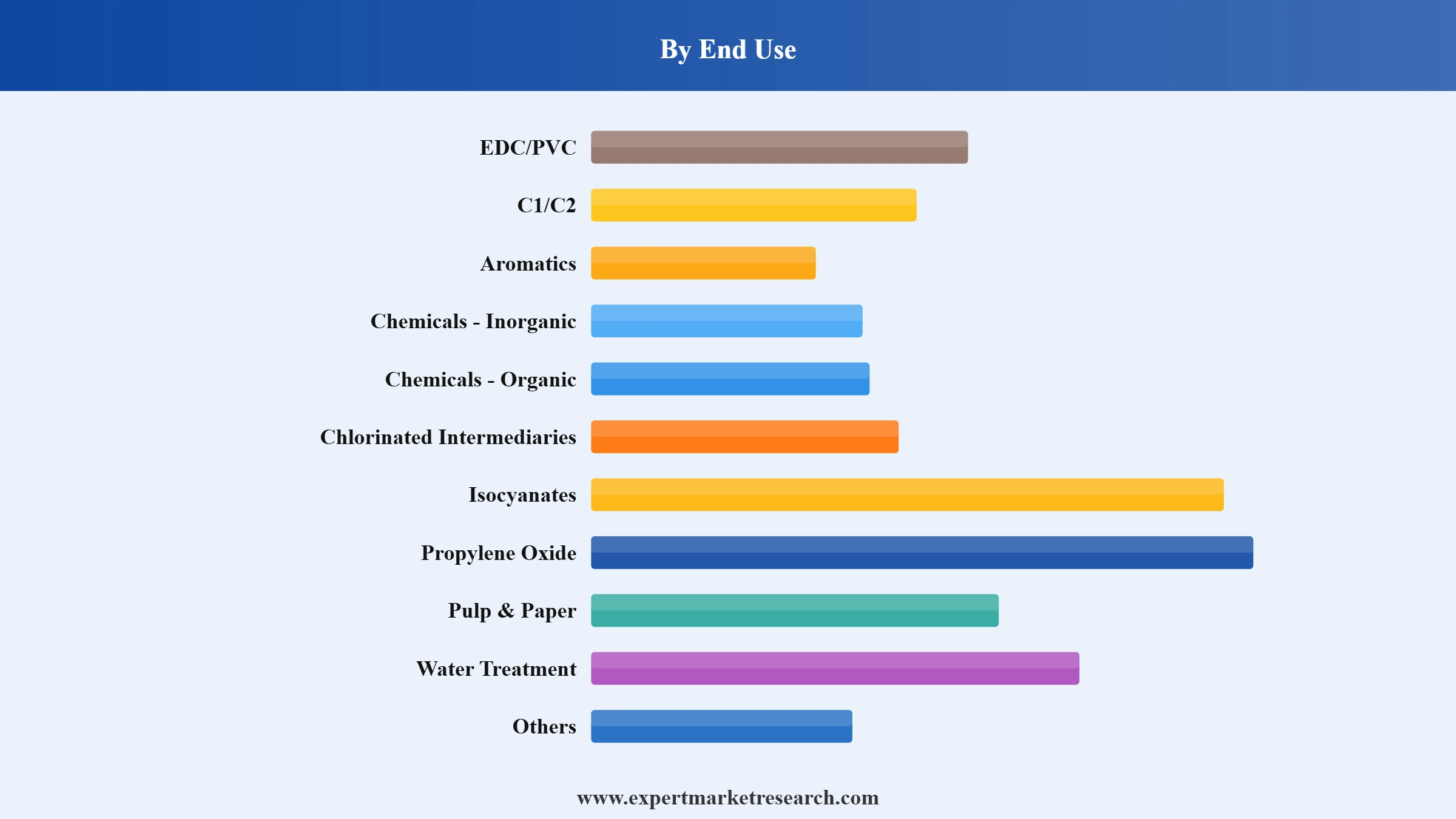
Market Breakup by End Use
Key Insight: EDC/PVC continues to be driven by construction demand for pipes, profiles, cables, and other infrastructure materials, whereas C1/C2 and aromatics have the advantage of being integrated with the feedstock chain. Inorganic chemicals rely on hydrochloric acid, hypochlorites, and mineral processing. Organic chemicals find an advantage in solvents and specialty synthesis, propelling the chlorine market revenue growth. Chlorinated intermediates are used in pharmaceuticals, agrochemicals, and performance chemicals, whereas isocyanates are used in the polyurethane value chain. The consumption of propylene oxide is derived from polyether and polyurethane manufacturing. Pulp and paper use chlorinated products for bleaching purposes, while water treatment benefits from disinfection demands.
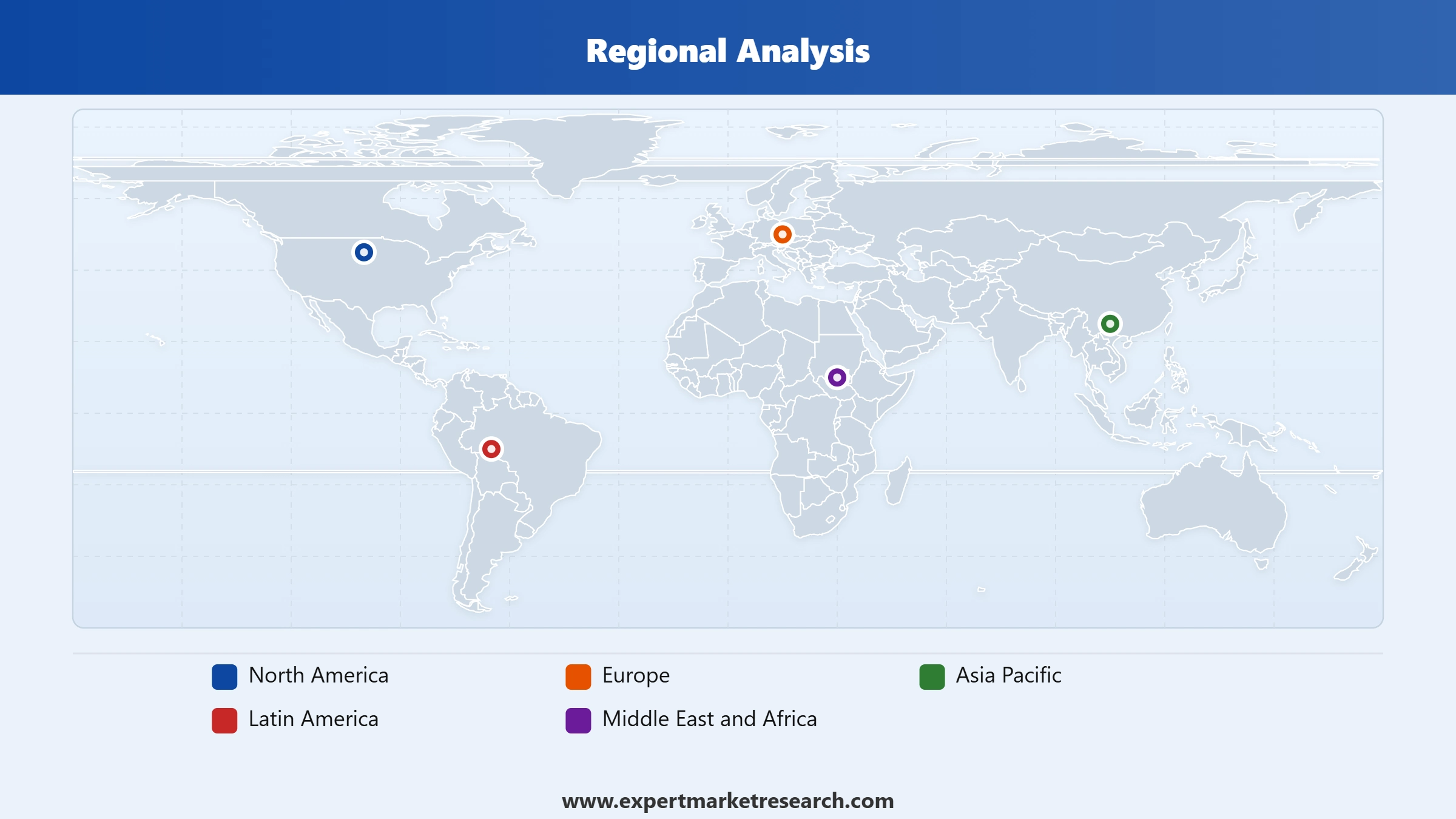
Market Breakup by Region
Key Insight: North America enjoys the advantage of having an extensive chlor-alkali network, integrated vinyl chain, and drinking water infrastructure investments, whereas Europe is influenced by energy efficiency regulations, carbon dioxide emission reduction and aging chemical facility renovation. In the chlorine market in Asia Pacific, large-scale PVC, chemical production and infrastructure utilization is the key driving factor for the industry, which also has extensive production integration. The growing influence of Latin America comes from sanitation improvement, industrial growth, and local chemical supply requirements. Middle East and Africa represent growth prospects with petrochemical integration, desalination, water treatment, and manufacturing infrastructure development.
Read more about this report - REQUEST FREE SAMPLE COPY IN PDF
By end use, EDC/PVC leads demand growth in the market due to integrated vinyl-chain consumption and capacity
The leading end use of chlorine is represented by the EDC/PVC segment, due to the fact that chlorine is an integral part of the EDC-VCM-PVC chain, thus ensuring continued captive demand for integrated manufacturers. PVC consumption is directly related to construction, pipes, cables, flooring, and infrastructure usage, while the chlor-alkali and vinyl operations are becoming increasingly preferred by producers as a means of controlling feedstock costs and supply risks. The capacity increases in Asia and North America make EDC/PVC an important end use for chlorine producers seeking predictable downstream demand in the chlorine industry. In May 2026, TA’ZIZ signed chemical agreements with Tricon worth up to USD 2.5 billion, covering PVC, EDC, and caustic soda exports.
Read more about this report - REQUEST FREE SAMPLE COPY IN PDF
The water treatment industry represents the fastest-growing end use, as the utilities increase their capacity to provide disinfection services, and industries are tightening control of their wastewater. Chlorine and chlorine-containing products continue playing an important role in the fight against microbial contamination of municipal drinking water, sewage, and process water. Infrastructural projects financed by governments stimulate installation of new treatment capacities, while tightening discharge requirements motivate buyers to improve their dosing and control capabilities. This is a new opportunity for chlorine market players to expand their scope of expertise other than commodities trading.
Read more about this report - REQUEST FREE SAMPLE COPY IN PDF
Asia Pacific dominates the market due to integrated chlor-alkali capacity and downstream chemical demand
The most dominant regional chlorine market is the Asia Pacific market, which includes the presence of China, India, Japan, and Southeast Asian economies. The region benefits from integrated production where there is a combination of chlor-alkali capacity and downstream PVC, chemicals, and water treatment demand. The major producer of volume is represented by China with its extensive vinyl and chemical chains, while India is increasing capacity along with infrastructure development. There is also opportunity in Southeast Asia due to the expansion of plastics, specialty chemicals, and industrial water treatment production facilities, resulting in diversified downstream demand for chlorine.
Latin America is expected to be the fastest-growing chlorine market due to the process of industrialization, infrastructure development for water treatment, and the development of chemical production. In Latin America, the largest base for demand comes from Brazil and it includes the use of chlorine for PVC, sanitation, pulp and paper, and chemical production. There is an ongoing process of development of utilities' treatment facilities and producers need reliable local sources of derivatives of chlorine. For example, in August 2025, Nouryon expanded South America’s sodium chlorate capacity by 20% to support Arauco’s new Brazilian pulp mill and industry growth.
Integration into the market continues to stay high, as leading chlorine companies are focusing on being efficient in the chlor-alkali processes, integration along the vinyl chain, supply assurance, and low carbon manufacturing. Increasing usage of membrane electrolysis, upgrades to the plants, internal consumption of chlorine, and specific chlorinated products is increasing efficiency and competitiveness in terms of cost.
Moreover, integration into production networks that link chlorine and caustic soda production with PVC, CPVC, chlorinated intermediates, water treatment products, and other specialties provides opportunities for better control of the chlorine supply and reduces risks due to transport and storing of such a dangerous product as chlorine. Additional possibilities for chlorine market players may come from digital process control systems, energy-efficient electrolyzers, usage of renewable energy, and monitoring systems that would help to reduce electricity consumption and increase the efficiency of the plants. With customers demanding secure and low-carbon supply of chemicals, integrated facilities, flexibility of production, and strong downstream relationships are becoming important assets for producers.
Formed in 1892 and having its corporate headquarters in the United States, Olin Corporation has a wide portfolio of chlor-alkali products within the industry. The Chlor Alkali Products & Vinyls division at Olin offers chlorine, caustic soda, hydrochloric acid, bleach, hydrogen, EDC, VCM and chlorinated organics. The company aims for integrated production, membrane, cost efficiency, and increased downstream use for vinyl and chemicals.
Occidental Petroleum Corporation was formed in 1920, and its corporate headquarters are in the United States. Through OxyChem which was a leading manufacturer of chlorine, caustic soda and PVC in North America, Occidental has traditionally been involved in the manufacture of the above-mentioned products.
INEOS was founded in 1998 and has its headquarters in London, United Kingdom. The chlor-alkali knowledge of INEOS has been gained in connection with its electrochemical business. INEOS products include chlorine, hydrochloric acid, and membrane electrolysis technology (BICHLOR electrolyzers). INEOS currently concentrates on energy efficient electrolysis, electrode renovation, and process optimization.
Hanwha Chemical Corporation was founded in 1965, has its headquarters in Seoul, South Korea. The Chemical Division of Hanwha Solutions, previously called Hanwha Chemical, conducts its business activities in chlor-alkali and petrochemicals. Hanwha was the pioneer in PVC manufacturing in Korea and offers a range of chlor-alkali chemicals as well as PVC and specialty chemicals.
*Please note that this is only a partial list; the complete list of key players is available in the full report. Additionally, the list of key players can be customized to better suit your needs.*
Unlock the latest insights with our chlorine market trends 2026 report. Discover regional growth patterns, consumer preferences, and key industry players. Stay ahead of competition with trusted data and expert analysis. Download your free sample report today and drive informed decisions in the market.


Upto 15% Off
USD
$2499 $2249
$3999 $3599
$4999 $4249
$5999 $5099


*While we strive to always give you current and accurate information, the numbers depicted on the website are indicative and may differ from the actual numbers in the main report. At Expert Market Research, we aim to bring you the latest insights and trends in the market. Using our analyses and forecasts, stakeholders can understand the market dynamics, navigate challenges, and capitalize on opportunities to make data-driven strategic decisions.*
In 2025, the market reached an approximate value of USD 39.95 Billion.
The market is projected to grow at a CAGR of 4.50% between 2026 and 2035.
The market is estimated to witness healthy growth in the forecast period of 2026-2035 to reach a value of around USD 62.04 Billion by 2035.
Stakeholders are modernizing electrolyzers, strengthening downstream integration, expanding localized distribution, securing renewable electricity, developing lower-carbon chlorine, improving storage safety, and targeting water-treatment and specialty-chemical customers.
The key trends guiding the market include the growing demand for clean water in developing nations and the rising utilisation of chlorine in the manufacturing of composites and automotive components.
The major regions in the market are North America, Latin America, the Middle East and Africa, Europe, and the Asia Pacific.
The major end uses of chlorine are EDC/PVC, C1/C2, aromatics, chemicals – inorganic, chemicals – organic, chlorinated intermediaries, isocyanates, propylene oxide, pulp and paper, and water treatment, among others.
The key players in the market include OLIN Corporation, Occidental Petroleum Corporation (OXY), Ineos AG, and Hanwha Chemical Corporation, among others.
Companies are facing electricity-intensive production, volatile energy and feedstock costs, stringent environmental requirements, hazardous chlorine logistics, aging assets, supply-chain disruptions, and pressure to decarbonize chlor-alkali operations.
Explore our key highlights of the report and gain a concise overview of key findings, trends, and actionable insights that will empower your strategic decisions.
| REPORT FEATURES | DETAILS |
| Base Year | 2025 |
| Historical Period | 2019-2025 |
| Forecast Period | 2026-2035 |
| Scope of the Report |
Historical and Forecast Trends, Industry Drivers and Constraints, Historical and Forecast Market Analysis by Segment:
|
| Breakup by End Use |
|
| Breakup by Region |
|
| Market Dynamics |
|
| Competitive Landscape |
|
| Companies Covered |
|
| Report Price and Purchase Option | Explore our purchase options that are best suited to your resources and industry needs. |
| Delivery Format | Delivered as an attached PDF and Excel through email, with an option of receiving an editable PPT, according to the purchase option. |
Datasheet
One User
USD 2,499
USD 2,249
tax inclusive*
Single User License
One User
USD 3,999
USD 3,599
tax inclusive*
Five User License
Five User
USD 4,999
USD 4,249
tax inclusive*
Corporate License
Unlimited Users
USD 5,999
USD 5,099
tax inclusive*
*Please note that the prices mentioned below are starting prices for each bundle type. Kindly contact our team for further details.*
Flash Bundle
Small Business Bundle
Growth Bundle
Enterprise Bundle
*Please note that the prices mentioned below are starting prices for each bundle type. Kindly contact our team for further details.*
Flash Bundle
Number of Reports: 3
20%
tax inclusive*
Small Business Bundle
Number of Reports: 5
25%
tax inclusive*
Growth Bundle
Number of Reports: 8
30%
tax inclusive*
Enterprise Bundle
Number of Reports: 10
35%
tax inclusive*
How To Order

Select License Type
Choose the right license for your needs and access rights.

Click on ‘Buy Now’
Add the report to your cart with one click and proceed to register.

Select Mode of Payment
Choose a payment option for a secure checkout. You will be redirected accordingly.
Strategic Solutions for Informed Decision-Making
Gain insights to stay ahead and seize opportunities.

Get insights & trends for a competitive edge.

Track prices with detailed trend reports.

Analyse trade data for supply chain insights.

Leverage cost reports for smart savings

Enhance supply chain with partnerships.

Connect For More Information
Our expert team of analysts will offer full support and resolve any queries regarding the report, before and after the purchase.
Our expert team of analysts will offer full support and resolve any queries regarding the report, before and after the purchase.
We employ meticulous research methods, blending advanced analytics and expert insights to deliver accurate, actionable industry intelligence, staying ahead of competitors.
Our skilled analysts offer unparalleled competitive advantage with detailed insights on current and emerging markets, ensuring your strategic edge.
We offer an in-depth yet simplified presentation of industry insights and analysis to meet your specific requirements effectively.




