

Consumer Insights
Uncover trends and behaviors shaping consumer choices today
Procurement Insights
Optimize your sourcing strategy with key market data
Industry Stats
Stay ahead with the latest trends and market analysis.
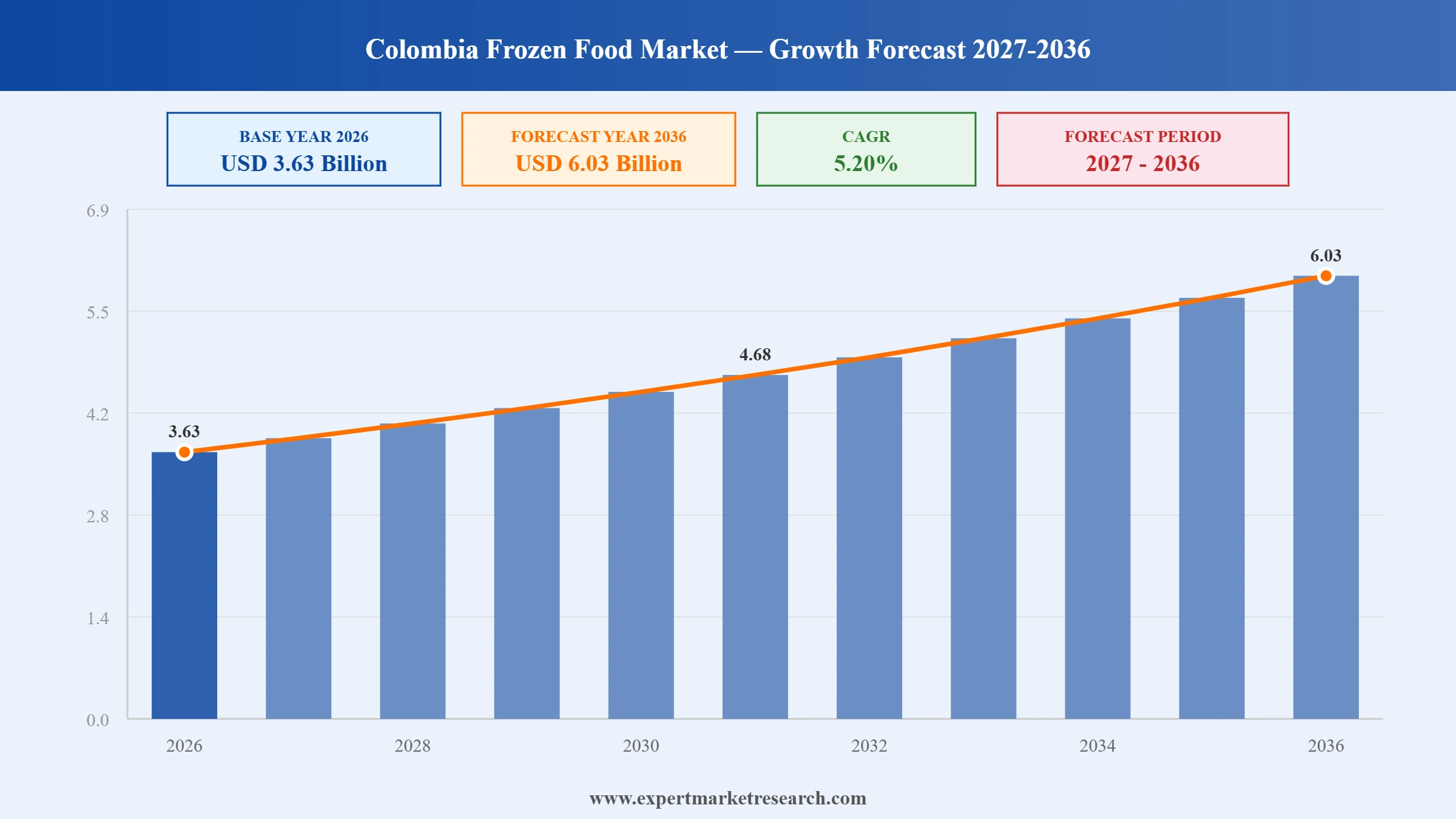
The Colombia frozen food market attained a value of USD 3.45 Billion in 2025 and is projected to expand at a CAGR of 5.20% through 2035. The market is further expected to achieve USD 5.73 Billion by 2035. Colombia's frozen-food opportunity is increasingly linked to infrastructure depth. Online sales reached COP 145.4 trillion in 2025, up 11.1%, while 684.6 million online purchases created a larger digital route to temperature-sensitive food distribution. For frozen-food suppliers, this supports investments in regional fulfillment, insulated last-mile delivery, smaller pack sizes, and inventory systems designed around predictable replenishment rather than only traditional supermarket distribution.
There is growing emphasis on ready-to-use foodservice products and sourcing from climate-proof agriculture in Colombia’s frozen foods market. There is an increasing need for standardized frozen ingredients in restaurants, hotels, institutions and catering services that offer reduced preparation time, labor and kitchen waste, providing opportunities for suppliers who provide standard cuts and portions. Additionally, there is an increased emphasis on potato and other crop processors developing crop varieties that adapt well to climate changes, contributing to the improvement in raw materials’ availability for frozen foods production. Therefore, companies entering the market will have opportunities to concentrate on foodservice-oriented formulations and specifications and improved connections with the local farmers to have reliable raw materials’ supply, thereby boosting the Colombia frozen food market value.
The Colombian processors have managed to introduce differentiation through the transformation of their local foods to convenient frozen foods that enable the consumer or the foodservice operator to enjoy the same taste but without the need for preparing these foods. Food categories like frozen plantain, cassava, yuca, potatoes and breaded foods allow the manufacturer to create a differentiated portfolio according to local conditions instead of trying to replicate their existing international range of frozen foods. This strategy works well especially for the new company entering into Colombia where they can design food items based on eating habits and taking advantage of freezing, portions and usability. Manufacturers can further differentiate through formats tailored to restaurants and institutional kitchens, including pre-sliced, pre-cooked and ready-to-fry products, creating value through preparation efficiency rather than relying solely on flavour innovation.
Potato availability presents a specific supply-side constraint for frozen-food manufacturers because processing depends on consistent raw-material quality and predictable agricultural yields. McCain Foods has highlighted the development of climate-adapted potato seed varieties for Colombia in response to challenging weather conditions, indicating that climatic variability is already influencing sourcing strategies. For processors, fluctuations in crop conditions can affect potato size, quality, starch characteristics and procurement costs, complicating production planning for frozen fries and other potato products. Companies establishing operations should therefore diversify sourcing regions, develop supplier agreements and evaluate varieties according to processing performance rather than relying solely on spot-market procurement. This can improve production continuity when agricultural conditions change, thereby boosting the Colombia frozen food market developments.
Read more about this report - REQUEST FREE SAMPLE COPY IN PDF
Emergent Cold LatAm announced a USD 150 million investment plan to strengthen its temperature-controlled infrastructure in Colombia. The company operates seven specialised warehouses across Funza, Girón, Buga and Cartagena, providing approximately 58,000 pallet positions. The expansion includes a new facility in Cali, an extension in Funza and a second Cartagena warehouse, alongside sustainable infrastructure projects. For frozen-food manufacturers, importers and distributors, the investment can improve access to refrigerated storage, support regional inventory positioning and facilitate broader distribution while reducing dependence on limited cold-chain capacity.
McCain Foods’ Andean management reported that the company was developing potato seed varieties adapted to difficult climatic conditions, including those associated with El Niño. The initiative is aimed at helping potato growers maintain production under increased drought and climate variability. McCain also discussed plans to export cassava to Europe, indicating broader development of its Colombian agricultural supply base. For Colombia’s frozen-food sector, climate-adapted varieties could strengthen raw-material availability and processing consistency, supporting manufacturers seeking greater resilience in potato sourcing and long-term supply planning.
Meals de Colombia expanded its Polet frozen-dessert portfolio with Polet Cereza Amarena Intensa and Polet Explosión de Caramelo. The company describes the products as innovations combining Polet’s characteristic crunchy coating, creamy ice cream and differentiated sauces, targeting indulgence-oriented consumption occasions. The launches broaden the brand’s premium flavour offering and provide additional points of differentiation within Colombia’s frozen-dessert category. For competing manufacturers, the development highlights opportunities to increase SKU variety through distinctive flavour combinations and layered textures rather than relying solely on conventional frozen-dessert formats.
Meals de Colombia began 2026 with two new products under its Crem Helado Casero platform: Casero Yogurt Fresa and Casero Yogurt Melocotón. The company positioned the launches around the Casero platform’s mass-market and multigenerational appeal, linking the products to home-based family consumption occasions. The products are currently sold in Colombia in individual 60 g formats, while the melocotón variant is also available in larger pack formats. The launch demonstrates how frozen-dessert manufacturers can expand established platforms through familiar fruit flavours and accessible portion sizes.
The USD 150 million investment program announced by Emergent Cold LatAm in Colombia, involving the expansion of about 58,000 pallet positions at seven existing warehouses, suggests that cold storage capacity is becoming a vital facilitator for frozen food market entrance and distribution. In the case of new producers, having their stock near major consumers and logistics hubs helps avoid reliance on one city distribution network and provides better service to supermarkets and foodservice clients. New entrants to the market must consider partnership with third-party cold storage providers prior to building their own facilities and must design product lines and delivery schedules according to pallet capacity availability. This approach can lower initial infrastructure requirements while supporting expansion beyond Bogotá and Medellín.
According to the Colombian Chamber of Electronic Commerce, the country has seen 684.6 million internet transactions in 2025, an increase of 19.9 percent from the previous year, while internet sales stood at COP 145.4 trillion. For entry into the frozen food industry, the focus would not be on copying traditional e-commerce but on creating distribution models that work with the help of digital means in a temperature-controlled environment. Manufacturers can initially test demand through selected marketplaces, supermarket platforms, and direct ordering, using purchase frequency and geographic data to identify viable SKUs. Small multipacks, family-size formats, promotional bundles, and recurring replenishment can be tested before expanding freezer placement across physical retail, helping new brands limit inventory and distribution risk.
Proterra Foods provides a concrete benchmark for companies considering Colombian IQF production. Its multiproduct facility has 7,500 tonnes of annual capacity, while 98% of its production is exported to more than 15 countries. For companies establishing operations, this demonstrates the potential of combining domestic agricultural sourcing with export-oriented processing rather than relying solely on Colombia’s retail market. New entrants can focus on standardized fruit and vegetable cuts, portion-controlled ingredients, and specifications required by food manufacturers and foodservice buyers. Investment decisions should prioritize IQF tunnel capacity, sorting, traceability, quality controls, and export-compliant packaging, allowing processors to serve Colombian customers while building an additional revenue base through international distribution.
The expansion of air-fryer-oriented frozen formats creates a specific product-development route for companies entering Colombia’s convenience-food segment. Rather than competing only through conventional frozen potatoes or breaded products, manufacturers can develop air-fryer-optimized SKUs with clearly defined cooking times, portion sizes, crispness performance, and packaging instructions. This is especially true in the case of prepared foods, snacks, vegetables, plantains, and breaded proteins, where the ease of preparation directly influences the purchase of the product. New companies must test the cooking performance of their products locally using various popular appliances and set parameters for moisture retention, browning, texture, and consistency. Positioning products around measurable preparation performance can provide retailers and foodservice distributors with a clearer commercial proposition than flavour extensions alone.
Grupo Leona’s Tropicold provides a specific B2B model, offering Colombian IQF vegetables for foodservice and industrial customers, with traceable origin and a cold chain maintained at -18°C through delivery. The company also states that its process can move produce from field to packaging within 48 hours. Companies entering Colombia can use a similar model by targeting restaurants, hotels, institutional kitchens, distributors, and food manufacturers rather than relying exclusively on consumer retail. Standardized cuts, documented sourcing, consistent temperature control, and ready-to-use formats can reduce preparation requirements for professional buyers. Establishing these specifications from the procurement stage can also help new suppliers compete for recurring B2B contracts where consistency and traceability are purchasing requirements.
The Expert Market Research’s report titled "Colombia Frozen Food Market Report and Forecast 2026-2035” offers a detailed analysis of the market based on the following segments:
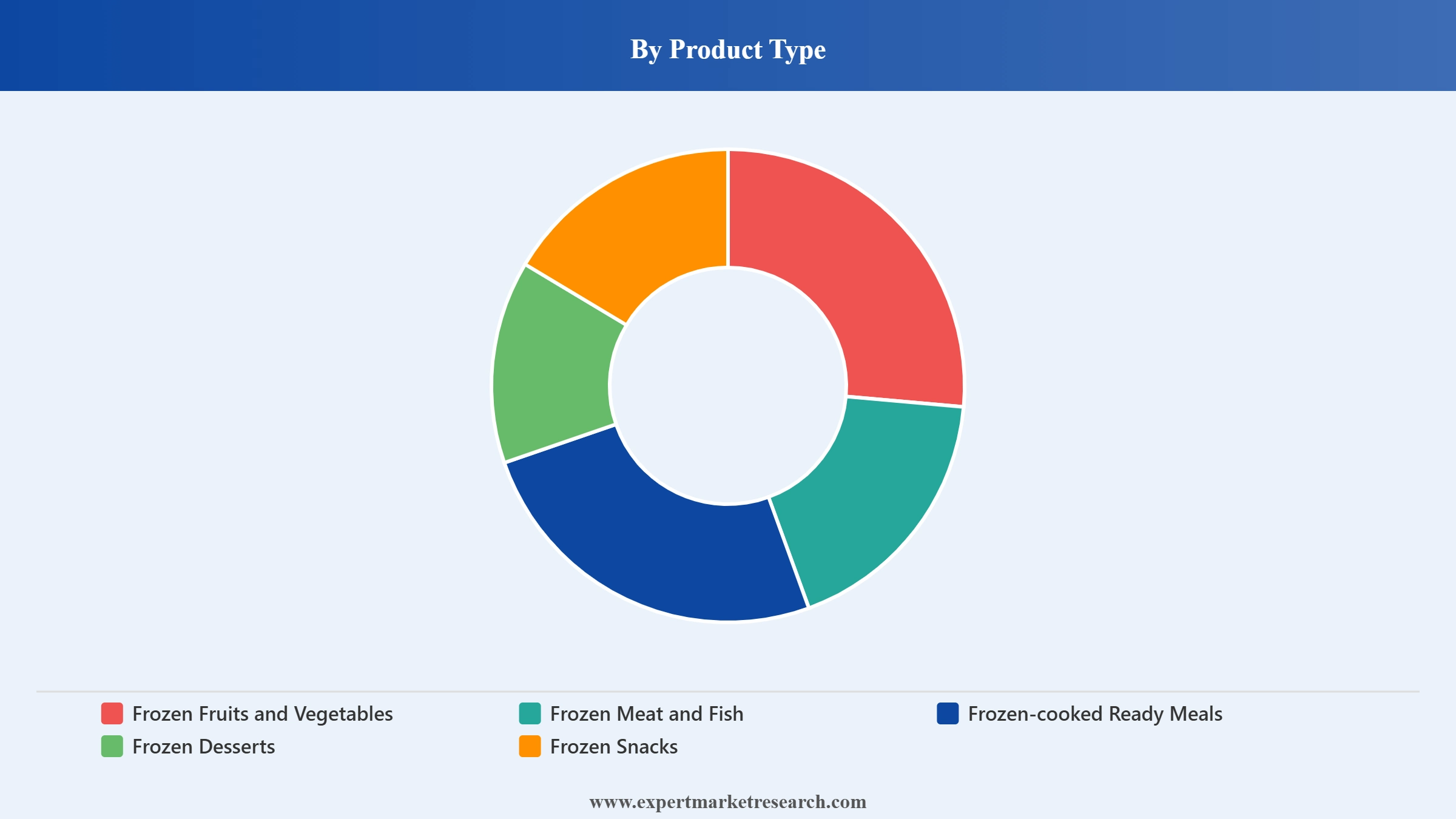
Market Breakup by Product Type
Key Insight: The Colombia frozen food market spans frozen fruits and vegetables, frozen meat and fish, frozen-cooked ready meals, frozen desserts, frozen snacks, and other specialized products. Agricultural processors are increasingly using IQF technology to convert Colombian produce into standardized, year-round ingredients, while food manufacturers are expanding prepared and snack formats designed for rapid preparation. Proterra Foods operates a 7,500-tonne multiproduct IQF facility and exports 98% of its output, illustrating the commercial relevance of processed frozen agricultural products. Meanwhile, Jumbo's 2026 assortment demonstrates substantial SKU diversity across potatoes, vegetables, yuca, snacks, pizzas, desserts, and fruit-based products. This broadens procurement opportunities for retailers, food-service distributors, and industrial users.
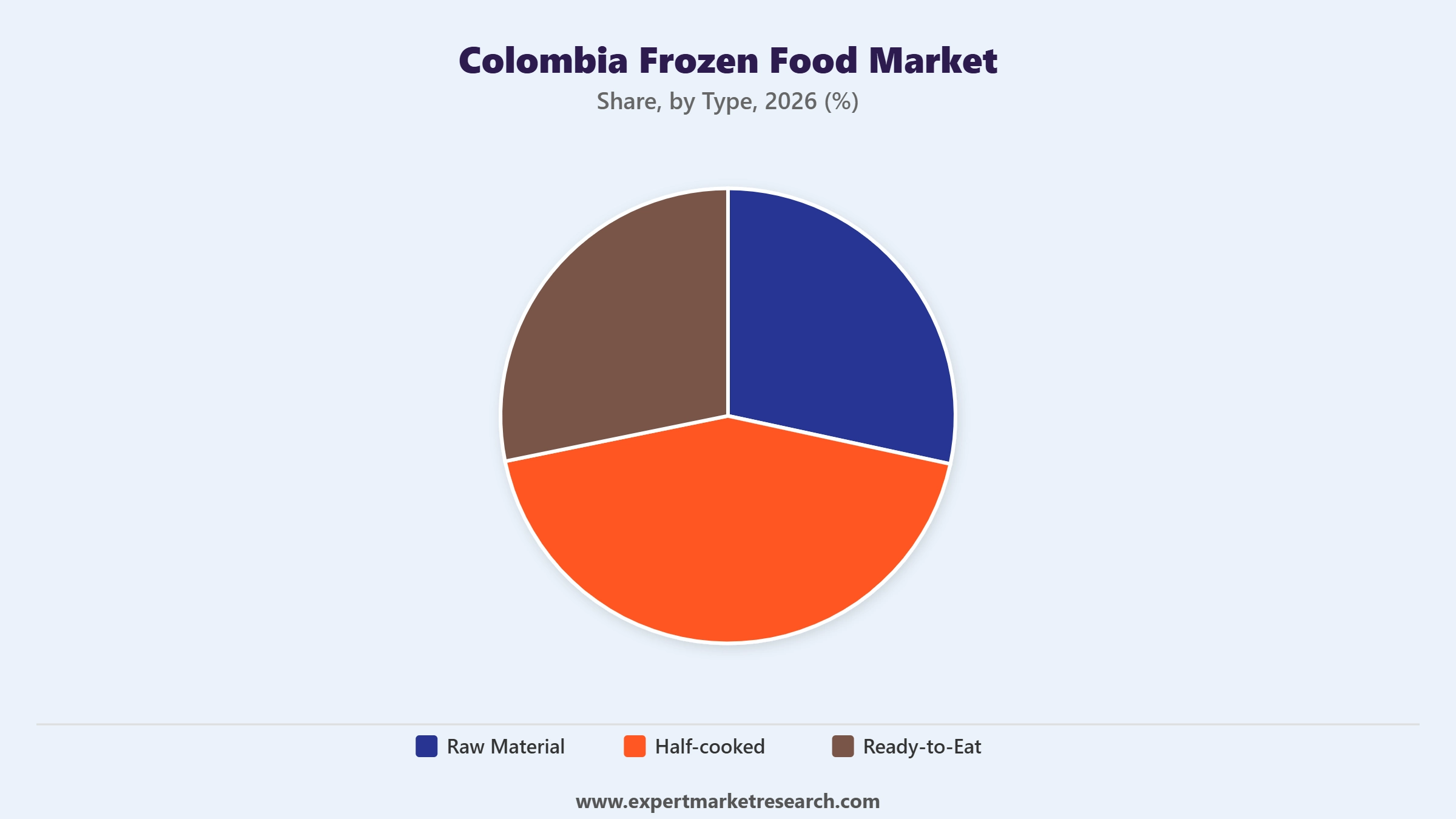
Market Breakup by Type
Key Insight: Raw-material frozen products remain important where processors, restaurants, and food manufacturers require flexibility over final preparation. Half-cooked products occupy an important middle position because they reduce kitchen labor while preserving customization, particularly in breaded foods, potato products, vegetables, and prepared components. Ready-to-eat products address the strongest requirement for speed because they minimize preparation and simplify portion management. Quick & Tasty provides an example of the convergence between industrial production and flexible product development: its facility supplies dairy, breaded, formed, and other prepared food categories and also provides maquila and co-packing services. The combination of institutional supply, retail products, and customized manufacturing supports wider adoption across all three product formats, thus driving the demand in the Colombia frozen food market.
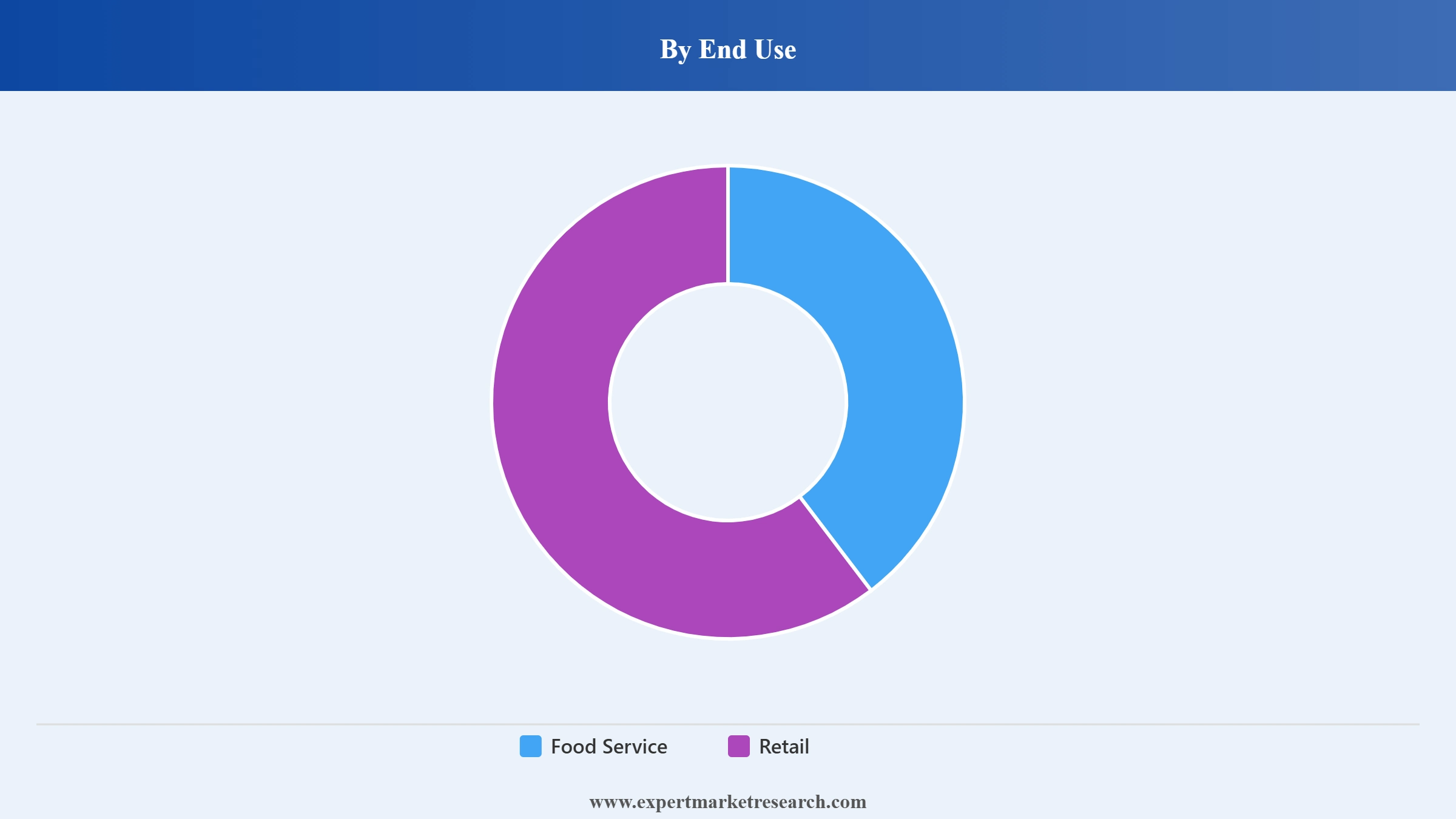
Market Breakup by End Use
Key Insight: Food service and retail are developing complementary demand pools. Food-service buyers require standardized specifications, predictable yields, consistent cooking performance, and reliable replenishment, making frozen products particularly useful for restaurants, institutional kitchens, hotels, and catering operators. Retail buyers, meanwhile, prioritize packaging, freezer rotation, household portion sizes, brand recognition, and increasingly digital visibility. Quick & Tasty reports supplying institutional customers while also operating through traditional channels, distributors, large retailers, exports, and mobile channels. On the consumer side, DANE recorded 7.3% year-on-year growth in real retail sales excluding fuels in July 2026, supporting the broader commercial environment for packaged food categories.
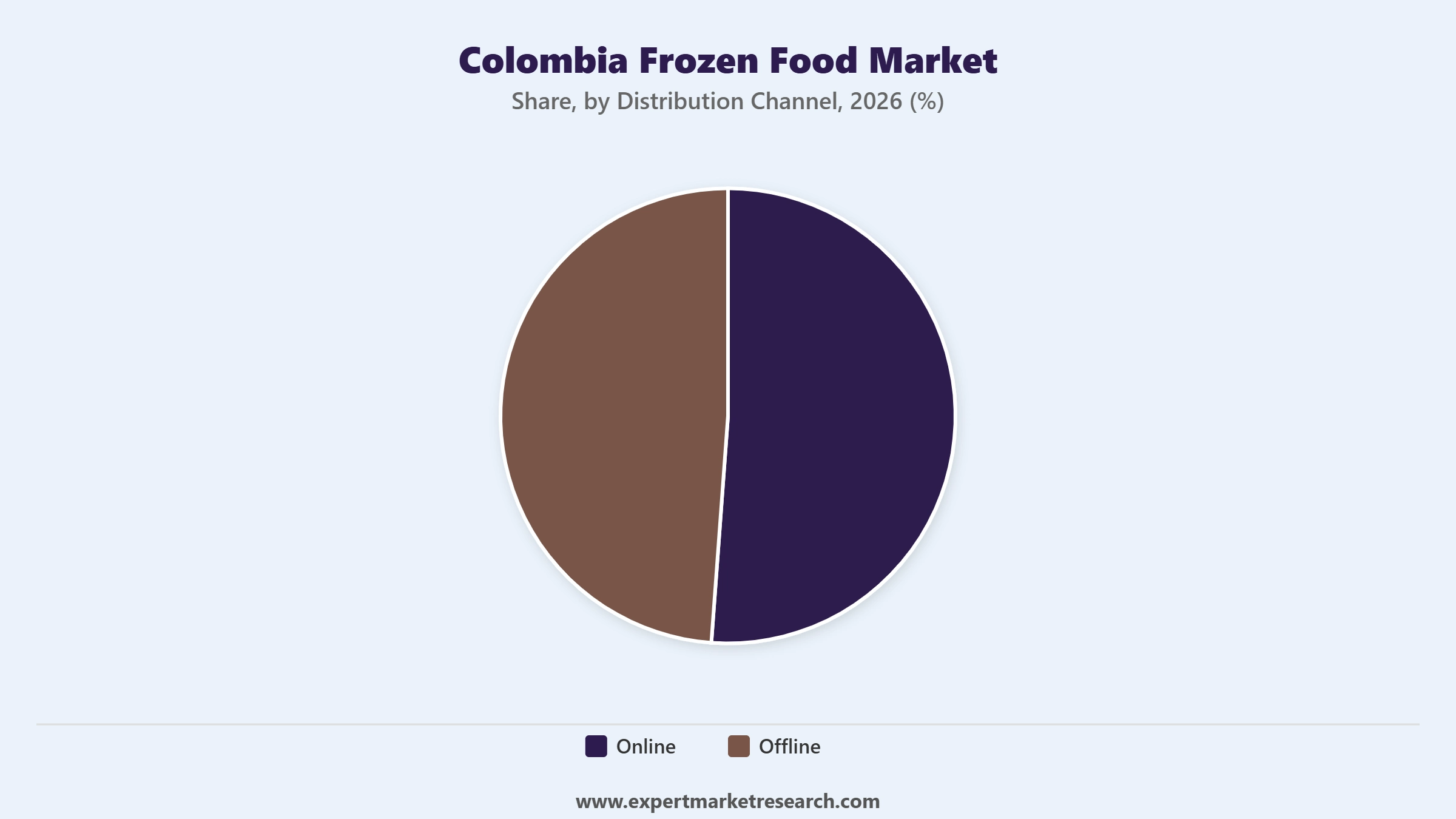
Market Breakup by Distribution Channel
Key Insight: Offline distribution remains central because frozen food depends on physical freezer infrastructure, temperature-controlled warehousing, and dependable replenishment. Supermarkets, hypermarkets, discounters, specialty stores, food-service distributors, and convenience outlets therefore remain critical for product availability. However, online distribution is gaining strategic relevance as Colombian digital commerce expands. DANE reported that e-commerce sales by measured retail companies increased 18.0% year-on-year in January 2026, while the Cámara Colombiana de Comercio Electrónico recorded 9.3 million digital buyers during 2025. The opportunity for frozen-food companies is not simply online sales, but integration of digital demand generation with regional cold-chain fulfillment and accurate inventory availability.
Read more about this report - REQUEST FREE SAMPLE COPY IN PDF
Frozen fruits and vegetables have a strong structural position because Colombia has an established agricultural base and specialized processors capable of converting produce into exportable IQF formats. Proterra Foods operates a multiproduct IQF facility with 7,500 tonnes of annual capacity, while Colfrost specializes in frozen Hass avocado in cubes, slices, vacuum-packed halves, bites, and pieces. The segment therefore serves retail, food service, and industrial ingredient demand simultaneously, giving suppliers multiple monetization routes. Such developments will thus boost Colombia frozen food market trends in the long run.
Read more about this report - REQUEST FREE SAMPLE COPY IN PDF
Frozen snacks are gaining commercial traction through convenience-oriented preparation formats, particularly products compatible with air fryers and rapid food-service cooking. Jumbo Colombia's May 2026 assortment included breaded onion rings, mozzarella sticks, jalapeño cheese products, hash browns, croquettes, and other ready-to-cook snack formats. This indicates increasing assortment depth across snack occasions and cooking methods, creating opportunities for manufacturers to differentiate through fillings, coatings, portion sizes, and cooking performance.
Ready-to-eat frozen foods offer great business potential since they minimize preparation processes and serve as standardized portions. Meals de Colombia is a company that revolves around its business of frozen foods, but its operations are based on three production facilities and 14 distribution centers in Colombia. Ready-to-eat foods are especially pertinent to food-service companies dealing with labor management and portion control. The potential value of ready-to-eat foods can also be realized in retailing by simplifying preparation, thus boosting the Colombia frozen food market revenues.
Read more about this report - REQUEST FREE SAMPLE COPY IN PDF
Half-cooked frozen foods provide a practical bridge between raw ingredients and fully prepared meals. Quick & Tasty's portfolio includes breaded products, chicken milanesa, chicken skewers, and nuggets, alongside customized food manufacturing and co-packing. These formats allow restaurants and institutional kitchens to reduce preparation labor while retaining control over cooking and final presentation. Their flexibility also makes them suitable for private-label and contract-manufacturing arrangements, creating additional opportunities for processors with adaptable production lines.
Retail remains the dominant end-use segment in Colombia’s frozen food market, supported by the broad availability of frozen potatoes, vegetables, prepared meals, poultry, and seafood through supermarkets and other consumer-facing outlets. DANE reported that real retail sales increased 5.3% year on year in July 2026, indicating continued expansion of Colombia’s retail environment. Frozen food manufacturers benefit from this channel because packaged products can be standardized for household use and distributed through established refrigerated retail infrastructure.
Read more about this report - REQUEST FREE SAMPLE COPY IN PDF
Food service is positioned for faster expansion as restaurants, hotels, cafeterias, and institutional kitchens increasingly use frozen ingredients to simplify preparation and maintain consistent portioning. Colombia’s DANE Microbusiness Survey specifically tracks economic activity across hotels and restaurants, alongside commerce and other services, reflecting the scale of this operating base. Frozen French fries, breaded chicken, vegetables, seafood, and ready-to-cook components are particularly suitable for food-service kitchens because they can be portioned and prepared according to demand without extensive on-site processing.
The offline distribution channel still serves as the main channel because frozen products need special storage space, refrigerated transportation, and physical merchandising. It is backed up by the supermarkets, hypermarkets, distributors, food service wholesalers, and conventional retailing. According to DANE's retail figures for January 2026, non-electronic retail sales accounted for 97.6% of retail sales, whereas electronic retailing only made up 2.4%. The figure covers the broader retail sector rather than frozen food specifically, but it demonstrates the continuing importance of physical distribution infrastructure.
Read more about this report - REQUEST FREE SAMPLE COPY IN PDF
The online channel is the fastest-growing distribution channel in terms of digital growth. In 2025, Colombia had e-commerce revenues worth COP 145.4 trillion, which saw an increase by 11.1%, whereas the online transactions were at 684.6 million, marking a growth rate of 19.9%. For the frozen food manufacturers, this provides an excellent opportunity to carry out digital assortment testing, fast delivery initiatives, targeted marketing campaigns, and also subscription-based replenishment. The principal constraint remains last-mile temperature control, meaning online growth will favor suppliers and retailers capable of integrating digital ordering with reliable cold-chain fulfillment.
Colombia's Andean economic corridor provides a particularly important commercial base for frozen food because Bogotá, Antioquia, and Valle del Cauca combine large consumer markets, industrial activity, food processing, logistics infrastructure, and organized retail. DANE's preliminary Urban Economic Census found that Bogotá accounted for 18% of urban economic units, Antioquia 12.5%, and Valle del Cauca 9.7%, together representing nearly 40% of the national total. January 2026 retail data also showed real retail-sales growth of 11.0% in Bogotá, 12.0% in Antioquia, and 9.0% in Valle del Cauca. These markets are therefore important for freezer placement, food-service distribution, processing partnerships, and regional warehousing, thereby directly boosting the Colombia frozen food market regional growth.
The Caribbean corridor provides a separate opportunity because Cartagena and Barranquilla connect food distribution with port infrastructure, while Santander and other interior markets are expanding their economic activity. DANE reported first-quarter 2026 departmental economic growth of 3.1% in Santander, 2.9% in Antioquia, 2.7% in Cundinamarca, 2.5% in Bogotá, 2.3% in Valle del Cauca, and 1.9% in Atlántico. Cold-chain expansion can help suppliers penetrate these secondary markets more efficiently. For exporters, Colombia's Pacific and Caribbean logistics corridors also provide access to international markets, particularly for IQF fruits, vegetables, and other agricultural frozen products.
Colombia frozen food market players are aiming to gain growth by expanding product portfolios, strengthening cold-chain capabilities, and increasing penetration across supermarkets, convenience stores, foodservice operators, and e-commerce channels. Companies are investing in frozen fruits, vegetables, prepared meals, breaded products, plantain-based foods, and other convenience-oriented formats to address demand for products that reduce preparation time. Local producers are also focusing on processing and packaging improvements to extend shelf life and maintain product quality. Export expansion is another important strategy, particularly for Colombian frozen fruit and vegetable processors seeking opportunities across North America, Europe, and other Latin American markets.
Colombia frozen food companies are also targeting growth through product differentiation, private-label manufacturing, institutional sales, and value-added processing. Frozen-food manufacturers are developing portion-controlled and ready-to-cook formats while improving packaging to support transportation and retail storage. Greater use of digital sales channels can help manufacturers reach consumers beyond traditional supermarkets, while partnerships with distributors and foodservice companies can broaden market coverage. These strategies allow players to respond to convenience trends while improving distribution efficiency and strengthening their presence in Colombia’s increasingly diversified frozen-food sector.
Established in 2018, Colfrost Zona Franca SAS is a Colombian frozen-fruit processor headquartered at the Zona Franca Internacional de Pereira, Risaralda, Colombia. The company specialises in IQF frozen fruits and vegetables, with frozen Hass avocado as its principal offering. Its portfolio includes Hass avocado in cubes, slices, vacuum-packed halves, bites and pieces, designed to preserve the fruit’s taste, aroma and texture while extending shelf life. Colfrost operates with a strong export orientation and supplies frozen avocado products to international markets.
Established in 2004, Quick and Tasty (Rápidos y Sabrosos) de Colombia S.A. is headquartered in Candelaria, Valle del Cauca, Colombia, with its industrial plant at Km 12, Cali–Candelaria, Cavasa. The company offers frozen and convenience food products under its Mr Quick brand, particularly breaded chicken products such as chicken milanesa, chicken skewers and chicken nuggets. It also provides contract manufacturing for breaded, formed and other food products, supplying institutional, retail and distribution channels across Colombia.
Established in 2006, Productora Agrícola AG CI SAS is headquartered in Zipaquirá, Cundinamarca, Colombia, where its production and logistics operations are based at Parque Logístico La Paz. The company specialises in processing, marketing and distributing frozen and dry foods. Its frozen portfolio includes pre-fried frozen plantain slices, whole ripe plantain, cassava pieces and pre-cooked creole potatoes, alongside other Latin American food products. The company has more than 30 years of family-business experience and exports its products to international markets.
Established in 2013, Inversiones Vallejuelo SAS is a Colombian agro-processing company headquartered in La Unión, Antioquia, Colombia, with operations at Km 6.5, vía La Unión–Sonsón. The company processes and preserves fruits, vegetables and tubers and supplies ready-to-use products to the foodservice and institutional sectors. Its frozen-food portfolio includes frozen mango and pineapple cubes, while its broader processed range includes peeled green plantain and fruits and vegetables in diced, sliced, grated and whole formats. The company operates under HACCP-certified food-processing standards.
Other key players in the market include Grupo Nutresa S. A., and Proterra Foods S.A.S, among others.
*Please note that this is only a partial list; the complete list of key players is available in the full report. Additionally, the list of key players can be customized to better suit your needs.*
Access the latest Colombia Frozen Food Market forecast 2026-2035 and understand the factors shaping procurement, production, distribution, and investment decisions. The report provides detailed analysis of Colombia Frozen Food Market trends 2026, market segmentation, competitive dynamics, and emerging opportunities across retail and food service. Download the sample report to evaluate the market outlook and identify actionable growth opportunities for your business.
Philippines Frozen Food Market


Upto 15% Off
USD
$2499 $2249
$3999 $3599
$4999 $4249
$5999 $5099


*While we strive to always give you current and accurate information, the numbers depicted on the website are indicative and may differ from the actual numbers in the main report. At Expert Market Research, we aim to bring you the latest insights and trends in the market. Using our analyses and forecasts, stakeholders can understand the market dynamics, navigate challenges, and capitalize on opportunities to make data-driven strategic decisions.*
The market is projected to grow at a CAGR of 5.20% between 2026 and 2035.
Key strategies driving the Colombia frozen food market include expanding cold-chain distribution, strengthening retail and e-commerce channels, introducing convenient and healthier products, investing in local sourcing and production, developing affordable product formats, improving packaging and shelf life, and expanding product availability across emerging urban markets.
The key trends aiding the market expansion include the growth of online platforms, increasing focus on product marketing, and increasing innovations by manufacturers to expand their frozen food offerings.
The major product types are frozen fruits and vegetables, frozen meat and fish, frozen-cooked ready meals, frozen desserts, and frozen snacks, among others.
The major distribution channels in the market are online and offline.
Key players in the market are Colfrost Zona Franca SAS, Quick and Tasty (Rapidos y Sabrosos) de Colombia SA, Productora Agrícola AG CI SAS, Inversiones Vallejuelo SAS, Grupo Nutresa S. A., and Proterra Foods S.A.S, among others, among others.
In 2025, the market reached an approximate value of USD 3.45 Billion.
Key challenges in the Colombia frozen food market include maintaining cold-chain infrastructure, managing high energy and logistics costs, ensuring consistent product quality, addressing storage limitations, navigating regulatory requirements, and meeting consumer demand for affordable, convenient, and nutritious frozen food products.
Explore our key highlights of the report and gain a concise overview of key findings, trends, and actionable insights that will empower your strategic decisions.
| REPORT FEATURES | DETAILS |
| Base Year | 2025 |
| Historical Period | 2019-2025 |
| Forecast Period | 2026-2035 |
| Scope of the Report |
Historical and Forecast Trends, Industry Drivers and Constraints, Historical and Forecast Market Analysis by Segment:
|
| Breakup by Product Type |
|
| Breakup by Type |
|
| Breakup by End Use |
|
| Breakup by Distribution Channel |
|
| Market Dynamics |
|
| Competitive Landscape |
|
| Companies Covered |
|
Datasheet
One User
USD 2,499
USD 2,249
tax inclusive*
Single User License
One User
USD 3,999
USD 3,599
tax inclusive*
Five User License
Five User
USD 4,999
USD 4,249
tax inclusive*
Corporate License
Unlimited Users
USD 5,999
USD 5,099
tax inclusive*
*Please note that the prices mentioned below are starting prices for each bundle type. Kindly contact our team for further details.*
Flash Bundle
Small Business Bundle
Growth Bundle
Enterprise Bundle
*Please note that the prices mentioned below are starting prices for each bundle type. Kindly contact our team for further details.*
Flash Bundle
Number of Reports: 3
20%
tax inclusive*
Small Business Bundle
Number of Reports: 5
25%
tax inclusive*
Growth Bundle
Number of Reports: 8
30%
tax inclusive*
Enterprise Bundle
Number of Reports: 10
35%
tax inclusive*
How To Order

Select License Type
Choose the right license for your needs and access rights.

Click on ‘Buy Now’
Add the report to your cart with one click and proceed to register.

Select Mode of Payment
Choose a payment option for a secure checkout. You will be redirected accordingly.
Strategic Solutions for Informed Decision-Making
Gain insights to stay ahead and seize opportunities.

Get insights & trends for a competitive edge.

Track prices with detailed trend reports.

Analyse trade data for supply chain insights.

Leverage cost reports for smart savings

Enhance supply chain with partnerships.

Connect For More Information
Our expert team of analysts will offer full support and resolve any queries regarding the report, before and after the purchase.
Our expert team of analysts will offer full support and resolve any queries regarding the report, before and after the purchase.
We employ meticulous research methods, blending advanced analytics and expert insights to deliver accurate, actionable industry intelligence, staying ahead of competitors.
Our skilled analysts offer unparalleled competitive advantage with detailed insights on current and emerging markets, ensuring your strategic edge.
We offer an in-depth yet simplified presentation of industry insights and analysis to meet your specific requirements effectively.




