

Consumer Insights
Uncover trends and behaviors shaping consumer choices today
Procurement Insights
Optimize your sourcing strategy with key market data
Industry Stats
Stay ahead with the latest trends and market analysis.
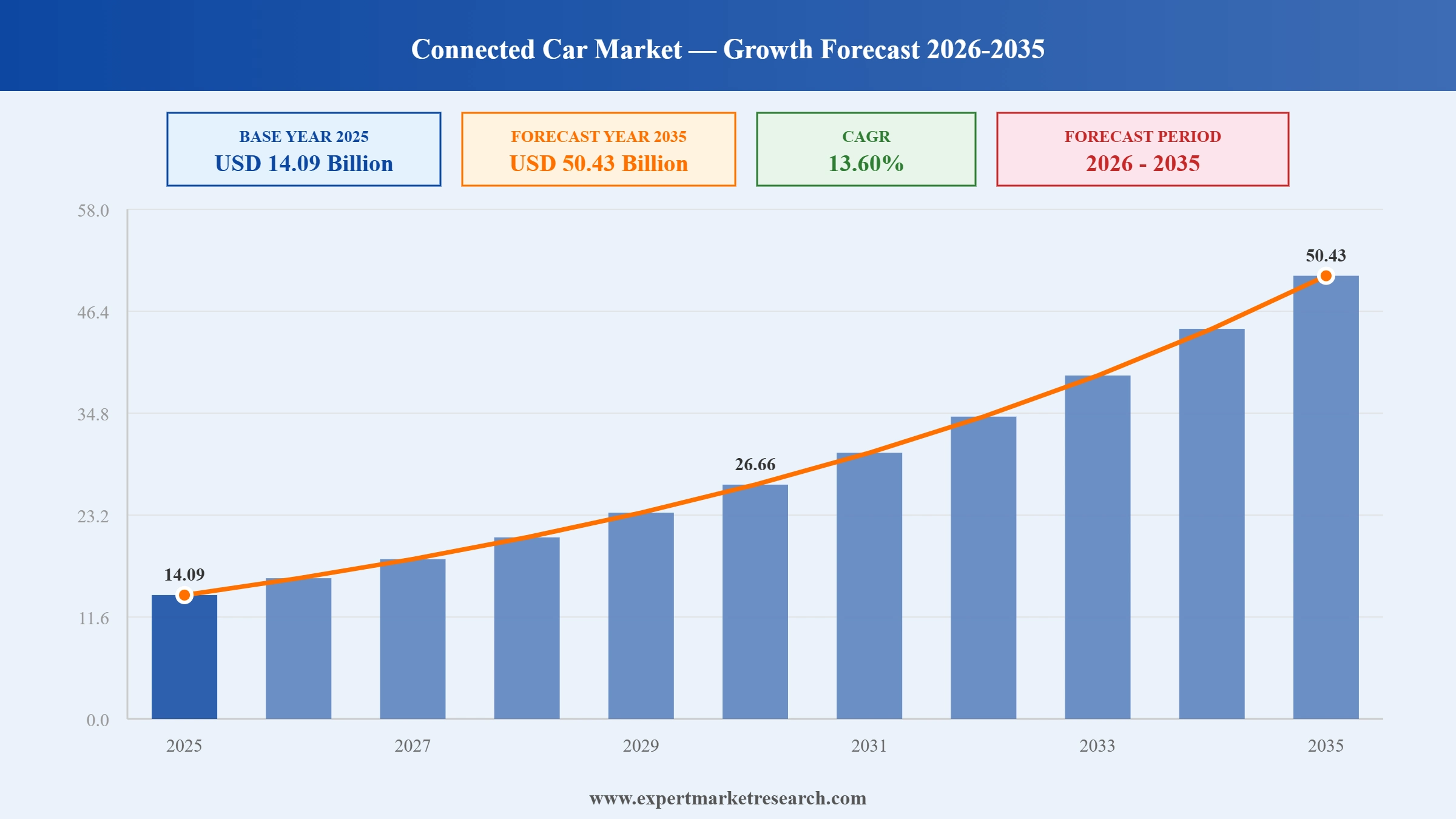
The global connected car market was valued at USD 14.09 Billion in 2025. The market is expected to grow at a CAGR of 13.60% during the forecast period of 2026-2035 to reach a value of USD 50.43 Billion by 2035. This sustained growth trajectory is driven by the accelerating integration of advanced connectivity technologies including 5G networks, vehicle-to-everything (V2X) communication systems, and artificial intelligence-powered driver assistance platforms into new vehicle designs globally. The connected car market encompasses vehicles and associated digital services that leverage internet connectivity to enhance safety, navigation, infotainment, telematics, remote diagnostics, and autonomous driving capabilities, positioning the connected car as a central node within the emerging smart mobility and smart city ecosystem.
The connected car concept has evolved substantially from early embedded navigation and hands-free calling capabilities into a sophisticated platform delivering real-time cloud connectivity, over-the-air software updates, predictive maintenance alerts, usage-based insurance services, and seamless smartphone integration. Modern connected vehicles are equipped with telematics control units (TCUs), V2X communication hardware, advanced driver assistance systems (ADAS), onboard diagnostic interfaces, and high-bandwidth communication modules that collectively generate and transmit large volumes of vehicle telemetry data to cloud platforms operated by OEMs, tier-one suppliers, and third-party service providers. The software-defined vehicle architecture is progressively decoupling vehicle functionality from hardware, enabling continuous feature enhancement and revenue generation throughout a vehicle's operational lifecycle. North America currently holds the largest regional market share, supported by a dense OEM and technology provider ecosystem, high consumer adoption of connected in-vehicle services, and a progressive regulatory environment supporting V2X deployment and ADAS mandates. Asia Pacific is the fastest-growing region, driven by the scale of China's automotive production, Japan's connected mobility technology investments, South Korea's 5G-V2X infrastructure deployment, and rapidly expanding connected vehicle markets in India, Vietnam, and Southeast Asia. Europe represents the second-largest regional market, shaped by stringent General Safety Regulation (GSR) mandates requiring ADAS features in new vehicles and an advancing C-ITS (Cooperative Intelligent Transport Systems) framework.
June 2026: The US Department of Transportation finalized rules requiring V2X communication technology in new light duty vehicles, representing the most significant connected car regulatory action in a decade and creating mandatory adoption demand for V2X hardware across the US automotive supply chain from 2028 onwards.
May 2026: South Korea completed the commercial deployment of its nationwide 5G-V2X infrastructure network covering major expressways and urban arterials, enabling real-time vehicle-to-infrastructure communication at scale and positioning South Korea as the global leader in operational V2X network coverage.
March 2026: Volkswagen AG deepened its partnership with a leading cloud software provider to accelerate Vehicle-to-Everything (V2X) capability development, targeting interoperability between its connected vehicle fleet and smart city infrastructure platforms across Europe and Asia.
October 2025: Toyota Motor Corporation launched a new initiative to develop a global network of connected vehicles leveraging cloud technology, using anonymized fleet telematics data to improve traffic management, predictive maintenance, and emission optimization across its global vehicle parc.
September 2025: Tesla unveiled an advanced AI-driven software update for its fleet incorporating enhanced autonomous navigation features, reinforcing the role of over-the-air updates as the primary vehicle feature delivery and monetization mechanism within the connected car market.
Read more about this report - REQUEST FREE SAMPLE COPY IN PDF
A connected car is a vehicle equipped with internet connectivity and the hardware and software necessary to communicate bidirectionally with external systems including cloud platforms, other vehicles, road infrastructure, mobile devices, and emergency services. This connectivity enables a broad range of services spanning real-time navigation and traffic management, over-the-air software updates, remote vehicle diagnostics, predictive maintenance alerts, in-vehicle entertainment, emergency response automation, usage-based insurance data collection, and advanced driver assistance system integration.
The connected car market encompasses the full commercial ecosystem of hardware, software, connectivity services, and data analytics platforms deployed to enable and monetize vehicle connectivity. Core connectivity architectures are classified into three categories: embedded systems, where connectivity hardware is factory-installed and operates independently; tethered solutions, where an external device such as a smartphone provides the connectivity interface; and integrated solutions, which combine embedded hardware with smartphone mirroring and cloud services. Communication technologies deployed include 3G, 4G/LTE, and 5G cellular networks, dedicated short-range communication (DSRC) for V2X applications, satellite connectivity for remote coverage, and Wi-Fi hotspot services for passenger use.
Read more about this report - REQUEST FREE SAMPLE COPY IN PDF
The connected car device ecosystem includes telematics control units (TCUs), vehicle-to-everything (V2X) communication modules, electronic control units (ECUs), onboard diagnostic (OBD) interfaces, ADAS sensors including cameras, radar, LiDAR, and ultrasonic units, as well as human-machine interface (HMI) systems including touchscreens, voice recognition, and augmented reality head-up displays. The market is shaped by regulatory frameworks including the European Union's eCall mandate requiring automatic emergency calling in new vehicles, the US NHTSA V2X communication rules, Japan's Connected and Automated Driving policy roadmap, and South Korea's C-ITS deployment program.
Road safety imperatives are the most powerful structural driver of connected car adoption globally. Advanced driver assistance systems including automatic emergency braking, lane departure warning, adaptive cruise control, blind spot monitoring, and pedestrian detection are progressively becoming mandatory in new vehicle regulations across major markets. The European General Safety Regulation, which came into force in 2024, mandates the inclusion of 19 specific ADAS features in all new vehicles sold in the EU, creating a non-discretionary demand driver for connected car hardware and software platforms across the European automotive supply chain. The US NHTSA has been advancing rulemaking for mandatory automatic emergency braking in passenger vehicles and light trucks, supplementing state-level initiatives. According to the World Health Organization, road traffic crashes kill approximately 1.35 million people annually and injure tens of millions, maintaining political pressure on governments worldwide to accelerate ADAS and connected car technology mandates.
The global commercial deployment of 5G networks is a transformative enabler for the connected car market, providing the ultra-low latency, high bandwidth, and network slicing capabilities that support safety-critical V2X communication, high-definition map streaming, autonomous driving sensor data transmission, and in-vehicle entertainment services. 5G's network slicing capability allows operators to reserve guaranteed bandwidth channels for safety-critical vehicle communication while simultaneously supporting infotainment data services on separate slices, creating a reliable quality-of-service architecture for mixed connected car service delivery. The GSMA projects that 5G connections globally will reach 5.7 billion by 2030, with automotive applications representing one of the largest non-consumer use cases for enterprise 5G deployments. South Korea, China, Japan, the United States, and Germany are the leading markets for 5G network coverage density, making them the primary early adoption zones for 5G-enabled connected car services and V2X deployments.
The rapid global transition to electric vehicles is creating a structural tailwind for connected car technology adoption, as EVs are inherently more software-intensive than internal combustion engine vehicles and are designed from inception as connected, over-the-air-updatable platforms. EV manufacturers including Tesla have demonstrated the commercial viability of the software-defined vehicle architecture, where a vehicle's features, performance parameters, and safety systems are continuously updated and expanded through OTA software deployments rather than hardware modifications. The International Energy Agency reported that global EV sales exceeded 14 million units in 2023, with the connected car service penetration rate significantly higher among EVs than comparable ICE models. Chinese EV manufacturers including BYD, Nio, Li Auto, and Xpeng are deploying highly sophisticated connected car platforms with OTA update cadences, AI driver assistance, and subscription service models that are redefining consumer expectations for in-vehicle connectivity globally.
Government policy is a powerful demand accelerator for the connected car market across all major geographies. The European Union's eCall regulation, already enforced, requires all new passenger cars and light commercial vehicles to include a built-in emergency call system that automatically contacts emergency services in the event of a serious accident. The EU's C-ITS Delegated Regulation establishes a legal framework for cooperative intelligent transport system deployment, enabling connected vehicles to communicate with road infrastructure across member states. The US Department of Transportation is advancing V2X communication mandates for new light-duty vehicles following the finalization of V2X rules in 2026. Japan's Connected and Automated Driving policy roadmap sets targets for OTA-capable vehicle penetration and V2I infrastructure deployment across national highway networks. South Korea's C-ITS program has deployed connected road infrastructure across its expressway network, creating operational V2X coverage for commercially available connected vehicles.
Vehicle-to-everything communication, encompassing vehicle-to-vehicle (V2V), vehicle-to-infrastructure (V2I), vehicle-to-pedestrian (V2P), and vehicle-to-network (V2N) communication, is transitioning from research and pilot phases to commercial deployment in leading connected car markets. V2X enables connected vehicles to exchange safety-critical information including location, speed, heading, and hazard data with surrounding vehicles and roadside infrastructure at latencies below 10 milliseconds, enabling collision avoidance, emergency vehicle preemption, and intelligent traffic signal coordination applications. The two competing V2X radio technologies, Dedicated Short-Range Communications (DSRC) based on IEEE 802.11p and Cellular V2X (C-V2X) based on 3GPP standards, have been largely resolved in favor of C-V2X in most major markets, providing a clear technical path for large-scale deployment. The US DOT's finalized V2X communication mandate, the EU's C-ITS Delegated Regulation, and South Korea's national 5G-V2X infrastructure rollout collectively represent the most significant regulatory tailwinds in the connected car market.
Over-the-air software update capability is becoming a standard feature in new vehicles across all major OEMs, fundamentally transforming the vehicle lifecycle economics and customer relationship model for automotive manufacturers. OTA updates allow manufacturers to deploy safety patches, feature additions, performance improvements, and subscription service activations without requiring a dealership visit, reducing warranty costs, improving customer satisfaction, and creating new recurring revenue streams from post-sale feature unlocking. The software-defined vehicle architecture, pioneered by Tesla and rapidly adopted by Chinese EV manufacturers, is now being implemented by traditional OEMs including Volkswagen, General Motors, Stellantis, and BMW, requiring fundamental reorganization of automotive software development processes, supplier relationships, and vehicle electrical architectures. AUTOSAR Adaptive Platform, Android Automotive OS, and QNX Neutrino RTOS are competing software platforms underpinning the software-defined vehicle transformation in the connected car market.
Artificial intelligence is transforming the connected car user experience across infotainment, navigation, driver assistance, and predictive services. Large language model-based voice assistants are replacing earlier generation command-recognition interfaces with natural conversation capabilities, enabling voice-controlled navigation, climate control, media selection, and vehicle settings without touchscreen interaction. AI-powered personalization engines analyze driver behavior, route preferences, and connected service usage patterns to proactively recommend navigation routes, predict maintenance needs, and optimize energy consumption in electric vehicles. The progressive convergence of connected car platforms with autonomous driving capabilities is creating a spectrum from advanced driver assistance to conditional automation (SAE Level 3) and beyond, with connected vehicle data networks providing the HD map updates, real-time hazard information, and regulatory reporting infrastructure that autonomous vehicle operation requires.
Read more about this report - REQUEST FREE SAMPLE COPY IN PDF
The expanding connectivity surface of modern vehicles has created significant cybersecurity vulnerabilities that regulators, OEMs, and cybersecurity specialists are actively working to address. The UNECE WP.29 Cybersecurity Regulation, which became mandatory for new vehicle type approvals in the EU, Japan, and South Korea, requires OEMs to implement cybersecurity management systems covering the full vehicle lifecycle from design through decommissioning. The ISO/SAE 21434 standard provides a technical framework for automotive cybersecurity engineering that is increasingly referenced in regulatory requirements and OEM supplier contracts. Cybersecurity threats targeting connected vehicle systems include remote code execution through telematics interfaces, unauthorized OBD port access, compromised OTA update mechanisms, and vehicle-to-cloud communication interception. The growing volume of personal data generated by connected car services, including precise location histories, driving behavior profiles, and occupant biometrics, is also attracting data privacy regulatory scrutiny under GDPR in Europe, CCPA in California, and sector-specific frameworks in China and South Korea.
Read more about this report - REQUEST FREE SAMPLE COPY IN PDF
The connected car market faces substantial challenges centered on cybersecurity risk management and data privacy compliance. The growing attack surface of network-connected vehicles creates systemic vulnerabilities that, if exploited, could affect vehicle safety systems, fleet management platforms, and large populations of identically configured vehicles simultaneously. Security researchers have demonstrated remote exploitation of vehicle telematics interfaces, keyless entry systems, and CAN bus networks on production vehicles, highlighting the real-world security consequences of inadequate cybersecurity engineering. OEMs face the challenge of maintaining software security across multi-year vehicle production runs and decade-long operational lifetimes, requiring ongoing security patch deployment, vulnerability monitoring, and incident response capabilities that are new organizational competencies for traditional automotive manufacturers. Consumer data privacy concerns, amplified by high-profile data breach incidents and investigative journalism covering OEM data collection practices, are creating reputational risks and regulatory scrutiny that could constrain connected service adoption among privacy-conscious consumer segments.
Structural restraints moderate the pace of connected car market expansion across several dimensions. The high cost of embedded connectivity hardware and data plan subscription fees adds to vehicle purchase prices in a market already under affordability pressure from EV price premiums, creating adoption barriers particularly in emerging markets and for price-sensitive consumer segments. The fragmentation of global V2X standards, network infrastructure deployment timelines, and regulatory frameworks across major markets creates engineering complexity for OEMs seeking to deploy globally consistent connected car platforms, increasing development costs and extending time-to-market for new connected services. 4G/LTE network coverage limitations in rural and remote areas create connected service availability gaps that undermine the reliability promise of connected car value propositions, particularly for navigation, emergency calling, and fleet telematics applications in low-density markets. The shortage of automotive software engineering talent with expertise in cloud connectivity, cybersecurity, and embedded software development is constraining the pace at which traditional OEMs can build in-house software capabilities required to compete with technology-native EV manufacturers.
Read more about this report - REQUEST FREE SAMPLE COPY IN PDF
The connected car market offers exceptional long-term growth opportunities across technology, services, data, and geographic dimensions. The software-defined vehicle transition creates a multi-decade revenue opportunity from post-sale feature unlocking, subscription services, OTA update monetization, and connected service platform fees that is estimated to generate revenues exceeding USD 400 billion annually by 2030 across the global automotive industry. The integration of connected car platforms with smart city infrastructure, V2X communication networks, and autonomous mobility services creates systemic value generation opportunities for OEMs, technology providers, and infrastructure operators that extend well beyond the vehicle itself. Emerging markets including India, Vietnam, Brazil, and Gulf Cooperation Council countries represent significant long-term demand pools with rapidly growing vehicle fleets, expanding 4G and 5G coverage, and government smart mobility investment programs. Usage-based insurance, predictive maintenance services, personalized mobility subscriptions, and in-vehicle commerce are early-stage but high-potential revenue streams that connected car platforms are uniquely positioned to deliver. Stakeholders seeking comprehensive intelligence on technology adoption trajectories, segment-level revenue forecasts, regulatory pathway analysis, and competitive positioning are invited to access the full Expert Market Research Connected Car Market Report and Forecast 2026-2035.
The EMR’s report titled “Connected Car Market Report and Forecast 2026-2035” offers a detailed analysis of the market based on the following segments:
Breakup by Network Type
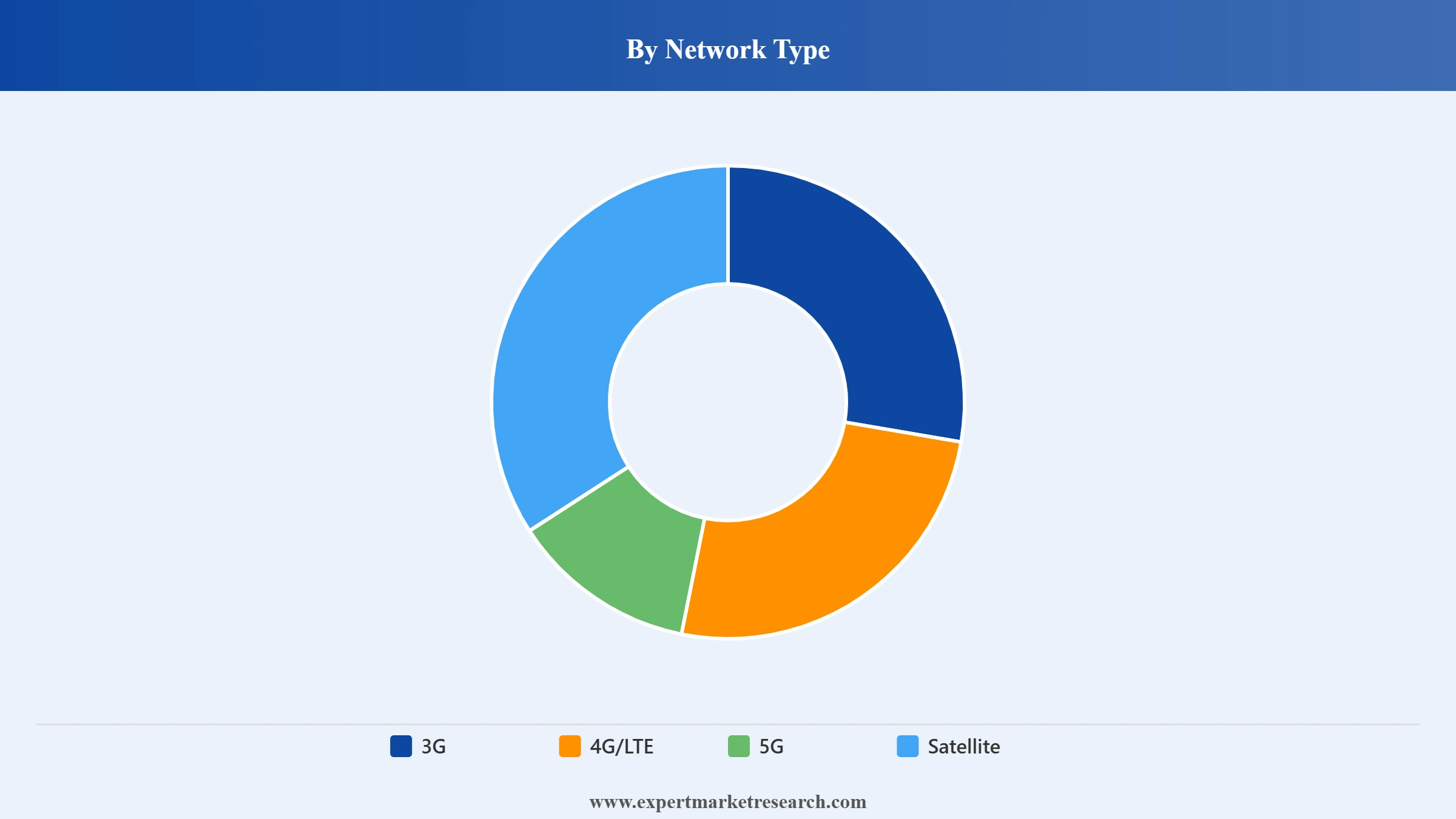
Key Insighta: The connected car market is segmented across 3G, 4G/LTE, 5G, and satellite connectivity. 4G/LTE dominates the current installed base, delivering reliable telematics and infotainment services at scale. 5G is the fastest-growing network type, enabling ultra-low latency V2X communication and autonomous driving data transmission. Satellite connectivity addresses remote and rural coverage gaps where cellular networks remain unavailable.
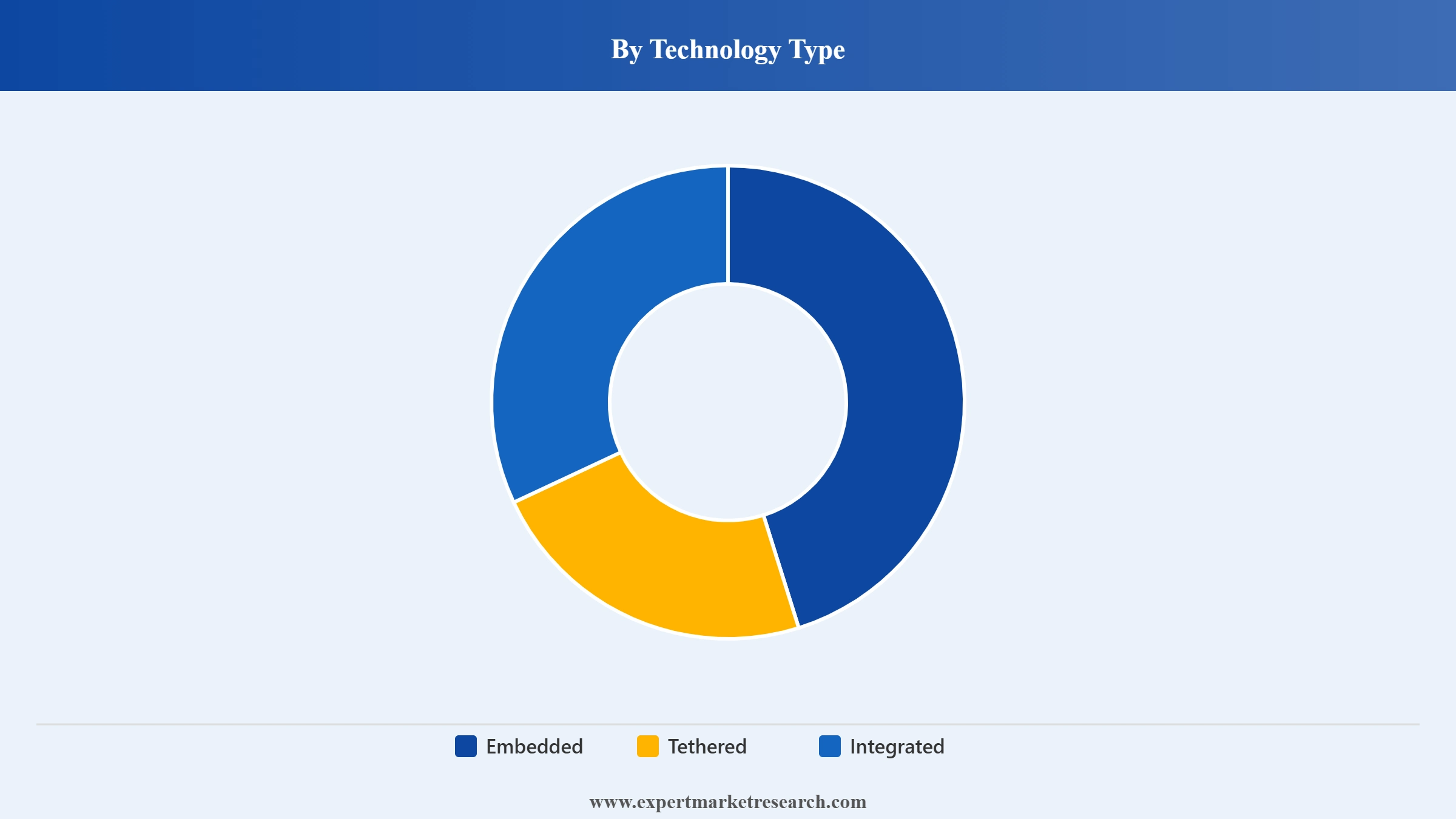
Breakup by Technology Type
Key Insights: Connected car technology is classified as embedded, tethered, and integrated. Embedded systems, with factory-installed cellular modems, dominate the OEM segment for always-on connectivity. Tethered solutions rely on smartphone pairing via Bluetooth or USB, offering a cost-effective aftermarket connectivity option. Integrated technology combines both embedded hardware and smartphone mirroring, delivering the broadest feature set across navigation, infotainment, and remote services.
Breakup by Service
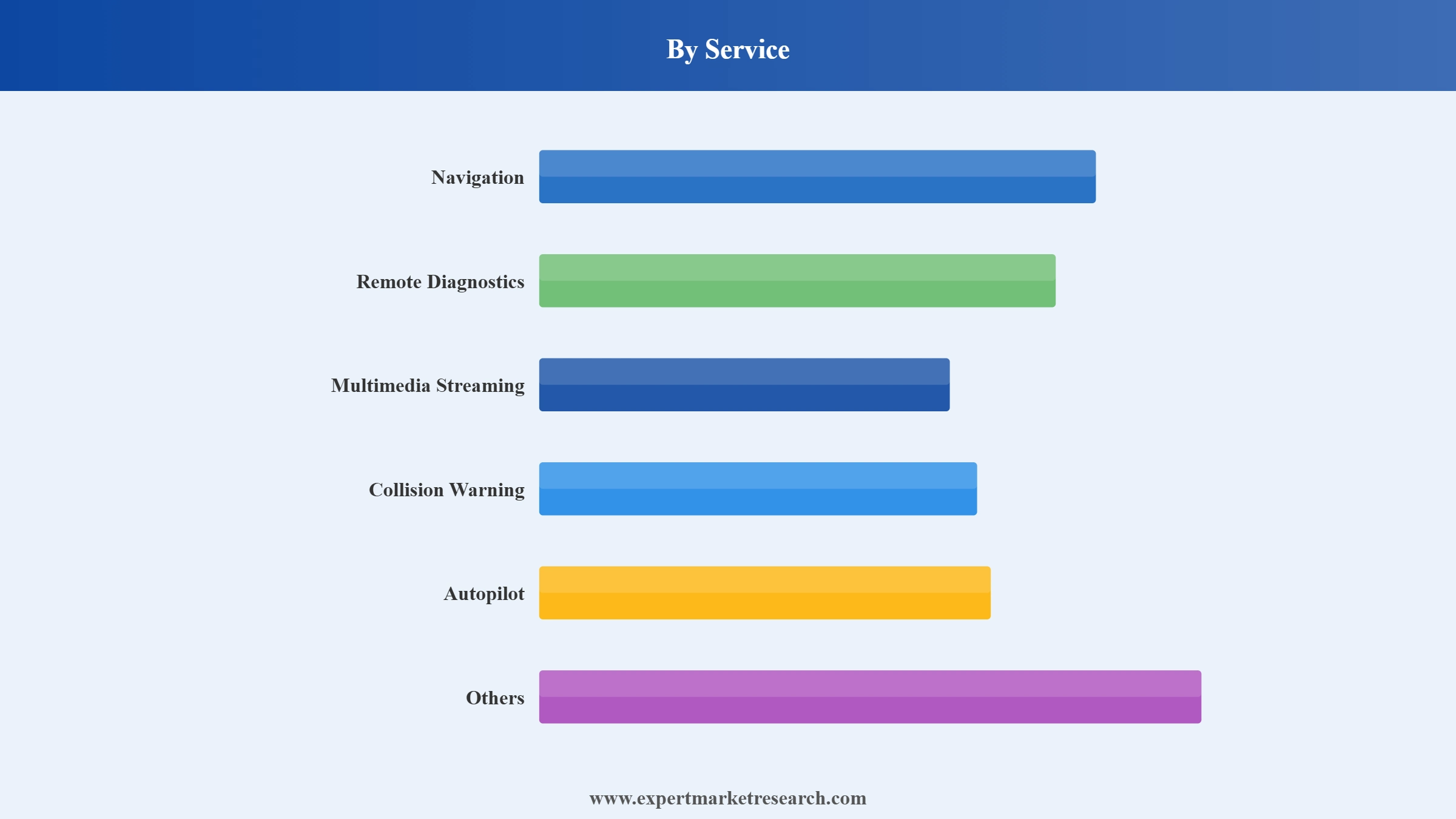
Key Insights: Key connected car services include navigation, remote diagnostics, multimedia streaming, collision warning, autopilot, and others. Navigation leads by adoption, supported by real-time traffic and HD mapping. Remote diagnostics enables predictive maintenance and OTA health monitoring. Collision warning is the fastest-growing safety service, driven by ADAS mandates. Autopilot and multimedia streaming are expanding rapidly alongside software-defined vehicle architectures and 5G network deployment.
Breakup by Communication Type
Key Insights: The connected car market operates across two primary communication modes: vehicle-to-vehicle (V2V) and vehicle-to-infrastructure (V2I). V2V communication enables direct data exchange between nearby vehicles for collision avoidance and cooperative driving safety applications. V2I connects vehicles with traffic signals, road sensors, and smart infrastructure for real-time hazard alerts, intersection management, and optimised traffic flow, forming the foundational architecture of intelligent transport systems globally.
Breakup by Sales Channel
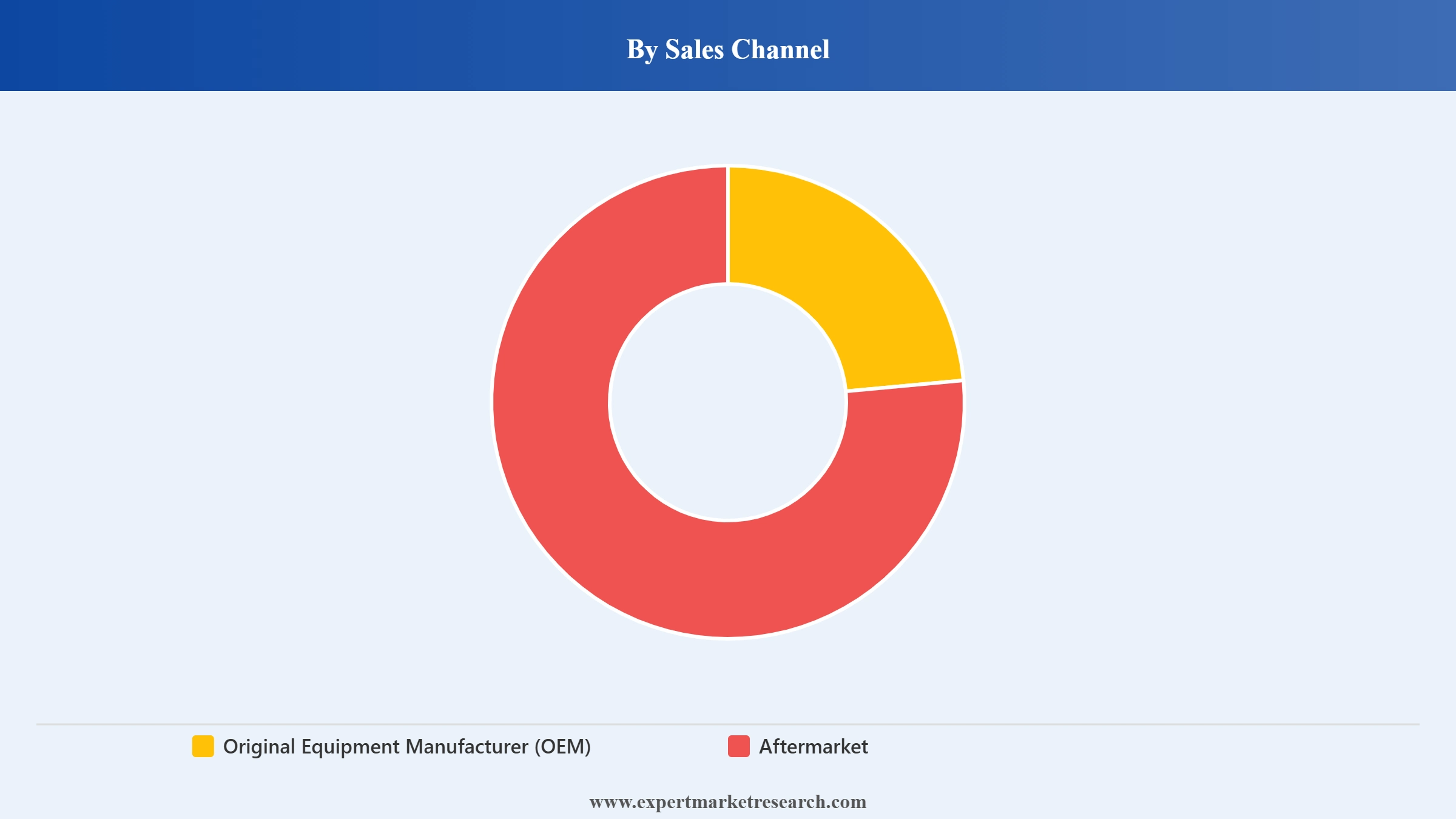
Key Insights: Connected car products and services are distributed through OEM and aftermarket sales channels. The OEM segment dominates, accounting for approximately 65% of market revenue, as automakers embed connectivity hardware and software platforms at the point of manufacture. The aftermarket segment is growing steadily, driven by demand for retrofit telematics devices, OBD dongles, and connectivity upgrade solutions for existing vehicle fleets.
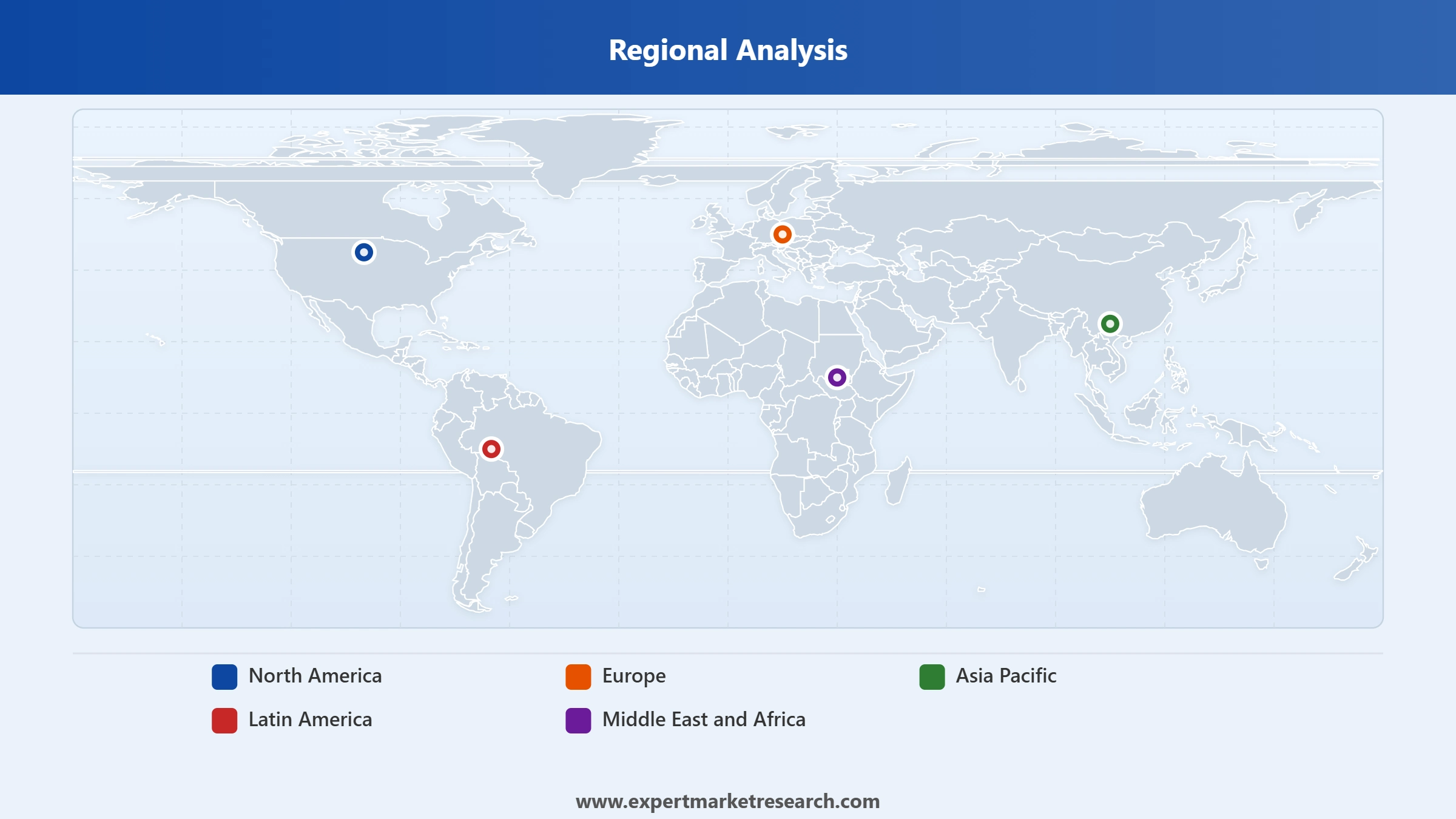
By region, the market is classified into:
Read more about this report - REQUEST FREE SAMPLE COPY IN PDF
North America is the largest regional market for connected cars, anchored by the United States automotive and technology ecosystem. The US market benefits from strong OEM investment in connected platforms by General Motors (OnStar), Ford (Ford Pro Intelligence / BlueCruise), Stellantis (Uconnect), and Tesla, combined with a consumer base with high smartphone integration expectations and growing 5G network coverage. The US DOT's finalization of V2X communication rules in 2026 is the most significant regulatory development in the North American connected car market, creating mandatory hardware demand for V2X-capable vehicles entering production from 2028. Qualcomm Technologies' Snapdragon Automotive platform dominates the connected car semiconductor supply chain in North America, powering connected car systems across multiple OEM platforms. Canada follows with strong smart mobility investment, while Mexico is an emerging connected car production hub as OEMs invest in manufacturing near-shoring strategies.
Read more about this report - REQUEST FREE SAMPLE COPY IN PDF
Europe is the second-largest regional market, characterized by a dense regulatory framework that is systematically driving connected car adoption across all vehicle segments. The General Safety Regulation (GSR), which became mandatory for new vehicle type approvals in 2024, requires 19 specific ADAS features in new cars sold in the EU, creating non-discretionary connected car hardware demand across the region. The eCall mandate, already in force, requires automatic emergency calling in all new vehicles. The EU's C-ITS Delegated Regulation is establishing interoperability standards for V2X communication between vehicles and road infrastructure. Germany is the largest European national market, housing Volkswagen Group, BMW, Mercedes-Benz, Continental AG, Robert Bosch, and ZF Friedrichshafen. The UK retains a significant connected car market outside the EU regulatory framework, with OEM connectivity adoption driven by consumer demand and NCAP safety ratings. France and Italy are significant markets, supported by Renault and Stellantis OEM connectivity programs respectively.
Asia Pacific is the fastest-growing regional market, driven by the combined automotive production scale of China and Japan, South Korea's advanced 5G-V2X infrastructure, India's rapidly expanding vehicle fleet, and emerging adoption in Vietnam and Southeast Asia. China holds the largest APAC market share, with domestic OEM brands including BYD, Nio, Li Auto, Xpeng, and Huawei-backed AITO deploying highly sophisticated connected car platforms that integrate AI voice assistants, OTA update platforms, V2X hardware, and subscription service ecosystems as core vehicle features. Japan represents a mature, high-value connected car market where Toyota, Honda, and Sony Honda Mobility (AFEELA) are investing in cloud-connected mobility platforms and cooperative driving technologies. South Korea completed nationwide 5G-V2X expressway coverage in 2026, with Hyundai, Kia, and LG Electronics driving connected car innovation. India is one of the fastest-growing national connected car markets, supported by OEM technology upgrades from Tata Motors, Maruti Suzuki, Hyundai India, and Ola Electric. Vietnam is a rapidly developing connected car market, with VinFast deploying connected electric vehicles domestically and internationally.
Latin America is an emerging connected car market, led by Brazil and Mexico. Brazil represents the largest national market within Latin America, driven by a large vehicle fleet, expanding 4G coverage, and growing consumer demand for in-vehicle connectivity among urban middle-class buyers. Connectivity features including infotainment, navigation, and remote vehicle access are increasingly offered as standard or optional equipment across volume market models. Mexico is significant both as a consumer market and as an automotive manufacturing hub, with OEM plants producing connected-capable vehicles for export and domestic sale. Challenges including economic volatility, high consumer price sensitivity, and limited 5G coverage outside major metropolitan areas moderate the pace of advanced connected service adoption, with 4G-based telematics and navigation services representing the dominant connected car application tier in the region.
The Middle East and Africa region is at an early but high-potential stage of connected car market development. The Gulf Cooperation Council countries, particularly the UAE and Saudi Arabia, represent the leading markets, characterized by high vehicle ownership rates, premium vehicle preferences, and significant government investment in smart city and intelligent transport system infrastructure. Dubai's Roads and Transport Authority has been actively deploying V2X roadside infrastructure as part of its smart mobility strategy, creating early-stage operational connected car infrastructure. Saudi Arabia's Vision 2030 program is directing investment into digital infrastructure including 5G networks and smart transportation systems that will support connected car adoption. Sub-Saharan Africa presents a longer-term opportunity as vehicle fleet growth, mobile internet expansion, and OEM connectivity investment progressively extend connected car services to new consumer segments.
The report offers an extensive assessment of major players in the global connected car market; it evaluates their capability, observes latest occurrences such as mergers and acquisitions, capacity expansions, and plant turnarounds:
Using SWOT analysis and Porter’s Five Forces model, the EMR report offers deep insights into the industry.


Upto 15% Off
USD
$2499 $2249
$3999 $3599
$4999 $4249
$5999 $5099


*While we strive to always give you current and accurate information, the numbers depicted on the website are indicative and may differ from the actual numbers in the main report. At Expert Market Research, we aim to bring you the latest insights and trends in the market. Using our analyses and forecasts, stakeholders can understand the market dynamics, navigate challenges, and capitalize on opportunities to make data-driven strategic decisions.*
The market is projected to grow at a CAGR of 13.60% between 2026 and 2035.
The major market drivers are the increasing demand for safer vehicles and growing technological advancements.
The key market trends include advancements in connectivity such as 5G networks, and government regulations encouraging the use of connected cars.
The major regions in the market are North America, Europe, the Asia Pacific, Latin America, and the Middle East and Africa.
The various network types in the market for connected cars include 3G, 4G/LTE, 5G, and Satellite.
The various technology types in the market for connected cars include embedded, tethered, and integrated.
The various services in the market for connected cars include navigation, remote diagnostics, multimedia streaming, collision warning, and autopilot, among others.
The various communication type in the market for connected cars includes Vehicle to Vehicle and Vehicle to Infrastructure.
The different sales channels in the market for connected cars include aftermarket and original equipment manufacturers (OEM).
The major players in the connected car market are Qualcomm Technologies Inc, General Motors Company, Robert Bosch GmbH, AT and T Inc, Samsung Electronics Co. Ltd, Airbiquity Inc., Telefonaktiebolaget LM Ericsson, HARMAN International, Continental AG, and CloudMade, among others.
In 2025, the global connected car market reached an approximate value of USD 14.09 Billion.
The market is expected to witness steady growth during the forecast period of 2026-2035 to reach a value of USD 50.43 Billion by 2035.
Explore our key highlights of the report and gain a concise overview of key findings, trends, and actionable insights that will empower your strategic decisions.
| REPORT FEATURES | DETAILS |
| Base Year | 2025 |
| Historical Period | 2019-2025 |
| Forecast Period | 2026-2035 |
| Scope of the Report |
Historical and Forecast Trends, Industry Drivers and Constraints, Historical and Forecast Market Analysis by Segment:
|
| Breakup by Network Type |
|
| Breakup by Technology Type |
|
| Breakup by Service |
|
| Breakup by Communication Type |
|
| Breakup by Sales Channel |
|
| Breakup by Region |
|
| Market Dynamics |
|
| Competitive Landscape |
|
| Companies Covered |
|
Datasheet
One User
USD 2,499
USD 2,249
tax inclusive*
Single User License
One User
USD 3,999
USD 3,599
tax inclusive*
Five User License
Five User
USD 4,999
USD 4,249
tax inclusive*
Corporate License
Unlimited Users
USD 5,999
USD 5,099
tax inclusive*
*Please note that the prices mentioned below are starting prices for each bundle type. Kindly contact our team for further details.*
Flash Bundle
Small Business Bundle
Growth Bundle
Enterprise Bundle
*Please note that the prices mentioned below are starting prices for each bundle type. Kindly contact our team for further details.*
Flash Bundle
Number of Reports: 3
20%
tax inclusive*
Small Business Bundle
Number of Reports: 5
25%
tax inclusive*
Growth Bundle
Number of Reports: 8
30%
tax inclusive*
Enterprise Bundle
Number of Reports: 10
35%
tax inclusive*
How To Order

Select License Type
Choose the right license for your needs and access rights.

Click on ‘Buy Now’
Add the report to your cart with one click and proceed to register.

Select Mode of Payment
Choose a payment option for a secure checkout. You will be redirected accordingly.
Strategic Solutions for Informed Decision-Making
Gain insights to stay ahead and seize opportunities.

Get insights & trends for a competitive edge.

Track prices with detailed trend reports.

Analyse trade data for supply chain insights.

Leverage cost reports for smart savings

Enhance supply chain with partnerships.

Connect For More Information
Our expert team of analysts will offer full support and resolve any queries regarding the report, before and after the purchase.
Our expert team of analysts will offer full support and resolve any queries regarding the report, before and after the purchase.
We employ meticulous research methods, blending advanced analytics and expert insights to deliver accurate, actionable industry intelligence, staying ahead of competitors.
Our skilled analysts offer unparalleled competitive advantage with detailed insights on current and emerging markets, ensuring your strategic edge.
We offer an in-depth yet simplified presentation of industry insights and analysis to meet your specific requirements effectively.




