

Consumer Insights
Uncover trends and behaviors shaping consumer choices today
Procurement Insights
Optimize your sourcing strategy with key market data
Industry Stats
Stay ahead with the latest trends and market analysis.
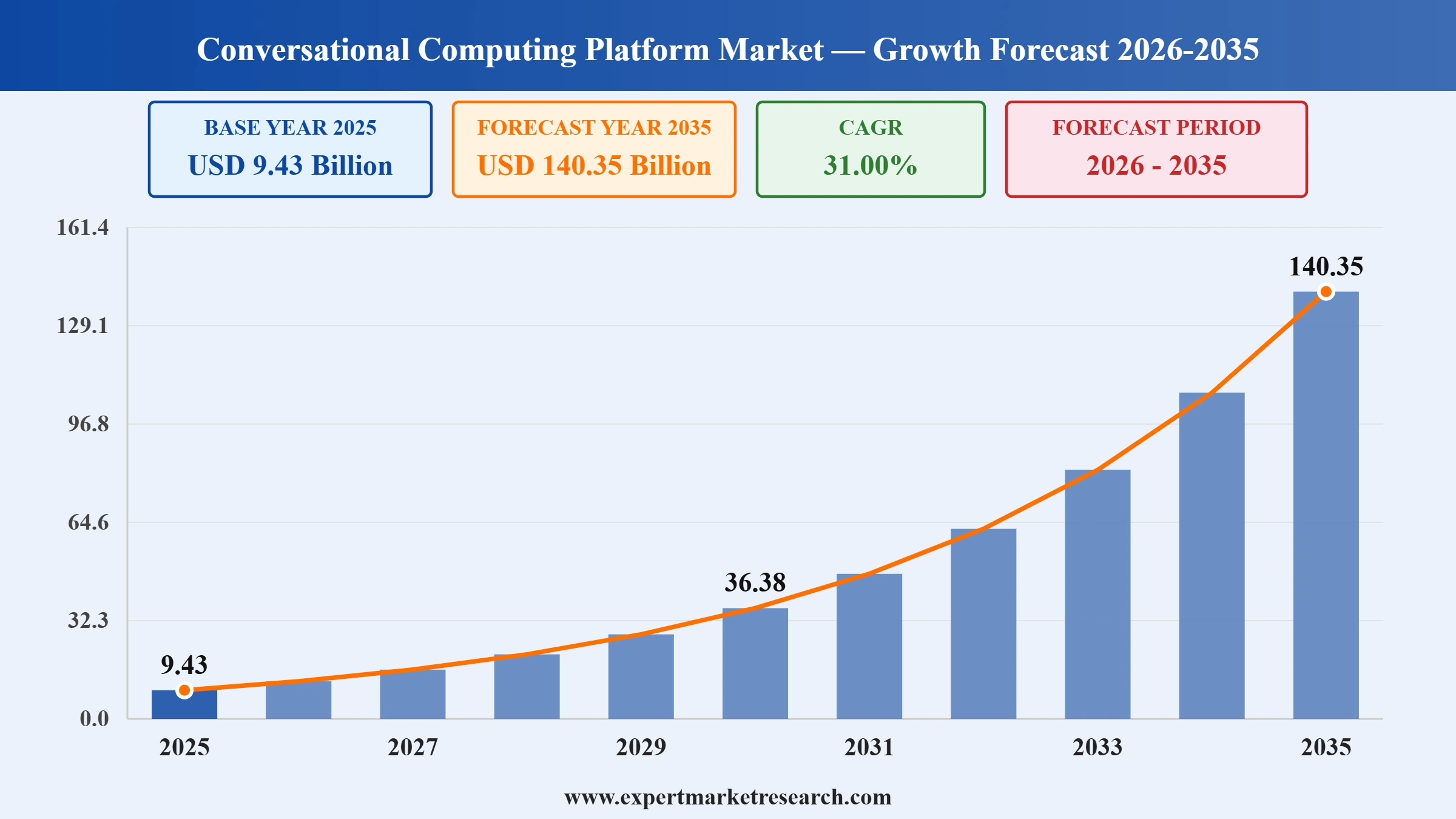
The global conversational computing platform market attained a value of USD 9.43 Billion in 2025 and is projected to expand at a CAGR of 31.00% through 2035. The market is further expected to achieve USD 140.35 Billion by 2035. As companies start to value increased productivity and effectiveness more than simple conversational capabilities that involve processing of data and execution of multistep procedures, the adoption of platforms offering artificial intelligence agents capable of working with proprietary data and executing complex workflows is becoming significantly higher.
There are two driving factors increasing demand in the conversational computing platform market. The first one is vendors' improvement of real-time data access provided through connectors that enable agents to use proprietary context available in CRM systems, as well as other tools used by developers and operations personnel, while keeping the same level of access permissions. The second one is enterprise agentic workflow automation which involves using platforms not only for answering questions but also for performing tasks.
The conversational computing platform market is shifting from chatbot deployment to enterprise-level platforms that provide reasoning over proprietary data, workflow execution, and decision-making on specific domains. The emergence of Google Gemini Enterprise was the first step in this direction, and its latest version of Gemini Enterprise Agent Platform, launched in April 2026, offers low-code agent development, governance capabilities, and long-running agents to handle workflows. More than 8 million paid seats of Gemini Enterprise within more than 2,800 enterprises are reported by Google, demonstrating the transformation of conversational interfaces into an enterprise operating layer.
Microsoft is adopting a similar strategy of developing Copilot Studio for enterprise knowledge integration. The Copilot connectors enable the retrieval of information from external sources while honoring the permission settings of the source, which allows sales, service, development, and operations teams to ask questions about business data without copying it to separate repositories. The previous versions of Copilot Studio offers connectors for GitHub, Salesforce Knowledge, Stack Overflow, and Unily, which shows the efforts of vendors to address heterogeneous enterprise settings rather than closed systems.
Read more about this report - REQUEST FREE SAMPLE COPY IN PDF
Conversational AI shopping by Newegg allowed shoppers to search for products using natural language questions and personalized recommendations. Businesses can develop conversational commerce platforms which involve product discovery, recommendation engines, and purchasing assistance, boosting the overall conversational computing platform market development.
Taboola offered an advertising platform for the AI answer engines. This would allow companies to access their audience through AI and conversational search. Advertising technology companies can design an AI solution that can incorporate sponsored recommendations.
Next-gen conversational AI agents were launched by Plataine, assisting manufacturers to communicate seamlessly with their production data and optimize decision making processes. Enterprises can create conversational agents tailored to the industry to help link production data with workflow and make decisions more efficiently.
Conversational insights and AI abilities were launched by Apptio, allowing technology spending data to be translated into quantifiable business outcomes for enterprises. Technology companies can build conversational analytics platforms that help make sense of enterprise data through natural language conversations, following such trends in the conversational computing platform market.
Conversational platforms are shifting towards agentic systems where delegation, tool invocation, and workflow coordination are possible. For example, in August 2026, TCS launched an agentic AI platform to accelerate drug development, automating workflows, and enabling faster, data-driven pharmaceutical research. Computer use is also added to automate desktop and web tasks, propelling the conversational computing platform market value. It is crucial for enterprises who look for conversational interfaces to perform work and not simply respond to questions.
Enterprise buyers expect from conversational platforms the possibility of safe integration with proprietary information, customer relationship management system records, documents, and operational systems. In November 2025, Nexla launched Express, a conversational data engineering platform enabling users to build AI-ready pipelines through natural-language commands. Such a feature allows for scenarios like sales support, technical support, and knowledge management for employees. According to the conversational computing platform market analysis, AIBots platform attracted 40,000 users from 115 agencies with 12,000 bots being created by July 2025.
The public sector is eventually becoming a testing ground for players in the conversational computing platform market, providing reference architectures that can be capitalized by enterprise vendors. Singapore’s VICA platform serves more than 60 government agencies and over 100 chatbots, generating more than 800,000 questions as of April 2025. It uses a hybrid NLP and generative AI solution to provide automation and accuracy. In the United Kingdom, the government is planning to trial AI agents that will be able to handle forms, applications, appointments, and personalized guidance with government services as the initial target as soon as 2027. Similarly, the Indian government announced plans to promote AI and digital technology adoption among MSMEs through the INR 10,371 crore IndiaAI Mission, in July 2026.
Security, governance, and controlled deployment of AI are becoming points of differentiation as conversational platforms move into regulated processes, redefining the entire conversational computing platform market dynamics. In August 2026, AI/R launched a unified enterprise AI governance platform, enabling organizations to manage AI initiatives from development through business applications. These functionalities were created in response to enterprise requirements for securing themselves from data exposure, inaccurate answers, and misuse of agents. Government guidelines are emphasizing these requirements. For example, the United Kingdom AI Playbook in 2025 includes 10 principles for safe and secure usage, procurement, deployment, limitations, and risk management of AI.
Conversational computing is going further from a text interface to multimodal and action-driven interaction that can happen on an application, channel, or enterprise level. In March 2026, SquadStack.ai launched a Humanoid Vision Agent, combining visual intelligence and voice AI to enhance contextual sales conversations. These advancements help companies integrate conversations with their operational activities, including document management and tedious data entry processes. Government modernization initiatives are increasing opportunities as well, accelerating the overall conversational computing platform market growth. For example, in February 2025 the United Kingdom government introduced AI-based tools like Humphrey to help public sector workers.
The Expert Market Research's report titled “Conversational Computing Platform Market Report and Forecast 2026-2035” offers a detailed analysis of the market based on the following segments:
Market Breakup by Type
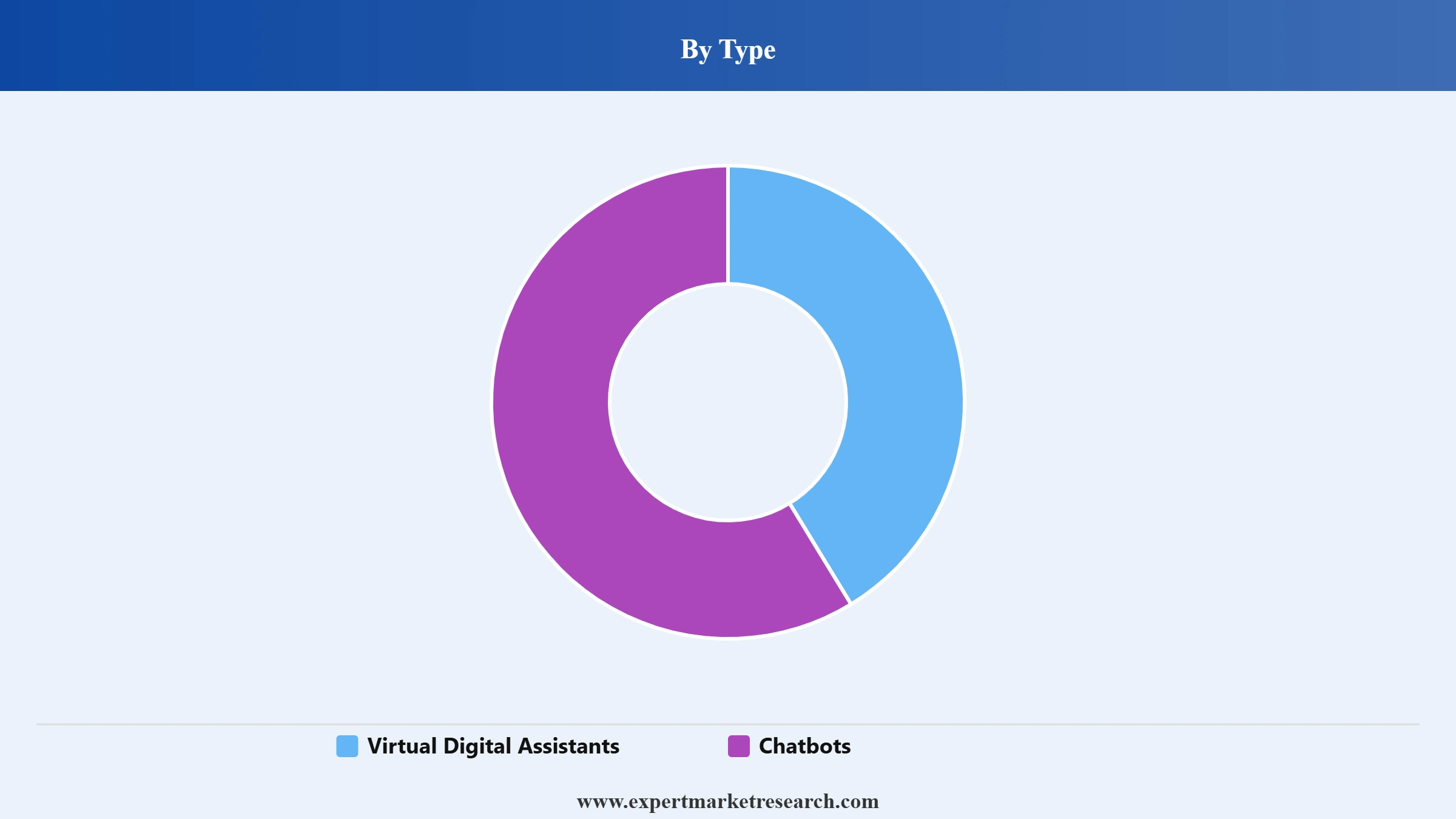
Key Insight: In terms of capabilities, virtual digital assistants can take advantage of personalization of the user experience, accessing the knowledge of the business entity, and performing regular workflows in order to facilitate wider use by customers and employees. Chatbots are becoming more popular due to the ease of implementation into websites, applications, and other channels of customer interaction, especially those with large volumes. Their growing compatibility with generative AI systems allows responding in a more flexible way while relying less on rigid conversation templates, sustaining demand in the conversational computing platform market. In both product categories, security access to proprietary knowledge, integration into the workflow, human takeover, and governance are becoming more important for buyers than conversation quality alone.
Market Breakup by Region
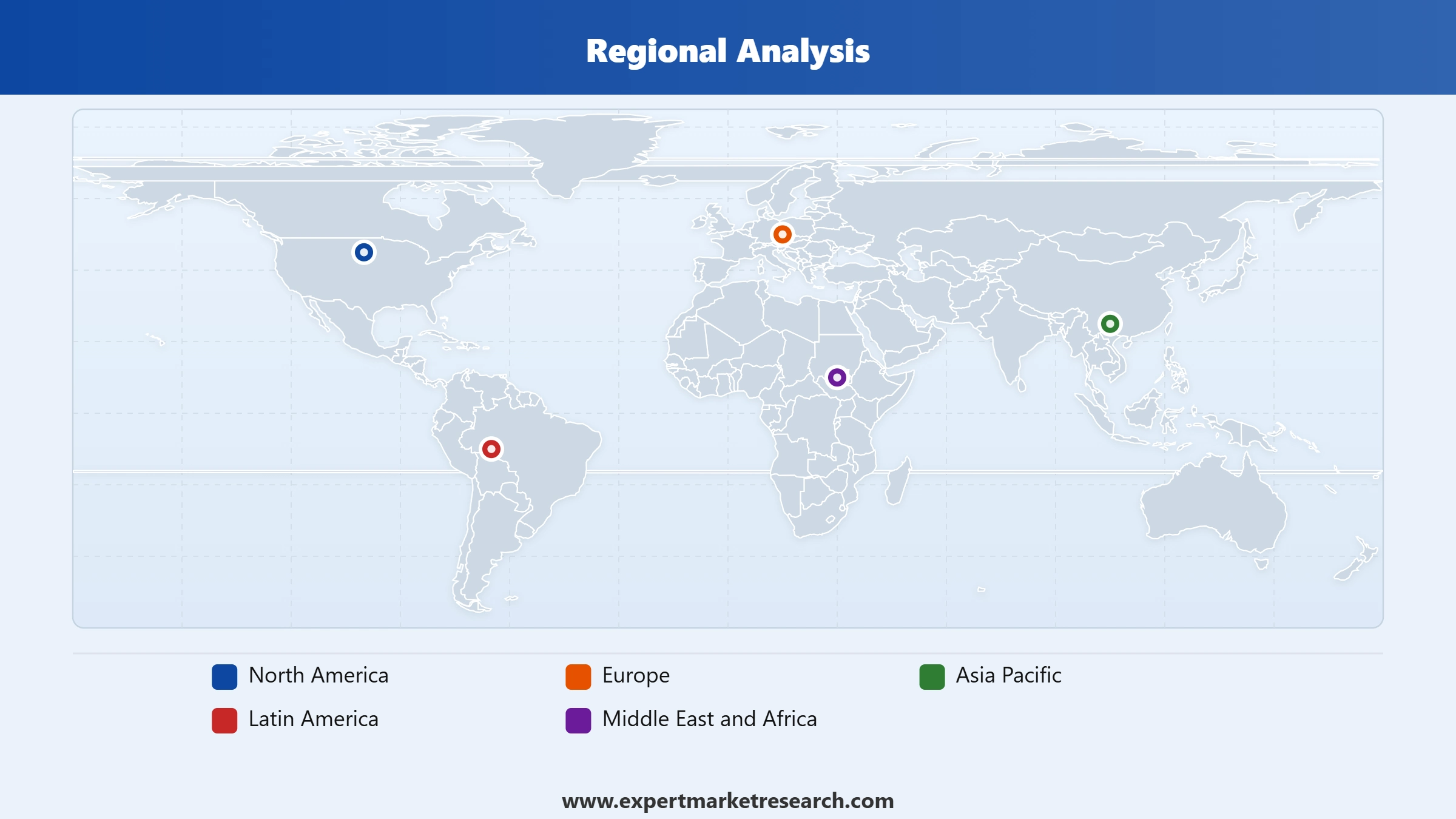
Key Insight: North America dominates the global industry with advanced cloud infrastructure, extensive enterprise AI investment, and high concentration of providers of conversational technology. The conversational computing platform market in Europe is characterized by regulated adoption of AI, data governance, multilingual public services, and requirements for reliable enterprise implementations. The Asia Pacific market growth is boosted by fast digitalization, governmental AI projects, cloud infrastructure growth, and sizable service industries enabled by technology. Latin America is developing due to digitalization of banking, e-commerce, and customer service, where conversational technologies could minimize costs. The market in Middle East and Africa is being developed due to smart government projects, digital public services, national AI strategies, and demand for multilingualism.
Read more about this report - REQUEST FREE SAMPLE COPY IN PDF
By type, virtual digital assistants lead growth in the market due to enterprise automation and personalized user interactions
Virtual digital assistants are currently dominating the conversational computing platform market scenario since businesses are employing them to help with productivity, customer service, appointment scheduling, and knowledge access via context-sensitive communication. Being able to interact with enterprise databases and business applications increases their value over independent conversational interfaces. Providers are improving these assistants with functionalities such as workflow handling, multiple channels of interaction, and individualized response, which means that businesses can automate their mundane service and administrative tasks. In July 2026, FCM Travel relaunched Sam as a conversational AI assistant, providing personalized, proactive support across corporate travel platforms and channels.
Read more about this report - REQUEST FREE SAMPLE COPY IN PDF
Chatbots remain the most rapidly growing segment of the conversational computing platform market as businesses are looking for scalable conversation interfaces to assist them in customer service, technical support, lead generation, and employee support. With the development of generative AI technologies, contemporary chatbots start progressing from the level of scripted answers to the level of context-based conversations and knowledge-based problem solving. Businesses incorporate chatbots into their CRM, commerce, and service management systems in order to reduce response times and automate conversations. In August 2026, GIC and Macquarie partnered with Anthropic to establish United States data centers, addressing rapidly growing demand for AI computing capacity.
North America captures leading share of the market due to advanced AI infrastructure and strong enterprise adoption
North America continues to be the leading regional conversational computing platform market due to the high density of AI creators, cloud companies, enterprise tech buyers, and venture funding. Financial services, retail, healthcare, tech, and customer service firms are using conversational platforms that connect AI with their business workflows. North America also has an abundance of investment from public and private sectors into AI that supports fast commercialization of new agentic and conversational technologies. In April 2026, ElevenLabs launched conversational AI agents for multilingual, real-time customer support, automating interactions across voice and text channels.
Read more about this report - REQUEST FREE SAMPLE COPY IN PDF
The fastest growing regional conversational computing platform market is Asia Pacific as it is witnessing accelerated AI-driven digital transformation in customer service, public sector administration, financial services and telecommunication. Countries such as Japan, Korea, Singapore, Australia and India are building their AI infrastructure and enterprise use cases that create opportunities for conversational platform vendors. Government programs are especially critical as they promote localized AI adoption, digital public services, and productivity at work. According to the OECD report, Japan and Korea belong to the top countries that actively use AI in government administration and Korea uses AI in procurement processes, demonstrating how institutional use cases lead to demand for enterprises.
The competitive environment in the market space revolves around agentic AI, enterprise integration, workflow orchestration, governance, and measurable business impact. Leading conversational computing platform market players such as Google, Microsoft, Salesforce, Oracle, IBM, ServiceNow, AWS, as well as new AI-based players, are seeking to establish themselves as enterprise-level operating systems instead of merely chatbot technologies.
Conversational computing platform companies are increasingly working on establishing connections between conversational agents and proprietary enterprise data, CRMs, customer service software, and multi-agent workflows. In addition, the shift towards open agent communication standards, including Google’s A2A protocol, also offers the chance to create an interoperable ecosystem for providers. Competitive advantages in the future can be achieved through security in execution, industry-specific agents, multimodal experiences, reduced deployment complexity, and productivity gains.
Amazon Web Services Inc., founded in 2006 with its headquarters located in Seattle, Washington, United States, is further developing conversational computing using Amazon Bedrock Agents and Bedrock Flows. The platform links foundation models to data, APIs, and knowledge bases, helping developers create multi-turn agents that perform tasks. It includes applications in customer service, automation, and orchestration.
Google LLC, founded in 1998 with its headquarters located in Mountain View, California, United States, is developing conversational computing using Gemini Enterprise and its agent ecosystem. Google allows organizations to deploy specific agents, workflows, and collaboration spaces. The Agent Marketplace is an application which adds partner-built agents to environments.
International Business Machines Corporation, founded in 1911 with headquarters located in Armonk, New York, United States, is working on enterprise conversational computing via watsonx Orchestrate. IBM is implementing agentic orchestration that will allow coordination of agents, tools, workflows, and foundation models. The company's strategy includes governed automation, runtime monitoring, and multi-agent collaboration for processes, customer service, and productivity.
Microsoft Corporation, founded in 1975 with headquarters located in Redmond, Washington, United States, is growing its conversational computing via Microsoft Copilot Studio. It allows organizations to create agents by natural language, connect proprietary business data, and automate workflows via channels. Microsoft is also developing its autonomous and multi-agent computing, as well as making agents tools for operations.
Other key players in the market include Nuance Communications Inc., among others.
*Please note that this is only a partial list; the complete list of key players is available in the full report. Additionally, the list of key players can be customized to better suit your needs.*
Unlock the latest insights with our conversational computing platform market trends 2026 report. Discover regional growth patterns, consumer preferences, and key industry players. Stay ahead of competition with trusted data and expert analysis. Download your free sample report today and drive informed decisions in the market.


Upto 15% Off
USD
$2499 $2249
$3999 $3599
$4999 $4249
$5999 $5099


*While we strive to always give you current and accurate information, the numbers depicted on the website are indicative and may differ from the actual numbers in the main report. At Expert Market Research, we aim to bring you the latest insights and trends in the market. Using our analyses and forecasts, stakeholders can understand the market dynamics, navigate challenges, and capitalize on opportunities to make data-driven strategic decisions.*
In 2025, the global conversational computing platform market attained a value of nearly USD 9.43 Billion.
The market is projected to grow at a CAGR of 31.00% between 2026 and 2035.
Stakeholders are strengthening agent governance, expanding secure data connectors, developing industry-specific assistants, improving interoperability, measuring workflow outcomes, prioritizing human oversight, and reducing deployment complexity across enterprises and regulated industries globally.
The rapid shift of consumers to conversation-based machines, developments in artificial intelligence and machine learning technologies, and increasing use of chatbots on various messaging applications are the key trends propelling market growth.
The major regions in the market are North America, Latin America, Middle East and Africa, Europe, and Asia Pacific.
Virtual digital assistants and chatbots are the two types in the global conversational computing platform market.
Conversational platforms use artificial intelligence to support human interaction in a manner similar to actual human conversation, thereby providing life-like conversation without need for labour.
The major players in the market are Amazon Web Services Inc., Google LLC, International Business Machines Corporation, Microsoft Corporation, and Nuance Communications Inc., among others.
Companies are facing data privacy risks, hallucinations, integration complexity, deployment costs, fragmented agent ecosystems, cybersecurity threats, governance gaps, and difficulty proving measurable returns from conversational AI investments across deployments.
Explore our key highlights of the report and gain a concise overview of key findings, trends, and actionable insights that will empower your strategic decisions.
| REPORT FEATURES | DETAILS |
| Base Year | 2025 |
| Historical Period | 2019-2025 |
| Forecast Period | 2026-2035 |
| Scope of the Report |
Historical and Forecast Trends, Industry Drivers and Constraints, Historical and Forecast Market Analysis by Segment:
|
| Breakup by Type |
|
| Breakup by Region |
|
| Market Dynamics |
|
| Competitive Landscape |
|
| Companies Covered |
|
| Report Price and Purchase Option | Explore our purchase options that are best suited to your resources and industry needs. |
| Delivery Format | Delivered as an attached PDF and Excel through email, with an option of receiving an editable PPT, according to the purchase option. |
Datasheet
One User
USD 2,499
USD 2,249
tax inclusive*
Single User License
One User
USD 3,999
USD 3,599
tax inclusive*
Five User License
Five User
USD 4,999
USD 4,249
tax inclusive*
Corporate License
Unlimited Users
USD 5,999
USD 5,099
tax inclusive*
*Please note that the prices mentioned below are starting prices for each bundle type. Kindly contact our team for further details.*
Flash Bundle
Small Business Bundle
Growth Bundle
Enterprise Bundle
*Please note that the prices mentioned below are starting prices for each bundle type. Kindly contact our team for further details.*
Flash Bundle
Number of Reports: 3
20%
tax inclusive*
Small Business Bundle
Number of Reports: 5
25%
tax inclusive*
Growth Bundle
Number of Reports: 8
30%
tax inclusive*
Enterprise Bundle
Number of Reports: 10
35%
tax inclusive*
How To Order

Select License Type
Choose the right license for your needs and access rights.

Click on ‘Buy Now’
Add the report to your cart with one click and proceed to register.

Select Mode of Payment
Choose a payment option for a secure checkout. You will be redirected accordingly.
Strategic Solutions for Informed Decision-Making
Gain insights to stay ahead and seize opportunities.

Get insights & trends for a competitive edge.

Track prices with detailed trend reports.

Analyse trade data for supply chain insights.

Leverage cost reports for smart savings

Enhance supply chain with partnerships.

Connect For More Information
Our expert team of analysts will offer full support and resolve any queries regarding the report, before and after the purchase.
Our expert team of analysts will offer full support and resolve any queries regarding the report, before and after the purchase.
We employ meticulous research methods, blending advanced analytics and expert insights to deliver accurate, actionable industry intelligence, staying ahead of competitors.
Our skilled analysts offer unparalleled competitive advantage with detailed insights on current and emerging markets, ensuring your strategic edge.
We offer an in-depth yet simplified presentation of industry insights and analysis to meet your specific requirements effectively.




