

Consumer Insights
Uncover trends and behaviors shaping consumer choices today
Procurement Insights
Optimize your sourcing strategy with key market data
Industry Stats
Stay ahead with the latest trends and market analysis.
The East Africa cement market was valued at USD 2.81 Billion in 2025. The market is expected to grow at a CAGR of 1.30% during the forecast period of 2026-2035 to reach a value of USD 3.20 Billion by 2035. Urban expansion in major cities is compelling cement companies to build decentralized grinding mills that optimize their efficiency at the last mile while ensuring supply arrangements for government-supported residential and transportation infrastructure projects.
Increased cross-border trade integration and incentives for domestic manufacturing are boosting demand in the East Africa cement market. Tariff policies on trade blocs are being liberalized, and governments are encouraging domestic clinker production. At the same time, competition is getting fiercer due to increased distribution networks among regional companies and online sales platforms. Bulk cement logistics, financing of dealers, and real-time inventory management are becoming critical means to ensure prompt supply arrangements.
The East Africa cement market is undergoing a transformation in terms of increased capacity investments and cross-border clinker policies, with the involvement of regional subsidiaries of international manufacturers being the key driving factors behind this phenomenon. For example, in November 2024, Amsons Group targeted East Africa expansion through acquisitions, capacity growth, and local production investments, aiming to reduce imports and dominate regional cement markets. The project was a result of the increasing regional cement demand, driven by large-scale procurement cycles initiated by the governments in favor of construction in the countries including Kenya and Rwanda.
Increasing structural changes in East African countries have made cement manufacturers more interested in developing production aligned with massive infrastructure projects and local building demands. The governments of Kenya, Ethiopia, and Uganda are increasingly focusing on improving their transport networks, establishing special economic zones, and promoting affordable housing through various initiatives, which are influencing procurement cycles positively. For example, in February 2025, Dangote invested USD 400 million to double Ethiopian cement capacity and build new greenfield grinding plant, strengthening regional market leadership. Companies in the East Africa cement market are also focusing on blended and low-clinker cements to cut costs and comply with sustainability requirements.
Compound Annual Growth Rate
1.3%
Value in USD Billion
2026-2035
|
East Africa Cement Market Report Summary |
Description |
Value |
|
Base Year |
USD Billion |
2025 |
|
Historical Period |
USD Billion |
2019-2025 |
|
Forecast Period |
USD Billion |
2026-2035 |
|
Market Size 2025 |
USD Billion |
2.81 |
|
Market Size 2035 |
USD Billion |
3.20 |
|
CAGR 2019-2025 |
Percentage |
XX% |
|
CAGR 2026-2035 |
Percentage |
1.30% |
|
CAGR 2026-2035 - Market by Country |
Rwanda |
1.2% |
|
CAGR 2026-2035 - Market by Country |
Ethiopia |
1.1% |
|
CAGR 2026-2035 - Market by Type |
Blended |
1.4% |
|
CAGR 2026-2035 - Market by End Use |
Infrastructural |
1.5% |
|
2025 Market Share by Country |
Kenya |
31.8% |
Uganda launched a Chinese-sponsored cement and manufacturing facility in Karamoja, increasing local production, decreasing dependency on imports, and improving regional infrastructure supply chains. Competing East Africa cement market players therefore have an opportunity to establish themselves in underdeveloped areas, using state-sponsored industrial parks to create localized production and optimize logistical expenses.
Dangote Cement took strides towards its Vision 2030 initiative by investing USD 1 billion, focusing on capacity enhancement, efficiency optimization, and improved distribution channels within East Africa. This demonstrates that organizations can expand their scope of operations and upgrade their distribution channels to compete against major corporations.
A new plant producing fibre cement was opened by Saint-Gobain Africa with emphasis on lightweight and durable construction material in East African markets to satisfy sustainable construction demands. Players can venture into the production of sustainable and lightweight construction material to fit changing construction requirements, leveraging such developments in the East Africa cement market.
An integrated plant was opened in Malawi by Huaxin Cement to increase the production of clinker and cement. Other companies can therefore set up an integrated plant to manage its supply chain, reduce costs, and leverage cross-border trading in East Africa.
Governments across East Africa are increasingly emphasizing self-reliance in clinker production, as it was previously imported in large volumes as a key raw material for cement manufacturing. Government policies in places such as Ethiopia and Kenya encourage local manufacture of clinker in various ways including provision of tax incentives and allocating lands. This trend in the East Africa cement market is being encouraged by firms that are producing clinker as a way of controlling costs and securing supply. In December 2023, East African Portland Cement announced plans of establishing a USD 200 million Kajiado clinker plant, boosting capacity, lowering costs, and enhancing regional export competitiveness.
Manufacturers are under pressure to come up with blended cement products that contain pozzolana and industrial wastes. Leading firms are engaging in research and development of low carbon cements in an attempt to respond to sustainability challenges. For example, in November 2025, Bamburi Cement launched DURAPLUS low-carbon cement reducing emissions over 45%, aligning with Kenya’s green building code and supporting sustainable infrastructure growth. Companies are leveraging such products to secure contracts in green building projects and donor-funded infrastructure developments, thereby accelerating the East Africa cement market value.
It is becoming common for cement manufacturers to form strategic relationships with governmental agencies and major construction contractors executing infrastructure megaprojects. The development of rail lines, roads, and port facilities leads to bulk cement purchase arrangements over several years. Manufacturers in Tanzania and Uganda now work in direct cooperation with EPC contractors to ensure material availability till the entire project completion. This guarantees long-term visibility while eliminating price fluctuations, accelerating demand in the East Africa cement market. Developing customized cement grades tailored to specific engineering requirements supports customer retention while also creating entry barriers for small-scale competitors. Reflecting this shift, in March 2026, Dangote secured USD 4.2 billion supply deal with GCL to power Ethiopia’s largest fertilizer plant, boosting industrial integration and food security.
Manufacturing companies are redefining their approach to distribution using digital means to link up their dealers and transportation networks with inventory management systems. Ordering systems are being developed in mobile format to facilitate better supply chain visibility. Some companies in Kenya use fintech platforms to enable dealer finance options so that small-scale dealers can hold stocks of products. This is important when it comes to managing logistics in fast-paced construction projects. Furthermore, digitalization helps improve the accuracy of demand data and planning regional demand. Aligning with this trend, in February 2026, Portland Cement restructured board after Tanzanian billionaire takeover, aiming improved governance, operational turnaround, strategic investments, and stronger positioning within the East Africa cement market.
Energy expenses continue to be a significant problem, driving cement manufacturing firms to explore other sources of energy, including biomass, waste-based fuel, and solar. The energy sector comprises about 30-40% of production costs in East Africa, necessitating efforts towards increased efficiency. Various factories in Kenya and Tanzania incorporate energy recovery from waste heat, reducing their power usage, redefining the overall East Africa cement market dynamics. Moreover, collaborations with municipal governments on converting waste to energy projects are increasing. Not only are these measures contributing to reduced expenses, but they are also aligning companies with carbon reduction targets, making them more attractive to foreign investors. In May 2026, Lafarge Africa reported 101% profit growth to NGN 98 billion, driven by strong cement sales, improved pricing strategies, and effective cost control measures.
The EMR’s report titled “East Africa Cement Market Report and Forecast 2026-2035” offers a detailed analysis of the market based on the following segments:
Market Breakup by Type
Key Insight: Blended cement retains its dominant position in the East Africa cement market because of their price competitiveness, compliance with regulations, and suitability for use with locally available raw materials. Portland cement is also growing steadily, driven by the need for strength assurance in advanced construction projects. In April 2026, SaltX and Holcim produced Portland-quality clinker using fully electrified process, eliminating fossil fuels and advancing scalable low-carbon cement manufacturing technology. Other types of cement, such as specialty and fast-setting products, are gradually gaining popularity for specific purposes like repair jobs and precast concrete components. Producers are striking a balance between their offerings to meet the requirements of large-scale infrastructure construction and specialized construction projects. This demonstrates that the competition is no longer only about pricing but also about performance and sustainability alignment.
Market Breakup by End Use
Key Insight: As per the East Africa cement market report, the infrastructure sector takes precedence owing to the magnitude involved, long contract duration, and government support, guaranteeing regular cement consumption in various large-scale projects. The growth in the residential building sector is growing at an accelerated pace due to the need for housing in urban areas as well as through developer-led projects. Other key sectors include the commercial, institutional, and industrial sectors in terms of offices, factories, and other public buildings. Manufacturers are aligning themselves with such needs by customizing their products and deliveries in line with a specific sector.
Market Breakup by Country
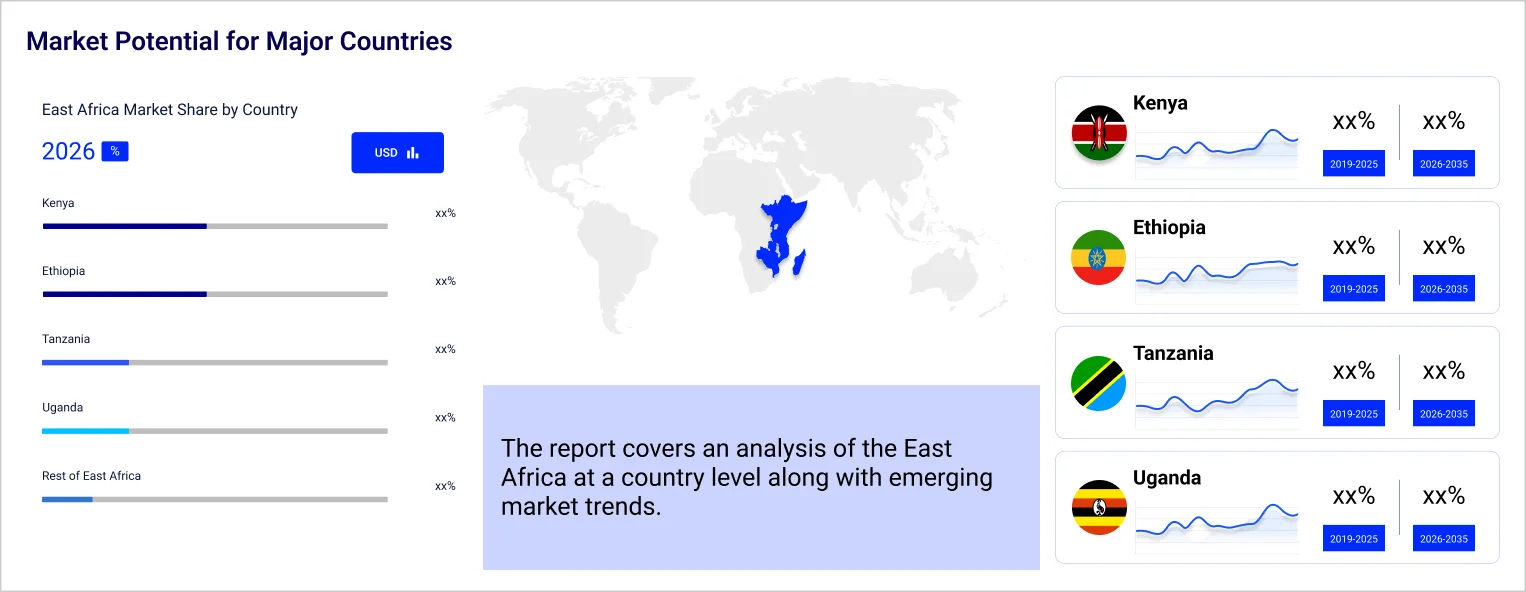
Key Insight: Ethiopia accounts for the dominant share in the East Africa cement market revenue due to their superior domestic production capabilities and infrastructure-based demand. Kenya exhibits an impressive growth rate due to the country’s focus on private investments and regional trade dynamics. Similarly, Tanzania and Uganda contribute significantly, owing to the constant flow of construction work and development in the industrial sector. Sudan and Rwanda boast promising prospects with respect to infrastructure redevelopment and housing construction initiatives taken by the government. The remaining nations in the region witness rising consumption of cement due to rapid urbanization.
By type, the blended cement category accelerates regional demand due to cost efficiency, sustainability targets
Blended cement is proving to be the most prominent segment within the East Africa cement market scope, primarily driven by strategic moves by manufacturers to incorporate cost efficiency and sustainability considerations in their product offerings. Manufacturers are opting for local supplies of pozzolana in order to reduce the reliance on clinker imports and protect margins from any associated risks. Blended cements are being heavily promoted in Kenya and Tanzania for bulk contracts in infrastructure projects such as roads and housing. Producers are selling their product line as an environmental solution for development projects funded through international agencies. In April 2026, Yaobai Cement commissioned USD 300 million Moroto plant, boosting clinker output, reducing imports, creating jobs, and supporting Uganda’s industrialization and regional exports.
Portland cement is also boosting growth in the East Africa cement market primarily owing to its applicability for structurally complex construction projects. Leading producers are investing in advanced kiln systems that will help achieve improved levels of compression and uniformity of the product. Manufacturers are actively promoting Portland cement in Ethiopia and Kenya as a product offering for large-scale infrastructure developments like rail networks and industrial parks. This segment is also gaining popularity in the face of increasing private sector investments in commercial construction.
By end use, the infrastructure segment accounts for the dominant market share due to government-backed transport and logistics expansion projects
Infrastructural development continues to be the most dominant end use for cement in the region as governments are embarking on massive investments in transport, logistics, and energy projects. Cement producers are meeting this demand by forming long-term contracts with construction companies for stable supply cycles, while others are developing logistics departments around these infrastructural projects to reduce the chances of delays, accelerating the overall East Africa cement market penetration. In addition to providing steady supply, some producers are also coming up with specialized cement mixes suitable for infrastructural projects, especially in harsh environments. Demonstrating this shift, in October 2025, Dangote Cement inaugurated USD 150 million Attingué plant in Côte d’Ivoire, adding 3Mta capacity, boosting jobs, and enhancing regional cement supply.
The residential housing sector is expanding its share in the East Africa cement market revenue owing to rapid urbanization as well as government support through affordable housing programs. Cement manufacturers are increasingly partnering with housing developers to provide a continuous supply of their materials for housing projects. Some cement producers in nations like Kenya and Uganda are developing flexible packaging options and financing schemes to accommodate both small- and large-scale developers.
|
CAGR 2026-2035 - Market by |
Country |
|
Rwanda |
1.2% |
|
Ethiopia |
1.1% |
|
Tanzania |
1.0% |
|
Kenya |
XX% |
|
Uganda |
XX% |
|
Others |
XX% |
Ethiopia dominates the market due to large-scale domestic production and infrastructure investments
The cement market in Ethiopia secures the dominant position within East Africa due to the high production levels within the country and the constant expansion of its infrastructure projects. The government's policies geared towards establishing industrial parks, transport corridors, and urban development are collectively increasing the demand for cement. Manufacturers are enhancing their production capacities while adopting efficient energy systems in order to produce more cement at reduced costs. Moreover, there is an increasing emphasis among the firms on exporting their products to other countries in the neighborhood.
The East Africa cement market observes significant growth through Kenya as a result of the development activities carried out by the private sector along with the country's favorable trade relations with other countries in the region. There is a rise in grinding capacities alongside the expansion of distribution networks in order to cater to the demand for cement from urban as well as semi-urban markets. Being the leading trade partner in the region, Kenya is attracting more cement exports from other neighboring countries, especially from Uganda and Rwanda. In April 2026, Amsons Group committed USD 35-40 million to build 10 maternal hospitals across Kenya, improving healthcare access, reducing mortality, and supporting universal health coverage goals.
The competition in the industry is rising, with East Africa cement companies concentrating on vertical integration, energy efficiency, and international business expansion. Leading companies are increasing their investment in clinker manufacturing projects to minimize dependence on imports, even as they expand grinding facilities near consumption locations. Digitizing the distribution channels and dealers' networks is another critical area of interest for many companies, allowing them to enhance supply chain visibility and customer engagement.
Through strategic collaborations with government authorities and infrastructure builders, organizations are entering into agreements that provide stable revenue. Moreover, sustainability is proving to be a decisive factor in the competitiveness of many East Africa cement market players through investments in low-carbon cement and alternative fuels. Major prospects for growth exist in the integration of regional commerce, where organizations can capitalize on their surplus production facilities to supply neighboring countries.
Established in 1981 and headquartered in Lagos, Nigeria, Dangote Cement Plc has made aggressive moves in expanding its operations across East Africa by establishing large-scale manufacturing plants for exporting cement to neighboring nations. This organization uses the cost leadership strategy, integrating the clinker process with distribution throughout several regional construction markets.
National Cement Share Company, which was established in 1936 and has its headquarters in Ethiopia, plays an important role in supplying the domestic market. The organization is currently enhancing its plant efficiency and optimizing energy consumption to position itself for participation in large-scale infrastructure projects across the country, thereby boosting the East Africa cement market development.
East African Holding was founded in 1891 and is located in Addis Ababa, Ethiopia. The organization runs various cement manufacturing operations through effective subsidiary companies. Its key areas of concentration include integrated production and distribution for use in infrastructure projects and industrial development. The company is further exploring possibilities of exports within the East Africa construction industry.
Ethio Cement PLC was formed in 2007 and is based in Addis Ababa, Ethiopia. The firm is concentrating on developing its grinding capacities and becoming more efficient in production and distribution processes. Ethio Cement PLC focuses on mid-sized construction projects and urbanization programs, leveraging flexible production processes to meet diverse project requirements.
Other key players in the market include Mombasa Cement Limited, Portland Cement Plc, Cemtech Limited, and CrossBoundary, LLC, among others.
*Please note that this is only a partial list; the complete list of key players is available in the full report. Additionally, the list of key players can be customized to better suit your needs.*
Explore the latest trends shaping the East Africa cement market 2026-2035 with our in-depth report. Gain strategic insights, future forecasts, and key market developments that can help you stay competitive. Download a free sample report or contact our team for customized consultation on East Africa cement market trends 2026.


Upto 15% Off
USD
$2499 $2249
$3999 $3599
$4999 $4249
$5999 $5099


*While we strive to always give you current and accurate information, the numbers depicted on the website are indicative and may differ from the actual numbers in the main report. At Expert Market Research, we aim to bring you the latest insights and trends in the market. Using our analyses and forecasts, stakeholders can understand the market dynamics, navigate challenges, and capitalize on opportunities to make data-driven strategic decisions.*
In 2025, the East Africa cement market reached an approximate value of USD 2.81 Billion.
The market is projected to grow at a CAGR of 1.30% between 2026 and 2035.
The key players in the market include Dangote Cement Plc, National Cement Share Company, East African Holding, Ethio Cement PLC, Mombasa Cement Limited, Portland Cement Plc, Cemtech Limited, and CrossBoundary, LLC, among others.
Expanding clinker production, strengthening regional distribution networks, adopting alternative fuels, forming infrastructure partnerships, and investing in digital sales platforms are enabling companies to improve margins and secure long-term contracts.
Volatile energy costs, clinker import dependence, currency fluctuations, and infrastructure bottlenecks are pressuring margins, while rising competition is forcing companies to balance pricing strategies with ongoing capacity investments.
Explore our key highlights of the report and gain a concise overview of key findings, trends, and actionable insights that will empower your strategic decisions.
| REPORT FEATURES | DETAILS |
| Base Year | 2025 |
| Historical Period | 2019-2025 |
| Forecast Period | 2026-2035 |
| Scope of the Report |
Historical and Forecast Trends, Industry Drivers and Constraints, Historical and Forecast Market Analysis by Segment:
|
| Breakup by Type |
|
| Breakup by End Use |
|
| Breakup by Region |
|
| Market Dynamics |
|
| Competitive Landscape |
|
| Companies Covered |
|
Datasheet
One User
USD 2,499
USD 2,249
tax inclusive*
Single User License
One User
USD 3,999
USD 3,599
tax inclusive*
Five User License
Five User
USD 4,999
USD 4,249
tax inclusive*
Corporate License
Unlimited Users
USD 5,999
USD 5,099
tax inclusive*
*Please note that the prices mentioned below are starting prices for each bundle type. Kindly contact our team for further details.*
Flash Bundle
Small Business Bundle
Growth Bundle
Enterprise Bundle
*Please note that the prices mentioned below are starting prices for each bundle type. Kindly contact our team for further details.*
Flash Bundle
Number of Reports: 3
20%
tax inclusive*
Small Business Bundle
Number of Reports: 5
25%
tax inclusive*
Growth Bundle
Number of Reports: 8
30%
tax inclusive*
Enterprise Bundle
Number of Reports: 10
35%
tax inclusive*
How To Order

Select License Type
Choose the right license for your needs and access rights.

Click on ‘Buy Now’
Add the report to your cart with one click and proceed to register.

Select Mode of Payment
Choose a payment option for a secure checkout. You will be redirected accordingly.
Strategic Solutions for Informed Decision-Making
Gain insights to stay ahead and seize opportunities.

Get insights & trends for a competitive edge.

Track prices with detailed trend reports.

Analyse trade data for supply chain insights.

Leverage cost reports for smart savings

Enhance supply chain with partnerships.

Connect For More Information
Our expert team of analysts will offer full support and resolve any queries regarding the report, before and after the purchase.
Our expert team of analysts will offer full support and resolve any queries regarding the report, before and after the purchase.
We employ meticulous research methods, blending advanced analytics and expert insights to deliver accurate, actionable industry intelligence, staying ahead of competitors.
Our skilled analysts offer unparalleled competitive advantage with detailed insights on current and emerging markets, ensuring your strategic edge.
We offer an in-depth yet simplified presentation of industry insights and analysis to meet your specific requirements effectively.




