

Consumer Insights
Uncover trends and behaviors shaping consumer choices today
Procurement Insights
Optimize your sourcing strategy with key market data
Industry Stats
Stay ahead with the latest trends and market analysis.
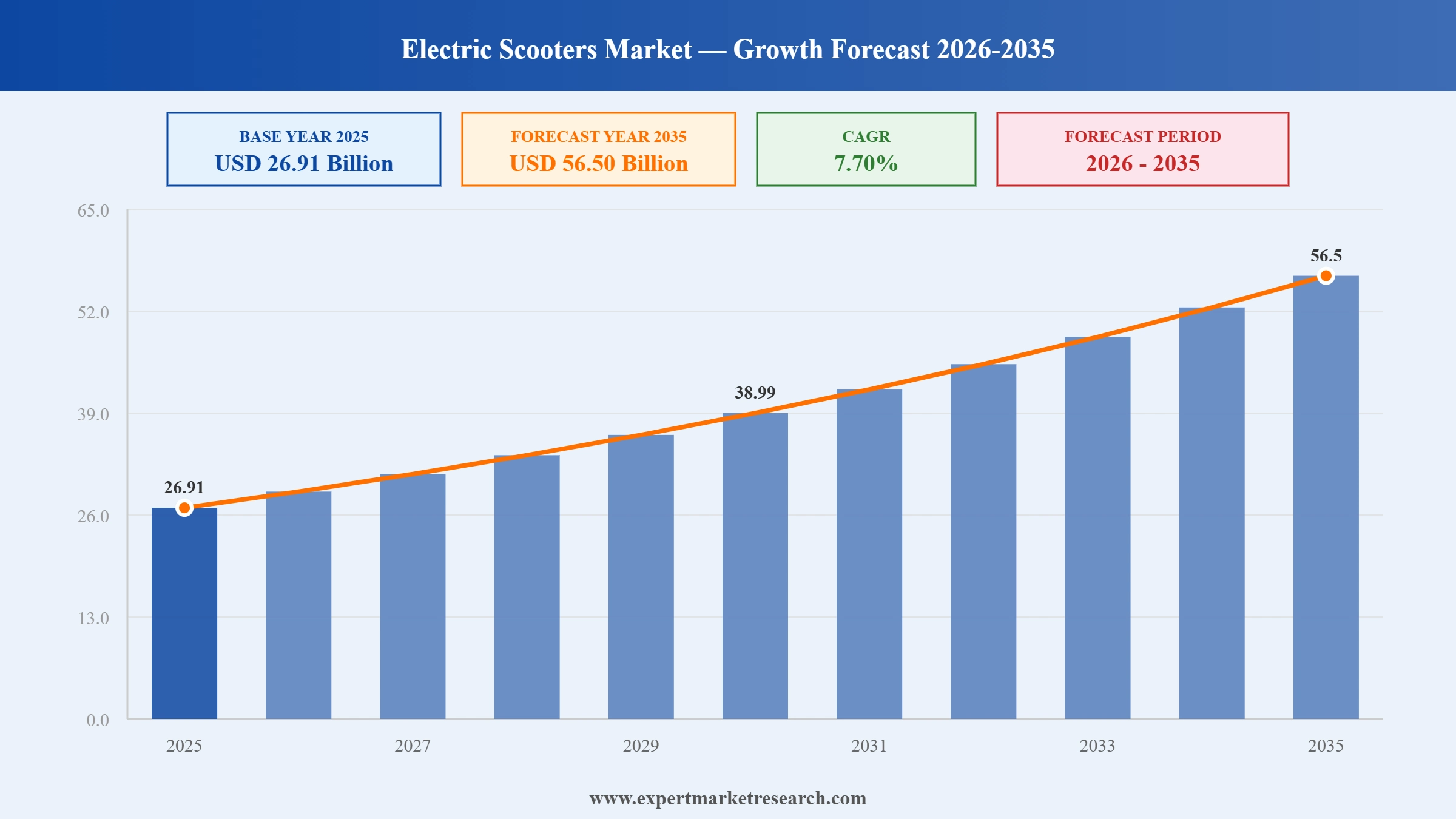
The electric scooters market reached a valuation of USD 26.91 Billion in 2025 and is projected to grow at a CAGR of 7.70% between 2026 and 2035, reaching nearly USD 56.50 Billion by 2035, according to Expert Market Research. This sustained growth trajectory reflects the structural acceleration of electric two-wheeler adoption globally, driven by escalating fuel prices, urban air quality mandates, government electric vehicle subsidy programmes, and the growing commercial viability of electric scooters as the preferred personal micro-mobility solution for urban and peri-urban last-mile connectivity across all income levels.
The electric scooters market encompasses a broad spectrum of two-wheeled electrically-powered personal mobility vehicles, ranging from standing kick scooters used primarily for shared micro-mobility services and individual short-distance commuting, to seated electric scooters with enclosed powertrains serving the personal daily commute, delivery logistics, and commercial fleet segments. The market spans kick and self-balancing standing models favoured in European and North American shared mobility ecosystems, retro and classic-styled seated electric scooters dominant in Asian markets, and folding electric scooters the fastest-growing product format which address the combined urban portability and last-mile transit integration requirements of commuters across all geographies. Electric scooters are powered by lithium-ion, lead-acid, or nickel-metal-hydride battery packs across 24V, 36V, 48V, and higher voltage configurations, with hub motor BLDC (brushless DC) drivetrains increasingly standard across modern production platforms, enabling regenerative braking, IoT connectivity integration, GPS tracking, geofencing, and over-the-air software updates that transform the electric scooter from a simple transportation tool into a smart, connected urban mobility platform.

Read more about this report - REQUEST FREE SAMPLE COPY IN PDF
The electric scooters market refers to the global commercial ecosystem encompassing the design, manufacture, distribution, and commercial operation of two-wheeled electrically-powered personal mobility vehicles designed for urban commuting, last-mile transit connectivity, shared micro-mobility services, commercial delivery logistics, and recreational use. Electric scooters are categorised by their primary design and intended use context into three major product types. Standing electric scooters also known as kick scooters are lightweight, kickboard-style vehicles where the rider stands on a deck and steers through handlebars, characterised by high portability, compact dimensions, and typical speed ranges of 15 to 30 kilometres per hour, used predominantly in shared dockless micro-mobility programmes by ride-sharing operators and by individual commuters integrating them into multimodal transit journeys. Seated electric scooters feature full chassis construction with a seat, footboard, storage, and enclosed drivetrain, providing a more comfortable, higher-range, and higher-payload vehicle suited for daily personal commuting, delivery fleet operations, and family use across Asian markets.
The technical architecture of a modern electric scooter comprises a rechargeable battery pack, a brushless DC (BLDC) hub motor or chain/belt drive motor system, a motor controller, a battery management system (BMS) governing charge/discharge cycles and thermal protection, and increasingly a connected telematics unit incorporating GPS, IoT sensors, cellular connectivity, and application programming interfaces enabling geofencing, real-time location tracking, theft prevention, remote diagnostics, over-the-air software updates, and integration with fleet management platforms. Hybrid electric scooters which combine a conventional internal combustion engine with a small electric motor and battery for regenerative braking energy recovery and urban EV mode operation represent an additional product category relevant to markets where charging infrastructure is developing and range anxiety remains a consumer concern, offering a bridge technology between conventional and full-electric personal mobility. Battery swapping systems where depleted battery packs are exchanged at network stations for fully charged replacements in under two minutes pioneered by Gogoro's Powered by Gogoro Network in Taiwan and progressively adopted across Asian markets, are addressing the charging time and range anxiety barriers that have historically constrained electric scooter adoption among high-mileage commercial users.
Read more about this report - REQUEST FREE SAMPLE COPY IN PDF
The growing global recognition of electric scooters as the optimal solution to urban traffic congestion, air pollution, and last-mile public transit connectivity is the most fundamental structural driver of the market's sustained growth. Electric scooters offer urban commuters a zero-tailpipe-emission personal vehicle capable of navigating congested city streets, accessing parking efficiently, and integrating seamlessly with public transit systems as a first-and-last-mile connector for journeys too short to justify private car use but too long or inconvenient for walking. The IEA projects that global electric scooter sales will exceed 70 million units annually by 2030, driven by this last-mile connectivity role across urban transportation ecosystems in Asia, Europe, and North America. As shared micro-mobility operators deploy electric scooter fleets across hundreds of cities globally with Europe alone recording over one million annual electric scooter registrations the normalisation of electric scooter usage as an everyday transportation option is progressively expanding consumer comfort with the technology and accelerating personal ownership adoption.
National and regional government electric vehicle incentive programmes, emission-reduction mandates, and urban transport decarbonisation policies are providing the financial and regulatory scaffolding that has enabled the electric scooter market's cost structure to become broadly competitive with conventional petrol-powered two-wheelers across major markets. India's PM E-DRIVE scheme extended through July 2026 after stimulating record monthly electric two-wheeler sales of 191,067 units in March 2026 exemplifies the direct impact of structured subsidy programmes on demand acceleration. China's government subsidies, policy support for domestic electric two-wheeler manufacturing, and vehicle emission standards excluding conventional petrol two-wheelers from an expanding number of urban areas have made China the world's largest electric scooter market by volume. European emission regulations, urban low-emission zones, and city-level municipal programmes restricting internal combustion engine vehicles in city centres are creating similar demand pull for electric scooters across major European markets.
The continued cost reduction of lithium-ion battery technology driven by scale economies in cell manufacturing, improved electrode chemistry, and supply chain maturation is progressively improving the purchase price competitiveness and per-kilometre operating cost advantage of electric scooters relative to petrol-powered equivalents. Modern lithium-ion battery packs enabling 80 to 150 kilometre ranges per charge at total weight additions of 8 to 15 kilograms are now commercially available at price points that bring the total cost of ownership of electric scooters below petrol alternatives across all major markets with non-trivial fuel costs. The introduction of Battery-as-a-Service (BaaS) financing models as pioneered by TVS Motor in March 2026 further improves electric scooter affordability by separating the battery's capital cost from the vehicle's purchase price, enabling buyers to access electric mobility at price parity with entry-level petrol scooters while paying for battery usage through a subscription or per-kilometre model.
The integration of artificial intelligence and IoT connectivity into electric scooter platforms is creating a generation of smart, data-driven two-wheelers that deliver substantially enhanced operational efficiency, user experience, and safety performance relative to conventional electric scooters. AI-powered fleet management platforms for shared mobility operators are enabling dynamic repositioning algorithms that predict scooter demand patterns by time of day and location, reducing idle vehicle time and maximising fleet utilisation. Real-time battery state monitoring, predictive maintenance diagnostics, and collision detection sensors are improving safety performance and reducing operational maintenance costs for both individual owners and fleet operators. Geofencing technology enables operators to define permitted riding zones, automatically reduce scooter speed in pedestrian-heavy areas, and remotely immobilise vehicles operating outside authorised boundaries a regulatory compliance capability that is increasingly required by municipal authorities granting shared mobility operating licences across European and North American cities.
The rapid expansion of dockless and docked electric scooter sharing services operated by companies deploying IoT-enabled scooter fleets across hundreds of cities globally is simultaneously stimulating demand for electric scooters as manufactured products and normalising the electric scooter as an everyday urban mobility option for a broad population that has not yet made a personal ownership commitment. Shared micro-mobility operators in Europe operating under increasingly sophisticated municipal licensing frameworks that require geofencing compliance, safety telemetry, and public transit API integration are professionalising and scaling the European shared electric scooter market in a way that drives both demand for new-generation connected scooter hardware and progressive consumer adoption of personal scooter ownership following positive shared-use experiences. The convergence of ride-sharing, delivery logistics, and micro-mobility on the electric scooter platform with food delivery companies in India, Indonesia, and Southeast Asia deploying electric scooter fleets to reduce delivery operating costs is creating substantial commercial fleet demand alongside the personal mobility market.
Folding electric scooters characterised by a collapsible frame mechanism enabling compact stowage under office desks, in vehicle trunks, and on public transit are the fastest-growing product segment within the global electric scooter market, driven by rising demand for portable, lightweight last-mile mobility solutions that integrate seamlessly with multimodal commuting patterns. Urban professionals, students, and commuters who combine electric scooter rides with metro, bus, or rail journeys are the primary adopter demographic, preferring compact designs that can be carried aboard transit vehicles and stored in limited urban living spaces. The folding segment's rapid growth has been particularly evident in Europe and Asia, where transit system integration has been facilitated by infrastructure investment in combined scooter-transit hubs, and in North America where the folding scooter's portability has driven adoption among urban professionals incorporating the format into office and campus commuting routines.
Battery swapping infrastructure enabling electric scooter users to exchange a depleted battery for a fully charged one at a network station in under two minutes, eliminating the charging wait time that represents the primary convenience disadvantage of electric mobility is emerging as a transformative business model innovation that is accelerating high-mileage commercial electric scooter adoption. Gogoro's Powered by Gogoro Network battery swapping infrastructure in Taiwan, now extending into India and other Asian markets, provides a physical energy infrastructure model where the battery is separated from the vehicle and managed as a network-level resource rather than a personal asset. TVS Motor's March 2026 launch of BaaS for its Indian electric scooter lineup enabling vehicle purchase without the battery capital cost at significantly lower upfront prices adapts the battery-separation concept to the largest and fastest-growing electric scooter market globally, with the potential to replicate across other markets where upfront cost is the primary adoption barrier.
The integration of electric scooters into urban mobility-as-a-service platforms alongside public transit, ride-hailing, and e-bike services is progressively transforming how municipal governments, transit authorities, and private operators think about urban transportation networks, with electric scooters positioned as an essential component of the seamless, app-coordinated multimodal transit ecosystem. In European cities, heavy municipal intervention through licensing, fleet caps, geofencing, and mandatory safety telemetry is creating a compliance-first market that rewards shared mobility operators who invest in robust IoT infrastructure, data sharing with transit authorities, and genuine integration with public transit payment and journey planning systems. London's Department for Transport extended its e-scooter rental trials through 2026, citing measurable reductions in car trips under five kilometres in participating boroughs providing policy validation data that is influencing regulatory framework development across European and North American cities evaluating permanent electric scooter legislation.
Hybrid electric scooters combining a conventional internal combustion engine with an electric motor and battery enabling regenerative braking energy recovery and all-electric urban operation are addressing the range anxiety and charging infrastructure limitations that continue to restrain full-electric scooter adoption in markets where charging network density is insufficient for high-mileage daily users. The hybrid e-scooter segment is particularly relevant in markets at intermediate EV infrastructure development stages rural and peri-urban areas where public charging is sparse, long-distance intercity commuting routes that exceed current full-electric range capabilities, and commercial delivery applications requiring continuous all-day operation without charging windows. Regulatory evolution in markets such as India, Southeast Asia, and Latin America is progressively establishing clearer frameworks for hybrid electric two-wheelers that qualify for partial EV incentives, enabling manufacturers to position hybrid models as a financially supported transitional technology platform for price-sensitive buyers not yet fully committed to pure-electric mobility.
Sustainability credentials are becoming an increasingly important commercial differentiator in the electric scooter market, as both consumer purchasing decisions and fleet operator procurement criteria incorporate lifecycle environmental impact alongside upfront cost and performance specifications. The battery lifecycle management challenge with lithium-ion battery packs in electric scooters reaching end-of-first-life after 3 to 7 years of active use and requiring either second-life repurposing for stationary energy storage or responsible recycling of constituent lithium, cobalt, and nickel materials is receiving growing regulatory attention across all major markets. European end-of-life vehicle and battery regulations are introducing extended producer responsibility requirements for electric scooter manufacturers. Modular battery design enabling individual cell module replacement extending battery system life beyond the useful life of the most-degraded module is gaining traction as both a sustainability measure and a total cost of ownership reduction strategy for fleet operators managing large electric scooter inventories.
Read more about this report - REQUEST FREE SAMPLE COPY IN PDF
The global electric scooters market faces several significant operational, regulatory, and consumer adoption challenges that moderate growth velocity despite the market's fundamentally strong secular drivers. Battery safety incidents including thermal runaway events in lithium-ion battery packs that have resulted in scooter fires in India, the United Kingdom, and Singapore have created significant consumer and regulatory concern around battery quality standards, particularly for lower-cost electric scooters using sub-standard cells from non-certified manufacturers. These incidents have prompted regulatory tightening of battery certification requirements across multiple markets, creating compliance cost increases for manufacturers and additional technology validation burdens that particularly affect smaller and emerging market entrants. Range anxiety the concern that battery charge will be exhausted before completing a journey or reaching a charging facility remains a persistent psychological barrier to electric scooter adoption among prospective buyers who have not yet had sustained personal experience with the technology, even as actual range performance of modern electric scooters has improved substantially to the point where the anxiety significantly overestimates real-world risk for typical urban commuting use cases. The highly fragmented and price-competitive nature of the electric scooter market, particularly in China and other Asian markets where hundreds of manufacturers compete at sub-USD 500 retail price points with rapidly commoditising products, creates continuous margin pressure that challenges sustainable investment in product quality, warranty support, and customer service infrastructure.
Several structural dynamics restrain the pace of electric scooter market expansion across specific product categories, geographic markets, and consumer segments. The relatively short operational lifespan of lead-acid battery packs historically dominant by volume in Asian electric scooter markets but offering only 300 to 500 charge cycles versus 800 to 1,500 cycles for lithium-ion alternatives creates recurring replacement cost burden for consumers and environmental waste management challenges for markets without established battery recycling infrastructure. Charging infrastructure scarcity in rural and peri-urban markets, where private home charging may be impractical for apartment-dwelling consumers and public charging networks remain sparse, constrains electric scooter adoption outside major urban centres where infrastructure investment has been concentrated. Weather dependency particularly in markets with harsh winter conditions that reduce lithium-ion battery efficiency and accessible range by 20 to 40% at sub-zero temperatures limits the year-round utility proposition of electric scooters in Northern European, North American, and Chinese markets where winter severity is significant. Insurance, licensing, and helmet requirement regulatory frameworks for electric scooters vary substantially across jurisdictions and in several markets remain ambiguous or restrictive, creating legal and practical friction for potential adopters.
The global electric scooters market presents substantial and well-documented commercial opportunities across product innovation, geographic market development, and commercial fleet adoption that support the sustained 7.70% CAGR growth through the 2026 to 2035 forecast period. India's electric two-wheeler market with record monthly sales of 191,067 units in March 2026 and EV market share of approximately 10% of total two-wheeler sales as of financial year-end 2026 is still in the early stages of a structural adoption curve that will eventually encompass several hundred million conventional scooter and motorcycle riders, representing one of the most significant single-market growth opportunities globally. The Battery-as-a-Service (BaaS) financial innovation reducing upfront electric scooter acquisition cost to parity with entry-level petrol alternatives has the potential to unlock a massive new addressable market of price-sensitive consumers across India, Southeast Asia, Latin America, and Africa who are excluded from electric adoption by capital cost barriers despite compelling operating cost advantages. Folding electric scooters' growing adoption in multimodal transit integration scenarios creates a structurally growing volume opportunity as urban transit authorities progressively plan around and enable scooter-transit interoperability. The commercial fleet segment encompassing food and e-commerce delivery riders, corporate campus transportation, hotel and hospitality concierge services, and urban logistics operators is converting rapidly from petrol to electric as the total operating cost advantage of electric scooters becomes decisive at fleet scale. To access comprehensive opportunity sizing, product-specific growth forecasts, and strategic market entry frameworks across all geographies and segments, explore Expert Market Research's complete Electric Scooters Market report.
Electric scooters, variously known as e-scooters, are plug-in two or three-wheeled vehicles which store electricity in a rechargeable battery. They are eco-friendly and cost-effective and therefore provide a better alternative to fuelled vehicles. Moreover, they are low maintenance and can be used comfortably in short distances.
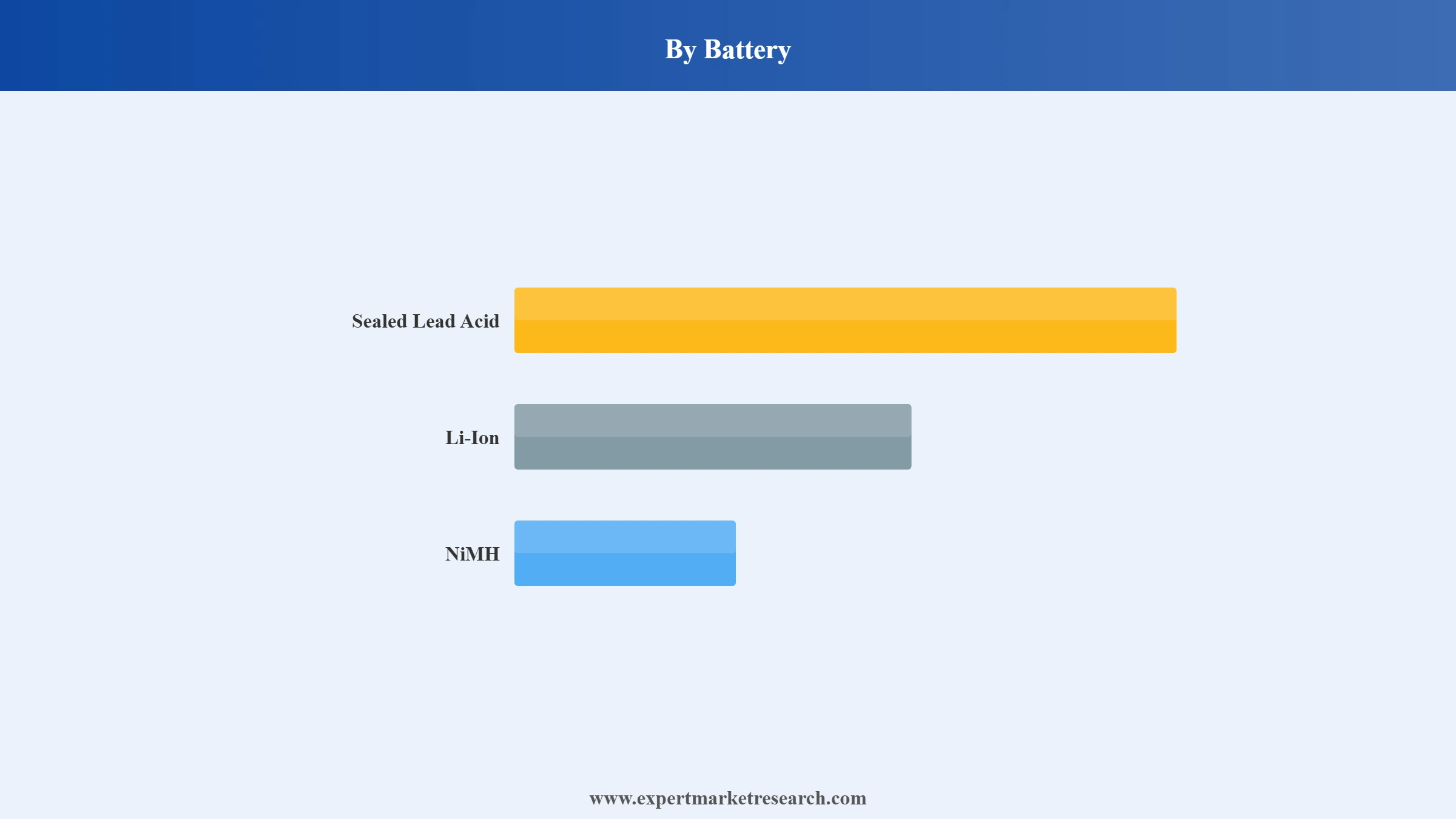
Based on the battery, the market is divided into:
Key Insights: Sealed lead acid (SLA) batteries retain the largest installed volume share in the global electric scooters market, primarily in China's vast base of low-cost electric scooters and in price-sensitive emerging market segments across Southeast Asia, Africa, and Latin America, where the upfront cost advantage of SLA packs despite their heavier weight, shorter cycle life of 300 to 500 charge cycles, and lower energy density remains the primary purchase decision driver for entry-level buyers. Lithium-ion batteries are the fastest-growing and highest-value battery segment, delivering superior energy density enabling 80 to 150+ kilometre ranges, significantly longer cycle life of 800 to 1,500 cycles, lighter pack weight, and compatibility with fast-charging infrastructure making lithium-ion the dominant battery choice for all new-generation mid-range and premium electric scooters globally. Nickel-metal-hydride batteries occupy a niche position, primarily in hybrid electric scooter applications where NiMH's established safety profile and tolerance for partial charge cycle operation aligns with hybrid drivetrain requirements.
Market Breakup by Voltage Type
Key Insights: 48V electric scooter platforms represent the dominant voltage segment for modern mid-range and high-performance electric scooters, providing the power-to-weight ratio and motor output necessary to deliver 30 to 50 km/h top speeds and the hill-climbing performance required for practical urban and suburban commuting. 36V platforms serve the mid-volume segment of moderate-speed urban electric scooters, balancing system weight, motor output, and pack cost for daily urban commuting applications. 24V configurations are primarily applied in entry-level short-range electric scooters and children's electric scooter products where speed and range requirements are limited. The greater than 48V segment encompassing 60V, 72V, and higher-voltage platforms is the fastest-growing voltage tier, enabling higher-performance electric scooters with 80+ km/h capabilities, longer usable range, and compatibility with faster DC charging infrastructure, primarily targeting premium personal electric scooters and high-intensity commercial delivery fleet applications.
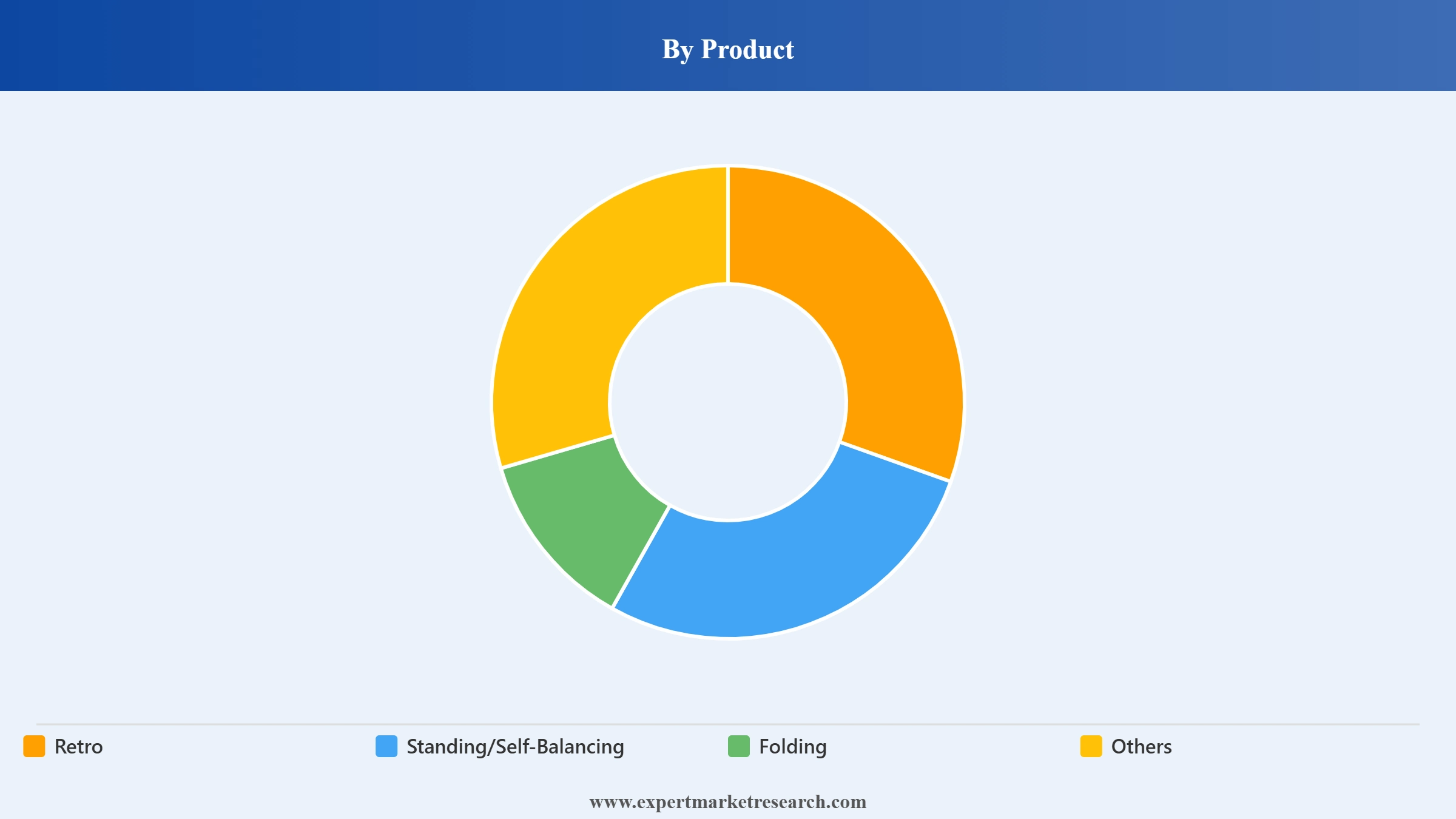
The major products of electric scooters in the market are:
Key Insights: Retro electric scooters featuring classic seated designs with nostalgic aesthetics and modern electric powertrains are a premium segment popular across India, Europe, and Southeast Asia among design-conscious urban buyers seeking style-differentiated mobility. Standing and self-balancing electric scooters are the dominant format in shared micro-mobility services across European and North American cities, deployed in dockless fleet operations for short urban trips and multimodal transit integration. Folding electric scooters are the fastest-growing product segment globally, valued for their portability, compact stowability, and transit-compatible design making them the preferred choice for urban professionals and multimodal commuters across Asia, Europe, and North America. Others includes all-terrain electric scooters for off-road recreational use, three-wheeled cargo scooters for delivery logistics, and self-balancing personal mobility devices for recreational and campus applications.
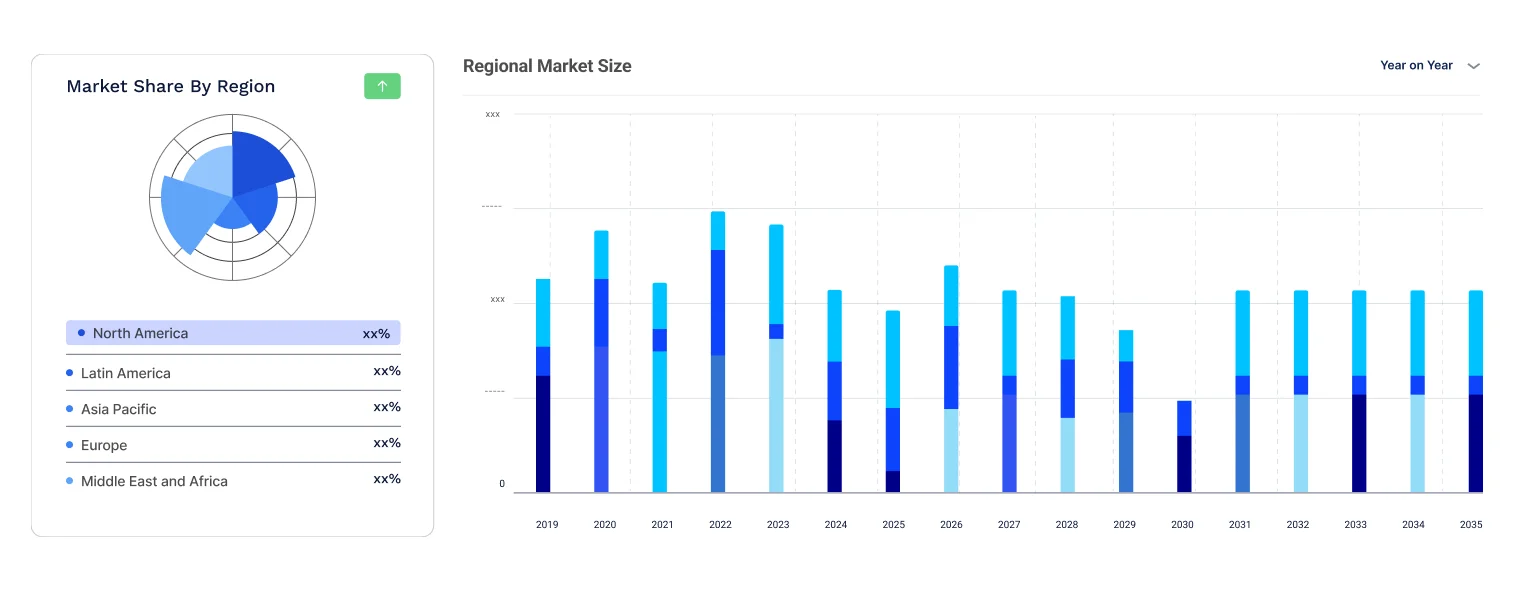
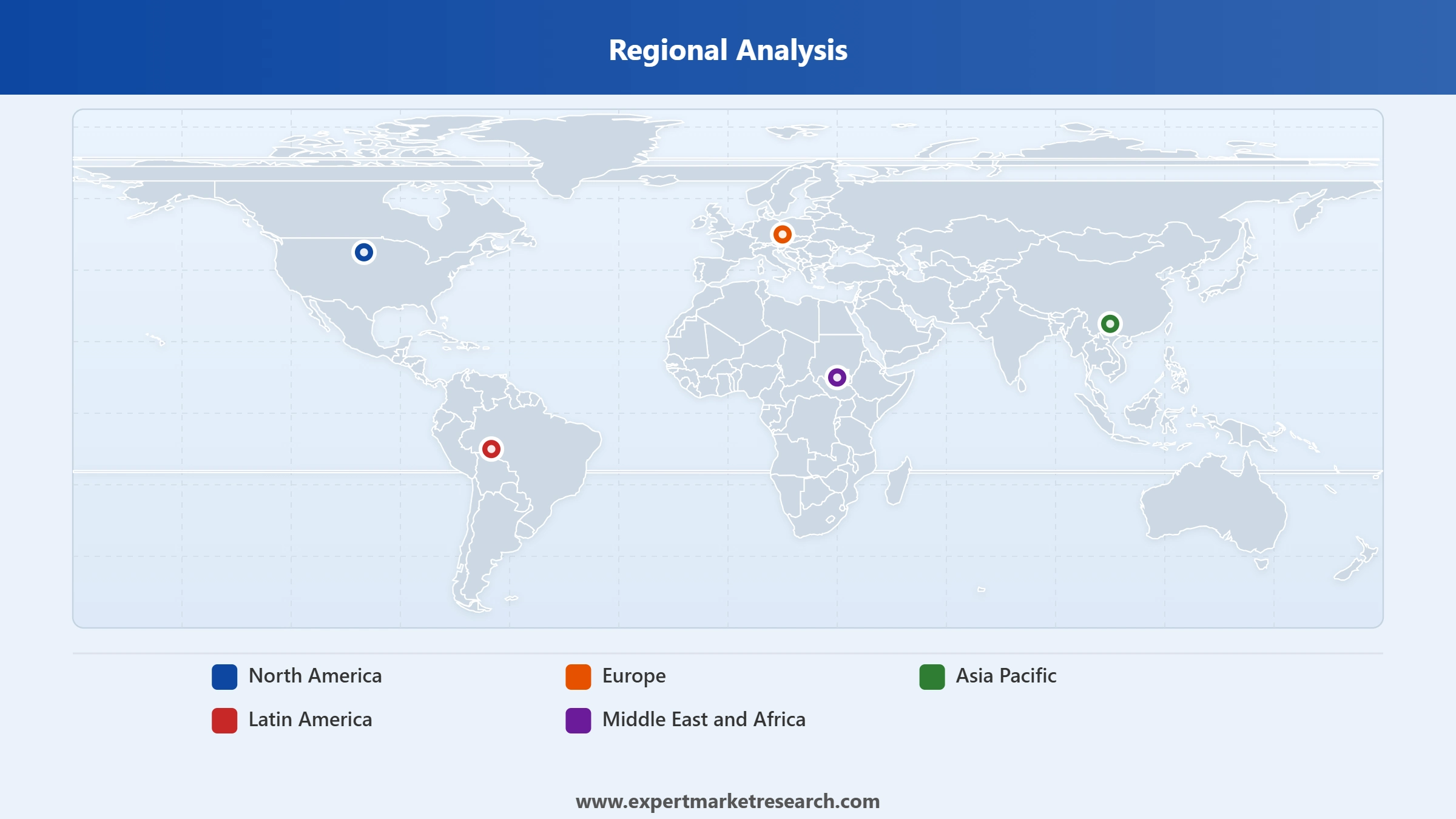
The EMR report looks into the regional markets of electric scooters like:
Read more about this report - REQUEST FREE SAMPLE COPY IN PDF
Asia Pacific dominates the global electric scooters market, accounting for approximately 80% of global market volume with China as the single largest national market by a substantial margin. China's electric scooter ecosystem comprising a vertically integrated domestic manufacturing sector, extensive urban charging infrastructure, government emission restrictions progressively excluding conventional petrol two-wheelers from urban zones, and a consumer market of hundreds of millions of two-wheeler users creates the world's largest and most developed electric scooter production and consumption base. China-based manufacturers including Yadea Technology Group, Jiangsu Xinri Electric Vehicle Co. (Xinri), and NIU Technologies collectively serve both the massive domestic market and growing export markets across Southeast Asia, Latin America, and Africa. Taiwan's Gogoro has established the world's most advanced battery swapping network, now expanding into India and other Asian markets as the Powered by Gogoro Network infrastructure model scales internationally.
India Electric Scooters Market
India is the fastest-growing major electric scooter market globally, reaching a record monthly high of 191,067 electric two-wheeler registrations in March 2026 representing approximately 9.8% of total two-wheeler sales in that month and posting full-year FY2026 industry growth of over 60% year-over-year. TVS Motor Company led India's FY2026 electric two-wheeler market with 341,513 units (+43.54% YoY), driven by the iQube family lineup's widespread service network coverage and the March 2026 introduction of Battery-as-a-Service financing. Bajaj Auto's Chetak electric scooter range secured second position with 289,349 units (+25.71%), while Ather Energy posted the strongest year-over-year growth among established players at 82.34% to 239,178 units, driven by the family-oriented Rizta scooter's penetration into semi-urban markets. Hero MotoCorp's Vida electric brand grew 196% in FY2026 to approximately 144,000 units, demonstrating the competitive entry power of India's largest two-wheeler manufacturer's EV strategy. The government's PM E-DRIVE scheme extended through July 2026 continues to provide structured demand support for the segment.
North America's electric scooter market is characterised by a different product and use case mix than Asian markets, with the shared micro-mobility segment deploying fleets of IoT-connected standing kick scooters and folding scooters in urban centres representing a larger portion of total market activity than in Asia, where personal ownership of seated electric scooters dominates. The United States and Canada are experiencing growing adoption of electric scooters for personal last-mile commuting and recreational use, particularly in cities with progressive micro-mobility policies and established bike lane infrastructure. Shared electric scooter operators including Lime, Bird, and Spin (partnering with Segway) are operating in hundreds of North American cities under municipal licensing frameworks, progressively professionalising their operations to meet safety, geofencing, and data-sharing requirements that have made fleet management technology quality as important as vehicle hardware in winning and retaining operating permits.
Read more about this report - REQUEST FREE SAMPLE COPY IN PDF
Europe is the world's most compliance-driven electric scooter market, where heavy municipal regulation encompassing licensing frameworks, fleet size caps, mandatory geofencing, speed limiters in pedestrian zones, and real-time data sharing with transit authorities has created an operational environment that rewards professional, technology-intensive micro-mobility operators over raw fleet scale. The United Kingdom's Department for Transport extended its e-scooter rental trials through 2026, citing measured reductions in car trips under five kilometres in participating boroughs, providing policy validation data that is accelerating the development of permanent national e-scooter legislation. Germany, France, Spain, the Netherlands, and Nordic countries are active electric scooter markets with both shared mobility services and growing personal ownership in urban centres. Europe's focus on emissions reduction, cycling infrastructure investment, and urban mobility sustainability is creating strong long-term structural demand for electric scooters as a complement to expanded public transit networks.
Latin America's electric scooter market is in an early but accelerating development phase, anchored by Brazil and Mexico as the region's largest potential markets and with Colombia, Chile, Argentina, and Peru as growing secondary markets. Mexico's growing urban population, severe traffic congestion in major cities, and government interest in urban mobility decarbonisation create conditions for shared micro-mobility service expansion and personal electric scooter adoption that several operators are beginning to address with urban fleet deployments. Brazil's large domestic two-wheeler market and government programmes supporting electric vehicle adoption provide a foundation for electric scooter market development, with both local and international brands progressively establishing distribution and service infrastructure. Latin America's electric scooter market is closely correlated with shared mobility platform development, as individual ownership is most stimulated by prior shared service exposure that normalises the electric scooter as a reliable, practical everyday vehicle.
The Middle East and Africa region's electric scooter market encompasses the GCC states' growing urban micro-mobility services in smart city developments and the large Sub-Saharan African two-wheeler market where electric scooters are progressively being introduced as a cleaner and lower operating cost alternative to conventional petrol motorcycles for commercial logistics and personal commuting. African electric scooter deployment focused particularly on last-mile delivery and urban commuting in Nigeria, Kenya, Rwanda, and South Africa is being supported by development finance institutions, international impact investors, and mobility start-ups pursuing electrification of Africa's vast motorcycle taxi (boda-boda) sector, where electric powertrains offer compelling total operating cost advantages for high-mileage daily commercial users. GCC electric scooter adoption is primarily shared micro-mobility focused, with smart city developments in the UAE and Saudi Arabia integrating electric scooter and e-bike services as components of carbon-neutral urban transportation planning.
The report presents a detailed analysis of the following key players in the global electric scooters market, looking into their capacity, market shares, and latest developments like capacity expansions, plant turnarounds, and mergers and acquisitions:
Gogoro Inc., headquartered in Taipei, Taiwan, is a leading provider of smart electric scooters and battery swapping infrastructure. Founded in 2011, the company's popular brands include Gogoro Smartscooter, Gogoro VIVA, and the Powered by Gogoro Network battery swapping platform, among others. Its products and services are distributed across Taiwan, India, Singapore, and select Asian and European markets through its proprietary battery swapping station network and authorised dealer channels.
Greenwit Ltd., headquartered in Hong Kong, China, is a leading manufacturer of electric scooters and personal electric mobility vehicles. Founded in 2012, the company's popular brands include Scrooser and a range of standing and seated electric scooter models, among others. Its products are distributed globally across Europe, North America, and Asia Pacific through online retail channels and authorised distribution partners.
Vmoto Limited, headquartered in Perth, Australia, is a leading manufacturer of electric scooters for both personal and commercial fleet applications. Founded in 2000, the company's popular brands include Super Soco, CPx, and Vmoto electric scooter models, among others. Its products are distributed across Europe, Asia Pacific, and emerging markets through a network of authorised dealers and fleet supply partnerships with logistics and delivery companies.
Terra Motors Corporation, headquartered in Tokyo, Japan, is a leading manufacturer and distributor of electric two-wheelers and mobility solutions across Asian and African markets. Founded in 2010, the company's popular brands include Terra A4000i, Terra Y4A, and a range of electric scooter and three-wheeler models, among others. Its products are distributed primarily across Japan, India, Bangladesh, the Philippines, and African markets through local dealer networks and fleet supply partnerships.
Others include TVS Motor Company, Bajaj Auto Ltd., Ather Energy, Hero MotoCorp (Vida), and Ola Electric, among other established and emerging electric scooter manufacturers contributing to the global electric scooters market's technological innovation and commercial growth.
The comprehensive report looks into the macro and micro aspects of the industry. The Expert Market Research report gives an in-depth insight into the market by providing a SWOT analysis as well as an analysis of Porter's Five Forces model.
*Please note that this is only a partial list; the complete list of key players is available in the full report. Additionally, the list of key players can be customized to better suit your needs.*


Upto 15% Off
USD
$2499 $2249
$3999 $3599
$4999 $4249
$5999 $5099


*While we strive to always give you current and accurate information, the numbers depicted on the website are indicative and may differ from the actual numbers in the main report. At Expert Market Research, we aim to bring you the latest insights and trends in the market. Using our analyses and forecasts, stakeholders can understand the market dynamics, navigate challenges, and capitalize on opportunities to make data-driven strategic decisions.*
In 2025, the global electric scooters market attained a value of nearly USD 26.91 Billion.
The market is projected to grow at a CAGR of 7.70% between 2026 and 2035.
The market is estimated to witness a healthy growth in the forecast period of 2026-2035 to reach nearly USD 56.50 Billion by 2035.
The market is being driven by the increasing preference of sustainable two-wheelers and favourable policies of various governments to promote green energy.
The key trends of the market include the advent of shared e-scooters and increasing research and development (R&D) to promote sustainable lifestyles.
The major regions in the market are North America, Latin America, the Middle East and Africa, Europe, and the Asia Pacific.
The major batteries in the market are sealed lead acid, Li-Ion, and NiMH.
The leading voltages in the market are 24V, 36V, 48V, and above 48V.
The significant products in the market are retro, standing/self-balancing, and folding, among others.
The key players in the global electric scooters market are Gogoro Inc., Greenwit Ltd., Vmoto Limited, Terra Motors Corporation, TVS Motor Company, Bajaj Auto Ltd., Ather Energy, Hero MotoCorp (Vida), and Ola Electric, among others.
Explore our key highlights of the report and gain a concise overview of key findings, trends, and actionable insights that will empower your strategic decisions.
| REPORT FEATURES | DETAILS |
| Base Year | 2025 |
| Historical Period | 2019-2025 |
| Forecast Period | 2026-2035 |
| Scope of the Report |
Historical and Forecast Trends, Industry Drivers and Constraints, Historical and Forecast Market Analysis by Segment:
|
| Breakup by Battery |
|
| Breakup by Voltage |
|
| Breakup by Product |
|
| Breakup by Region |
|
| Market Dynamics |
|
| Competitive Landscape |
|
| Companies Covered |
|
| Report Price and Purchase Option | Explore our purchase options that are best suited to your resources and industry needs. |
| Delivery Format | Delivered as an attached PDF and Excel through email, with an option of receiving an editable PPT, according to the purchase option. |
Datasheet
One User
USD 2,499
USD 2,249
tax inclusive*
Single User License
One User
USD 3,999
USD 3,599
tax inclusive*
Five User License
Five User
USD 4,999
USD 4,249
tax inclusive*
Corporate License
Unlimited Users
USD 5,999
USD 5,099
tax inclusive*
*Please note that the prices mentioned below are starting prices for each bundle type. Kindly contact our team for further details.*
Flash Bundle
Small Business Bundle
Growth Bundle
Enterprise Bundle
*Please note that the prices mentioned below are starting prices for each bundle type. Kindly contact our team for further details.*
Flash Bundle
Number of Reports: 3
20%
tax inclusive*
Small Business Bundle
Number of Reports: 5
25%
tax inclusive*
Growth Bundle
Number of Reports: 8
30%
tax inclusive*
Enterprise Bundle
Number of Reports: 10
35%
tax inclusive*
How To Order

Select License Type
Choose the right license for your needs and access rights.

Click on ‘Buy Now’
Add the report to your cart with one click and proceed to register.

Select Mode of Payment
Choose a payment option for a secure checkout. You will be redirected accordingly.
Strategic Solutions for Informed Decision-Making
Gain insights to stay ahead and seize opportunities.

Get insights & trends for a competitive edge.

Track prices with detailed trend reports.

Analyse trade data for supply chain insights.

Leverage cost reports for smart savings

Enhance supply chain with partnerships.

Connect For More Information
Our expert team of analysts will offer full support and resolve any queries regarding the report, before and after the purchase.
Our expert team of analysts will offer full support and resolve any queries regarding the report, before and after the purchase.
We employ meticulous research methods, blending advanced analytics and expert insights to deliver accurate, actionable industry intelligence, staying ahead of competitors.
Our skilled analysts offer unparalleled competitive advantage with detailed insights on current and emerging markets, ensuring your strategic edge.
We offer an in-depth yet simplified presentation of industry insights and analysis to meet your specific requirements effectively.




