

Consumer Insights
Uncover trends and behaviors shaping consumer choices today
Procurement Insights
Optimize your sourcing strategy with key market data
Industry Stats
Stay ahead with the latest trends and market analysis.
The global enterprise data management market was valued at USD 104.92 Billion in 2025. Blockchain-driven master data management solutions are accelerating cross-border data validation across regulated industries. In turn, the market is expected to grow at a CAGR of 12.80% during the forecast period of 2026-2035 to reach a value of USD 349.90 Billion by 2035.
One of the most defining trends in the market is the shift toward real-time data governance across mission-critical workflows. With data volumes forecasted to exceed 180 zettabytes by 2025, organisations are prioritising proactive governance and compliance solutions. The surge in stringent data regulations like the EU Data Governance Act and India’s Digital Personal Data Protection Act 2023 has intensified enterprise demand for structured, secure, and transparent data environment, accelerating the enterprise data management market growth. This movement is especially visible across banking and telecom sectors, where operational efficiency hinges on the integrity and speed of data handling.
According to industry reports, nearly 30% of enterprise-generated data will be real-time by 2025. Meanwhile, the United Kingdom’s National Data Strategy continues to encourage digital maturity in public and private sectors, with EUR 100 million allocated for data infrastructure upgrades. Additionally, the Smart Data Initiative across the EU is expected to stimulate interoperable data exchange frameworks. These enterprise data management market developments collectively signal a market climate ripe for scalable EDM tools, especially those capable of handling unstructured, cross-border, and heterogeneous data sets.
Compound Annual Growth Rate
12.8%
Value in USD Billion
2026-2035
Enterprise Data Cloud (EDC), a new benchmark in data and storage management simplicity that frees up organisations to concentrate on business outcomes rather than infrastructure, is being introduced by Pure Storage, the IT pioneer that provides the most cutting-edge data storage technology and services in the world. Pure Storage’s EDC simplifies storage-layer management, enabling enterprises to prioritise outcome-driven data strategies over infrastructure complexities in global EDM deployments.
The launch of Persistent iAURA, a suite of AI-powered data solutions designed to spur corporate success, was announced by Persistent Systems, a global leader in digital engineering and enterprise modernisation. Businesses are empowered by iAURA's smooth deployment and accuracy in handling data problems for AI initiatives. This enterprise data management market development enhances enterprise data readiness for AI by offering seamless integration and automated data quality solutions, reinforcing the foundation of AI-enabled EDM frameworks.
Leading AI-powered Master Data Management (MDM) solutions provider Verdantis announced the release of Auto-Enrich AI and Auto-Spec AI, two state-of-the-art autonomous AI agents that will transform data enrichment, normalisation, and standardisation for businesses globally. These autonomous agents streamline master data standardisation and enrichment, reducing manual intervention and accelerating data governance initiatives across enterprise systems.
SAP SE unveiled SAP Business Data Cloud, a ground-breaking solution that integrates all SAP and external data across an organisation, giving businesses the dependable data base they require to develop trustworthy AI and make more significant judgements. SAP’s platform unifies internal and third-party data into a single trusted source, strengthening data reliability and interoperability for enterprise-wide decision-making and AI governance.
Enterprise data management is evolving from generic platforms to industry-vertical solutions. For instance, healthcare providers are leveraging AI-powered data fabrics to unify siloed clinical, operational, and financial data. In November 2021, Roche Diagnostics integrated a custom EDM platform to harmonise global lab data, reducing data retrieval latency to a significant extent. Meanwhile, manufacturing players in Europe are deploying contextual data layers to enhance predictive maintenance. This enterprise data management market trend is supported by the United Kingdom Industrial Strategy Challenge Fund, which commits EUR 147 million to digital manufacturing, including data infrastructure modernisation. Sector-aligned platforms are not only streamlining compliance but also helping in driving intelligent automation.
Global enterprises are abandoning centralised data lakes in favour of federated data mesh models to decentralise ownership and scalability. Firms like Zalando are transitioning to a mesh architecture to streamline data, boosting internal data delivery considerably. This model allows domain-specific teams to self-serve and manage data as a product. Governments are also encouraging growth in the enterprise data management market. For example, Singapore’s Smart Nation initiative is promoting data decentralisation in public services, fostering innovation without compromising compliance. The data mesh approach is gaining traction as organisations grow more complex and geographically dispersed, demanding agile and autonomous data operations.
Environmental, Social, and Governance (ESG) frameworks are now a major motivator for EDM adoption. With the EU Corporate Sustainability Reporting Directive (CSRD) taking effect, companies are now legally bound to report sustainability data. As a result, firms are integrating ESG data modules into their existing EDM platforms. For instance, SAP launched a Sustainability Control Tower in December 2021 to offer real-time ESG analytics through enterprise data systems, aiding to the enterprise data management market value. This shift is particularly resonant in energy, manufacturing, and financial services, where stakeholders demand transparent ESG metrics to meet investor expectations and regulatory obligations.
Generative AI (GenAI) is rapidly being integrated into enterprise metadata repositories to enhance cataloguing, lineage tracking, and anomaly detection. In May 2024, Informatica launched CLAIRE GPT, a GenAI assistant that enables contextual metadata exploration across multi-cloud data estates. This allows data stewards to auto-suggest classifications and automate data quality diagnostics. According to the enterprise data management market analysis, nearly 68% of global enterprises have integrated GenAI in their data governance tools. The fusion of GenAI and metadata management is enabling contextual understanding at scale, boosting enterprise agility and reducing human intervention in data lifecycle management.
The increasing push for open data by governments is leading to standardisation in data infrastructure and favouring consolidated vendor ecosystems. The United States Federal Data Strategy mandates all agencies to maintain enterprise data inventories, promoting interoperability. Similarly, India’s National Data & Analytics Platform (NDAP) offers sector-specific datasets for public use, urging companies to align with compatible EDM tools. Vendors with robust compliance, scalability, and multi-format support are gaining favour, pushing niche providers toward consolidation or exit.
Read more about this report - REQUEST FREE SAMPLE COPY IN PDF
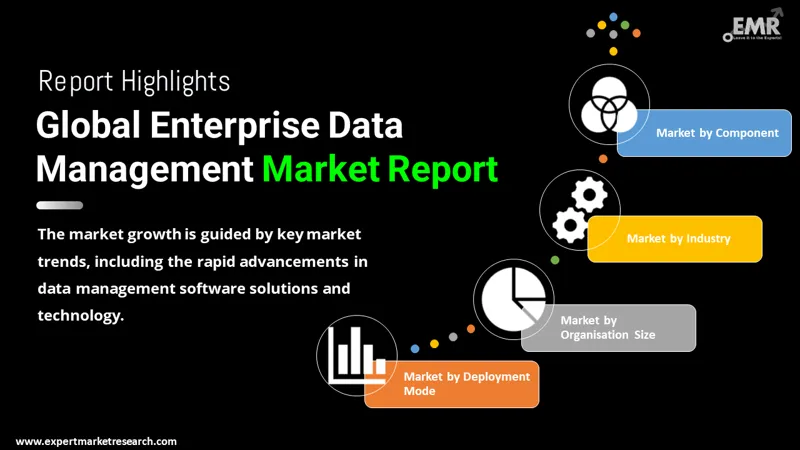
The EMR’s report titled “Global Enterprise Data Management Market Report and Forecast 2026-2035” offers a detailed analysis of the market based on the following segments:
Market Breakup by Component
Key Insight: Software leads the global enterprise data management market owing to modular data integration platforms and AI-powered engines. Meanwhile, services are surging, fuelled by the complexity of hybrid cloud migrations and global compliance frameworks. Organisations now prefer solutions that combine licensing with implementation and support capabilities, making end-to-end offerings particularly attractive. As firms expand their digital operations, the line between software and services continues to blur, with vendors increasingly offering bundled solutions tailored to sector-specific demands.
Market Breakup by Deployment Mode
Key Insight: On-premise models largely contribute to the enterprise data management market revenue where security, data sovereignty, and compliance are paramount, particularly in finance and healthcare. However, cloud solutions are scaling fast across less-regulated verticals, offering speed and flexibility. Hybrid deployment strategies are becoming more common, allowing enterprises to keep sensitive data in-house while utilising cloud capabilities for analytics and scalability.
Market Breakup by Organisation Size
Key Insight: Large enterprises rely on robust, multilayered data ecosystems for operational and regulatory efficiency, while SMEs are rapidly adopting plug-and-play EDM solutions to compete more intelligently. Both organisation sizes are driving demand for flexible, scalable data infrastructure, albeit at different levels of complexity and investment. As vendors increasingly provide industry-specific packages and pricing tiers, the barriers to entry are lowering for SMEs, making EDM a universally relevant function across organisation sizes.
Market Breakup by Industry
Key Insight: BFSI offers significant enterprise data management market opportunities for growth due to its compliance-heavy operations and demand for fraud-resistant, high-integrity data platforms. Meanwhile, healthcare is scaling quickly as precision medicine and clinical digitisation demand interoperable, compliant, and fast-access data infrastructure. Other verticals such as retail, IT, and logistics are also increasingly embedding EDM in their digital strategies to optimise supply chains, personalise customer experiences, and enable real-time decision-making.
Market Breakup by Region
Key Insight: North America leads in the global enterprise data management market, backed by compliance and innovation-friendly environments. Asia Pacific follows closely, driven by state-led digitalisation and a burgeoning tech ecosystem. Europe remains strong in data ethics and cross-border governance, while Latin America and MEA are gradually catching up, aided by digital banking, e-governance, and cross-sectoral digital initiatives.
Read more about this report - REQUEST FREE SAMPLE COPY IN PDF
By Component, Software Dominates the Market Owing to Advanced AI Data Pipelines
The software component is forecast to hold the dominant CAGR by component, which is largely propelled by the integration of AI and real-time analytics tools. Modern platforms like Talend Data Fabric and Microsoft Purview provide AI-enhanced data quality management, ensuring regulatory compliance and seamless integration across cloud environments. The demand is especially high across BFSI and life sciences sectors, where legacy systems are being replaced with intelligent, modular data platforms. The ability to handle multi-format, high-velocity data while maintaining data lineage makes enterprise-grade EDM software an indispensable tool across global operations.
As per the enterprise data management market report, professional and managed services are registering the fastest CAGR as enterprises struggle to navigate evolving data regulations and architecture transformations. Firms like Capgemini and Wipro are expanding data consultancy units to help businesses migrate from legacy EDM setups to cloud-native ecosystems. The complexity of setting up data lakes, taxonomies, and governance policies across hybrid environments has led to a surge in demand for services.
On-Premise Deployment Mode Leads the Market Due to Data Sovereignty in Regulated Sectors
Despite the cloud push, on-premise deployment continues to dominate among industries bound by strict data residency laws. Financial institutions, defence contractors, and critical infrastructure operators often require full control over their data environment. Additionally, industries handling sensitive personal data, like healthcare and legal sectors prefer on-site EDM to ensure compliance and limit third-party exposure. The increasing frequency of cyber-attacks and growing emphasis on digital autonomy has further validated the demand in the enterprise data management market.
Cloud-based EDM is emerging as the fastest-growing deployment mode, largely due to its scalability and ease of integration across distributed data environments. The surge in remote work, global operations, and multi-cloud strategies has prompted enterprises to adopt SaaS-based EDM tools like Collibra and Informatica IDMC. The United Kingdom Government’s Cloud First policy continues to promote adoption across public sector organisations. Cloud deployments also facilitate faster compliance updates, cross-border data synchronisation, and simplified API integrations.
Large Enterprises Account for the Largest Share Due to Complex Data Ecosystem Demands
Large enterprises account for the largest share of the market revenue owing to their expansive, decentralised data environments and compliance-heavy operations. These organisations typically generate petabytes of structured and unstructured data across geographies and departments. As a result, there is strong adoption of enterprise-grade EDM platforms that support advanced metadata management, real-time data processing, and auditability. Sectors like BFSI, pharma, and telecom are deploying hybrid data ecosystems to meet both speed and sovereignty requirements.
Small and medium-sized enterprises are experiencing the fastest growth in the enterprise data management market, primarily fuelled by the rise of affordable, subscription-based cloud solutions. No longer confined to spreadsheets or manual data tools, SMEs now access tools with embedded analytics, scalable storage, and no-code interfaces. Vendors like Snowflake and Zoho are tailoring modular data management solutions for mid-market companies, particularly in retail, logistics, and IT services.
The BFSI Industry Dominates the Market Due to Rising Regulatory and Risk Management Needs
Banking, financial services, and insurance firms are the dominant adopters of EDM, largely due to their stringent data reporting, fraud detection, and audit trail requirements. Real-time processing, data lineage, and metadata management are mission-critical functions for these institutions. Major banks are integrating EDM with regtech and customer intelligence tools, creating unified platforms that support compliance with regulations like Basel III, MiFID II, and FATCA.
The healthcare and life sciences sector is experiencing rapid growth in enterprise data management adoption, driven by the need to manage vast, diverse datasets, ranging from clinical trial results to patient records and genomic sequencing data. With regulations like HIPAA, GDPR, and the 21st Century Cures Act mandating secure and interoperable health data, providers are investing in EDM systems that offer lineage tracking, consent-based access controls, and real-time insights. Pharmaceutical firms are also using EDM to streamline drug development cycles, track adverse event data, and harmonise R&D operations globally. This sector’s digital maturity curve is now accelerating, catalysed by post-COVID innovations.




North America Secures the Leading Position in the Market Due to Strong Regulatory Frameworks and Tech Investments
North America continues to hold the largest market share, supported by early tech adoption, strong data protection laws, and a mature enterprise ecosystem. The United States and Canada have well-established regulatory structures like SOX, HIPAA, and CPRA that demand structured data governance. Enterprises in this region are investing heavily in integrated EDM and analytics platforms to comply with both industry and federal mandates.
The enterprise data management market in Asia Pacific is experiencing the fastest growth, led by digital transformation initiatives across India, China, Southeast Asia, and Australia. Government programmes like India’s Digital India Mission and Japan’s Society 5.0 are aggressively driving data-centric models in public and private sectors. Enterprises in this region are increasingly integrating EDM to manage multilingual, unstructured, and high-velocity data.
Leading enterprise data management market players are focusing on AI integration, real-time analytics, and data security enhancements to serve highly regulated sectors. The market boasts a visible shift towards vertical-specific platforms, offering bespoke solutions for BFSI, healthcare, and telecom sectors. Multi-cloud operability, zero-trust architecture, and automation-driven metadata management are gaining importance. Vendors are also expanding professional service arms to guide clients through compliance, architecture redesign, and change management.
Emerging opportunities for enterprise data management companies lie in ESG reporting, decentralised data ownership, and GenAI-enabled search across repositories. The global competition is all about value extraction, regulatory trust, and scalability. As organisations struggle to balance agility and compliance, solution providers that offer end-to-end visibility, interoperability, and automation will likely gain competitive ground.
SAP SE, established in 1972 and headquartered in Walldorf, Germany, serves enterprise clients with end-to-end data management tools that integrate governance, data lineage, and real-time analytics. Its cloud-based Business Technology Platform supports AI, IoT, and advanced analytics.
Oracle Corporation, established in 1977 and headquartered in California, United States, offers cloud-native data management platforms that integrate metadata automation and built-in security. Its Autonomous Database platform supports self-repairing infrastructure with predictive analytics capabilities.
Teradata Corporation, established in 1979 and headquartered in San Diego, California, focuses on enterprise analytics and data unification. It offers VantageCloud, an AI-enabled platform enabling large-scale, real-time business intelligence and cross-channel customer engagement.
NortonLifeLock Inc, established in 2005 and headquartered in Tempe, Arizona, extends data governance into cyber protection. It caters to enterprise-level clients with privacy-centric data classification, breach monitoring, and compliance-focused governance dashboards.
*Please note that this is only a partial list; the complete list of key players is available in the full report. Additionally, the list of key players can be customized to better suit your needs.*
Other key players in the global enterprise data management market are Cloudera, Inc. and others.
Explore the latest trends shaping the global enterprise data management market 2026-2035 with our in-depth report. Gain strategic insights, future forecasts, and key market developments that can help you stay competitive. Download a free sample report or contact our team for customised consultation on enterprise data management market trends 2026.


Upto 15% Off
USD
$2499 $2249
$3999 $3599
$4999 $4249
$5999 $5099


*While we strive to always give you current and accurate information, the numbers depicted on the website are indicative and may differ from the actual numbers in the main report. At Expert Market Research, we aim to bring you the latest insights and trends in the market. Using our analyses and forecasts, stakeholders can understand the market dynamics, navigate challenges, and capitalize on opportunities to make data-driven strategic decisions.*
In 2025, the enterprise data management market reached an approximate volume of 104.92 Billion.
The market is projected to grow at a CAGR of 12.80% between 2026 and 2035.
The market is estimated to witness a healthy growth in the forecast period of 2026-2035 to reach over USD 349.90 Billion by 2035.
The major regions in the market are North America, Latin America, the Middle East and Africa, Europe, and the Asia Pacific.
Investing in AI-enabled governance tools, expanding industry-specific data models, adopting hybrid deployments, integrating ESG data systems, and forming vendor partnerships for compliance alignment are driving sustainable growth in enterprise data management.
The key trends aiding the market expansion include rapid advancements in data management software solutions and technology and the rising use of advanced technologies like AI.
Software and services are the major components of enterprise data management solutions.
On-premise and cloud are the different deployment modes considered within the market report.
Healthcare and life sciences, banking, financial services, and insurance, telecom and information technology, retail and consumer goods, media and entertainment, manufacturing, energy and utilities, transportation and logistics, and government and defence, among others are the significant industries in the market.
The major players in the market are SAP SE, Oracle Corporation, Teradata Corporation, NortonLifeLock Inc., and Cloudera, Inc., among others.
Balancing scalability with data security, managing siloed legacy systems, ensuring cross-border compliance, and adapting to rapidly changing regulations are major hurdles for companies in the enterprise data management market deploying enterprise data management frameworks globally.
Explore our key highlights of the report and gain a concise overview of key findings, trends, and actionable insights that will empower your strategic decisions.
| REPORT FEATURES | DETAILS |
| Base Year | 2025 |
| Historical Period | 2019-2025 |
| Forecast Period | 2026-2035 |
| Scope of the Report |
Historical and Forecast Trends, Industry Drivers and Constraints, Historical and Forecast Market Analysis by Segment:
|
| Breakup by Component |
|
| Breakup by Deployment Mode |
|
| Breakup by Organisation Size |
|
| Breakup by Industry |
|
| Breakup by Region |
|
| Market Dynamics |
|
| Competitive Landscape |
|
| Companies Covered |
|
Datasheet
One User
USD 2,499
USD 2,249
tax inclusive*
Single User License
One User
USD 3,999
USD 3,599
tax inclusive*
Five User License
Five User
USD 4,999
USD 4,249
tax inclusive*
Corporate License
Unlimited Users
USD 5,999
USD 5,099
tax inclusive*
*Please note that the prices mentioned below are starting prices for each bundle type. Kindly contact our team for further details.*
Flash Bundle
Small Business Bundle
Growth Bundle
Enterprise Bundle
*Please note that the prices mentioned below are starting prices for each bundle type. Kindly contact our team for further details.*
Flash Bundle
Number of Reports: 3
20%
tax inclusive*
Small Business Bundle
Number of Reports: 5
25%
tax inclusive*
Growth Bundle
Number of Reports: 8
30%
tax inclusive*
Enterprise Bundle
Number of Reports: 10
35%
tax inclusive*
How To Order

Select License Type
Choose the right license for your needs and access rights.

Click on ‘Buy Now’
Add the report to your cart with one click and proceed to register.

Select Mode of Payment
Choose a payment option for a secure checkout. You will be redirected accordingly.
Strategic Solutions for Informed Decision-Making
Gain insights to stay ahead and seize opportunities.

Get insights & trends for a competitive edge.

Track prices with detailed trend reports.

Analyse trade data for supply chain insights.

Leverage cost reports for smart savings

Enhance supply chain with partnerships.

Connect For More Information
Our expert team of analysts will offer full support and resolve any queries regarding the report, before and after the purchase.
Our expert team of analysts will offer full support and resolve any queries regarding the report, before and after the purchase.
We employ meticulous research methods, blending advanced analytics and expert insights to deliver accurate, actionable industry intelligence, staying ahead of competitors.
Our skilled analysts offer unparalleled competitive advantage with detailed insights on current and emerging markets, ensuring your strategic edge.
We offer an in-depth yet simplified presentation of industry insights and analysis to meet your specific requirements effectively.




