

Consumer Insights
Uncover trends and behaviors shaping consumer choices today
Procurement Insights
Optimize your sourcing strategy with key market data
Industry Stats
Stay ahead with the latest trends and market analysis.
The Europe wires and cables market attained a value of USD 50.98 Billion in 2025 and is projected to expand at a CAGR of 3.20% through 2035. The market is further expected to achieve USD 69.85 Billion by 2035. Europe’s shift toward smart grid-enhancing technologies is creating demand for advanced cable systems that increase network capacity without relying solely on new infrastructure. EU estimates indicate these technologies can expand network capacity by up to 40% while reducing conventional grid-expansion costs by up to 35%. This is particularly significant as Europe faces rising electricity demand and extensive grid-modernisation requirements.
The strongest structural opportunity is emerging from electricity-grid reinforcement. The European Commission estimates that EUR 584 billion of grid investment is needed by 2030, while electricity consumption in the EU is expected to rise by around 60% by 2030. In June 2025, the Commission also estimated requirements of EUR 730 billion for distribution and EUR 477 billion for transmission grid development through 2040. At the same time, offshore renewable development, cross-border interconnectors, fibre deployment, data-centre infrastructure and vehicle electrification are broadening demand beyond conventional building wires. Europe's installed wind capacity reached 246 GW in 2025, while FTTP coverage reached 74.1% of EU27 households by mid-2025, thereby boosting the Europe wires and cables market value.
Grid modernisation is the primary structural catalyst for higher-value cable demand across Europe. The European Commission estimates that EUR 584 billion of electricity-grid investment is required by 2030, while 40% of Europe's distribution grids are already more than 40 years old. Germany alone approved roughly 2,000 km of power lines during 2025, including major HVDC corridors, approximately 45% more than in 2024. A second factor is the expansion of cross-border and offshore electricity infrastructure. EU countries have established a combined ambition of approximately 88 GW of offshore renewable capacity by 2030 and around 360 GW by 2050, creating sustained requirements for submarine and high-voltage systems.
One of the key issues facing Europe’s wires and cables market is volatility in the cost of copper and aluminum, two commodities that have a direct effect on the cost of producing cables. The volume of projects in Europe involving transmission and distribution, as well as those relating to renewable energy, needs the use of many copper and aluminum cables, making the manufacturers vulnerable to commodity price fluctuations. Issues related to the availability of copper can further exacerbate the procurement risks, and high cost of electricity and labor can put pressure on the production margins. On the other hand, long qualification times and limited manufacturing capacity are the issues facing manufacturers of highly specialized HVDC and submarine cables, thereby restricting the Europe wires and cables market developments.
Compound Annual Growth Rate
3.2%
Value in USD Billion
2026-2035
Read more about this report - Request a Free Sample
Prysmian announced that it was onboarding new cable jointers and committing to a dedicated training academy in Scotland. The initiative addresses specialist workforce requirements associated with complex cable infrastructure and supports the company's ability to execute energy-transition projects in the UK. The initiative can improve the availability of specialist installation skills for Europe's expanding transmission and subsea-cable pipeline. It also highlights how labour availability is becoming an important capacity constraint alongside manufacturing capability.
Nexans and Epsilon Composite completed the first field validation of CORECHECK technology on TenneT's 380 kV transmission network in the Netherlands. The technology enables utilities to verify the integrity of composite-core conductors after installation, strengthening quality assurance for high-voltage grid assets. Monitoring technologies can increase the value proposition of advanced cable systems by reducing inspection and project risks. Their adoption should favour suppliers offering intelligent cable and conductor solutions rather than conventional hardware alone.
The European Commission opened two Connecting Europe Facility calls worth EUR 200 million for high-capacity digital networks, including submarine cables. EUR 180 million was allocated to backbone networks, while EUR 20 million targeted smart infrastructure capable of monitoring and improving the resilience of digital connectivity assets. Public funding is reducing barriers to strategic European cable projects and increasing the addressable pipeline for subsea and backbone suppliers. Smart-cable requirements should also encourage higher-value monitoring and resilience technologies, thus boosting the trends of the Europe wires and cables market.
Furukawa Electric announced mass production of a 13,824-count optical-fibre cable, with twice the transmission capacity of its existing cables. The company also began operating a specialised plant at its Mie Works for ultra-high-count optical-fibre cable production to strengthen supply for hyperscale data centres. Higher fibre density directly addresses the connectivity requirements created by hyperscale computing and AI infrastructure. European cable suppliers will face increasing pressure to improve fibre density, manufacturing scalability and data-centre-specific product portfolios.
European network operators are increasingly planning infrastructure around renewable integration, electrification and cross-border power flows rather than only replacement of ageing assets. Germany's approval of roughly 2,000 km of power lines during 2025 illustrates the scale of transmission activity, while the country's network regulator has stated that further expansion of the extra-high-voltage network remains necessary. This creates commercial opportunities for suppliers of HV, EHV, HVDC and associated accessories, particularly where manufacturers can provide installation, testing and monitoring alongside cable systems.
Europe's offshore-energy strategy increasingly links renewable generation with coordinated transmission infrastructure rather than isolated national projects. In January 2026, Germany and Denmark agreed to jointly develop the Bornholm Energy Island project, linking 3 GW of offshore generation with both national grids and supported by a EUR 645 million EU grant. The project is designed as part of Europe's emerging offshore energy-hub model. For cable manufacturers, this favours high-voltage submarine cable capacity, installation vessels, accessories and engineering capabilities rather than commodity-only supply, thus shaping the Europe wires and cables market trends.
The European Commission's 2026 connectivity assessment found that FTTP became Europe's most widespread fixed connectivity technology, reaching 74.1% of EU27 households by mid-2025, while 5G household coverage reached 96.8%. At the same time, legacy copper networks are being progressively retired. This transition changes the product mix from traditional copper telecommunications infrastructure toward fibre-optic cables, high-density connectivity systems and associated data-centre infrastructure, creating opportunities for manufacturers with advanced optical-fibre production and high-density deployment capabilities.
In February 2026, the European Commission allocated EUR 347 million to strategic submarine-cable projects and introduced a Cable Security Toolbox, including funding to strengthen European cable-repair capabilities. A further EUR 200 million in CEF calls was announced in March 2026 for high-capacity backbone networks and smart cable infrastructure. This is expanding the addressable market from cable manufacture toward monitoring, resilience, repair and lifecycle-management solutions for critical subsea networks.
The Expert Market Research’s report titled "Europe Wires and Cables Market Report and Forecast 2026-2035” offers a detailed analysis of the market based on the following segments:
Market Breakup by Voltage
Key Insight: The Europe wires and cables market is segmented into low voltage, medium voltage and high voltage. Low-voltage products remain closely connected with buildings, commercial facilities and local electrical distribution, while medium-voltage systems serve industrial facilities and distribution networks. High-voltage cables are increasingly linked to transmission reinforcement, renewable-energy integration and cross-border electricity infrastructure. The European Commission's grid plans and national HVDC projects are therefore shifting strategic attention toward higher-voltage systems. Germany's completion of approvals for four major electricity highways in 2025 illustrates the scale of high-voltage infrastructure being prepared for deployment, thus boosting the Europe wires and cables market growth.
Market Breakup by Product
Key Insight: The product segmentation comprises power cables, building wires, flexible wires and cables, EHV cables, control/instrumentation cables and others. Product demand is increasingly diverging according to end-use requirements. Building wires retain a large installed-base market, flexible and control cables serve industrial equipment and automation, while power and EHV cables benefit directly from transmission and renewable-energy infrastructure. The distinction is becoming commercially important because infrastructure projects increasingly require engineered cable systems, accessories, installation and testing rather than standalone cable supply.
Market Breakup by Material
Key Insight: The market is segmented into copper, aluminium and others. Material selection depends on electrical conductivity, weight, thermal performance, installation conditions, project economics and application requirements. Copper remains important across building, industrial and specialised cable applications, while aluminium has a strategic role in transmission because of its lower weight and suitability for large-scale conductor systems. Material sourcing and recycling are also gaining importance as manufacturers respond to supply-chain resilience and circularity requirements.
Market Breakup by End Use
Key Insight: Construction demand is tied to Europe’s renovation and energy-efficiency programmes, where wires and cables are used for electrical distribution, heat-pump installations, building controls, fire-safety systems, and commercial retrofits. Telecommunications is supported by European fibre rollout and 5G network densification, requiring fibre-optic, data, and power cables. Energy and power is the strongest cable-intensive segment, with HVDC transmission corridors, offshore wind connections, grid reinforcement, and cross-border interconnectors requiring high-voltage and subsea cables. Automotive demand is linked to Europe’s EV manufacturing, using high-voltage battery, charging, and vehicle wiring systems. Aerospace and defence require lightweight, specialised cables for avionics, radar, communications, and military platforms, while other applications include European rail electrification, industrial automation, and renewable-energy equipment.
Market Breakup by Country
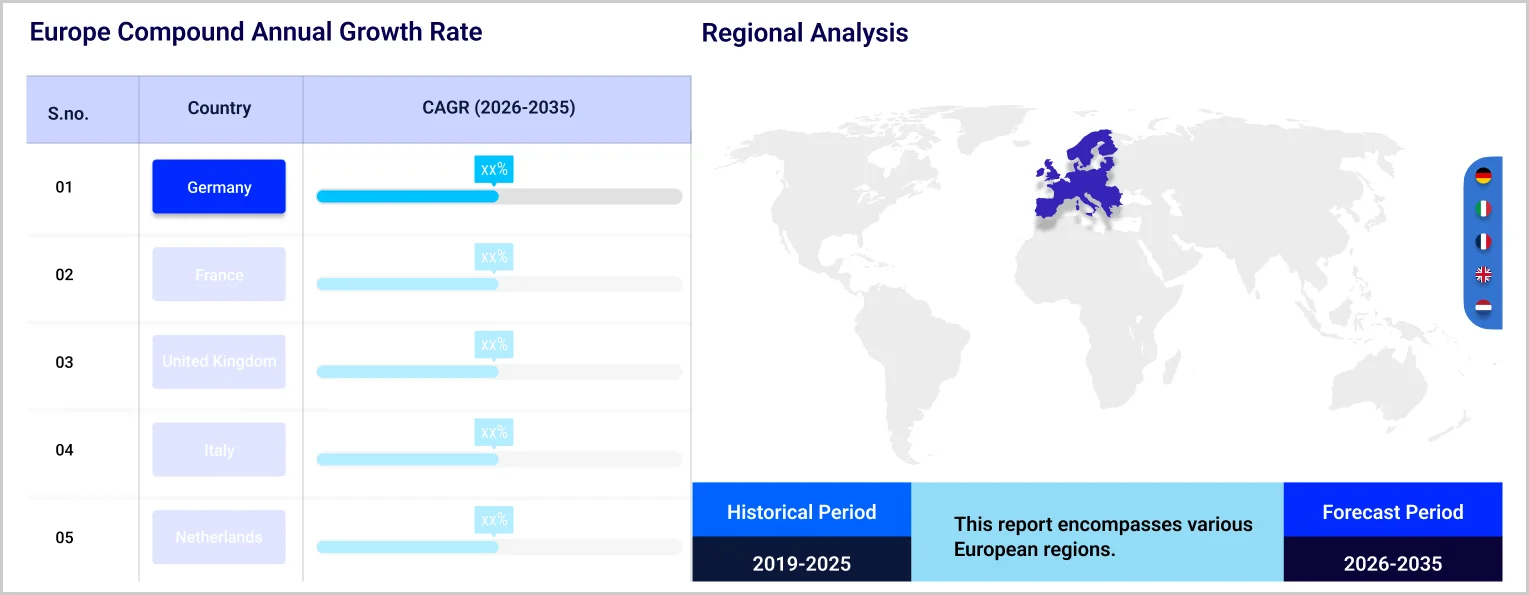
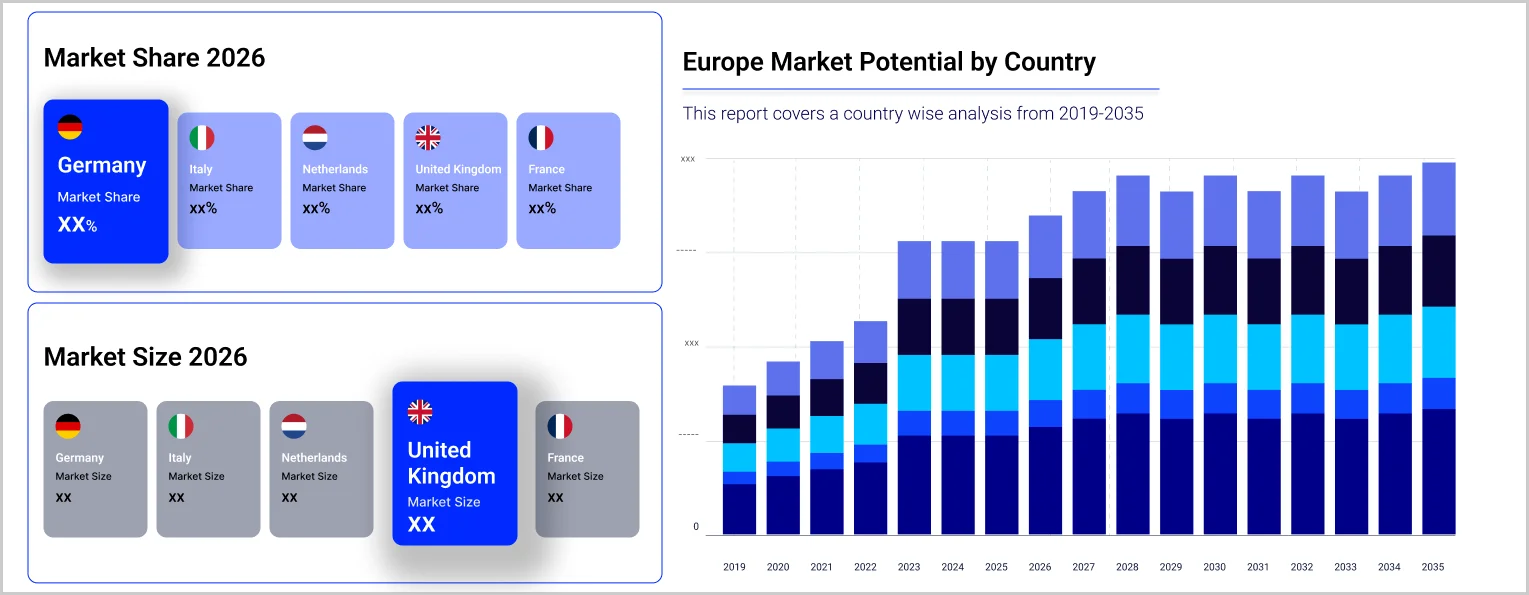
Key Insight: Germany is seeing strong cable demand from HVDC corridors, grid reinforcement and renewable-energy connections, while the UK is expanding subsea cables for offshore wind and interconnection. France is increasing cable requirements through nuclear-power infrastructure, renewable integration and grid upgrades. Italy is driving demand through grid modernisation, renewable connections and submarine interconnections across the Mediterranean. Other European markets are contributing through offshore wind development, electricity-grid expansion, fibre deployment and rail electrification. Across these countries, wires and cables are increasingly required for high-voltage transmission, subsea power links, renewable-energy connections, telecommunications networks, EV infrastructure and building electrification.
Low-voltage cables serve diverse residential, commercial, industrial, and infrastructure applications
Low-voltage cables have the broadest application base because they are used throughout residential, commercial, industrial and infrastructure installations. Their demand is supported by electrical distribution, building refurbishment, data-centre construction and equipment connections. Nexans' 2026 reporting also demonstrates the strategic importance manufacturers attach to low-voltage markets, although that particular development concerns the US rather than Europe. The European market therefore retains a broad recurring demand base for low-voltage products even as transmission projects receive greater investment intensity. Such developments will thus boost the Europe wires and cables market dynamics and trends in the long run.
High-voltage demand has the strongest evidence of accelerated structural expansion because European electricity consumption, renewable integration and cross-border transmission require significant network reinforcement. Germany's 2025 approval of roughly 2,000 km of power lines and the EU's offshore-grid programme provide direct evidence of project expansion.
By product, power cables lead broad demand while EHV systems gain infrastructure-led momentum
Power cables have the widest exposure to Europe's electricity infrastructure because they serve generation, distribution, transmission and industrial applications. Their importance is reinforced by grid modernisation programmes covering both replacement of ageing infrastructure and expansion for electrification. The European Commission's estimated EUR 584 billion grid-investment requirement through 2030 provides a substantial infrastructure backdrop for power-cable procurement, thereby bolstering the Europe wires and cables demand.
EHV cables have a strong expansion case due to large transmission corridors and interconnector projects. Germany's HVDC electricity highways and Europe's offshore energy-hub plans directly require high-capacity transmission systems. However, publicly available primary sources do not provide a sufficiently consistent Europe-wide product dataset to quantify a formal fastest-growing ranking, so the assessment is based on documented infrastructure pipelines rather than an invented growth rate.
By material, copper remains foundational while aluminium gains importance in transmission applications
Copper remains a fundamental cable material because of its high conductivity and broad suitability across low-, medium- and high-performance electrical applications. Its importance extends from building wires to industrial systems and specialised electrical equipment. European manufacturers are also increasingly addressing copper availability through recycling and circular-economy initiatives, making material recovery part of competitive positioning rather than solely a sustainability consideration. Nexans, for example, highlights copper recycling as part of its integrated supply-chain strategy, and thereby bolstering the demand of the Europe wires and cables market.
Aluminium has a strong structural opportunity in transmission and large-scale electricity infrastructure because its lower weight can support long-distance conductor applications. The European grid expansion pipeline provides a favourable application environment. However, primary Europe-wide public datasets do not provide sufficiently comparable segment growth rates to designate aluminium as statistically the fastest-growing material. It is therefore more appropriate to describe aluminium as a high-opportunity material rather than claim an unsupported ranking.
By end use, energy and power leads as grid investment reshapes European cable procurement
Energy and power remains the most strategically significant end-use segment, supported by Europe’s accelerating electrification, renewable energy deployment, grid modernisation, and cross-border interconnection requirements. Growing electricity demand is driving investments in transmission and distribution infrastructure, including high-voltage and subsea cable systems. The European Commission estimates that approximately EUR 584 billion in grid investment will be required by 2030. This substantial infrastructure requirement is expected to sustain demand for power cables, grid components, and related electrical systems across European markets.
Energy and power has the strongest evidence of accelerated infrastructure expansion across Europe. Germany’s major HVDC corridors, the Bornholm Energy Island project, and EU-funded interconnectors highlight a substantial pipeline of cable-intensive developments. Sector growth is being driven by electrification, renewable energy deployment, grid modernisation, cross-border power connectivity, and energy-security objectives. These developments are expected to support sustained demand for high-voltage, subsea, and transmission cables.
Read more about this report - Request a Free Sample
Germany’s energy transition drives major demand for transmission infrastructure reinforcement
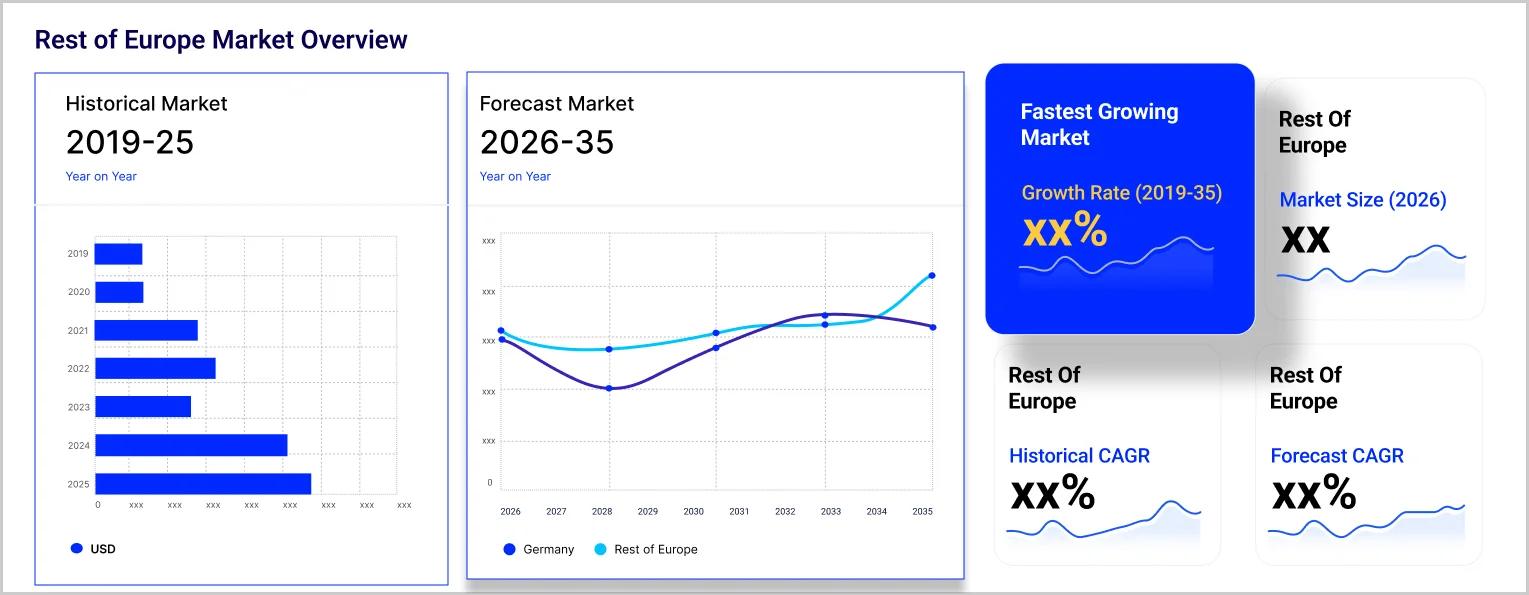
Germany represents a major demand centre because its energy transition requires substantial transmission reinforcement. The Bundesnetzagentur reported approximately 2,000 km of power-line approvals in 2025, including the completion of approval procedures for A-Nord, Ultranet, SuedLink and SuedOstLink. France is also entering a major network-investment cycle. RTE stated in July 2026 that it plans to increase its annual investment pace threefold by 2030, with EUR 8 billion specifically dedicated to electrification uses and a broader EUR 94 billion investment programme through 2040, thereby directly boosting the Europe wires and cables market regional growth.
The UK combines transmission expansion with interconnection and offshore-wind requirements. Ofgem's May 2026 funding decision supports accelerated construction of major Scottish transmission projects, while the UK government's March 2026 interconnection policy positions cross-border electricity links as part of its Clean Energy Superpower strategy. France and Ireland are also progressing the 575-km Celtic Interconnector, a 700 MW HVDC link scheduled for commissioning in 2028. These projects demonstrate that European cable demand increasingly follows interconnected regional energy planning rather than isolated national procurement.
Competition in Europe's wires and cables market is increasingly centred on the ability to deliver complete infrastructure solutions rather than simply manufacture cable. Large Europe wires and cables market players are investing in transmission capacity, specialised installation expertise, digital monitoring, high-density optical systems and project execution capabilities. The market therefore rewards companies with engineering resources, manufacturing scale, cable-laying assets, long-term utility relationships and the ability to comply with demanding technical and sustainability requirements.
Prysmian is strengthening its position through transmission, digital solutions and specialist workforce development, while Nexans is concentrating on electrification and developing monitoring technologies for advanced grid infrastructure. Japanese supplier Furukawa Electric is increasing its exposure to high-density optical infrastructure, while LEONI remains strongly positioned around automotive power and data-management systems.
Nexans was established in 1879 and is headquartered in Paris, France. The company operates across the electrification value chain, with activities spanning power transmission, power grids and power connections. Its 2025 integrated reporting identifies more than 140 years of operation, more than 60 plants and operations in 41 countries. In Europe, its relevance is particularly strong in high-voltage transmission, grid modernisation and sustainable electrification solutions.
Prysmian's cable-industry roots date to 1879, when Pirelli established its cable division in Italy. The group is headquartered in Milan and today operates a broad international manufacturing and R&D network. Its portfolio spans energy and digital applications, including power transmission, distribution, submarine cables and optical connectivity. Its European presence and cable-laying capabilities make it a major supplier for complex transmission and electrification projects.
Furukawa Electric was founded in 1884 and established as a company in 1896, with headquarters in Tokyo, Japan. Its capabilities span telecommunications, energy infrastructure, automotive systems, metals and electronics. Within the wires and cables industry, the company has particular relevance to optical-fibre and communications infrastructure, alongside energy products. Its 2026 ultra-high-count fibre production programme illustrates its focus on high-density connectivity applications.
LEONI's modern corporate history dates to 1917, while its wire-making roots extend back to 1569. Headquartered in Nuremberg, Germany, the group supplies power-distribution and connectivity products primarily to the automotive industry. Its portfolio includes wiring systems, cable harnesses and solutions for electrified and connected vehicles. The company is strategically relevant to the European cable industry through automotive electrification, high-voltage vehicle wiring and advanced vehicle electrical architectures.
Other key players in the market include KEI Industries Limited, Cable Harnesses UK Ltd., Sumitomo Electric Industries, Ltd., Heatsense Cables Limited, Tratos Cavi S.p.A, and Cleveland Cable Company, among others.
*Please note that this is only a partial list; the complete list of key players is available in the full report. Additionally, the list of key players can be customized to better suit your needs.*
Access the sample report to understand the Europe wires and cables Market Size, market structure and emerging commercial opportunities. The report provides detailed coverage of Europe wires and cables trends 2026, market segmentation, competitive developments and the Europe wires and cables Market analysis, alongside the official 2026-2035 market forecast. It can support manufacturers, infrastructure investors, distributors and strategic planners evaluating the European cable industry.


Upto 15% Off
USD
$2499 $2249
$3999 $3599
$4999 $4249
$5999 $5099


*While we strive to always give you current and accurate information, the numbers depicted on the website are indicative and may differ from the actual numbers in the main report. At Expert Market Research, we aim to bring you the latest insights and trends in the market. Using our analyses and forecasts, stakeholders can understand the market dynamics, navigate challenges, and capitalize on opportunities to make data-driven strategic decisions.*
In 2025, the market reached an approximate value of USD 50.98 Billion.
The market is projected to grow at a CAGR of 3.20% between 2026 and 2035.
The market is estimated to witness a healthy growth during 2026-2035 to reach around USD 69.85 Billion by 2035.
Germany, the United Kingdom, France, and Italy are the major countries explored in the market report.
The key materials are copper, aluminium, and others.
Low voltage, medium voltage, and high voltage are the three types of voltages for wires and cables.
The products include power cables, building wires, flexible wires, and cables, EHV cables, control/instrumentation cables, and others.
The major players in the market are Nexans S.A., Prysmian S.p.A, Furukawa Electric Co. Ltd., Leoni AG, KEI Industries Limited, Cable Harnesses UK Ltd., Sumitomo Electric Industries, Ltd., Heatsense Cables Limited, Tratos Cavi S.p.A, and Cleveland Cable Company, among others.
Key challenges in the Europe wires and cables market include volatile raw material prices, supply chain disruptions, stringent environmental regulations, high energy and manufacturing costs, skilled labour shortages, intense competition, and the need for significant investment in advanced, sustainable cable technologies.
Key strategies driving the Europe wires and cables market include expanding high-voltage and subsea cable capacity, investing in renewable energy and grid infrastructure, developing sustainable and recyclable cables, adopting advanced manufacturing technologies, strengthening supply chains, and pursuing strategic partnerships and acquisitions.
Explore our key highlights of the report and gain a concise overview of key findings, trends, and actionable insights that will empower your strategic decisions.
| REPORT FEATURES | DETAILS |
| Base Year | 2025 |
| Historical Period | 2019-2025 |
| Forecast Period | 2026-2035 |
| Scope of the Report |
Historical and Forecast Trends, Industry Drivers and Constraints, Historical and Forecast Market Analysis by Segment:
|
| Breakup by Voltage |
|
| Breakup by Product |
|
| Breakup by Material |
|
| Breakup by End Use |
|
| Breakup by Region |
|
| Market Dynamics |
|
| Competitive Landscape |
|
| Companies Covered |
|
Datasheet
One User
USD 2,499
USD 2,249
tax inclusive*
Single User License
One User
USD 3,999
USD 3,599
tax inclusive*
Five User License
Five User
USD 4,999
USD 4,249
tax inclusive*
Corporate License
Unlimited Users
USD 5,999
USD 5,099
tax inclusive*
*Please note that the prices mentioned below are starting prices for each bundle type. Kindly contact our team for further details.*
Flash Bundle
Small Business Bundle
Growth Bundle
Enterprise Bundle
*Please note that the prices mentioned below are starting prices for each bundle type. Kindly contact our team for further details.*
Flash Bundle
Number of Reports: 3
20%
tax inclusive*
Small Business Bundle
Number of Reports: 5
25%
tax inclusive*
Growth Bundle
Number of Reports: 8
30%
tax inclusive*
Enterprise Bundle
Number of Reports: 10
35%
tax inclusive*
How To Order

Select License Type
Choose the right license for your needs and access rights.

Click on ‘Buy Now’
Add the report to your cart with one click and proceed to register.

Select Mode of Payment
Choose a payment option for a secure checkout. You will be redirected accordingly.
Strategic Solutions for Informed Decision-Making
Gain insights to stay ahead and seize opportunities.

Get insights & trends for a competitive edge.

Track prices with detailed trend reports.

Analyse trade data for supply chain insights.

Leverage cost reports for smart savings

Enhance supply chain with partnerships.

Connect For More Information
Our expert team of analysts will offer full support and resolve any queries regarding the report, before and after the purchase.
Our expert team of analysts will offer full support and resolve any queries regarding the report, before and after the purchase.
We employ meticulous research methods, blending advanced analytics and expert insights to deliver accurate, actionable industry intelligence, staying ahead of competitors.
Our skilled analysts offer unparalleled competitive advantage with detailed insights on current and emerging markets, ensuring your strategic edge.
We offer an in-depth yet simplified presentation of industry insights and analysis to meet your specific requirements effectively.




