

Consumer Insights
Uncover trends and behaviors shaping consumer choices today
Procurement Insights
Optimize your sourcing strategy with key market data
Industry Stats
Stay ahead with the latest trends and market analysis.
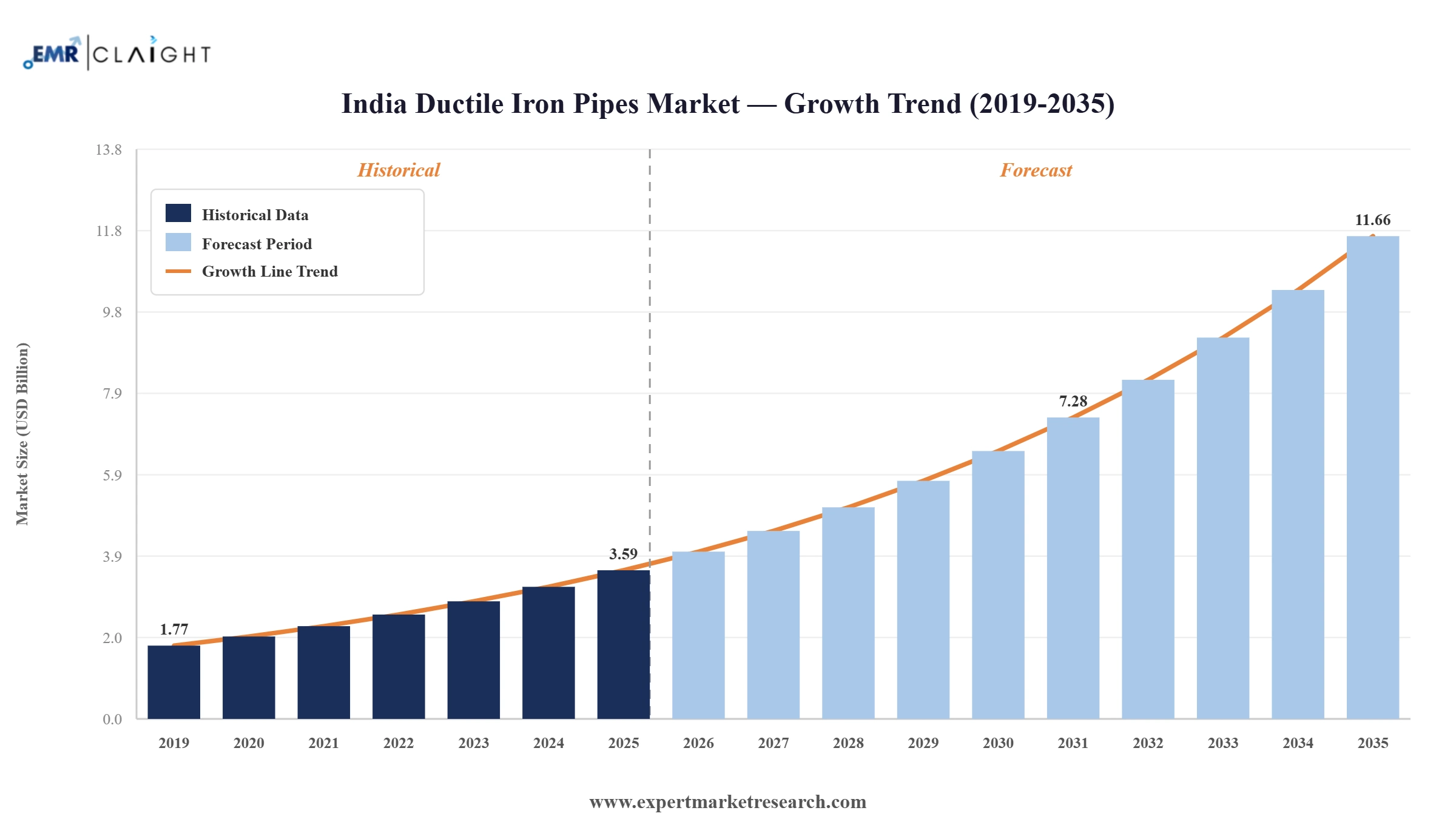
The India ductile iron pipes market was valued at USD 3.59 Billion in 2025. The market is expected to grow at a CAGR of 12.50% during the forecast period of 2026-2035 to reach a value of USD 11.66 Billion by 2035. Rising adoption of renewable-powered pipe casting plants is emerging as a growth lever, as manufacturers reduce operational emissions while aligning with India’s broader decarbonization goals.
Ductile iron (DI) pipes are high-strength, corrosion-resistant pipes manufactured from ductile cast iron, a material that combines the structural strength of steel with the excellent corrosion resistance and castability of iron. Unlike traditional grey cast iron pipes, ductile iron pipes possess significantly higher tensile strength (≥420 MPa), elongation (≥10%), and impact resistance, making them the preferred choice for underground water distribution, sewerage, irrigation, and industrial fluid transmission systems globally.
In India, ductile iron pipes are manufactured in accordance with IS 8329:2000 and classified into pressure classes K7, K9, and K12 based on wall thickness and operating pressure ratings. They are available in diameters ranging from DN 80 to DN 2000, with internal linings including cement mortar lining and polyurethane (PU) lining for corrosion protection, and external coatings of zinc, bituminous paint, or polyurethane for soil-side protection. The socket and spigot joint with a rubber gasket is the most widely used connection system, enabling quick installation and accommodating ground movement, a critical advantage in India's diverse seismic and soil conditions.
India's ductile iron pipe market in 2026 is robust, supported by major manufacturers like Electrosteel Castings, Jindal SAW, Welspun Corp, Electrotherm, Rashmi Metaliks, and Tata Metaliks, each offering strengths in segments like municipal infrastructure, industrial piping, and large-scale utility networks.
Read more about this report - REQUEST FREE SAMPLE COPY IN PDF
| India Ductile Iron Pipes Market Report Summary | Description | Value |
| Base Year | USD Billion | 2025 |
| Historical Period | USD Billion | 2019-2025 |
| Forecast Period | USD Billion | 2026-2035 |
| Market Size 2025 | USD Billion | 3.59 |
| Market Size 2035 | USD Billion | 11.66 |
| CAGR 2019-2025 | Percentage | XX% |
| CAGR 2026-2035 | Percentage | 12.50% |
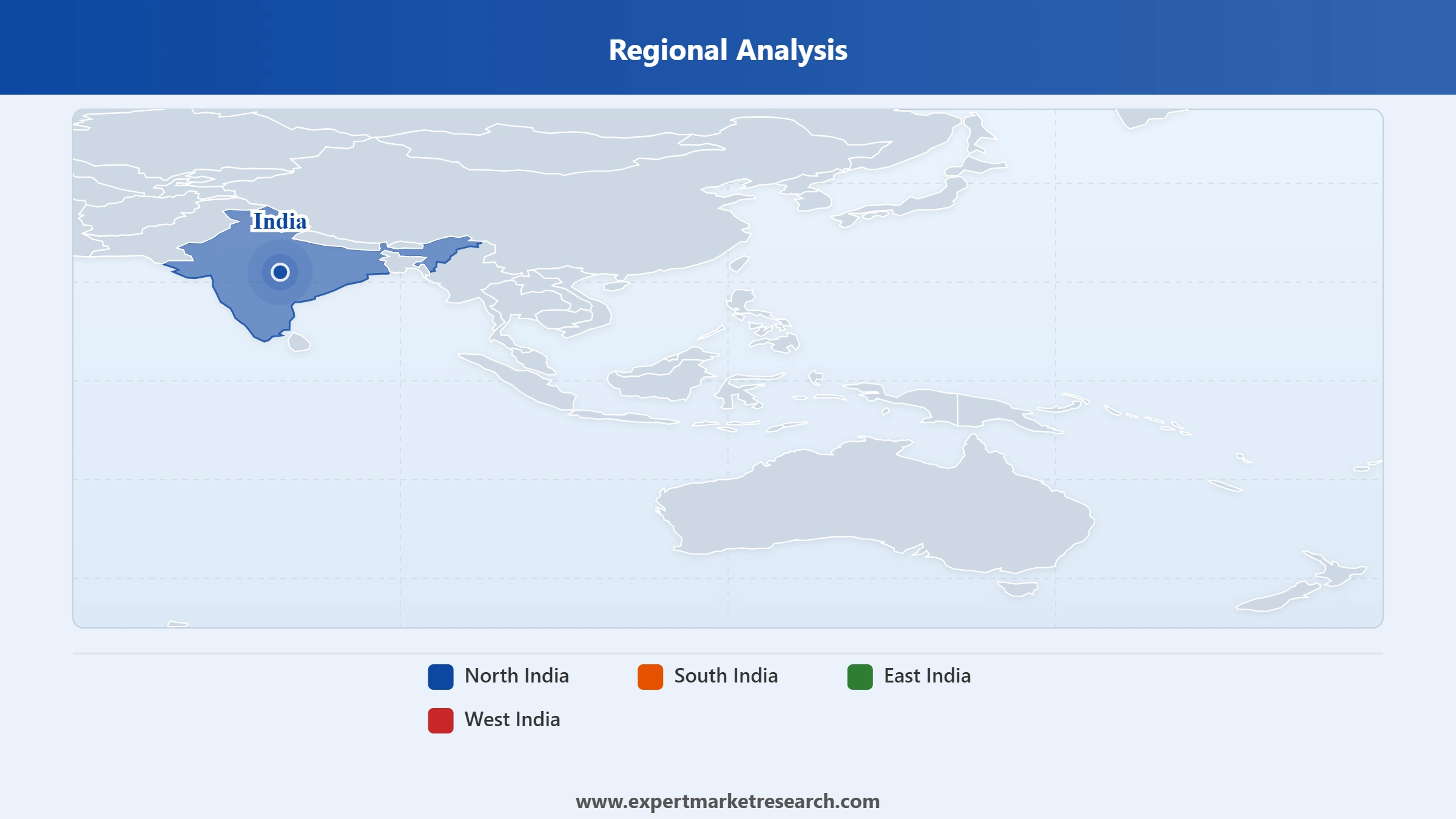
| CAGR 2026-2035 - Market by Region | West India | 13.1% |
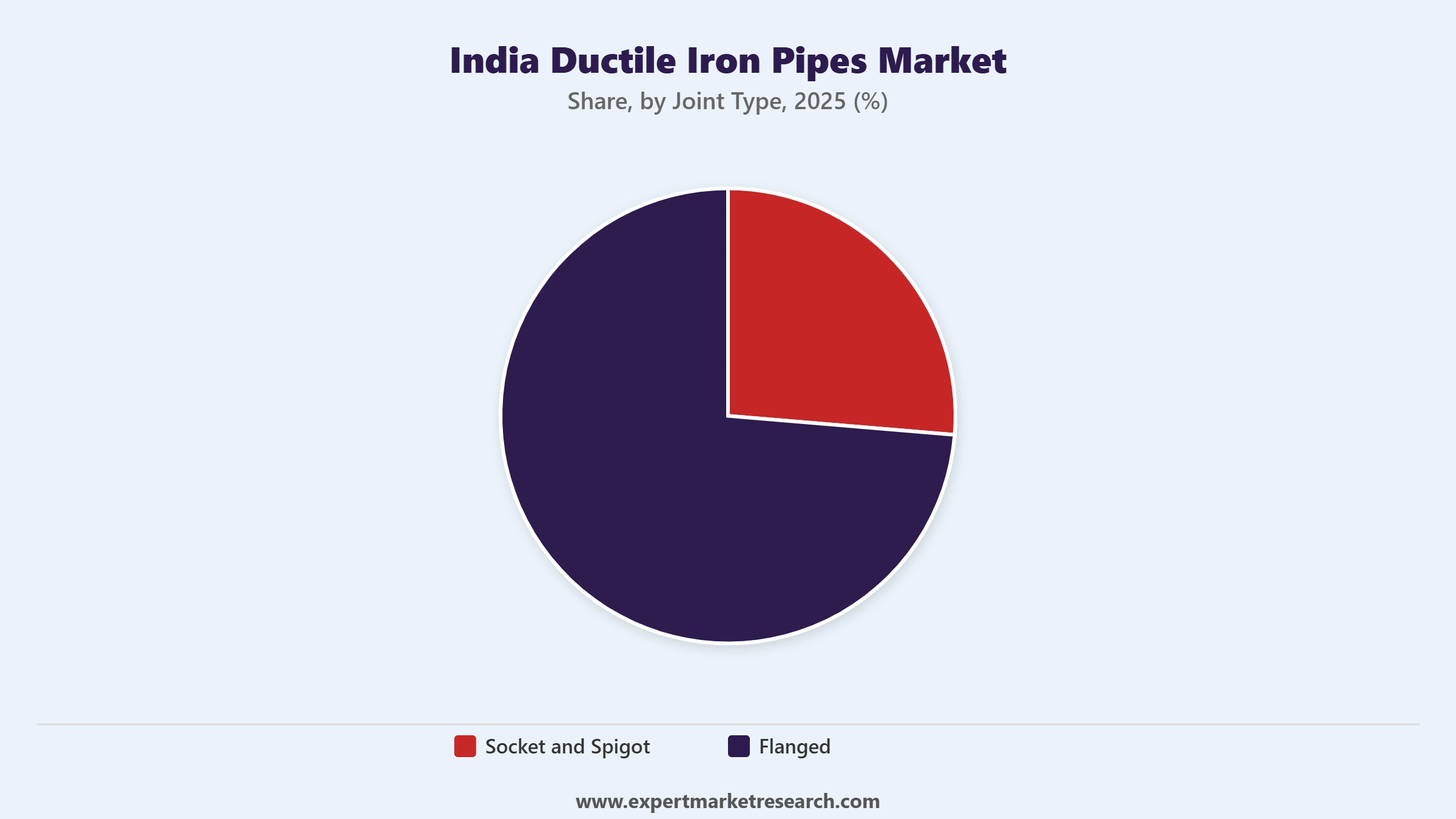
| CAGR 2026-2035 - Market by Joint Type | Socket and Spigot | 12.9% |
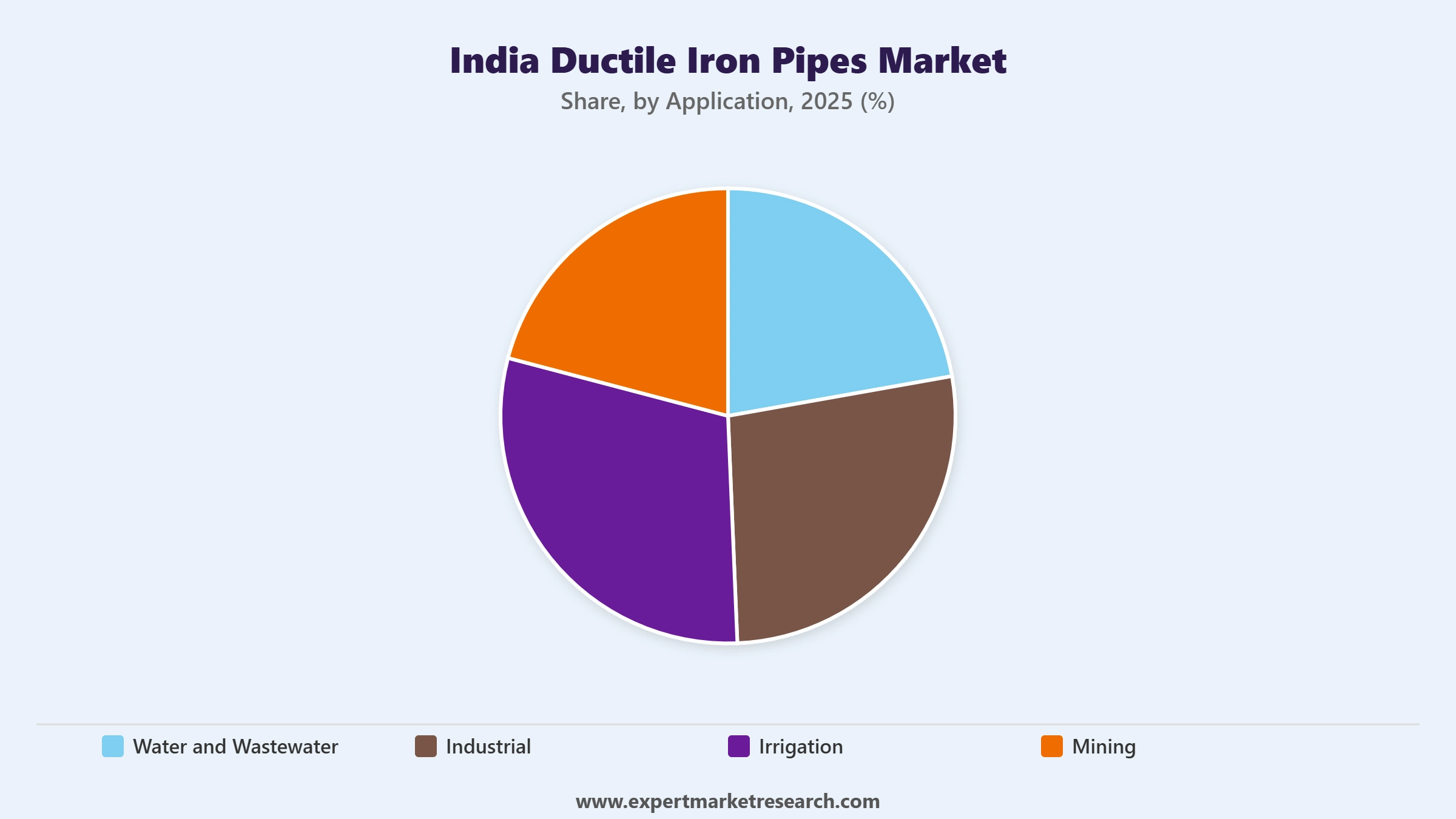
| CAGR 2026-2035 - Market by Application | Water and Watewater | 13.7% |
| Market Share by Region | North India | 34.7% |
India's DI pipe market reported a structural supply-demand gap, with Maharashtra alone facing a 40% supply deficit, while K9-grade DI pipe prices firmed at ₹3,238 per meter for 300mm sections, as a 52% spike in upstream feedstock costs and Strait of Hormuz disruptions impacting specialty alloy imports pushed prices to a structural high.
The Union Cabinet approved JJM 2.0, extending the Jal Jeevan Mission to December 2028 with a total outlay of ₹8.69 trillion, triggering a sharp rally in DI pipe stocks Jindal SAW surged 19%, Electrosteel Castings hit the 20% upper circuit, and Enviro Infra Engineers gained 14% as analysts flagged strong multi-year order book visibility for DI pipe manufacturers.
Electrosteel Castings received Odisha government approval to establish a 500,000 MT DI pipe manufacturing plant in Dhenkanal, while Rungta Steel commenced DI pipe production at its Chaliyama Steel Plant in Jharkhand two of the largest capacity additions in the India DI pipe market in the current decade.
Tembo Global Industries secured two significant domestic DI pipe contracts totaling ₹51.82 crore, while Jindal SAW piloted renewable energy integration at its foundries and expanded into Middle East supply contracts via new JVs reflecting the industry's dual focus on domestic infrastructure demand and international export growth.
The modernization of urban water systems is one of the strongest growth catalysts for DI pipes. Cities like Pune, Hyderabad, and Nagpur are replicating this trend in the India ductile iron pipes market, replacing outdated lines with DI solutions that reduce leakages and improve pressure management. The focus is shifting from intermittent distribution to 24/7 supply, critical for growing urban populations. With national smart city objectives emphasizing sustainability, DI pipes are positioned as the core material enabling long-term resilience in India’s urban water infrastructure.
India’s DI pipe demand is estimated at nearly 7 lakh tons annually, far higher than the current installed production. Large-scale projects under the Jal Jeevan Mission and AMRUT 2.0 are accelerating consumption. However, with only a handful of major manufacturers, supply gaps persist, signaling opportunity for capacity expansions and joint ventures. This demand-supply mismatch has drawn new investment interest in backward integration, energy-efficient foundries, and digital quality control, accelerating the India ductile iron pipes market opportunities.
India’s Smart Cities Mission has been a strong factor driving the ductile iron pipes demand in India. With 1200 km of pipelines already laid in Pune’s continuous supply project and 75% completion reported by October 2024, the adoption of DI pipes is evident. Similar initiatives across Bengaluru and Nagpur are driving installations for water, sewage, and stormwater systems. The material’s durability makes it ideal for underground urban projects where maintenance costs must remain low.
Industrial expansion is reshaping the India ductile iron pipes market dynamics. Corridors like Delhi-Mumbai and Chennai-Bengaluru are upgrading infrastructure with DI systems to support new clusters in Talegaon and Chakan. The pipes’ resilience to high-pressure flows and chemicals makes them ideal for industrial water management. DI pipes are becoming integral to India’s industrialization strategy, bridging durability with operational reliability in high-demand zones.
India’s water and wastewater pipeline network is expanding rapidly under government schemes. As of August 2025, under AMRUT 2.0 so far, 3,571 water supply projects worth INR 1,18,421.92 crore have been approved by MoHUA. DI pipes are the preferred choice for such projects due to their leak-proof jointing and corrosion resistance, accelerating the India ductile iron pipes market scope. These large-scale infrastructure upgrades create recurring demand, as new installations and replacements often extend across multi-year timelines.
Figure: Key Ductile Iron Pipe Manufacturers' Capacity (MT) in India
| Plant Location | Company | Capacity (MT) |
| Kutch, Gujarat |
Jindal Saw Ltd. Welspun Corp Limited Electrotherm |
5,00,000 4,00,000 2,00,000 |
| Chitoor, AP | Srikalahasthi Pipes Limited | 3,50,000 |
| Bokaro, Jharkhand | ESL Steel Limited | 3,50,000 |
| Kharagpur, WB | TATA Metalliks | 4,00,000 |
| West Bengal | Rashmi Group | 3,50,000 |
| Khardah, WB | Electrosteel Castings Limited | 2,80,000 |
| Dhurgapur, WB |
Jai Balaji Group Kejriwal Castings Limited |
2,40,000 50,000 |
| Anantapuramu, AP | Sathavahanalspat Limited | 2,10,000 |
The Expert Market Research's report titled “India Ductile Iron Pipes Market Report and Forecast 2026-2035” offers a detailed analysis of the market based on the following segments:
Marke Breakup by Diameter
Key Insight: By diameter, large pipes dominate the India ductile iron pipe industry dynamics, mainly driven by centralized water and sewage projects. However, rapid expansion of rural drinking water schemes is fueling higher demand for small-to-medium diameters. New casting and coating technologies are bridging cost-performance gaps, allowing producers to serve both urban megaprojects and rural rollouts.
Market Breakup by Joint Type
Key Insight: Push-on joints dominate because they simplify installation while maintaining durability, making them highly suitable for municipal projects. Yet, the India ductile iron pipes market is seeing faster growth in mechanical joints due to their versatility in industrial environments. Industrial hubs expanding under Make in India policies are turning mechanical joints into a growth driving factor, while urban utilities continue to prefer push-on types.
Market Breakup by Application
Key Insight: Applications for ductile iron pipes are diversifying, but water supply continues to lead the market, driven by rural connectivity and urban distribution upgrades, boosting the India ductile iron pipes market growth. Meanwhile, sewage and wastewater treatment networks are registering higher growth momentum as India prioritizes sanitation infrastructure. Municipal corporations are shifting to DI pipes for their corrosion resistance, ensuring stability in chemical-laden effluent systems.
Market Breakup by Region
Key Insight: Regionally, North India continues to dominate due to large irrigation and drinking water projects, but Southern states are emerging as hotspots of growth with combined demand from urban, industrial, and irrigation sectors. Cities like Bengaluru and Hyderabad are becoming case studies for DI adoption in 24x7 water supply. With central projects concentrated in the north and state-driven initiatives taking off in the south, the India ductile iron pipes demand forecast remains geographically balanced.
Read more about this report - REQUEST FREE SAMPLE COPY IN PDF
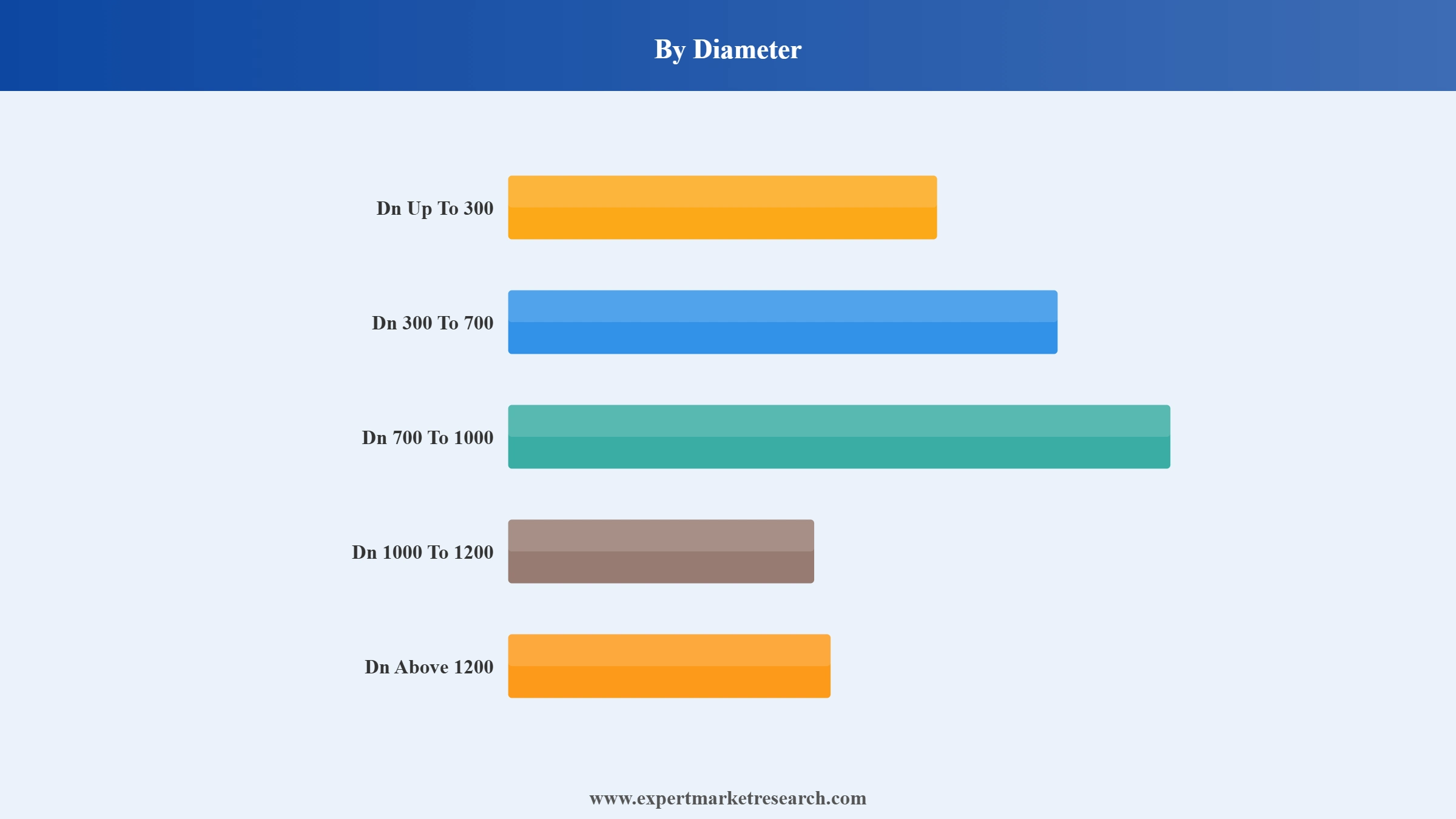
By diameter, large diameter pipes account for the largest share of the market owing to widespread application in water supply projects
Large diameter pipes (600 mm and above) dominate the market, backed by their widespread use in mega water supply projects and sewage treatment networks. The Jal Jeevan Mission and Smart Cities schemes prefer these diameters for long-distance transmission and high-capacity delivery. Recent adoption of robotic casting has also improved consistency in these large-diameter ranges, enhancing pressure resistance and reducing failure risks. Their dominance stems from their ability to meet bulk urban and industrial requirements, making them indispensable in high-capex projects where reliability is critical.
Small to medium diameters (150–500 mm) are registering the fastest growth in the India ductile iron pipes market. Their rising use in rural water connections, peri-urban developments, and in-house sewage projects is notable. Under the Jal Jeevan Mission, millions of households require such sizes for tap-to-home networks. Lightweight DI designs with push-on joints are simplifying on-ground handling, speeding up rural rollouts. As decentralized sewage and water systems gain momentum in townships and gated communities, the growth trajectory for these pipes is expected to remain strong.
Read more about this report - REQUEST FREE SAMPLE COPY IN PDF
By joint type, push-on joints secure a substantial share of the market owing to flexibility, leak resistance, and ease of installation
Push-on joints dominate the market owing to their flexibility, leak resistance, and ease of installation. Urban water supply projects in Delhi, Hyderabad, and Nagpur have adopted these joints widely due to reduced labor costs and faster laying speeds. Enhanced rubber gasket technologies are improving durability, even in high-pressure zones, making push-on joints the go-to choice for municipalities and contractors seeking faster project execution without compromising long-term reliability.
As per the India ductile iron pipes market report, mechanical joints are expected to grow at the fastest pace, particularly in industrial corridors and repair-focused projects. Their ability to be disassembled and reinstalled offers high utility in industries with frequent network changes. With industrial clusters like Pune-Chakan and Gujarat’s Dholera SEZ expanding, mechanical joints are gaining demand. Their adaptability and suitability for maintenance-heavy networks provide them with strong momentum, particularly in industrial water and effluent management systems.
Read more about this report - REQUEST FREE SAMPLE COPY IN PDF
By application, water supply retains dominance, powered by government initiatives
Water supply remains the dominant application, supported by initiatives like Jal Jeevan Mission and AMRUT 2.0. With INR 44,777 crore allocated to water projects in FY 2024-25, DI pipes are increasingly becoming the material of choice due to durability, long service life, and leak-proof features. Large metropolitan utilities are driving consistent demand, particularly in upgrades from PVC and steel pipelines to DI networks for enhanced reliability.
Sewage and wastewater are projected to grow at the fastest pace, driving the India ductile iron pipes market value. With AMRUT alone adding 4,447 MLD sewage treatment capacity in 2024-25, demand for robust sewage networks has spiked. DI pipes are gaining favor due to their chemical resistance and superior jointing systems that withstand corrosive effluents. The rising push for decentralized treatment plants and urban wastewater recycling systems is strengthening demand for DI pipes across both tier-1 and tier-2 cities.
Read more about this report - REQUEST FREE SAMPLE COPY IN PDF
North India boasts a dominant position in the market
North India dominates the market, supported by extensive infrastructure upgrades in Uttar Pradesh, Haryana, and Punjab. Large irrigation networks and urban water supply projects are central to this dominance. The Ganga Jal projects and Delhi water supply upgrades illustrate the scale of regional adoption. The presence of strong manufacturing bases nearby further strengthens supply.
The South India ductile iron pipes market is witnessing accelerated growth, largely due to expanding smart cities and industrial corridors. Bengaluru, Hyderabad, and Chennai are investing heavily in water and sewage networks, where DI pipes are being prioritized. In addition, irrigation expansion in Andhra Pradesh and Telangana is fueling further adoption. Advanced city projects like Hyderabad’s 24x7 supply scheme are setting new benchmarks for DI pipe usage.
Read more about this report - REQUEST FREE SAMPLE COPY IN PDF
Leading India ductile iron pipes market players are focusing on scaling production capacities, investing in energy-efficient casting, and adopting digital quality controls to improve throughput. A major area of focus is sustainable production. Manufacturers are increasingly shifting to renewable-powered foundries and recycling scrap iron to reduce carbon footprints. Players are also innovating with coatings like epoxy-lined and anti-biofilm interiors to enhance performance in sewage networks.
Apart from manufacturing, India ductile iron pipe companies find opportunities in strategic partnerships with municipal bodies and EPC contractors for long-term supply contracts. With demand consistently outpacing supply, companies investing in backward integration and new plant setups are expected to secure long-term advantages. The competitive landscape is thus shifting towards firms that can balance sustainability, technological innovation, and cost efficiency, ensuring readiness for India’s massive water and sewage expansion goals.
Jindal SAW Ltd. was established in 1984 and is headquartered in New Delhi. The company supplies large-diameter DI and steel pipes for water, oil, and gas projects, scaling capacity with automated casting lines. Jindal SAW is piloting renewable-energy integration at foundries and expanding supply to Middle East projects via recent JVs, aiming to secure long-term EPC contracts.
Welspun Corp, was established in 1995 and is headquartered in Mumbai. Known for line pipes and DI pipe ventures, Welspun is investing in modular foundry cells and digitized quality control to reduce defects. The firm is testing IoT-enabled coating inspection and traceability platforms for project buyers, improving warranty certainty for municipal clients.
Jai Balaji Industries Ltd. was established in 1999 and is headquartered in Kolkata. The group produces DI pipes and downstream steel products, focusing on backward integration to secure raw-material flows. Jai Balaji is trialing low-emission cupola replacements and automated mould handling to shorten lead times for municipal orders.
Tata Metaliks Ltd. was established in 1990 and is headquartered in Kolkata. The Tata group member is supplying ductile iron pipes alongside pig iron, investing in epoxy lining R&D and automated pouring systems. Tata Metaliks is piloting anti-biofilm interior coatings and digital batch certificates to meet sewage and drinking-water standards.
Other key players in the market are Tosem Steel Pvt Ltd., Rashmi Metaliks Ltd., Electrosteel Castings Limited, and ESL Steel Limited, among others.
*Please note that this is only a partial list; the complete list of key players is available in the full report. Additionally, the list of key players can be customized to better suit your needs.*
Explore the latest trends shaping the India ductile iron pipes market 2026-2035 with our in-depth report. Gain strategic insights, future forecasts, and key market developments that can help you stay competitive. Download a free sample report or contact our team for customized consultation on India ductile iron pipes market trends 2026.


Upto 15% Off
USD
$2499 $2249
$3999 $3599
$4999 $4249
$5999 $5099


*While we strive to always give you current and accurate information, the numbers depicted on the website are indicative and may differ from the actual numbers in the main report. At Expert Market Research, we aim to bring you the latest insights and trends in the market. Using our analyses and forecasts, stakeholders can understand the market dynamics, navigate challenges, and capitalize on opportunities to make data-driven strategic decisions.*
In 2025, the India ductile iron pipes market reached an approximate value of USD 3.59 Billion.
The market is projected to grow at a CAGR of 12.50% between 2026 and 2035.
The market is estimated to witness healthy growth in the forecast period of 2026-2035 to reach a value of around USD 11.66 Billion by 2035.
Expanding modular foundry capacity, deploying IoT inspection, adopting renewable power, piloting advanced epoxy and anti-biofilm linings, digitizing traceability certificates, and signing long-term EPC supply contracts with municipal buyers.
The key trends of the India ductile iron pipes market include growing demand for sustainable water transmission pipes, increased implementation of high-end materials such as internal polyurethane lining and external polyurethane coating in ductile iron pipes, and favourable government initiatives such as the ‘Nal Se Jal’ scheme.
The major regions in the market are North India, South India, East India, and West India.
The socket and spigot is the leading category for joint types in the market.
The key players in the market include Jindal SAW Ltd., Welspun Corp Limited, Jai Balaji Industries Ltd., Tata Metaliks Ltd., Tosem Steel Pvt Ltd., Rashmi Metaliks Ltd., Electrosteel Castings Limited, and ESL Steel Limited, among others.
Supply shortfalls, raw-material volatility, energy price shocks, long public procurement cycles, and stricter environmental compliances are squeezing margins while forcing heavy capex into cleaner, automated foundries and faster delivery systems.
Explore our key highlights of the report and gain a concise overview of key findings, trends, and actionable insights that will empower your strategic decisions.
| REPORT FEATURES | DETAILS |
| Base Year | 2025 |
| Historical Period | 2019-2025 |
| Forecast Period | 2026-2035 |
| Scope of the Report |
Historical and Forecast Trends, Industry Drivers and Constraints, Historical and Forecast Market Analysis by Segment:
|
| Breakup by Diameter |
|
| Breakup by Joint Type |
|
| Breakup by Application |
|
| Breakup by Region |
|
| Market Dynamics |
|
| Competitive Landscape |
|
| Companies Covered |
|
Datasheet
One User
USD 2,499
USD 2,249
tax inclusive*
Single User License
One User
USD 3,999
USD 3,599
tax inclusive*
Five User License
Five User
USD 4,999
USD 4,249
tax inclusive*
Corporate License
Unlimited Users
USD 5,999
USD 5,099
tax inclusive*
*Please note that the prices mentioned below are starting prices for each bundle type. Kindly contact our team for further details.*
Flash Bundle
Small Business Bundle
Growth Bundle
Enterprise Bundle
*Please note that the prices mentioned below are starting prices for each bundle type. Kindly contact our team for further details.*
Flash Bundle
Number of Reports: 3
20%
tax inclusive*
Small Business Bundle
Number of Reports: 5
25%
tax inclusive*
Growth Bundle
Number of Reports: 8
30%
tax inclusive*
Enterprise Bundle
Number of Reports: 10
35%
tax inclusive*
How To Order

Select License Type
Choose the right license for your needs and access rights.

Click on ‘Buy Now’
Add the report to your cart with one click and proceed to register.

Select Mode of Payment
Choose a payment option for a secure checkout. You will be redirected accordingly.
Strategic Solutions for Informed Decision-Making
Gain insights to stay ahead and seize opportunities.

Get insights & trends for a competitive edge.

Track prices with detailed trend reports.

Analyse trade data for supply chain insights.

Leverage cost reports for smart savings

Enhance supply chain with partnerships.

Connect For More Information
Our expert team of analysts will offer full support and resolve any queries regarding the report, before and after the purchase.
Our expert team of analysts will offer full support and resolve any queries regarding the report, before and after the purchase.
We employ meticulous research methods, blending advanced analytics and expert insights to deliver accurate, actionable industry intelligence, staying ahead of competitors.
Our skilled analysts offer unparalleled competitive advantage with detailed insights on current and emerging markets, ensuring your strategic edge.
We offer an in-depth yet simplified presentation of industry insights and analysis to meet your specific requirements effectively.




