

Consumer Insights
Uncover trends and behaviors shaping consumer choices today
Procurement Insights
Optimize your sourcing strategy with key market data
Industry Stats
Stay ahead with the latest trends and market analysis.
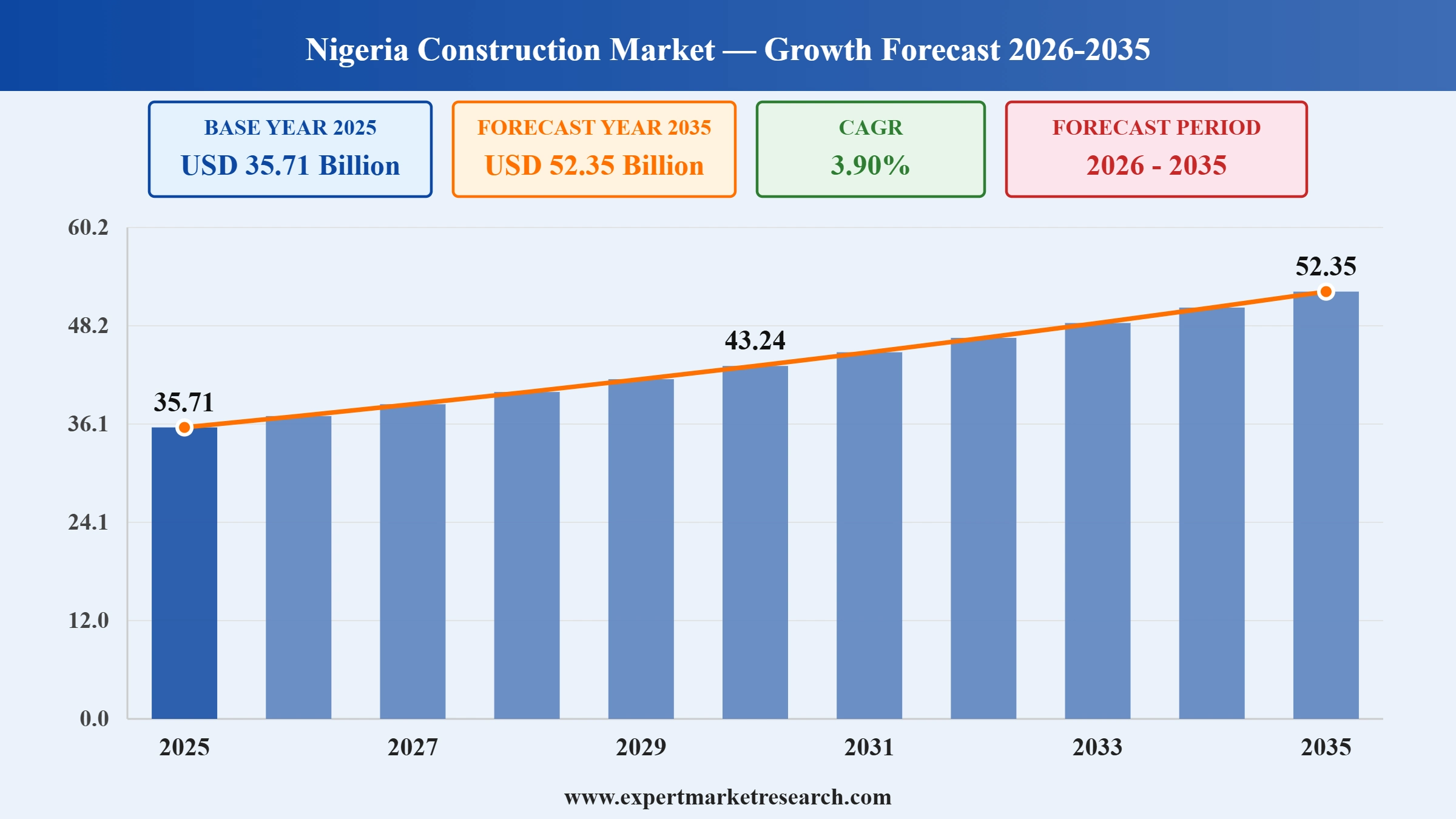
The Nigeria Construction Market reached a value of USD 35.71 Billion at 2025 and is projected to expand at a CAGR of around 3.90% during the forecast period of 2026-2035. With Nigeria's continued urbanization driving residential construction demand well above current supply, major government-backed infrastructure investments in expressways, coastal highways, and bridges reinforcing New Construction activity, growing public-private partnerships broadening the sources of project financing and international contractor participation, and expanding industrial construction activity linked to oil and gas, LNG, and energy infrastructure development, the market is expected to reach USD 52.35 Billion by 2035.
Read more about this report - REQUEST FREE SAMPLE COPY IN PDF
| Nigeria Construction Market Report Summary |
Description |
Value |
|
Base Year |
USD Billion |
2025 |
|
Historical Period |
USD Billion |
2019-2025 |
|
Forecast Period |
USD Billion |
2026-2035 |
|
Market Size 2025 |
USD Billion |
35.71 |
|
Market Size 2035 |
USD Billion |
52.35 |
|
CAGR 2019-2025 |
Percentage |
XX% |
|
CAGR 2026-2035 |
Percentage |
3.90% |
|
CAGR 2026-2035 - Market by Material |
New Construction |
4.3% |
|
CAGR 2026-2035 - Market by End Use |
Residential |
4.3% |
Nigeria's construction market is being shaped by large-scale government infrastructure programs, a deepening housing shortage driving residential construction investment, growing foreign direct investment in industrial and energy projects, and a regulatory reform agenda that is improving transparency and broadening access to project financing for both public and private sector developers.
In 2025, Nigeria commenced construction on five mini-liquefied natural gas (LNG) plants in Ajaokuta, Kogi State, with a combined nameplate capacity of 97 million standard cubic feet per day. The Nigerian National Petroleum Company Limited (NNPC) holds equity stakes across three of the five facilities, covering Prime LNG, NGML/Gasnexus LNG, and BUA LNG. The development of the Ajaokuta LNG cluster represents a significant expansion of industrial construction activity in Nigeria's inland energy infrastructure, channeling investment into the country's midstream gas sector and providing local industrial construction companies with a sustained pipeline of engineering and civil works contracts across multiple concurrent project sites.
In June 2025, the African Medical Centre of Excellence (AMCE) in Abuja, a landmark institutional construction project spearheaded by Afreximbank in collaboration with King's College Hospital London, completed all civil and structural works and prepared for its operational launch. The facility is designed to provide specialist services in oncology, haematology, cardiovascular care, and general healthcare across sub-Saharan Africa, representing a major milestone in institutional healthcare construction in Nigeria. The AMCE project underscores the growing pipeline of hospital and specialty healthcare facility construction in Nigeria, where the convergence of public health investment, international development financing, and institutional partnership is driving demand for high-specification institutional construction activity.
In February 2025, the Nigerian government approved a landmark infrastructure investment package of approximately N4.2 trillion (equivalent to around USD 6 billion) covering the construction of multiple highways and bridges across the country. The package includes the flagship Lagos-Calabar Coastal Highway, a major reinforced concrete road project designed to connect Nigeria's southwestern and southeastern coastal regions, along with several other national road and bridge initiatives. The announcement reinforced the federal government's commitment to using physical infrastructure as a primary economic development lever and represents one of the largest single infrastructure spending commitments in Nigeria's recent history, with far-reaching implications for construction activity across the residential, commercial, and institutional segments that depend on transport connectivity.
In February 2025, China National Chemical Engineering Co. (CNCEC) entered a construction partnership with UK-based Alpha Grip Management Company (AGMC) for the development of the Ogidigben Gas Revolution Industrial Park (GRIP) in Delta State, Nigeria, valued at approximately NGN 30 trillion (equivalent to USD 16.6 billion). The project aims to establish a world-scale gas processing and industrial manufacturing complex in Nigeria's oil-producing region, covering refining, petrochemicals, and downstream gas utilization. The scale of the GRIP project positions it as one of the most significant industrial construction undertakings in Nigerian history and reinforces the country's strategy of monetizing its gas resources through domestically situated processing infrastructure rather than raw export.
In November 2024, the development of Snake Island Port in Lagos received formal approval through a 45-year concession agreement between the developer and the Nigerian Ports Authority, with the project expected to attract approximately USD 1 billion in foreign direct investment. The port development represents a significant institutional and industrial construction project in Lagos, Nigeria's primary commercial hub, and signals the growing viability of public-private partnership models for large-scale maritime infrastructure financing. The project builds on a Federal Executive Council approval granted in May 2023 and demonstrates the impact of regulatory reforms aimed at improving transparency and investor confidence in Nigeria's infrastructure and construction sector.
Government-initiated mega-infrastructure projects are the most powerful near-term driver of Nigeria's construction market, with the federal government committing unprecedented resources to road, bridge, and coastal connectivity projects that are generating significant construction volumes across the country. The Lagos-Calabar Coastal Highway, budgeted at approximately USD 6 billion under the February 2025 federal endorsement, is the centerpiece of a broader infrastructure push that also encompasses the rehabilitation of critical inter-state expressways and the construction of new bridges across major river crossings. These projects are being implemented using reinforced concrete construction methods designed for long-term durability in Nigeria's tropical climate and coastal conditions. The scale of the government's infrastructure commitment creates a substantial project pipeline for both domestic contractors and international construction companies with experience in large civil engineering works. This Nigeria construction market growth driver is reinforced by international development finance from the African Development Bank and the European Investment Bank, which together committed over USD 1 billion to Nigerian energy and infrastructure projects in early 2025. In February 2025, the Nigerian government also approved a budget increase from NGN 49.7 trillion to NGN 54.2 trillion for 2025, a 9% uplift that includes substantial allocations to capital infrastructure projects.
Nigeria's rapid and sustained urbanization is creating a structural residential construction deficit that will drive market activity for the entirety of the forecast period. With urban population expected to continue growing as rural-to-urban migration persists across all geopolitical zones, the demand for formal and semi-formal residential housing in Lagos, Abuja, Port Harcourt, Kano, and emerging secondary cities far exceeds current construction capacity. The World Bank estimated Nigeria's urban population at 55% in 2024, and this share is projected to rise continuously as agricultural productivity challenges, educational and employment opportunities in cities, and infrastructure improvements in urban areas all reinforce migration flows. Private real estate developers are increasingly targeting the middle-income and affordable housing segments, supported by growing mortgage market development and federal government housing finance initiatives through the Federal Mortgage Bank of Nigeria. The EMR-cited residential CAGR of 7.4% for the end use segment through 2034 underscores the scale of unmet housing demand as the most dynamic demand driver within Nigeria's overall construction market. In 2025, the construction value-add in Nigeria grew 5.6% year-on-year in Q3, according to the National Bureau of Statistics, reflecting the market's sustained momentum.
Public-private partnerships have emerged as the primary mechanism through which Nigeria's federal and state governments are mobilizing construction investment beyond the limits of public budget capacity. PPP frameworks are being applied to ports, roads, power infrastructure, and industrial parks, enabling the government to leverage private sector capital and operational expertise while retaining strategic ownership of critical national assets. The Snake Island Port concession agreement in November 2024, which brought in an estimated USD 1 billion in foreign direct investment through a 45-year arrangement with the Nigerian Ports Authority, exemplifies the PPP model's capacity to attract large-scale international capital into Nigerian infrastructure. Regulatory reforms undertaken since 2023 to improve transparency, streamline project approvals, and provide foreign investors with greater legal certainty over concession rights have materially improved investor confidence. The Infrastructure Concession Regulatory Commission (ICRC) has played an active role in standardizing PPP documentation and due diligence processes. Continued refinement of the PPP framework is expected to expand the pipeline of construction projects accessible to private capital through the forecast period.
Nigeria's industrial construction segment is entering a period of elevated activity driven by the federal government's strategy to monetize the country's vast gas reserves through domestically sited processing, refining, and industrial manufacturing infrastructure. The mini-LNG plants under construction in Ajaokuta, the CNCEC-AGMC Ogidigben Gas Revolution Industrial Park in Delta State valued at approximately USD 16.6 billion, and the broader pipeline of oil and gas infrastructure investments represent a structural uplift for industrial construction over the next decade. International construction firms including those from China, Europe, and the United States are active in these projects, bringing engineering and project management capabilities that are simultaneously strengthening the skills base of Nigerian subcontractors working alongside them. The NNPC's participation as an equity partner in LNG plant projects provides an element of financial credibility and government commitment that reduces completion risk and improves financing access. In February 2025, China National Chemical Engineering partnered with AGMC for the Ogidigben Gas Revolution Industrial Park, one of the largest single construction commitments in Nigeria's history at that time.
The Expert Market Research's report titled "Nigeria Construction Market Report and Forecast 2026 to 2035" offers a detailed analysis of the market based on the following segments:
Market Breakup by Construction Type
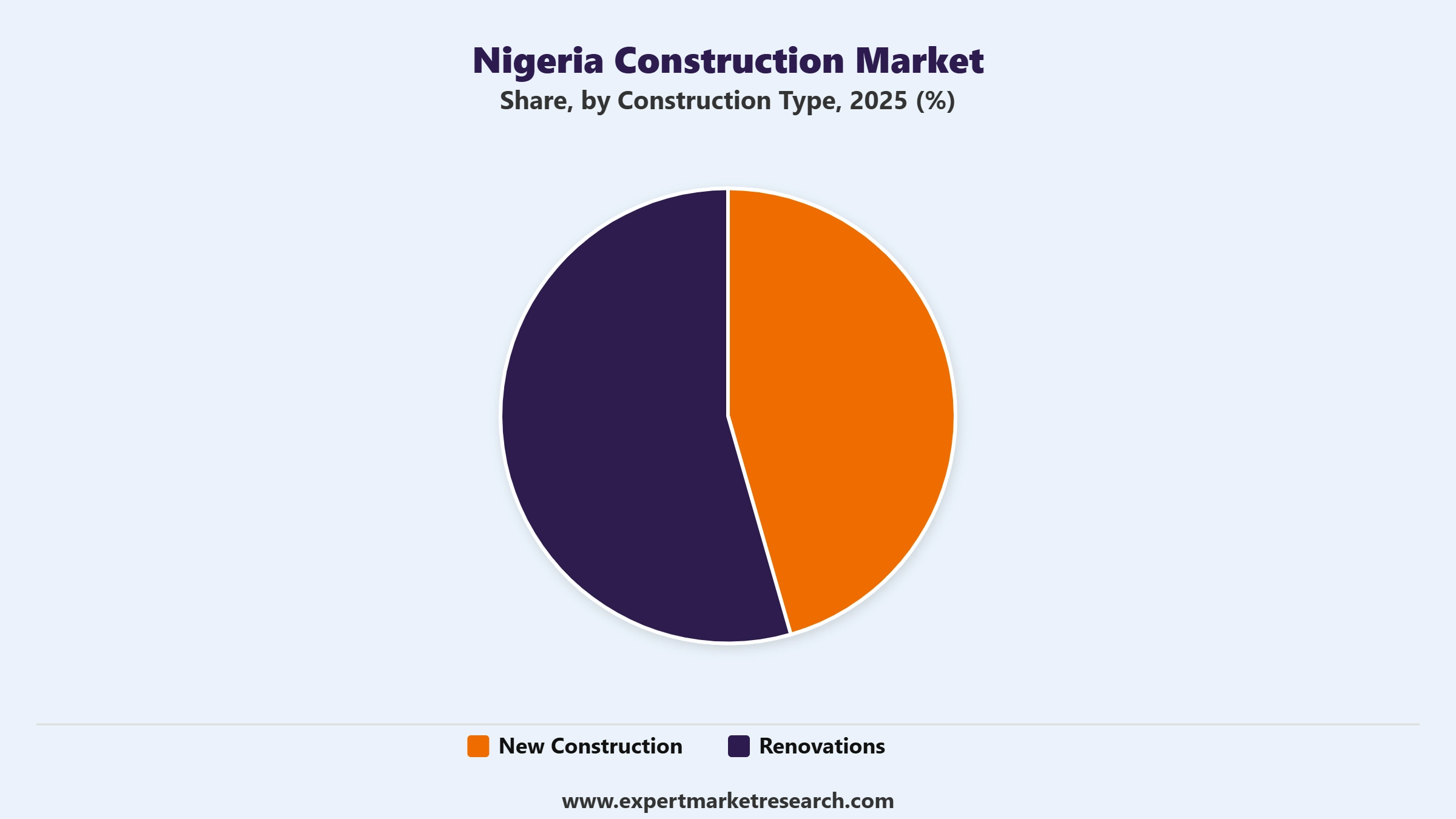
Key Insight: New Construction is the dominant construction type in the Nigeria market, accounting for the large majority of the market's output value. Nigeria's severe housing deficit, estimated at over 20 million units and growing with each year of urban population expansion, creates a structural pipeline of residential new construction that no renovation activity can substitute for. Government infrastructure investments, including roads, bridges, ports, schools, hospitals, and government buildings, are virtually entirely additive new construction activities that further reinforce this segment's dominance. Industrial construction linked to the LNG, oil and gas, and energy sectors is also additive rather than retrofit in nature, adding new processing facilities, power plants, and industrial estates to the existing infrastructure stock. Renovations represent a smaller but stable segment, driven primarily by the commercial real estate sector in Lagos and Abuja, where property owners are upgrading aging office buildings, retail centers, and hospitality properties to remain competitive in a market where new supply is continuously raising occupier expectations.
Market Breakup by End Use
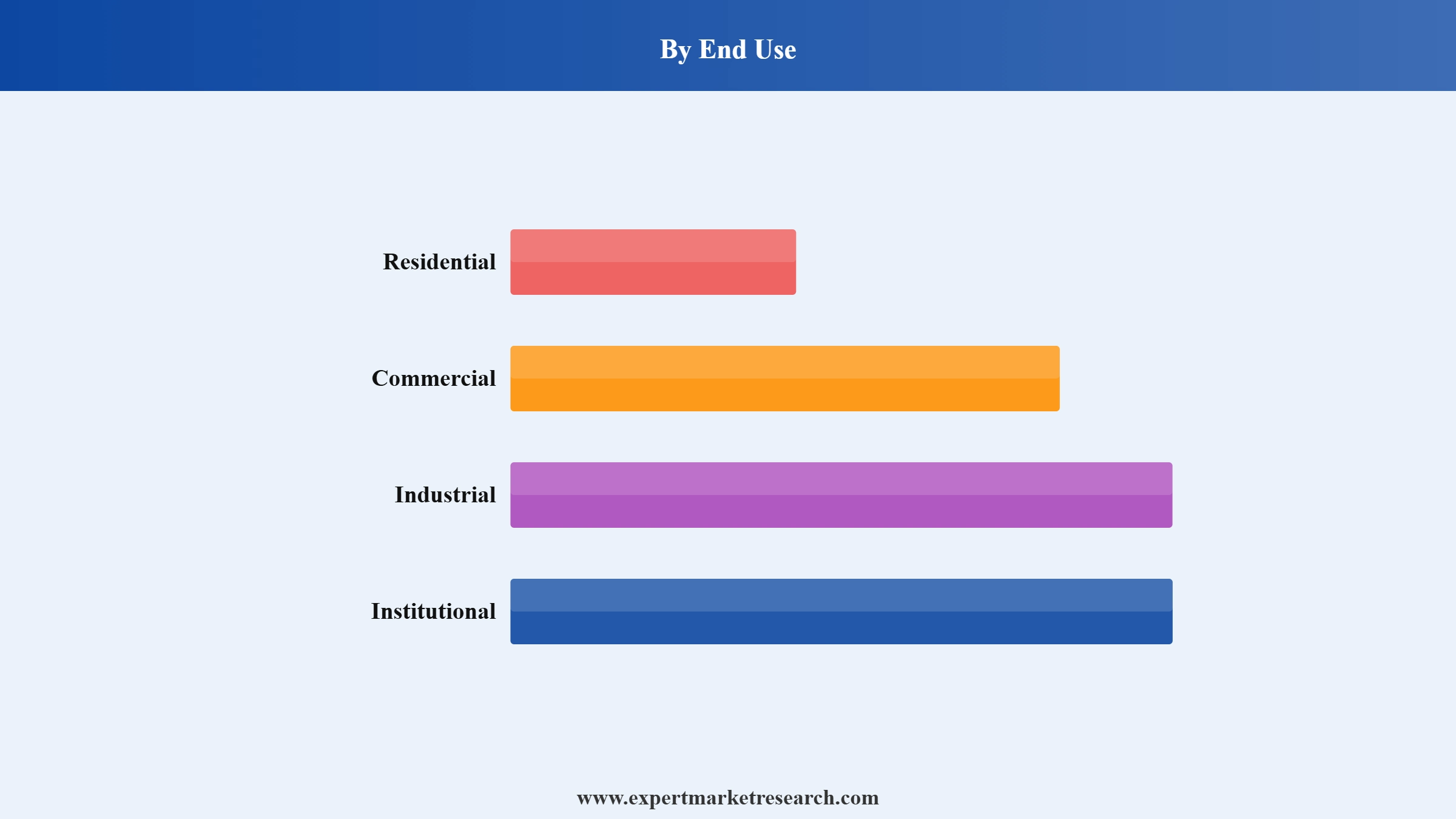
Key Insight: Residential construction is the fastest-growing end use segment in the Nigeria Construction Market, projected at a CAGR of 7.4% through 2034, reflecting the structural housing supply shortfall that is widening as Nigeria's urban population grows faster than residential construction capacity. Key demand hubs include Lagos, where informal settlements and inadequate formal housing co-exist in the same metropolitan area, and Abuja, where the capital's growing government and corporate workforce requires housing that the market is struggling to supply at sufficient scale and quality. Commercial construction, which encompasses office buildings, retail centers, hotels, and mixed-use developments, is concentrated in Lagos Island, Victoria Island, and the Abuja Central Business District, supported by growing multinational corporate presence and domestic business expansion. Industrial construction activity is expanding significantly linked to the government's gas monetization and economic diversification agenda. Institutional construction, covering hospitals, schools, universities, and government facilities, is receiving increased public sector attention as service delivery needs grow with the population.
Read more about this report - REQUEST FREE SAMPLE COPY IN PDF
Within the construction type segmentation, New Construction holds the dominant market share by a wide margin, driven by the structural demand gaps that characterize Nigeria's development stage. The housing deficit, infrastructure shortfall, and industrial capacity gap all require additive new construction rather than renovation of existing assets. Private residential developers, federal and state government agencies, and international construction contractors operating in Nigeria's energy sector all contribute to the dominance of new construction activity. Julius Berger Nigeria Plc, Nigeria's most established international construction contractor, and domestic players including Dutum Group Construction Company execute the bulk of large-scale new construction contracts across the major urban markets and government project pipeline.
Read more about this report - REQUEST FREE SAMPLE COPY IN PDF
New Construction dominates the construction type segmentation with an overwhelming share, as Nigeria's combination of population growth, urban expansion, and infrastructure deficit makes additive investment the primary form of construction activity throughout the market. The Renovations segment, while stable, is limited to a subset of the commercial real estate market and selected government facilities where aging assets require upgrading to maintain operational functionality and market relevance.
Within the end use segmentation, Residential construction holds the largest and fastest-growing market share, anchored by the chronic structural housing supply deficit in Nigeria's rapidly growing urban population centers. The combination of urbanization-driven demand and historically low mortgage market penetration has created a large backlog of unmet housing need that private and public sector developers are attempting to address through both formal housing schemes and incremental self-construction. Commercial construction holds the second-largest end use share, concentrated in the Lagos and Abuja commercial real estate markets where office, retail, and hospitality demand is sustained by corporate sector growth. Industrial construction is gaining share rapidly due to the LNG and gas infrastructure investment programs, while Institutional construction is growing steadily as government facility development tracks population-driven service demand.
Read more about this report - REQUEST FREE SAMPLE COPY IN PDF
The Nigeria construction market features a mix of large domestic contractors, international construction firms operating through local partnerships, and a large number of small and medium-sized local builders that handle the majority of informal and residential construction activity. The organized formal sector, which handles government infrastructure, large commercial developments, and industrial projects, is dominated by a small number of established companies with the track record, bonding capacity, and technical capability required to secure and execute large-scale contracts.
Competitive dynamics in the formal construction sector are shaped by relationships with government procurement agencies, access to project financing and letters of credit, technical certifications and local content compliance, and the ability to mobilize skilled labor and equipment across multiple simultaneous project sites. Foreign direct investment from Chinese construction firms and European engineering contractors is also a significant competitive factor in mega-project segments, where project values and technical complexity exceed the standalone capacity of domestic contractors. Public-private partnership opportunities are emerging as a growing source of competitive differentiation, with firms that have developed PPP structuring and concession management capabilities gaining access to infrastructure project pipelines that would otherwise require full public sector financing.
Dutum Group Construction Company is one of Nigeria's leading indigenous construction firms, with a portfolio spanning civil engineering, building construction, road infrastructure, and industrial projects. The company has established itself as a nationally significant contractor through its execution of major government-funded road, bridge, and building projects across multiple Nigerian states. As a local contractor with deep knowledge of Nigeria's terrain, regulatory environment, and supply chain dynamics, Dutum Group competes effectively in the federal and state government project procurement arena. The company's track record in delivering complex civil engineering works positions it as a key participant in the expanding infrastructure construction pipeline being generated by the federal government's multi-trillion naira infrastructure investment programs.
Julius Berger Nigeria Plc is Nigeria's most established and widely recognized construction company, with a history in Nigeria dating to 1970 and a listing on the Nigerian Stock Exchange. The company is a subsidiary of Bilfinger SE, a German engineering and services firm, and operates as a full-spectrum construction and civil engineering contractor handling roads, bridges, airports, buildings, industrial facilities, and infrastructure maintenance. Julius Berger has built or maintained some of Nigeria's most critical infrastructure including the Third Mainland Bridge in Lagos, multiple federal highways, and major institutional buildings. The company's combination of international engineering standards, local market knowledge, and long-established government relationships makes it the benchmark competitor in Nigeria's formal construction sector and the preferred contractor for technically complex government-financed projects.
Megastar Technical and Construction Company is a Nigerian construction firm operating across the civil engineering and building construction segments of the market. The company participates in government-funded construction projects at federal and state levels, offering services that include road construction, building works, and civil infrastructure development. As a domestic contractor with established operational capacity in Nigeria's market, Megastar contributes to the growing organizational depth of Nigeria's indigenous construction sector, which is increasingly expected to demonstrate local content delivery in major public infrastructure projects as part of the government's broader economic development agenda.
Founded in 1950 and headquartered in Cairo, Egypt, The Arab Contractors is one of the largest and oldest construction companies in Africa and the Arab world. The firm operates across civil engineering, building construction, industrial facilities, and specialized infrastructure projects and has maintained an active presence in Nigeria through participation in major government and institutional construction programs. The Arab Contractors brings Egyptian and international engineering expertise to the Nigerian market, competing effectively in the large-scale civil engineering and institutional construction segments where technical complexity and multi-disciplinary project management capability are essential differentiators. The company's track record across African construction markets provides it with valuable precedents for managing the logistical, regulatory, and financing challenges specific to large-scale construction in Nigeria.
Other key players in the market are Cappa and D'Alberto Ltd, ITB Nigeria Limited, Elalan Construction Company, Setraco Nigeria Limited, Craneburg Construction Company, and Others.
*Please note that this is only a partial list; the complete list of key players is available in the full report. Additionally, the list of key players can be customized to better suit your needs.*
Gain a comprehensive view of one of Africa's largest and most complex construction markets with our 2026 Nigeria Construction Market report. From government mega-project pipelines and residential housing demand to industrial LNG investments and PPP frameworks opening new financing avenues, this report provides the intelligence needed to compete and invest with confidence. Whether you are a contractor positioning for government tenders, a real estate developer targeting the housing deficit, or an investor evaluating Nigeria's infrastructure opportunity, this report delivers the data and strategic context to move decisively. Download your free sample today and discover the opportunities shaping the future of Construction in Nigeria.


Upto 15% Off
USD
$2499 $2249
$3999 $3599
$4999 $4249
$5999 $5099


*While we strive to always give you current and accurate information, the numbers depicted on the website are indicative and may differ from the actual numbers in the main report. At Expert Market Research, we aim to bring you the latest insights and trends in the market. Using our analyses and forecasts, stakeholders can understand the market dynamics, navigate challenges, and capitalize on opportunities to make data-driven strategic decisions.*
In 2025, the Nigeria construction market reached an approximate value of USD 35.71 Billion.
The market is projected to grow at a CAGR of 3.90% between 2026 and 2035.
The key players in the market includes Dutum Group Construction Company, Julius Berger Nigeria Plc, Megastar Technical and Construction Company, The Arab Contractors (Osman Ahmed Osman & Co.), Cappa and D’Alberto Ltd, ITB Nigeria Limited, Elalan Construction Company, Setraco Nigeria Limited, Craneburg Construction Company, among others.
The market is projected to grow significantly during the forecast period 2026 to 2035 to reach USD 52.35 Billion by 2035..
Some of the key strategies include public-private partnerships, use of new construction technologies, foreign direct investment, regulatory reforms, and infrastructure development through government-sponsored mega projects to drive economic growth and urban development.
Explore our key highlights of the report and gain a concise overview of key findings, trends, and actionable insights that will empower your strategic decisions.
| REPORT FEATURES | DETAILS |
| Base Year | 2025 |
| Historical Period | 2019-2025 |
| Forecast Period | 2026-2035 |
| Scope of the Report |
Historical and Forecast Trends, Industry Drivers and Constraints, Historical and Forecast Market Analysis by Segment:
|
| Breakup by Construction Type |
|
| Breakup by End Use |
|
| Market Dynamics |
|
| Competitive Landscape |
|
| Companies Covered |
|
Datasheet
One User
USD 2,499
USD 2,249
tax inclusive*
Single User License
One User
USD 3,999
USD 3,599
tax inclusive*
Five User License
Five User
USD 4,999
USD 4,249
tax inclusive*
Corporate License
Unlimited Users
USD 5,999
USD 5,099
tax inclusive*
*Please note that the prices mentioned below are starting prices for each bundle type. Kindly contact our team for further details.*
Flash Bundle
Small Business Bundle
Growth Bundle
Enterprise Bundle
*Please note that the prices mentioned below are starting prices for each bundle type. Kindly contact our team for further details.*
Flash Bundle
Number of Reports: 3
20%
tax inclusive*
Small Business Bundle
Number of Reports: 5
25%
tax inclusive*
Growth Bundle
Number of Reports: 8
30%
tax inclusive*
Enterprise Bundle
Number of Reports: 10
35%
tax inclusive*
How To Order

Select License Type
Choose the right license for your needs and access rights.

Click on ‘Buy Now’
Add the report to your cart with one click and proceed to register.

Select Mode of Payment
Choose a payment option for a secure checkout. You will be redirected accordingly.
Strategic Solutions for Informed Decision-Making
Gain insights to stay ahead and seize opportunities.

Get insights & trends for a competitive edge.

Track prices with detailed trend reports.

Analyse trade data for supply chain insights.

Leverage cost reports for smart savings

Enhance supply chain with partnerships.

Connect For More Information
Our expert team of analysts will offer full support and resolve any queries regarding the report, before and after the purchase.
Our expert team of analysts will offer full support and resolve any queries regarding the report, before and after the purchase.
We employ meticulous research methods, blending advanced analytics and expert insights to deliver accurate, actionable industry intelligence, staying ahead of competitors.
Our skilled analysts offer unparalleled competitive advantage with detailed insights on current and emerging markets, ensuring your strategic edge.
We offer an in-depth yet simplified presentation of industry insights and analysis to meet your specific requirements effectively.




