

Consumer Insights
Uncover trends and behaviors shaping consumer choices today
Procurement Insights
Optimize your sourcing strategy with key market data
Industry Stats
Stay ahead with the latest trends and market analysis.
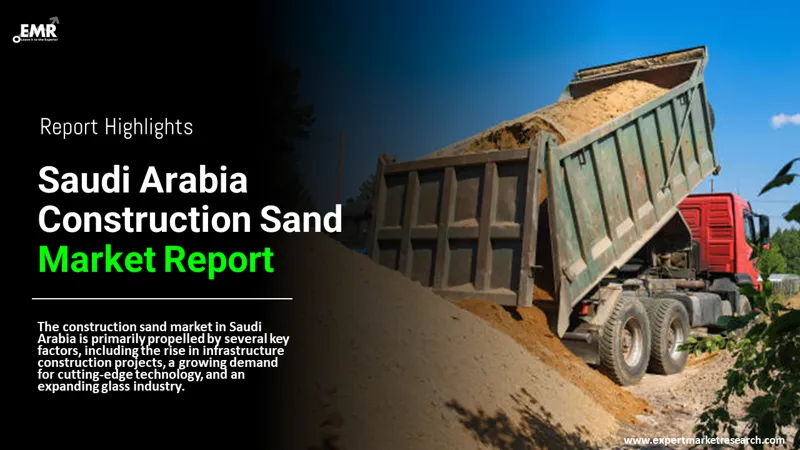
The Saudi Arabia construction sand market reached a volume of 170.20 MMT in 2025 and is expected to grow at a CAGR of 3.80% to reach 247.13 MMT by 2035. Rapid urbanisation, sustained government investment under Vision 2030 giga-projects, and the gradual depletion of natural sand reserves are propelling demand for both natural and synthetic construction sand across residential, commercial, and industrial building activity in the Kingdom.
Rapid urbanisation and sustained government investment in national infrastructure development are central to expansion of the Saudi Arabia construction sand market, as residential, commercial, and industrial construction activity continues to accelerate across the Kingdom. At the same time, natural sand reserves near major population centers are facing growing depletion, encouraging producers to invest in mechanical crushing and sieving capacity for synthetic sand while adopting more disciplined quarry management practices to keep pace with rising demand.
The Saudi Arabia construction sand market is also being reshaped by Vision 2030 giga-projects, as NEOM, the Red Sea Project, and Diriyah Gate collectively require enormous volumes of aggregate, concrete-grade sand, and construction-grade rock, prompting regulators to accelerate domestic quarry licensing to keep pace. In January 2026, Saleh Abdulaziz Al Rashed & Sons, a construction materials and quarry operator, became the first Saudi company of the year to file an initial public offering prospectus on the Saudi Exchange, offering 5.58 million shares equal to 30 percent of the company. This kind of capital markets activity reflects growing investor confidence in domestic quarrying and construction materials businesses as demand for building materials continues to expand.
Demand for construction sand is not evenly distributed across the Kingdom. The Central region, anchored by Riyadh's dense residential and infrastructure pipeline, and the Eastern Province, home to established quarrying clusters and industrial processing capacity, together account for the bulk of current demand, while the Western region is seeing the fastest acceleration in demand as NEOM and the Red Sea Project move deeper into their construction timelines. Producers are expanding their own regional footprint to stay close to these shifting demand centers. BMS, for instance, operates processing facilities spanning Alkharj in the Central region and Jeddah on the Western coast, positioning the company to serve both the Kingdom's traditional Riyadh-centered construction market and its faster-growing western giga-project corridor.
Compound Annual Growth Rate
3.8%
Value in MMT
2026-2035
Read more about this report - REQUEST FREE SAMPLE COPY IN PDF
Saudi construction materials firms advanced low-carbon concrete production through calcined clay plants with a combined annual capacity of 350,000 tonnes, cutting cement-related emissions to support green building targets and reduce reliance on traditional Portland cement across large-scale infrastructure projects. Concrete producers can use calcined clay blends to lower embodied carbon without redesigning existing mix specifications or plant equipment.
Saudi Arabia's Ministry of Industry and Mineral Resources issued 80 new mining licenses during March 2026 across five permit categories, with building materials quarry licenses accounting for the largest single share of approvals granted during the month. Producers can use the expanding licensing pipeline to plan new quarry openings with greater regulatory certainty and reduced project lead times.
The Heavy Equipment Connect 2026 expo in Dammam showcased AI-enhanced robotics for foundries, with exhibitors demonstrating equipment capable of speeding production by up to 35 percent in support of Vision 2030's broader industrial transformation agenda across the Kingdom's manufacturing base. Foundries can use this equipment to raise casting throughput without expanding existing floor space or headcount.
Saudi Ceramic Company expanded its retail presence with new showrooms in Riyadh, improving customer access to its full range of ceramic and porcelain tiles while strengthening local supply for Vision 2030 infrastructure and housing initiatives across the Kingdom's fast-growing residential and commercial construction sectors. Buyers can use the expanded showroom network to source silica-based tile products closer to active project sites.
Foundry operators across Saudi Arabia are increasingly forming joint ventures to bring specialized casting capacity online, since combining capital and technical expertise with an established partner moves faster than building the capability independently. Glass and building materials groups are extending into adjacent casting and metal forming businesses to diversify their revenue base. Obeikan Glass and Al-Esra Aluminum are jointly operating Saudi Alucast's new aluminum casting plant in Madinah, inaugurated in October 2025, with production capacity currently at 5,000 tons and plans in place to scale toward 15,000 tons by 2030 as automotive and industrial demand grows.
Glass manufacturers in the Kingdom are ramping up investment in float glass and coating line capacity to meet rising demand from architectural and automotive glazing customers, reducing reliance on imported glass products as Vision 2030 construction activity accelerates. In December 2025, Gulf Guard began building a SAR 1 billion glass manufacturing plant in Jubail featuring float and coater lines, strengthening domestic production of high-performance glass for both construction and industrial applications and giving local buyers a shorter, more reliable supply chain than importing specialized glazing products.
Manufacturers across Saudi Arabia's building materials sector are increasingly integrating AI driven automation to improve quality control and production efficiency, reducing the scrap rates and inconsistency that manual inspection processes have historically struggled to catch across shifts and operators. In October 2025, the Smart Foundry Initiative deepened AI integration across participating facilities, lifting quality control accuracy by 30 percent, while in March 2026, China Harbour opened an advanced modular production facility in Riyadh that applies robotics and digital technologies to accelerate affordable housing delivery for ROSHN projects, together illustrating how automation is spreading across both heavy industry and residential construction.
Global construction chemicals companies are increasingly acquiring established local distributors to gain faster access to regional customer relationships and regulatory approvals, rather than building a domestic sales network from scratch in a market where formulation performance depends heavily on local climate and raw material conditions. In January 2026, Master Builders Solutions acquired Arkaz Al Sharq, boosting local supply of concrete admixtures and waterproofing solutions aimed at lowering carbon emissions across major Saudi infrastructure projects and strengthening the acquirer's regional distribution footprint.
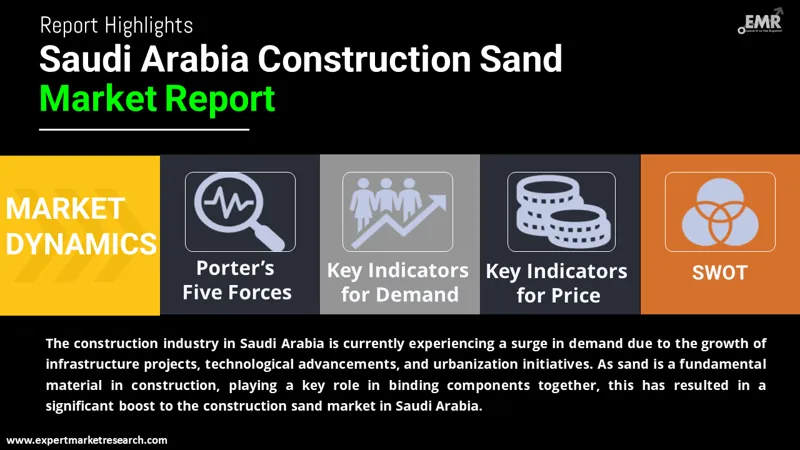
Foreign direct investment and construction sector growth are both reinforcing underlying demand for sand, aggregate, and other bulk building materials as Saudi Arabia continues diversifying its economy away from oil revenue under Vision 2030. As of data published in early 2026, the Kingdom attracted a net FDI inflow of SAR 72.3 billion during the first nine months of 2025, an increase of 32.7 percent year on year, while its construction industry is on track to grow by 3.6 percent in real terms in 2026, with average annual growth projected to accelerate further to 4.7 percent between 2027 and 2030.
Read more about this report - REQUEST FREE SAMPLE COPY IN PDF
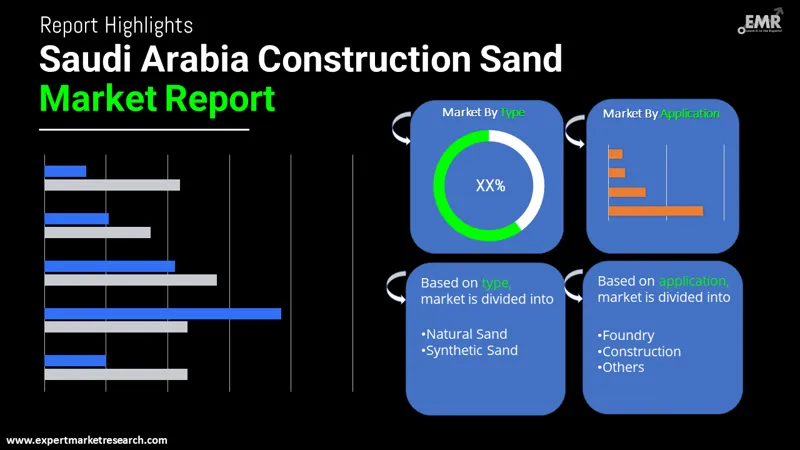
The Expert Market Research’s report titled “Saudi Arabia Construction Sand Market Report and Forecast 2026-2035 offers a detailed analysis of the market based on the following segments:
Market Breakup by Type
Key Insight: Natural sand continues to hold the largest share of the Saudi Arabia construction sand market, valued for its affordability and its rounded, workable particle shape that requires less water to achieve durable concrete. Synthetic sand, also known as crushed sand, is growing at a faster pace as natural reserves near major population centers become depleted and as regulators restrict river sand extraction due to pollution and erosion concerns. Synthetic sand offers more consistent gradation and shape than natural sand, and producers are investing in mechanical crushing and sieving capacity to meet the resulting shift in demand, particularly as construction activity intensifies around NEOM and other giga-projects further from traditional natural sand deposits.
Market Breakup by Application
Key Insight: Construction remains the leading application for sand in the Kingdom, consumed directly in concrete, mortar, and masonry work across residential and commercial building activity. Glass manufacturing is growing quickly as demand rises for flat glass, solar control glazing, and lightweight glazing used in both automotive and architectural applications. Foundry applications use sand as a moulding and casting medium for metal parts, ceramics and refractories applications rely on sand for kiln linings and heat-resistant products used in industrial furnaces, and other applications include water filtration media and sports facility surfacing. In February 2026, industry leaders expanded adoption of self-healing concrete and smart glass in high-performance building facades, reflecting how construction and glass manufacturing applications are increasingly converging around advanced, sand-derived materials.
Read more about this report - REQUEST FREE SAMPLE COPY IN PDF
By type, natural sand dominates the market through its affordability and workability in concrete applications
Natural sand holds the largest share of the Saudi Arabia construction sand market by type, as its naturally rounded particle shape makes it easier to work into durable concrete without requiring excessive water content. The material remains the more affordable option for large-volume residential and commercial construction projects across the Kingdom. Builders continue to favor natural sand for standard concrete and masonry work wherever nearby deposits remain economically accessible, sustaining its position as the default choice for high-volume construction activity despite gradually tightening local supply.
Synthetic sand is the fastest-growing type, driven by the gradual exhaustion of natural sand reserves near major population centers and by regulatory restrictions on river sand mining introduced to address pollution and erosion concerns. Producers are investing in mechanical crushing and sieving equipment to meet this shift, since synthetic sand offers more consistent gradation, shape, and stability than natural alternatives. In November 2025, FABO GLOBAL deployed a 1,000 tonne per hour crushing and screening plant to support the NEOM project, illustrating the scale of processing capacity now being brought online to convert crushed rock into consistent, construction-grade synthetic sand.
By application, construction leads the market on sheer building volume while glass manufacturing grows fastest on Vision 2030 demand
Construction accounts for the largest application share of the Saudi Arabia construction sand market, reflecting the sheer volume of sand consumed in concrete, mortar, and masonry across the Kingdom's residential and commercial building activity. Vision 2030 giga-projects, including NEOM and the Red Sea Project, continue to anchor long-run demand for this application, alongside ROSHN's multi-year residential delivery program. This construction pipeline gives sand producers a relatively predictable, multi-year demand base even as individual project timelines shift.
Glass manufacturing is the fastest-growing application, supported by rising demand for flat glass, solar control glazing, and lightweight automotive glazing tied to the Kingdom's renewable energy and construction ambitions. Higher purity sand grades are increasingly required as glass manufacturers pursue more specialized architectural and automotive glazing products. Saudi Arabia's target of 58.7 gigawatts of renewable energy capacity by 2030, centered heavily on solar power, is reinforcing this shift by driving sustained demand for the ultra-pure silica sand grades that photovoltaic glass manufacturing requires.
Read more about this report - REQUEST FREE SAMPLE COPY IN PDF
The industry is becoming quality and integration oriented as major Saudi Arabia construction sand companies compete on raw material consistency, processing capacity, and proximity to giga-project construction sites. Producers are expanding quarry licensing activity, investing in mechanical crushing and sieving capacity for synthetic sand, and broadening into value-added finishing products such as wall putty and tile adhesives to capture more value per project. Many construction sand companies are also strengthening domestic processing capacity to reduce the Kingdom's historical reliance on imported sand as Vision 2030 construction activity accelerates.
Consolidation remains limited in this fragmented industry, as Saudi Arabia construction sand market players continue to compete through regional quarry access and established customer relationships rather than large-scale mergers. Opportunities are concentrated around synthetic sand production, higher purity grades for glass and ceramics manufacturing, and value-added finishing products that command stronger margins than raw material sales alone. Construction sand market players that combine reliable quarry access with processing capacity are best positioned to capture demand as giga-project construction accelerates across the Kingdom.
Founded in 1991 and headquartered in Riyadh, Saudi Arabia, Adwan Chemical Industries Co. Ltd. is a fully owned subsidiary of Adwan Development Co. and operates as a basic manufacturer of inorganic chemicals and processor of industrial minerals. The company exploits high grade white silica sand deposits to produce silica sand, silica flour, silicate, and aluminate products, operating vertically integrated facilities across Riyadh and Dammam. Adwan Chemical Industries sells to more than 1,250 clients across over 30 countries and holds ISO 9001, ISO 14001, ISO 45001, and NSF certifications supporting its export operations.
Founded in 1995 and headquartered in Jeddah, Saudi Arabia, BMS, also known as Gharbalah Industrial Co., specializes in mining and treating industrial minerals, including silica sand, limestone, and calcium carbonate, for water treatment filtration media and broader industrial raw material applications. The company extracts natural materials from Saudi Arabia's mineral resources and processes them physically and chemically across facilities located throughout the Kingdom. BMS supplies both domestic customers and export markets, serving industries ranging from water purification to oil well drilling with more than 25 years of mineral mining experience.
Founded in 2007 and headquartered in Riyadh, Saudi Arabia, Muadinoon Mining Company is engaged in the mining and sale of minerals and raw materials serving a wide range of downstream industries. The company is one of the Kingdom's important suppliers of industrial silica and iron, contributing to Saudi Arabia's broader mineral resource development under Vision 2030. Muadinoon Mining Company continues to expand its supply relationships across construction, glass, and industrial customers seeking consistent domestic access to processed mineral raw materials.
Founded in 2008 and headquartered in Riyadh, Saudi Arabia, White Sand Industry Company is one of the Kingdom's leading factories manufacturing finishing products with cement, alongside waterproofing and thermal insulation solutions. The company specializes in supplying raw materials while also introducing innovative finishing products, including wall putty, paints, grouts, and tile adhesives, to the Saudi construction market. White Sand Industry Company has built its business around combining raw sand supply with a broader portfolio of value-added finishing products for residential and commercial construction customers.
Other key players in the market include Modern Building Material Company, Thrrat Factory for The Industry, Mohammed Hadi Al-Rasheed & Co., Al Salam Al Ma'asi Co. (ASAMCO), and Delmon Group, among others.
*Please note that this is only a partial list; the complete list of key players is available in the full report. Additionally, the list of key players can be customized to better suit your needs.*
Unlock the latest insights with our Saudi Arabia construction sand market trends 2026 report. Discover application-level demand patterns, regulatory developments, and key industry players. Stay ahead of competition with trusted data and expert analysis. Download your free sample report today and drive informed decisions in the market.


Upto 15% Off
USD
$2499 $2249
$3999 $3599
$4999 $4249
$5999 $5099


*While we strive to always give you current and accurate information, the numbers depicted on the website are indicative and may differ from the actual numbers in the main report. At Expert Market Research, we aim to bring you the latest insights and trends in the market. Using our analyses and forecasts, stakeholders can understand the market dynamics, navigate challenges, and capitalize on opportunities to make data-driven strategic decisions.*
In 2025, the market reached an approximate volume of 170.20 MMT.
The market is expected to grow at a CAGR of 3.80% between 2026-2035.
The market is estimated to witness a healthy growth in the forecast period of 2026-2035 to reach a volume of 247.13 MMT by 2035.
The major market drivers for construction sand market in Saudi Arabia are increasing construction of infrastructure, demand for advanced technology, growth in the glass industry.
Some of the key trends of the market are the increasing usage of synthetic sand, development of advanced buildings, durable automotive glass.
Natural sand holds the largest share, given its affordability and workability in standard concrete applications.
The applications of construction sand in Saudi Arabia are foundry, construction, ceramics and refractories, and glass manufacturing, among others.
Natural sand is naturally extracted from riverbeds, whereas synthetic sand is mechanically made by eroding rock.
Construction sand has a higher level of modules index compared to general sand which increases its workability for concrete and can be used effectively for construction.
The key players in the Saudi Arabia construction sand market are Modern Building Material Company, BMS (Gharbalah Industrial Co.), Adwan Chemical Industries Co. Ltd., Thrrat Factory for the industry, Mohammed hadi Al-Rashedd & Co., Muadinoon Mining Company, Al Salam Al Ma’asi Co., Delmon Goup, and White Sand Industry Company, among others.
Synthetic sand is expected to register the fastest growth as natural reserves deplete and regulatory restrictions on river sand mining tighten.
Explore our key highlights of the report and gain a concise overview of key findings, trends, and actionable insights that will empower your strategic decisions.
| REPORT FEATURES | DETAILS |
| Base Year | 2025 |
| Historical Period | 2019-2025 |
| Forecast Period | 2026-2035 |
| Scope of the Report |
Historical and Forecast Trends, Industry Drivers and Constraints, Historical and Forecast Market Analysis by Segment:
|
| Breakup by Type |
|
| Breakup by Application |
|
| Market Dynamics |
|
| Competitive Landscape |
|
| Companies Covered |
|
Datasheet
One User
USD 2,499
USD 2,249
tax inclusive*
Single User License
One User
USD 3,999
USD 3,599
tax inclusive*
Five User License
Five User
USD 4,999
USD 4,249
tax inclusive*
Corporate License
Unlimited Users
USD 5,999
USD 5,099
tax inclusive*
*Please note that the prices mentioned below are starting prices for each bundle type. Kindly contact our team for further details.*
Flash Bundle
Small Business Bundle
Growth Bundle
Enterprise Bundle
*Please note that the prices mentioned below are starting prices for each bundle type. Kindly contact our team for further details.*
Flash Bundle
Number of Reports: 3
20%
tax inclusive*
Small Business Bundle
Number of Reports: 5
25%
tax inclusive*
Growth Bundle
Number of Reports: 8
30%
tax inclusive*
Enterprise Bundle
Number of Reports: 10
35%
tax inclusive*
How To Order

Select License Type
Choose the right license for your needs and access rights.

Click on ‘Buy Now’
Add the report to your cart with one click and proceed to register.

Select Mode of Payment
Choose a payment option for a secure checkout. You will be redirected accordingly.
Strategic Solutions for Informed Decision-Making
Gain insights to stay ahead and seize opportunities.

Get insights & trends for a competitive edge.

Track prices with detailed trend reports.

Analyse trade data for supply chain insights.

Leverage cost reports for smart savings

Enhance supply chain with partnerships.

Connect For More Information
Our expert team of analysts will offer full support and resolve any queries regarding the report, before and after the purchase.
Our expert team of analysts will offer full support and resolve any queries regarding the report, before and after the purchase.
We employ meticulous research methods, blending advanced analytics and expert insights to deliver accurate, actionable industry intelligence, staying ahead of competitors.
Our skilled analysts offer unparalleled competitive advantage with detailed insights on current and emerging markets, ensuring your strategic edge.
We offer an in-depth yet simplified presentation of industry insights and analysis to meet your specific requirements effectively.




