

Consumer Insights
Uncover trends and behaviors shaping consumer choices today
Procurement Insights
Optimize your sourcing strategy with key market data
Industry Stats
Stay ahead with the latest trends and market analysis.



The Saudi Arabia solar photovoltaic (PV) market attained a volume of 2.12 Gigawatt in 2025 and is projected to expand at a CAGR of 11.50% through 2035. The market is further expected to achieve a volume of 6.30 Gigawatt by 2035. Accelerated grid modernization investments are enabling higher photovoltaic penetration. This is encouraging utilities and developers to adopt smart inverters, storage ready PV systems, and digital forecasting tools across utility and commercial installations.
Rising electricity consumption due to data centers and industrial areas is resulting in quite stable daytime load profiles, which are perfect for the installation of large, scale PV systems. Meanwhile, the declining Levelized Cost of Electricity for bifacial modules is helping the projects become more economically viable. Panel manufacturers that offer higher rear side gain and advanced trackers to lift yields have been the focus of developers. These factors are accelerating tender activity while shaping product specifications demanded by utilities, accelerating the overall Saudi Arabia solar photovoltaic (PV) market growth.
As part of Saudi Arabia's Vision 2030, the Kingdom aims to source 50% of its electricity from renewable energy (RE). As a contribution to this target, in October 2025, ACWA Power advanced its utility scale solar portfolio by advancing the Sudair Solar PV project into full commercial operations, positioning it among the world’s largest single site installations. According to the Saudi Arabia solar photovoltaic (PV) market analysis, Sudair can support the power needs of around 185,000 households, which stresses the way scale-driven projects are transforming the purchasing strategies of EPC contractors, inverter suppliers, and module manufacturers who are aiming at long-term government backed offtake agreements.
The market is further shifting toward localization and technology differentiation. Major developers are aligning with the National Renewable Energy Program to localize module assembly, tracker manufacturing, and O&M services. Firms such as JinkoSolar and LONGi are signaling interest in regional partnerships to serve giga scale tenders more competitively. For example, Nextpower's new Saudi manufacturing facility, announced in January 2026, is poised to produce up to 12GW of PV tracker systems, propelling the Saudi Arabia solar photovoltaic (PV) market growth.
Compound Annual Growth Rate
11.5%
Value in Gigawatt
2026-2035
Read more about this report - REQUEST FREE SAMPLE COPY IN PDF
Trinasolar revealed its partnership with Haala Energy during the World Future Energy Summit (WFES) 2026. Such developments in the Saudi Arabia solar photovoltaic (PV) market signals growing preference for supplier–installer alliances, creating funding and entry opportunities for module makers and EPC firms aligning with Saudi-based developers to access utility and C&I pipelines.
Saudia Dairy & Foodstuff Company (SADAFCO) and Yellow Door Energy entered into a solar lease that is designed to supply clean energy to seven of SADAFCO's locations. Therefore, manufacturers, financiers, and IPPs can fund rooftop and captive solar projects across food, logistics, and industrial facilities, following such developments in the market.
TotalEnergies and Aljomaih Energy & Water (AEW) secured the license to design, construct, and manage the 400-megawatt As Sufun solar photovoltaic facility in the Hail area. Global energy companies and local partners can thus find opportunities to co-invest in large-scale projects, attracting capital into EPC services, grid integration, and long-term asset management.
SIG and Yellow Door Energy officially inaugurated SIG's 2-megawatt solar initiative in Riyadh. Such Saudi Arabia solar photovoltaic (PV) market developments create opportunities for solution providers and investors to fund modular PV systems for corporates seeking fast deployment and predictable energy costs.
The market is being shaped by utility scale tenders anchored by sovereign entities. The Ministry of Energy continues to release multi-gigawatt procurement rounds under the National Renewable Energy Program. Leveraging this opportunity, in August 2023, ACWA Power and Badeel closed financing for the 2 GW Al Shuaibah Solar PV project. Such a development is reinforcing lender confidence in long dated power purchase agreements, widening the Saudi Arabia solar photovoltaic (PV) market scope. EPC firms are aligning bid strategies around scale efficiency and delivery certainty, while module suppliers are prioritizing high wattage formats.
Local content requirements are emerging as a decisive factor in Saudi Arabia’s solar market. Government led procurement increasingly scores bids based on domestic manufacturing contribution. For example, in July 2024, the Public Investment Fund supported plans for integrated solar component manufacturing zones. International module makers are also exploring joint ventures to assemble panels locally. For example, in October 2025, China-based solar module manufacturer SoleFiori announced that the company is setting up a 6 GW heterojunction (HJT) module manufacturing facility in Saudi Arabia. This trend in the Saudi Arabia solar photovoltaic (PV) market is pushing companies to redesign supply chains for proximity and compliance.
Extreme climate conditions are influencing product selection across Saudi solar projects. Developers are demanding modules with low temperature coefficients and advanced anti soiling coatings. Bifacial panels paired with single axis trackers have now become standard in large-scale projects. Inverter manufacturers are promoting liquid cooled systems for thermal stability, accelerating demand in the Saudi Arabia solar photovoltaic (PV) market. For example, OptimalPV's AI-powered software automates the design of solar PV systems by using 3D modeling and optimization algorithms, since July 2024.
Grid stability requirements are shaping solar photovoltaic deployments in Saudi Arabia. Utilities are increasingly pairing PV plants with battery energy storage systems. As a result, developers are specifying storage-ready inverters and advanced control systems. Technology providers offering hybrid solutions are gaining strategic relevance, stimulating the Saudi Arabia solar photovoltaic (PV) market value. Storage integration also improves bankability for lenders. For example, in December 2025, the Kingdom of Saudi Arabia officially completed grid connection of its landmark battery energy storage project with the nameplate capacity of 7.8 GWh.
Industrial diversification programs are driving the overall meter solar adoption surge across Saudi Arabia. Manufacturing zones and logistics hubs are seeking predictable power costs, while Vision 2030 policies encourage private sector renewable investments. This is creating demand for modular PV systems and long-term service contracts. Inverter suppliers are focusing on medium voltage compatibility, accelerating the Saudi Arabia solar photovoltaic (PV) market growth. For instance, Larsen & Toubro (L&T) renewable vertical signed a Memorandum of Understanding (MoU) in September 2025, with ACWA Power for the renewables and grid scope of the Yanbu Green Ammonia Project in Saudi Arabia. Companies serving industrial clients benefit from repeat orders and stable margins compared to competitive utility scale tenders.
The EMR’s report titled “Saudi Arabia Solar Photovoltaic (PV) Market Report and Forecast 2026-2035” offers a detailed analysis of the market based on the following segments:
Market Breakup by Technology
Key Insight: Technology choices in the Saudi Arabia solar photovoltaic (PV) market reflect performance certainty and operating conditions. Mono-Si remains the preferred option due to efficiency and durability. Thin film is gaining attention for heat tolerance and specific use cases. Multi-Si adoption continues to decline as yield expectations rise, while other technologies remain limited to testing and specialized installations. Buyers focus on long term output stability rather than upfront pricing. In June 2025, scientists from Saudi Arabia at King Abdullah University of Science and Technology ( KAUST) developed an innovative and amazing technology that reduces the temperature of photovoltaic panels.
Market Breakup by Deployment
Key Insight: Ground-mounted systems dominate national capacity additions due to centralized planning and land access. Rooftop solar is also gaining steady momentum across private commercial assets. Each deployment type serves a different buyer profile, for example, while utility developers prioritize standardized ground designs, commercial users favor faster rooftop execution. The Saudi Arabia solar photovoltaic (PV) market benefits from parallel deployment pathways that reduce concentration risk while improving geographic and sectoral penetration.
Market Breakup by Connectivity
Key Insight: On-grid systems dominate the Saudi Arabia solar photovoltaic (PV) market dynamics due to transmission investments and contract certainty. Utilities rely on grid stability for dispatch planning. Off-grid systems serve remote industrial needs. These projects emphasize autonomy and reliability, as developers assess connectivity risks early. Technology providers are tailoring solutions to match grid availability and operating conditions, ensuring compatibility with both centralized and remote deployments.
Market Breakup by End Use
Key Insight: Utility projects lead capacity due to government backing and scale while commercial adoption is accelerating as energy costs gain visibility. In October 2025, Masdar has secured two new solar PV projects in Saudi Arabia with a combined capacity of 2GW under the National Renewable Energy Program. Each segment, considered in the Saudi Arabia solar photovoltaic (PV) market report demands distinct delivery models. Utility buyers emphasize compliance and bankability and on the other hand, commercial clients value flexibility and service. EPC firms customize offerings and equipment suppliers align portfolios to categorize requirements.
Market Breakup by Region
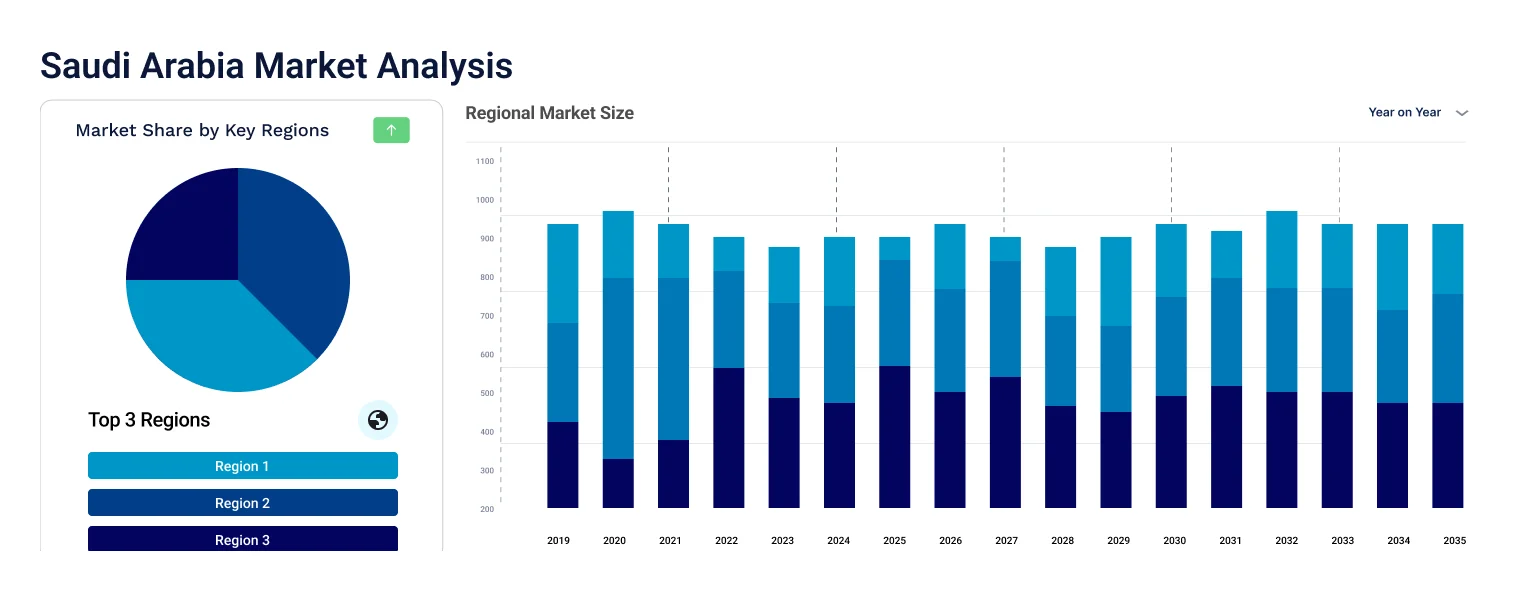
Key Insight: Regional deployment reflects infrastructure readiness and economic activity. Riyadh leads installations due to grid access and administrative concentration. Eastern Province represents and emerging market through the region’s rapid industrial demand. Makkah and Madinah see selective growth tied to urban needs, while Qassim supports smaller scale applications. Developers prioritize regions with approval efficiency and load centers and suppliers allocate resources accordingly. Regional diversification in the Saudi Arabia solar photovoltaic (PV) market improves project distribution and risk management.
Read more about this report - REQUEST FREE SAMPLE COPY IN PDF
By technology, the mono-si category accounts for the dominant market share due to higher efficiency and desert performance stability
Mono-Si technology dominates the Saudi Arabia solar photovoltaic (PV) market due to its higher efficiency under extreme heat. Utility developers prefer mono modules for large ground projects where land optimization matters. Degradation rates of mono-si technologies are lower compared to their alternatives, thereby supporting long operational duration. Local partners are adapting mono module assembly lines to meet domestic content targets. Suppliers focusing on desert durability coatings are gaining repeat orders. In October 2023, JinkoSolar announced a major technical breakthrough in its 182mm high-efficiency N-type monocrystalline silicon solar cell technology, that significantly enhances performance and scalability.
Thin film technology is steadily growing its share in the Saudi Arabia solar photovoltaic (PV) market dynamics due to its lower sensitivity to heat and shading. Industrial users are exploring thin films for captive installations with space constraints. The technology performs consistently during high temperature afternoons. International suppliers are positioning thin film as a complementary option. Growth in the category is driven by niche performance advantages rather than volume focused bidding strategies alone.
By deployment, ground-mounted systems lead adoption due to utility-scale procurement dominance
Ground-mounted systems account for the dominant share in the deployment category in Saudi Arabia due to vast land availability and centralized procurement. Utility scale projects favor single axis trackers to boost output. Developers design layouts for dust management and maintenance access. Financing institutions prefer ground-mounted assets for predictable generation profiles. Government-led tenders continue to prioritize large sites connected directly to transmission infrastructure. For instance, GameChange Solar was selected to supply its Genius Tracker 1P system for ACWA Power’s Khulis Solar PV independent power project in December 2025.
Rooftop solar is expanding across commercial and industrial facilities, stimulating the Saudi Arabia solar photovoltaic (PV) market revenue growth. Companies are introducing lightweight mounting systems to reduce roof reinforcement needs. Warehouses and logistics parks lead adoption, pushing developers to offer turnkey rooftop solutions in order to secure long-term service contracts. This segment benefits companies offering integrated engineering and maintenance. Rooftop solar complements utility scale assets by serving localized demand centers without transmission dependency.
By connectivity, on-grid systems’ dominance is supported by national grid expansion programs
On-grid connectivity leads the Saudi Arabia solar photovoltaic (PV) market due to expanding transmission capacity. Utility-scale solar plants rely on stable grid access to support accurate dispatch planning and predictable output scheduling. Standardized grid codes simplify system integration and reduce approval timelines. Developers therefore prefer on-grid configurations to secure revenue certainty, as power purchase agreements depend on consistent grid availability.
Off-grid solar is gaining relevance in remote industrial and infrastructure projects. Mining sites and telecom installations are driving off-grid solar demand as operators seek greater energy independence and reduced reliance on diesel generation. Hybrid systems that combine solar with battery storage are becoming standard to ensure reliability. Developers prioritize system stability and uptime rather than project scale. Suppliers offering fully integrated hardware, software, and maintenance packages are gaining traction, as asset owners prefer single-point accountability for long-term operational performance. For instance, in September 2024, Huawei Digital Power built a solar-storage microgrid in Saudi Arabia’s Red Sea New City, operating smoothly for a year and delivering over 1 TWh of green electricity.
By end use, the utility segment dominates installations backed by sovereign scale solar tenders
Utility end use creates new Saudi Arabia solar photovoltaic (PV) market opportunities through giga-scale projects. Developers are building project portfolios around long-term power contracts, which provides revenue certainty and supports large-scale deployment planning. Equipment suppliers benefit from predictable demand cycles, allowing better production scheduling and cost control. Standardization across utility projects reduces execution complexity and shortens delivery timelines. Utility installations also support national energy diversification. For example, in July 2025, Sharjah launched its first utility-scale solar farm, while a new passive cooling tech boosts PV performance in Saudi Arabia.
Commercial end users are accelerating solar photovoltaic adoption in Saudi Arabia to manage operating costs. Solar adoption in this category is being led by malls and data centers that prioritize predictable energy costs and high system uptime. Developers are increasingly offering leasing and OPEX-based models, allowing asset owners to deploy solar without upfront capital commitments. Moreover, custom system sizing improves project returns by aligning generation profiles with load patterns. Inverter suppliers are focusing on mid-voltage compatibility to support larger commercial installations.
Read more about this report - REQUEST FREE SAMPLE COPY IN PDF
Riyadh account for the largest share of installations due to grid access and project concentration
Riyadh dominates regional deployment due to its concentration of infrastructure and strong grid connectivity. The presence of central government agencies that influence project approvals and procurement decisions. The regional dominance reflects administrative and economic factors, leading suppliers to prioritize early engagement and sustained investment across both utility-scale and commercial segments. In January 2026, CATL has opened the Middle East’s first and largest new energy aftermarket facility, the NING SERVICE Experience Center in Riyadh, boosting regional after-sales support and clean-energy deployment, shaping the entire Saudi Arabia solar photovoltaic (PV) market growth dynamics.
The Eastern Province is emerging as a high-potential solar market driven by concentrated industrial activity and energy-intensive operations seeking cost stability and decarbonization pathways. Refineries, petrochemical complexes, and logistics hubs are increasingly evaluating on-site solar integration, with hybrid projects combining grid supply and storage gaining attention. Investor interest is rising as industrial players commit to sustainability targets.
The competitive landscape of the market is shaped by scale readiness, localization alignment, and technology adaptation. Leading Saudi Arabia solar photovoltaic (PV) market players are focusing on utility-scale supply contracts while adjusting product lines for extreme heat and dust conditions. Competitive advantage is being increasingly tied to execution credibility rather than pricing alone.
Saudi Arabia solar photovoltaic (PV) companies are also targeting localization mandates by exploring assembly partnerships and service hubs within the Kingdom. Storage-ready PV solutions are becoming a key differentiator as grid operators demand stability. Commercial and industrial segments offer parallel opportunities through customized system sizing and faster deployment cycles. Players investing in bankability, performance guarantees, and long-term service capabilities are gaining preference.
Founded in 2000 and headquartered in Xi’an, China, LONGi focuses on high-efficiency mono crystalline modules for utility-scale projects. In Saudi Arabia, the company supplies large format wafers designed for desert yield stability. LONGi emphasizes low degradation rates and advanced cell architecture. The firm aligns closely with EPC partners bidding for sovereign-backed tenders.
Established in 1984 and headquartered in Wenzhou, China, CHINT Group serves the Saudi market through integrated electrical and solar solutions. The company provides modules, inverters, and grid equipment for large solar installations. CHINT focuses on system compatibility and grid compliance, which appeals to utility developers. Its ability to bundle power equipment with PV solutions offers cost and coordination advantages.
GTek Solar, founded in 2012 and headquartered in Riyadh, Saudi Arabia, specializes in mono PERC and bifacial modules. In Saudi Arabia, GTek focuses on performance under high irradiance and temperature conditions. The company supplies modules optimized for tracker systems. By addressing niche performance requirements, GTek is gaining traction in selective utility and commercial projects where yield optimization matters more than brand scale.
Founded in 2006 and headquartered in Shanghai, China, Jinko Solar is a major supplier to Saudi utility-scale solar projects. The company offers high-wattage bifacial modules suitable for desert environments. Jinko emphasizes advanced encapsulation and anti-soiling coatings. It supports developers with bankability documentation and performance guarantees.
*Please note that this is only a partial list; the complete list of key players is available in the full report. Additionally, the list of key players can be customized to better suit your needs.*
Other key players in the market include Clean Technologies Co, Bin Omairah Holding, and Power Lines Contracting Co., among others.
Unlock the latest insights with our Saudi Arabia solar photovoltaic (PV) market trends 2026 report. Discover regional growth patterns, consumer preferences, and key industry players. Stay ahead of competition with trusted data and expert analysis. Download your free sample report today and drive informed decisions in the market.
Solar Photovoltaic (PV) Market


Upto 15% Off
USD
$2499 $2249
$3999 $3599
$4999 $4249
$5999 $5099


*While we strive to always give you current and accurate information, the numbers depicted on the website are indicative and may differ from the actual numbers in the main report. At Expert Market Research, we aim to bring you the latest insights and trends in the market. Using our analyses and forecasts, stakeholders can understand the market dynamics, navigate challenges, and capitalize on opportunities to make data-driven strategic decisions.*
In 2025, the market reached an approximate volume of 2.12 Gigawatt.
The market is projected to grow at a CAGR of 11.50% between 2026 and 2035.
The market is estimated to witness a healthy growth in the forecast period of 2026-2035 to reach 6.30 Gigawatt by 2035.
Stakeholders are strengthening local partnerships, redesigning products for desert resilience, expanding service capabilities, aligning with tender frameworks, and targeting commercial clients while building storage-ready and grid-compliant solar solutions.
The key trends fuelling the growth of the market include growing investments towards research and development activities for photovoltaic technologies by the key players of the market and rising environmental concerns.
The major regions in the market are Makkah, Riyadh, Madinah, Qassim, and Eastern Province, among others.
The end uses of solar photovoltaic include residential, commercial, and utility.
The key players in the market include LONGi Green Energy Technology Co., Ltd., CHINT Group, GTek Solar, Jinko Solar Co., Ltd, Clean Technologies Co, Bin Omairah Holding, and Power Lines Contracting Co., among others.
Companies face challenges from localization requirements, extreme climate performance expectations, pricing pressure in large tenders, long approval cycles, and rising competition among bankable suppliers targeting the same utility-scale opportunities.
Explore our key highlights of the report and gain a concise overview of key findings, trends, and actionable insights that will empower your strategic decisions.
| REPORT FEATURES | DETAILS |
| Base Year | 2025 |
| Historical Period | 2019-2025 |
| Forecast Period | 2026-2035 |
| Scope of the Report |
Historical and Forecast Trends, Industry Drivers and Constraints, Historical and Forecast Market Analysis by Segment:
|
| Breakup by Technology |
|
| Breakup by Deployment |
|
| Breakup by Connectivity |
|
| Breakup by End Use |
|
| Breakup by Region |
|
| Market Dynamics |
|
| Competitive Landscape |
|
| Companies Covered |
|
Datasheet
One User
USD 2,499
USD 2,249
tax inclusive*
Single User License
One User
USD 3,999
USD 3,599
tax inclusive*
Five User License
Five User
USD 4,999
USD 4,249
tax inclusive*
Corporate License
Unlimited Users
USD 5,999
USD 5,099
tax inclusive*
*Please note that the prices mentioned below are starting prices for each bundle type. Kindly contact our team for further details.*
Flash Bundle
Small Business Bundle
Growth Bundle
Enterprise Bundle
*Please note that the prices mentioned below are starting prices for each bundle type. Kindly contact our team for further details.*
Flash Bundle
Number of Reports: 3
20%
tax inclusive*
Small Business Bundle
Number of Reports: 5
25%
tax inclusive*
Growth Bundle
Number of Reports: 8
30%
tax inclusive*
Enterprise Bundle
Number of Reports: 10
35%
tax inclusive*
How To Order

Select License Type
Choose the right license for your needs and access rights.

Click on ‘Buy Now’
Add the report to your cart with one click and proceed to register.

Select Mode of Payment
Choose a payment option for a secure checkout. You will be redirected accordingly.
Strategic Solutions for Informed Decision-Making
Gain insights to stay ahead and seize opportunities.

Get insights & trends for a competitive edge.

Track prices with detailed trend reports.

Analyse trade data for supply chain insights.

Leverage cost reports for smart savings

Enhance supply chain with partnerships.

Connect For More Information
Our expert team of analysts will offer full support and resolve any queries regarding the report, before and after the purchase.
Our expert team of analysts will offer full support and resolve any queries regarding the report, before and after the purchase.
We employ meticulous research methods, blending advanced analytics and expert insights to deliver accurate, actionable industry intelligence, staying ahead of competitors.
Our skilled analysts offer unparalleled competitive advantage with detailed insights on current and emerging markets, ensuring your strategic edge.
We offer an in-depth yet simplified presentation of industry insights and analysis to meet your specific requirements effectively.




