

Consumer Insights
Uncover trends and behaviors shaping consumer choices today
Procurement Insights
Optimize your sourcing strategy with key market data
Industry Stats
Stay ahead with the latest trends and market analysis.
The India solar photovoltaic (PV) market size reached 20.48 Gigawatt in 2025. The market is expected to grow at a CAGR of 13.10% during the forecast period of 2026-2035 to reach 70.14 Gigawatt by 2035. Rising corporate renewable procurement and ESG mandates are accelerating rooftop solar adoption, enabling businesses to reduce carbon footprints, achieve sustainability goals, and integrate decentralized solar generation across industrial and commercial facilities.
The market is rapidly transforming the nation’s energy landscape, largely driven by strong government incentives and progressive renewable targets. By April 2025, India’s installed solar PV capacity surpassed 107.9 GW, representing over 61% of the renewable energy capacity. Programs such as the Production-Linked Incentive (PLI) scheme, PM-KUSUM, and state-level solar parks have accelerated large-scale deployment while boosting domestic manufacturing. Net metering initiatives and rooftop solar subsidies are encouraging households and businesses to adopt solar solutions, lowering electricity costs, and promoting energy independence. The government’s target of 500 GW of non-fossil fuel capacity by 2030 remains a central catalyst for India solar photovoltaic (PV) market growth.
Technological advancements are also playing a crucial role in market expansion. High-efficiency modules, including monocrystalline, TOPCon, and HJT technologies, are increasingly deployed, with monocrystalline modules accounting for 67.5% of production capacity. Companies like Solex and Waaree Energies are driving innovation through high-efficiency modules, improving output while reducing project costs. By integrating these technologies into rooftop and utility-scale projects, the country is enhancing overall system efficiency and reducing the levelized cost of electricity, further accelerating demand in the India solar photovoltaic (PV) market.
Compound Annual Growth Rate
13.1%
Value in Gigawatt
2026-2035
India’s Minister for New and Renewable Energy announced the country is set to achieve 20.8 GW of domestic polysilicon capacity, strengthening the solar photovoltaic supply chain and reducing reliance on imported raw materials for PV manufacturing. This strengthens the solar PV supply chain, lowers import dependence, and supports large-scale local PV manufacturing growth.
Art-PV India Pvt Ltd received a USD 10 million MNRE grant to establish a high-efficiency tandem solar cell manufacturing plant, aiming to commercialize advanced technology with 29.8% efficiency in partnership with IIT Bombay and industry leaders, boosting India’s advanced PV innovation and manufacturing capabilities.
SJVN, an Indian government-owned power generation firm, acquired 200 MW solar capacity in Gujarat Urja Vikas Nigam Ltd.'s auction for GSECL Solar Park. This India solar photovoltaic (PV) market development enhances the country’s utility-scale solar capacity, supporting state and national renewable energy targets.
Tamil Nadu Energy Development Agency (TEDA) issued a tender to set up grid-connected solar photovoltaic (PV) systems in government premises such as collectorates, tax offices, and courts. This promotes distributed solar adoption, energy efficiency, and government-led PV deployment across Tamil Nadu.
Government policy continues to be the primary motivator of market growth. The PLI scheme, PM-KUSUM, and solar parks facilitate large-scale deployment and domestic manufacturing. As per the India solar photovoltaic (PV) market analysis, in 2024, the country added 25.2 GW of solar capacity, a 204% increase from the previous year, underscoring policy efficacy. State-level incentives, net metering, and capital subsidies accelerate adoption across residential, commercial, and agricultural sectors. Ambitious national targets, including 500 GW of non-fossil fuel capacity by 2030, are positioning India as a global renewable leader and driving investor confidence in long-term solar infrastructure projects.
High-efficiency modules such as monocrystalline, TOPCon, and HJT are reshaping India’s solar landscape. For example, Solex’s TOPCon modules achieve up to 23.1% efficiency, reducing LCOE and enhancing project viability. Advanced bifacial panels and innovative mounting systems improve energy yield, particularly in utility-scale and rooftop applications. Continuous R&D in high-density cells, smart trackers, and integrated storage solutions is enhancing both performance and durability, reshaping the India solar photovoltaic (PV) market trends and dynamics. These technological upgrades allow urban and rural projects to optimize space and cost, while government-backed demonstration projects validate efficiency gains, promoting further adoption in premium and industrial installations.
Utility-scale and rooftop solar installations are expanding simultaneously. India deployed 18.5 GW of utility-scale and 4.59 GW of rooftop solar in 2024. Rooftop systems, incentivized through PM Surya Ghar, empower urban users to generate electricity, reduce bills, and enhance energy autonomy. Falling module and installation costs further encourage adoption in commercial and industrial sectors, stimulating India solar photovoltaic (PV) market opportunities. Utility-scale parks benefit from economies of scale and optimal land availability, particularly in Rajasthan and Gujarat. The convergence of government incentives, affordability, and urbanization continues to drive market growth across all end-user applications.
Private investment and international collaboration are strengthening the India solar photovoltaic 9PV) demand forecast. Companies like Adani Green, ReNew, O2 Power, and Tata Power Solar have expanded project pipelines, while Waaree Energies captured 14.1% of module shipments in August 2025. Strategic partnerships with global EPC contractors such as Jakson Green and Sterling & Wilson enhance project execution, manufacturing capabilities, and technology transfers. This trend ensures continuous deployment of both rooftop and utility-scale projects, fostering a competitive environment and encouraging sustainable investment strategies.
Solar module prices declined by over 23% in 2024 due to global oversupply, domestic production growth, and technological innovations. Lower costs reduce LCOE, making solar energy as useful as conventional energy. This economic advantage enables aggressive bidding in government auctions and attracts commercial, industrial, and residential users. The price decline also supports hybrid and storage-integrated projects, further expanding India solar photovoltaic (PV) market scope. Cost-effectiveness, combined with government subsidies and financing schemes, ensures sustained adoption, particularly in urban areas and industrial clusters seeking affordable, clean energy solutions.
The EMR’s report titled “India Solar Photovoltaic (PV) Market Report and Forecast 2026-2035” offers a detailed analysis of the market based on the following segments:
Market Breakup by Product Type
Key Insight: Ground-mounted systems lead the market due to scalability and utility-scale suitability, while rooftop solar is steadily expanding its share in the India solar photovoltaic (PV) market, because of urban adoption and policy support. Both residential and industrial sectors are benefiting from falling module costs and government subsidies. Hybrid and integrated storage solutions complement both approaches. Adoption is widespread across rural, urban, and industrial zones, with utility-scale projects dominating West India and rooftop systems proliferating in South India.
Market Breakup by Technology
Key Insight: Thin film technology leads the market by a significant share owing to its cost-effectiveness and flexibility, which is ideal for large utility-scale projects. Monocrystalline silicon grows rapidly due to efficiency and compact design, favored in urban and premium applications. Polycrystalline remains relevant for cost-sensitive installations. Advanced technologies like TOPCon, HJT, and bifacial modules are increasingly deployed across categories. The adoption of hybrid, rooftop, and utility-scale systems leverages these technologies to optimize output and reduce costs.
Market Breakup by Region
Key Insight: West India currently secures the dominant position in the market with utility-scale solar parks, policy support, and high solar irradiance, whereas South India is growing at the fastest pace, driven by urbanization, industrial demand, and rooftop adoption. North India contributes through Rajasthan’s solar hubs, while the East India solar photovoltaic (PV) market is emerging with government-backed projects. Regional diversity allows India to optimize both centralized and decentralized solar capacity.
Ground-mounted solar PV systems account for the largest market share owing to scalability, optimal sun exposure and cost effectiveness
Ground-mounted solar PV systems dominate India due to scalability, optimal sun exposure, and cost advantages for utility-scale generation. Large land parcels in Rajasthan, Gujarat, and Madhya Pradesh facilitate massive solar parks. Projects like Adani Green’s 551 MW Gujarat installation and NTPC’s 300 MW Nokhra Solar Project exemplify this dominance. These systems efficiently support grid integration, benefit from economies of scale, and enable advanced tracking and bifacial modules, maximizing output, boosting the India solar photovoltaic (PV) market value.
Rooftop solar experiences strong growth, driven by urbanization, rising electricity costs, and government incentives such as PM Surya Ghar: Muft Bijli Yojana. Residential, commercial, and industrial users are adopting rooftop PV for energy autonomy and bill reduction. Rooftop systems also provide ancillary benefits like thermal insulation and integration with battery storage. Declining installation costs, net metering policies, and corporate ESG commitments accelerate adoption.
By technology, thin film holds the largest market share due to its cost-effectiveness
Thin film technology commands the dominant share of the market due to low cost, light weight, and strong performance in low-light, high-temperature environments. It is widely applied in industrial rooftops, large utility-scale projects, and building-integrated photovoltaics (BIPV). Its flexibility enables installation on diverse surfaces and retrofits. The technology is supported by government procurement programs and public-private partnerships, solidifying its adoption across utility-scale projects. Its adaptability and aesthetic appeal for commercial rooftops further enhance its position as the leading solar technology in India.
As per the India solar photovoltaic (PV) market report, monocrystalline silicon is being increasingly prized for high efficiency, durability, and compact footprint. Urban areas and premium installations adopt it due to limited space and high-power density. Technological advancements, such as bifacial modules and TOPCon cells, further enhance energy yield. Cost reductions and government subsidies increase competitiveness, making it suitable for rooftop, industrial, and hybrid projects. Continuous innovation, coupled with high consumer demand for efficiency and aesthetics, ensures rapid market penetration.

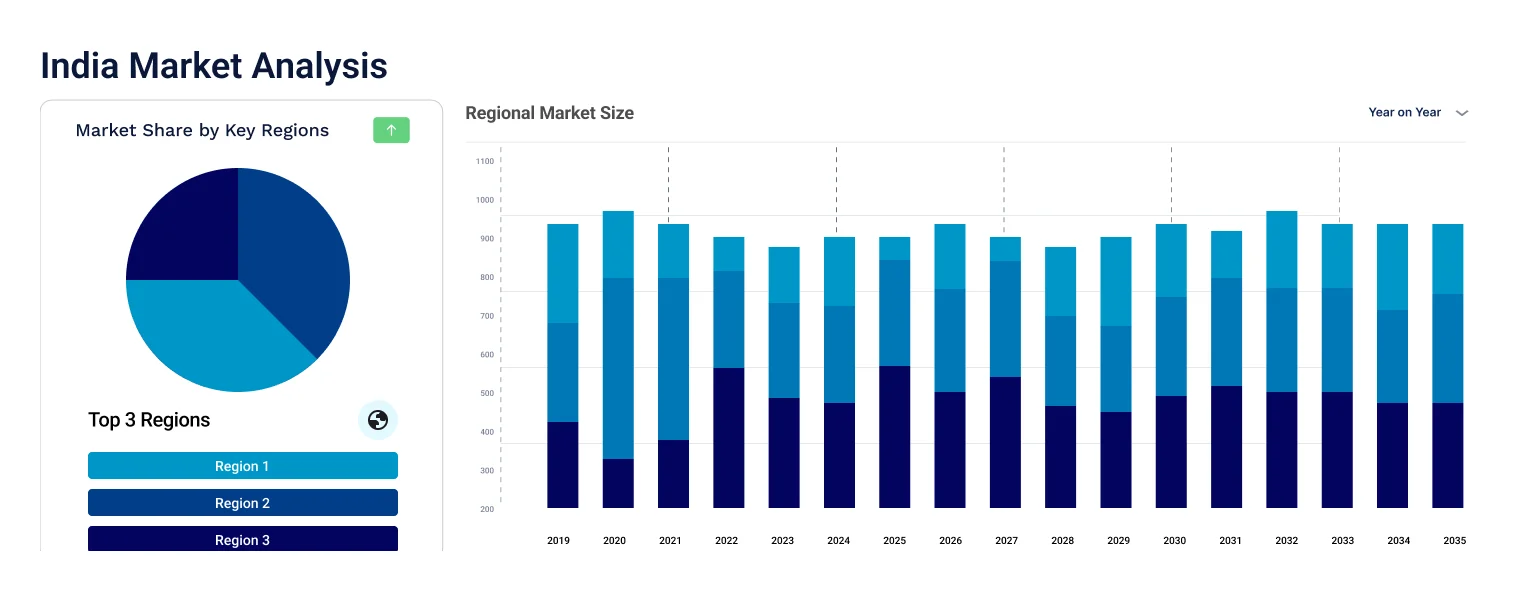
West India secures the leading position in the market with Rajasthan-Gujarat solar parks
West India boasts significant solar PV capacity due to Rajasthan and Gujarat, high solar irradiance, abundant land, and proactive policies supporting large solar parks. Major utility-scale projects like ReNew and Adani Green’s installations enhance the region’s dominance. Well-developed grid infrastructure, robust private investment, and favorable permitting processes accelerate deployment. Industrial clusters, government-backed auctions, and favorable land acquisition policies strengthen the region’s position.
Growth of the South India solar photovoltaic (PV) market is driven by Tamil Nadu, Karnataka, and Telangana. Industrial demand, urbanization, and supportive policies accelerate rooftop and utility-scale adoption. Strong grid infrastructure, state incentives, and favorable solar irradiation levels enhance expansion. Rooftop adoption in urban centers and industrial parks is rising, while hybrid and storage-integrated systems complement growth. South India represents a dynamic hub for renewable innovation and private investment, fueling market diversification.
Leading India solar photovoltaic (PV) companies are focusing on high-efficiency modules, bifacial panels, and rooftop solutions to address diverse consumer and industrial needs. Strategic partnerships with global EPC firms enable technology transfer, capacity expansion, and faster project execution. Government policies, tax incentives, and renewable procurement mandates provide a favorable investment environment, lowering entry barriers for new firms.
India solar photovoltaic (PV) market players are increasingly investing in R&D for advanced TOPCon and HJT modules, integrating storage solutions, and developing hybrid systems. Competitive differentiation also comes through supply chain optimization, local manufacturing, and modular solutions for urban and industrial rooftops. Private investment and ESG-driven corporate adoption create additional opportunities for scaling projects. These strategies position companies to capitalize on India’s ambitious renewable energy goals, high solar potential, and the accelerating pace of utility-scale and rooftop deployment.
Established in 1989 and headquartered in Uttar Pradesh, India Tata Power Solar is a leading manufacturer and EPC solutions provider in India. The company offers high-efficiency solar modules, rooftop solutions, and utility-scale installations, catering to residential, commercial, and industrial clients. It emphasizes technological innovation through bifacial and high-density modules, energy storage integration, and smart monitoring systems.
Founded in 2005 and based in Kolkata, Vikram Solar specializes in high-efficiency photovoltaic modules and turnkey EPC solutions. The company integrates advanced monocrystalline PERC modules and bifacial designs to enhance output and reliability. It serves utility-scale developers, rooftop clients, and government solar programs, including solar parks and rooftop subsidy schemes.
Established in 1989 with headquarters in India, WAAREE Energies is one of India’s largest solar module manufacturers and EPC service providers. The company produces high-capacity bifacial, monocrystalline, and polycrystalline modules and actively promotes utility-scale and rooftop solar adoption. WAAREE focuses on innovations like half-cut cell technology and integrated solar-plus-storage solutions.
Founded in 1992 and headquartered in Karnataka, EMMVEE PV manufactures advanced solar modules and turnkey solutions for domestic and international markets. The company specializes in monocrystalline and polycrystalline modules, emphasizing high efficiency, durability, and performance in diverse climatic conditions.
*Please note that this is only a partial list; the complete list of key players is available in the full report. Additionally, the list of key players can be customized to better suit your needs.*
Other key players in the market are Loom Solar Pvt Ltd, Websol Energy Systems Limited, Adani Group, Saatvik Group, and Jakson Group, among others.
Explore the latest trends shaping the India solar photovoltaic (PV) market 2026-2035 with our in-depth report. Gain strategic insights, future forecasts, and key market developments that can help you stay competitive. Download a free sample report or contact our team for customized consultation on India solar photovoltaic (PV) market trends 2026.
Saudi Arabia Solar Photovoltaic (PV) Market
Chile Solar Photovoltaics Market
Solar Photovoltaic (PV) Market


Upto 15% Off
USD
$2499 $2249
$3999 $3599
$4999 $4249
$5999 $5099


*While we strive to always give you current and accurate information, the numbers depicted on the website are indicative and may differ from the actual numbers in the main report. At Expert Market Research, we aim to bring you the latest insights and trends in the market. Using our analyses and forecasts, stakeholders can understand the market dynamics, navigate challenges, and capitalize on opportunities to make data-driven strategic decisions.*
In 2025, the India solar photovoltaic (PV) market reached an approximate volume of 20.48 Gigawatt.
The market is projected to grow at a CAGR of 13.10% between 2026 and 2035.
The India solar photovoltaic (PV) market is expected to reach 70.14 Gigawatt in 2035.
Stakeholders are expanding rooftop initiatives, deploying hybrid storage solutions, leveraging government incentives, integrating smart monitoring technologies, and forming strategic partnerships to accelerate solar adoption and optimize return on investment.
The solar photovoltaic (PV) market is categorised according to its product type, which includes ground-mounted and rooftop.
The key players in the market include Tata Power Solar Systems Limited, Vikram Solar Pvt Ltd, WAAREE Energies Ltd., EMMVEE Photovoltaic Power Private Limited, Loom Solar Pvt Ltd, Websol Energy Systems Limited, Adani Group, Saatvik Group, and Jakson Group, among others.
Based on the technology, the market is divided into monocrystalline silicon, thin film, polycrystalline silicon, and others.
The major market areas include East India, West India, South India and North India.
High upfront project costs, fluctuating module prices, land acquisition hurdles, regulatory complexities, and grid integration challenges hinder efficient deployment, scaling, and cost-effective execution of solar PV projects across the nation.
Explore our key highlights of the report and gain a concise overview of key findings, trends, and actionable insights that will empower your strategic decisions.
| REPORT FEATURES | DETAILS |
| Base Year | 2025 |
| Historical Period | 2019-2025 |
| Forecast Period | 2026-2035 |
| Scope of the Report |
Historical and Forecast Trends, Industry Drivers and Constraints, Historical and Forecast Market Analysis by Segment:
|
| Breakup by Product Type |
|
| Breakup by Technology |
|
| Breakup by Region |
|
| Market Dynamics |
|
| Competitive Landscape |
|
| Companies Covered |
|
Datasheet
One User
USD 2,499
USD 2,249
tax inclusive*
Single User License
One User
USD 3,999
USD 3,599
tax inclusive*
Five User License
Five User
USD 4,999
USD 4,249
tax inclusive*
Corporate License
Unlimited Users
USD 5,999
USD 5,099
tax inclusive*
*Please note that the prices mentioned below are starting prices for each bundle type. Kindly contact our team for further details.*
Flash Bundle
Small Business Bundle
Growth Bundle
Enterprise Bundle
*Please note that the prices mentioned below are starting prices for each bundle type. Kindly contact our team for further details.*
Flash Bundle
Number of Reports: 3
20%
tax inclusive*
Small Business Bundle
Number of Reports: 5
25%
tax inclusive*
Growth Bundle
Number of Reports: 8
30%
tax inclusive*
Enterprise Bundle
Number of Reports: 10
35%
tax inclusive*
How To Order

Select License Type
Choose the right license for your needs and access rights.

Click on ‘Buy Now’
Add the report to your cart with one click and proceed to register.

Select Mode of Payment
Choose a payment option for a secure checkout. You will be redirected accordingly.
Strategic Solutions for Informed Decision-Making
Gain insights to stay ahead and seize opportunities.

Get insights & trends for a competitive edge.

Track prices with detailed trend reports.

Analyse trade data for supply chain insights.

Leverage cost reports for smart savings

Enhance supply chain with partnerships.

Connect For More Information
Our expert team of analysts will offer full support and resolve any queries regarding the report, before and after the purchase.
Our expert team of analysts will offer full support and resolve any queries regarding the report, before and after the purchase.
We employ meticulous research methods, blending advanced analytics and expert insights to deliver accurate, actionable industry intelligence, staying ahead of competitors.
Our skilled analysts offer unparalleled competitive advantage with detailed insights on current and emerging markets, ensuring your strategic edge.
We offer an in-depth yet simplified presentation of industry insights and analysis to meet your specific requirements effectively.




