

Consumer Insights
Uncover trends and behaviors shaping consumer choices today
Procurement Insights
Optimize your sourcing strategy with key market data
Industry Stats
Stay ahead with the latest trends and market analysis.
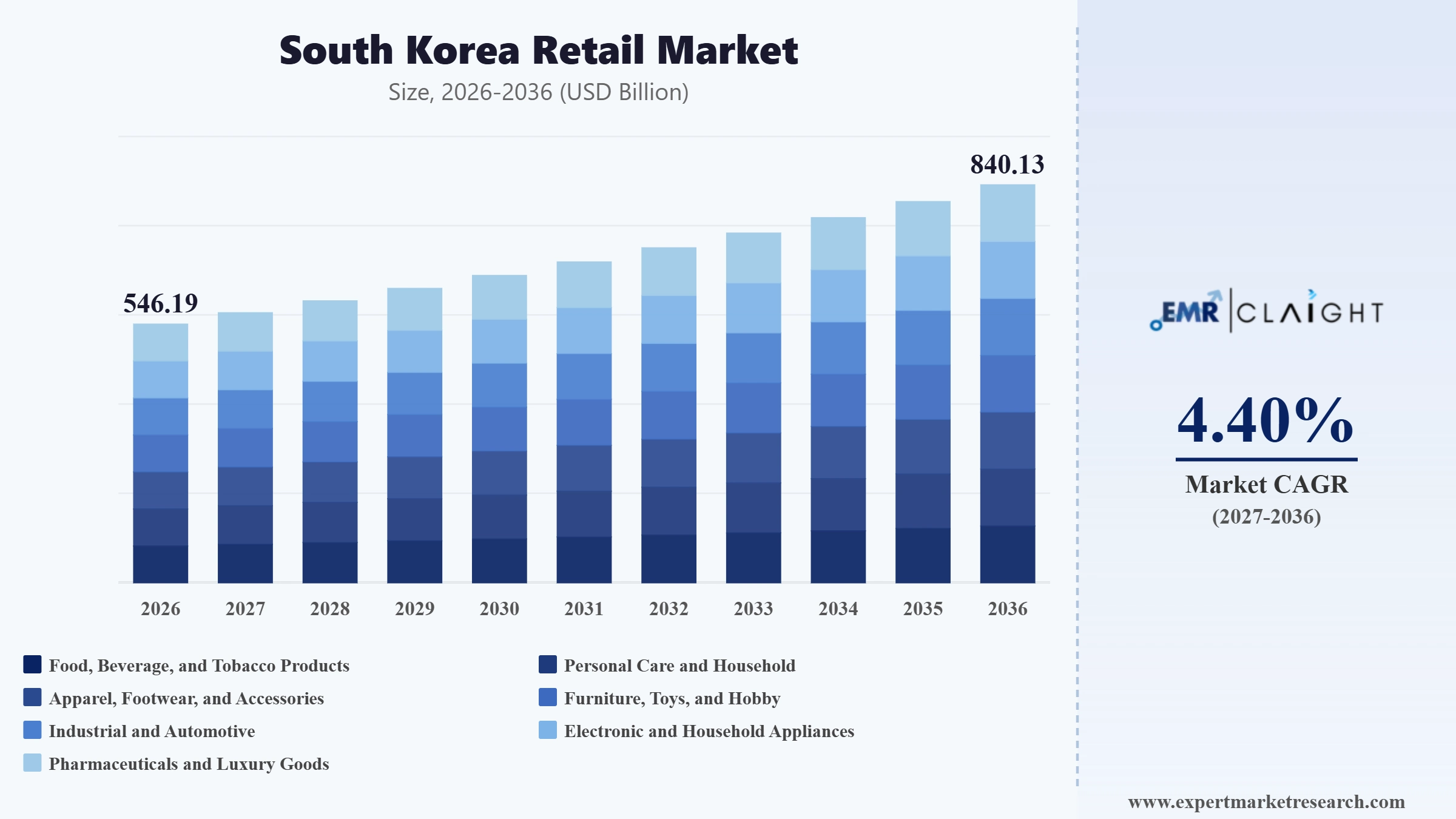
The South Korea retail market was valued at USD 523.17 Billion in 2025 and is projected to grow at a CAGR of 4.40% through 2026 and 2035, reaching USD 804.73 Billion by 2035. Rapid expansion of online distribution channels, growth of the food and beverage sector, and rising consumer preference for convenient shopping solutions are driving overall growth in the South Korea retail market, with e-commerce platforms and convenience store chains reshaping how consumers access everyday goods.
The South Korea retail market encompasses food and beverage, personal care, apparel, furniture, industrial, electronics, and pharmaceutical product categories sold through hypermarkets, convenience stores, speciality stores, and online platforms. Demand continues to be shaped by high smartphone penetration, a mature e-commerce infrastructure, and rising cross border competition, with the food, beverage, and tobacco category accounting for the largest product share given sustained daily consumer spending across the market.
These companies are increasingly forming joint ventures with global e-commerce platforms to strengthen online distribution capabilities, reflecting intensifying competition from Chinese cross border marketplaces entering the domestic market. In April 2026, Amorepacific reopened its AMORE YONGSAN flagship store at its Seoul headquarters, incorporating an in-store Beauty Lab where customers participate directly in product testing and sensory research alongside longevity focused wellness programming.
Established South Korea retail companies are increasingly directing growth capital toward artificial intelligence infrastructure and digital operations rather than concentrating solely on physical store networks, reflecting a strategic shift toward technology driven efficiency as domestic population growth slows. Companies are pursuing parallel investment across synthetic consumer research, automated fulfilment, and personalised shopping platforms, while strengthening in house research and development to compete against rising international competitors. In July 2026, BGF Retail's CU signed a partnership with startup Intellisia to generate synthetic consumer profiles for new product planning, compressing research timelines from months to days.
Read more about this report - REQUEST FREE SAMPLE COPY IN PDF
Amorepacific partnered with telecommunications provider KT to launch a joint artificial intelligence platform aimed at accelerating cosmetics research and development, combining beauty formulation expertise with large scale data infrastructure across markets. Companies across the South Korea retail market can leverage cross industry AI partnerships to shorten product development cycles and strengthen competitive positioning in premium beauty categories and markets across the wider industry and sector.
7-Eleven opened New Wave flagship stores in Busan and Gwangju, combining diverse product offerings spanning food, fashion, and beauty with modern design reflecting regional character for residents across markets and regions. Companies across the South Korea retail market can leverage regional flagship formats to create differentiated spatial consumption experiences that strengthen brand identity beyond standard convenience store layouts and formats nationwide and internationally.
7-Eleven unveiled AI powered inventory tracking and expiration management technology at its annual product exhibition, having tested the system across 1,700 stores and recorded a 7 percent sales increase ahead of rollout and expansion nationally. Companies across the South Korea retail market can leverage AI driven inventory systems to reduce waste and improve sales performance across large, geographically distributed convenience store networks and franchise operations worldwide.
Shinsegae Group and Alibaba Group formed a joint venture combining Shinsegae's local retail brand power and logistics network with Alibaba's international e-commerce technology and marketplace reach across formats and regions. Companies can leverage cross border joint ventures to counter rising competition from Chinese platforms while accessing new technology capabilities and infrastructure across the wider sector and industry.
Established department store operators across the South Korea retail market are increasingly opening large format luxury fashion halls in secondary metropolitan hubs, rather than concentrating flagship investment solely in central Seoul, to capture affluent suburban and regional shoppers. This is helping department stores extend their premium brand reach into fast growing metropolitan areas beyond the capital. In December 2025, Lotte Department Store opened its Incheon location's luxury fashion hall spanning 9,250 square metres and featuring 59 brands, the largest such facility in the region.
Established department store operators across the South Korea retail market are increasingly repositioning as global content platforms curating homegrown fashion and beauty labels, rather than pursuing costly overseas real estate expansion, to introduce Korean brands to new markets. This is helping retailers export brand discovery capabilities without the capital intensity of physical store rollouts. In October 2025, Hyundai Department Store opened a pop-up store in Shin Kong Mitsukoshi, Taipei, part of its The Hyundai Global platform promoting emerging Korean fashion companies internationally and beyond.
Established retail chains across the South Korea retail market are increasingly securing new warehouse club sites to expand membership-based retail formats beyond existing metropolitan markets, rather than relying solely on urban department store growth, as consumer demand for bulk value shopping continues rising. This is helping chains build new footholds across regional cities historically underserved by warehouse retail. In June 2025, Costco confirmed its twentieth South Korean location at a new site in Iksan, extending its warehouse club network into the Jeolla region.
Established e-commerce platforms across the South Korea retail market are increasingly deepening partnerships with international brands to expand cross border direct import catalogues, rather than relying on broad marketplace listings alone, to capture demand that might otherwise go to global platforms. This is helping domestic platforms retain customers seeking authentic, small and midsize international brands. In August 2026, Coupang announced its Rocket Direct Import service had surpassed 600 new global brands for the year, including 200-year-old American salt producer J.Q. Dickinson Saltworks.
Established convenience store chains are increasingly pursuing overseas franchise expansion into Southeast Asian markets, rather than concentrating solely on domestic store density, as international demand for Korean convenience retail formats grows. This is helping chains build new growth channels beyond an increasingly saturated domestic convenience store landscape and industry. In June 2025, E-Mart24 reported its Malaysian operation had surpassed 100 stores across 11 states, targeting 115 outlets by year end and 200 stores by 2026.
The Expert Market Research's report titled “South Korea Retail Market Report and Forecast 2026-2035” offers a detailed analysis of the market based on the following segments:
Market Breakup by Product Type
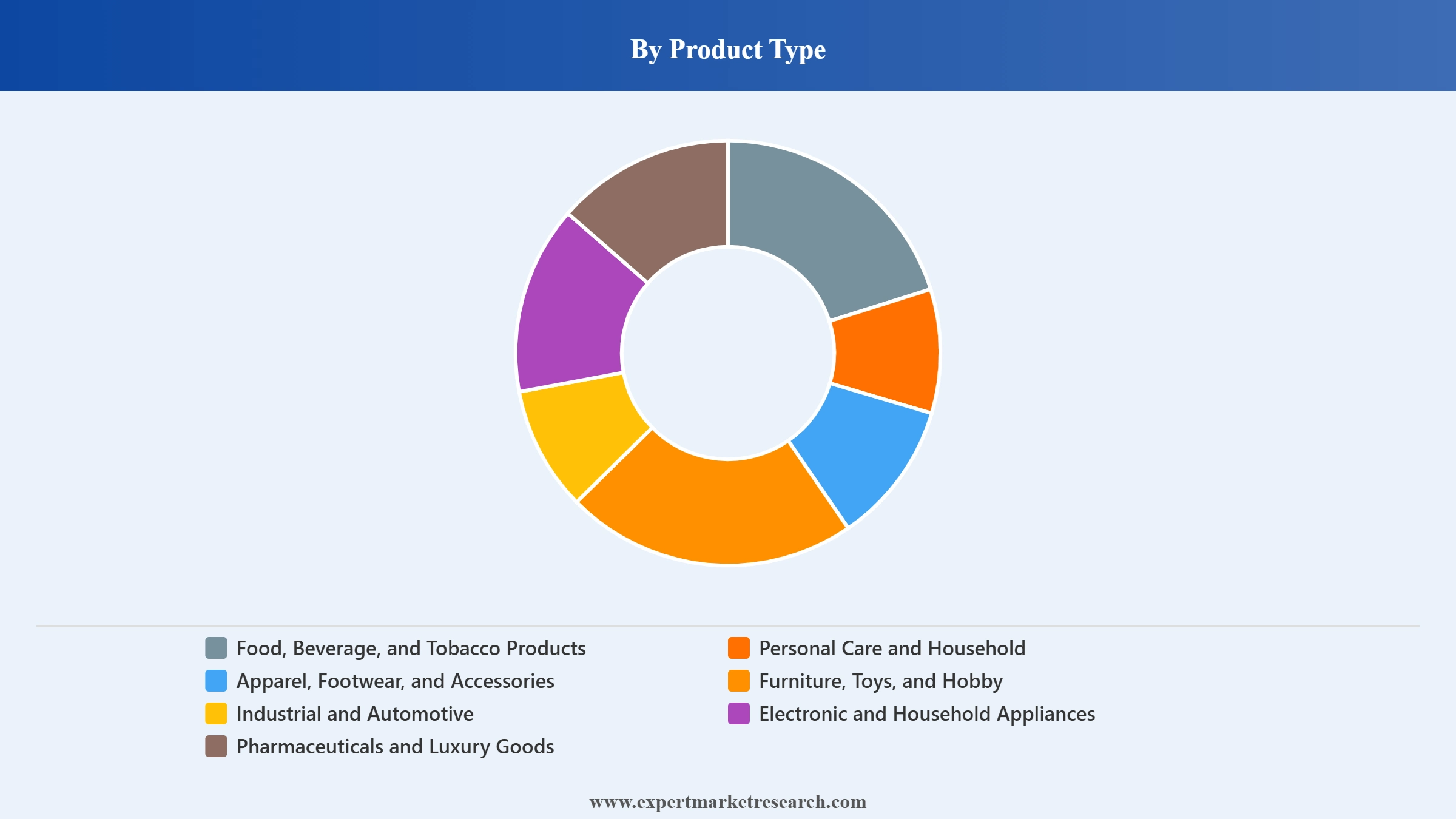
Key Insight: Food, Beverage, and Tobacco Products: This category holds the largest product share in the South Korea retail market, supported by sustained daily consumer spending across hypermarkets and convenience stores. Personal Care and Household: Rising demand for premium skincare and household goods continues to expand this category's footprint. Apparel, Footwear, and Accessories: Fashion retail benefits from department store renovation and content platform strategies targeting younger consumers. Furniture, Toys, and Hobby: This category is growing quickly as home focused leisure spending rises among urban households. Industrial and Automotive: Automotive parts and industrial goods serve a smaller but stable specialty retail segment. Electronic and Household Appliances: Consumer electronics remain a significant category, illustrated by LG Electronics unveiling its largest ever premium built-in appliance lineup at Milan Design Week in April 2026. Pharmaceuticals and Luxury Goods: Luxury retail continues to expand through flagship department store fashion halls. Others: Remaining categories contribute smaller shares across specialised retail formats.
Market Breakup by Distribution Channel
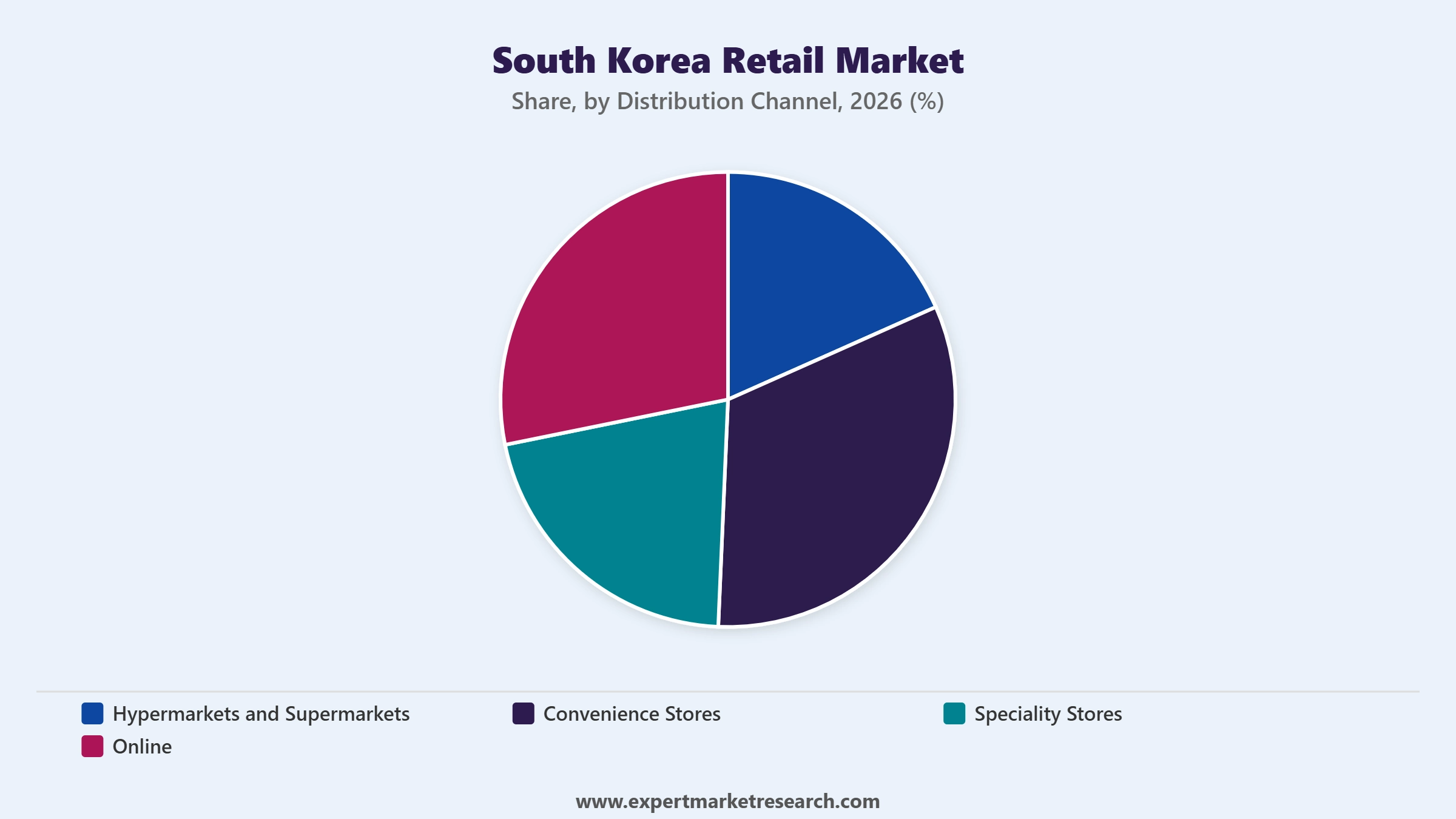
Key Insight: Hypermarkets and Supermarkets: This channel retains a significant share through broad product assortments and established store networks. Convenience Stores: South Korea's convenience store density remains among the highest globally, with chains continuing to refine premium and gourmet offerings. Speciality Stores: Speciality retail continues to serve niche categories including beauty and electronics. Online: Online is growing quickly as e-commerce platforms expand cross border shipping and AI powered personalisation features, illustrated by Coupang's July 2025 launch of Coupang Intelligent Cloud, an AI ecosystem accelerating fulfilment centre scheduling and delivery route optimisation. Others: Remaining distribution formats contribute smaller shares across the South Korea retail market.
Read more about this report - REQUEST FREE SAMPLE COPY IN PDF
By product type, food, beverage, and tobacco products dominates the market through sustained daily consumer spending
Food, beverage, and tobacco products account for the largest product type share of the South Korea retail market, supported by sustained daily consumer spending across hypermarkets, supermarkets, and convenience stores across regions, formats, and channels. In August 2026, E-Mart announced plans to expand its quick commerce delivery service from 110 stores to its entire nationwide network, alongside a new hypermarket opening planned for the Chungcheong region and surrounding areas nationally, regionally, provincially, and beyond across the country.
Read more about this report - REQUEST FREE SAMPLE COPY IN PDF
Pharmaceuticals and luxury goods are growing quickly as department store operators across the South Korea retail market expand flagship fashion and luxury halls to capture affluent shoppers beyond central Seoul and its surrounding districts steadily, and consistently. In September 2026, Lotte Shopping approved its first overhaul of the Jamsil department store in 38 years, with phased renovation of premium dining, luxury, and fashion floors aimed at overtaking Shinsegae's Gangnam store as the country's top selling location and premier flagship shopping destination overall across the industry.
By distribution channel, hypermarkets and supermarkets dominate the market through broad product assortments and store networks
Hypermarkets and supermarkets account for the largest distribution channel share of the South Korea retail market, offering broad product assortments across food, household, and personal care categories through established store networks and formats nationally and beyond across formats, channels, and regions. In February 2025, Costco Korea announced its first membership fee increase in eight years, raising Gold Star membership by 11.7 percent as the warehouse retailer expanded its store count to twenty locations across all regions.
Read more about this report - REQUEST FREE SAMPLE COPY IN PDF
Online is growing quickly as e-commerce platforms expand cross border shipping and artificial intelligence powered personalisation features to compete against rising Chinese marketplace entrants across formats, platforms, and channels. In March 2026, Naver Plus Store's monthly active users reached a record 7.77 million following the February introduction of its AI Shopping Agent, with user satisfaction surpassing rival Coupang for the first time across the domestic shopping app market and broader industry landscape in scope.
The South Korea retail companies are becoming increasingly competitive as major South Korea retail companies invest in AI powered personalisation, cross border e-commerce partnerships, and premium beauty portfolios to differentiate their offerings across product categories. Companies are prioritising logistics automation, super app integration, and overseas brand expansion to appeal to increasingly digital, cross border shopping consumers. Established South Korea retail companies are also deepening loyalty programme integration, warehouse club footprints, and flagship store renovation to strengthen customer retention, while investing in quick commerce and automated fulfilment technology to defend market share against rising international competitors.
Major South Korea retail market players are also focusing on department store renovation and joint ventures with global technology platforms to capture growing demand across online and premium retail categories. Strategic emphasis on convenience store overseas franchising and dermatology focused beauty brands is allowing established companies to capture market share as domestic population growth slows and international competition intensifies. The retail market players continue to pursue partnerships with global logistics and beauty technology providers, particularly across Asia Pacific, Europe, and North America, to diversify revenue beyond the domestic market while smaller specialty chains compete on store experience and product curation to retain younger, digitally native shoppers.
Founded in 2010 and headquartered in Seoul, South Korea, Coupang is a leading name in the market, operating an extensive logistics network of more than 100 fulfilment centres supporting its Rocket Delivery same day and overnight shipping service. The company's Rocket WOW membership programme has exceeded 14 million subscribers, and Coupang continues to expand internationally, with Taiwan emerging as a key new growth market.
Founded in 1967 and headquartered in Seoul, South Korea, Lotte Corporation is a diversified conglomerate and major presence in the market, whose retail division, Lotte Shopping, operates department stores, hypermarkets, and electronics retail chains including Lotte Hi-Mart. The group's retail operations span domestic department stores, supermarkets, and home shopping channels, with international operations previously extending across Russia, Indonesia, and Vietnam.
Founded in 1971 and headquartered in Seoul, South Korea, Hyundai Department Store Group is a retail conglomerate within the market, operating department stores, duty free outlets, and home shopping channels across the country. The group's portfolio spans retail, fashion, healthcare, and lifestyle businesses through subsidiaries including Hyundai Livart, Hyundai Green Food, and Hyundai L&C.
Founded in 1945 and headquartered in Seoul, South Korea, Amorepacific is a leading beauty and personal care company in the market, whose portfolio includes Sulwhasoo, LANEIGE, Innisfree, and Etude House. The company operates research centres across Korea, France, Japan, and China, and has expanded flagship brands including HERA and Mamonde into North American and European markets through cross border retail channels.
Other key players in the market include LG Electronics, Inc., Shinsegae I&C Inc., BGF Group, 7-Eleven, Inc., EMART Inc., and Costco Korea Co., Ltd., among others.
*Please note that this is only a partial list; the complete list of key players is available in the full report. Additionally, the list of key players can be customized to better suit your needs.*
Unlock the latest insights with our South Korea retail market trends 2026 report. Discover regional growth patterns, product type and distribution channel economics, and key industry players. Stay ahead of competition with trusted data and expert analysis. Download your free sample report today and drive informed decisions in the market.


Upto 15% Off
USD
$2499 $2249
$3999 $3599
$4999 $4249
$5999 $5099


*While we strive to always give you current and accurate information, the numbers depicted on the website are indicative and may differ from the actual numbers in the main report. At Expert Market Research, we aim to bring you the latest insights and trends in the market. Using our analyses and forecasts, stakeholders can understand the market dynamics, navigate challenges, and capitalize on opportunities to make data-driven strategic decisions.*
In 2025, the market reached an approximate value of USD 523.17 Billion.
The market is projected to grow at a CAGR of 4.40% between 2026 and 2035.
The market is estimated to witness a healthy growth in the forecast period of 2026-2035 to reach a value of around USD 804.73 Billion by 2035.
The market is being driven by the rapid expansion of online distribution channels and the growth of the food and beverage sector.
The key trends aiding the market expansion include the rapid technological advancements, innovative marketing strategies adopted by retailers, and improvements in e-commerce platforms.
The major product types include food, beverage, and tobacco products; personal care and household; apparel, footwear, and accessories; furniture, toys, and hobby; industrial and automotive; electronic and household appliances; and pharmaceuticals and luxury goods, among others.
The distribution channels include hypermarkets and supermarkets, convenience stores, speciality stores, and online, among others.
The key players in the market include Coupang Co., Ltd., Lotte Corporation, LG Electronics, Inc., Hyundai Department Store Group. Co., Ltd., Shinsegae I&C Inc., BGF Group, 7-Eleven, Inc., EMART Inc., Costco Korea Co., Ltd., and Amorepacific Corporation, among others.
The Seoul Capital Area dominates the market, supported by its concentration of retail headquarters and consumer spending power.
Food, beverage, and tobacco products hold the largest product type share, supported by sustained daily consumer spending.
Explore our key highlights of the report and gain a concise overview of key findings, trends, and actionable insights that will empower your strategic decisions.
| REPORT FEATURES | DETAILS |
| Base Year | 2025 |
| Historical Period | 2019-2025 |
| Forecast Period | 2026-2035 |
| Scope of the Report |
Historical and Forecast Trends, Industry Drivers and Constraints, Historical and Forecast Market Analysis by Segment:
|
| Breakup by Product Type |
|
| Breakup by Distribution Channel |
|
| Market Dynamics |
|
| Competitive Landscape |
|
| Companies Covered |
|
Datasheet
One User
USD 2,499
USD 2,249
tax inclusive*
Single User License
One User
USD 3,999
USD 3,599
tax inclusive*
Five User License
Five User
USD 4,999
USD 4,249
tax inclusive*
Corporate License
Unlimited Users
USD 5,999
USD 5,099
tax inclusive*
*Please note that the prices mentioned below are starting prices for each bundle type. Kindly contact our team for further details.*
Flash Bundle
Small Business Bundle
Growth Bundle
Enterprise Bundle
*Please note that the prices mentioned below are starting prices for each bundle type. Kindly contact our team for further details.*
Flash Bundle
Number of Reports: 3
20%
tax inclusive*
Small Business Bundle
Number of Reports: 5
25%
tax inclusive*
Growth Bundle
Number of Reports: 8
30%
tax inclusive*
Enterprise Bundle
Number of Reports: 10
35%
tax inclusive*
How To Order

Select License Type
Choose the right license for your needs and access rights.

Click on ‘Buy Now’
Add the report to your cart with one click and proceed to register.

Select Mode of Payment
Choose a payment option for a secure checkout. You will be redirected accordingly.
Strategic Solutions for Informed Decision-Making
Gain insights to stay ahead and seize opportunities.

Get insights & trends for a competitive edge.

Track prices with detailed trend reports.

Analyse trade data for supply chain insights.

Leverage cost reports for smart savings

Enhance supply chain with partnerships.

Connect For More Information
Our expert team of analysts will offer full support and resolve any queries regarding the report, before and after the purchase.
Our expert team of analysts will offer full support and resolve any queries regarding the report, before and after the purchase.
We employ meticulous research methods, blending advanced analytics and expert insights to deliver accurate, actionable industry intelligence, staying ahead of competitors.
Our skilled analysts offer unparalleled competitive advantage with detailed insights on current and emerging markets, ensuring your strategic edge.
We offer an in-depth yet simplified presentation of industry insights and analysis to meet your specific requirements effectively.




