

Consumer Insights
Uncover trends and behaviors shaping consumer choices today
Procurement Insights
Optimize your sourcing strategy with key market data
Industry Stats
Stay ahead with the latest trends and market analysis.
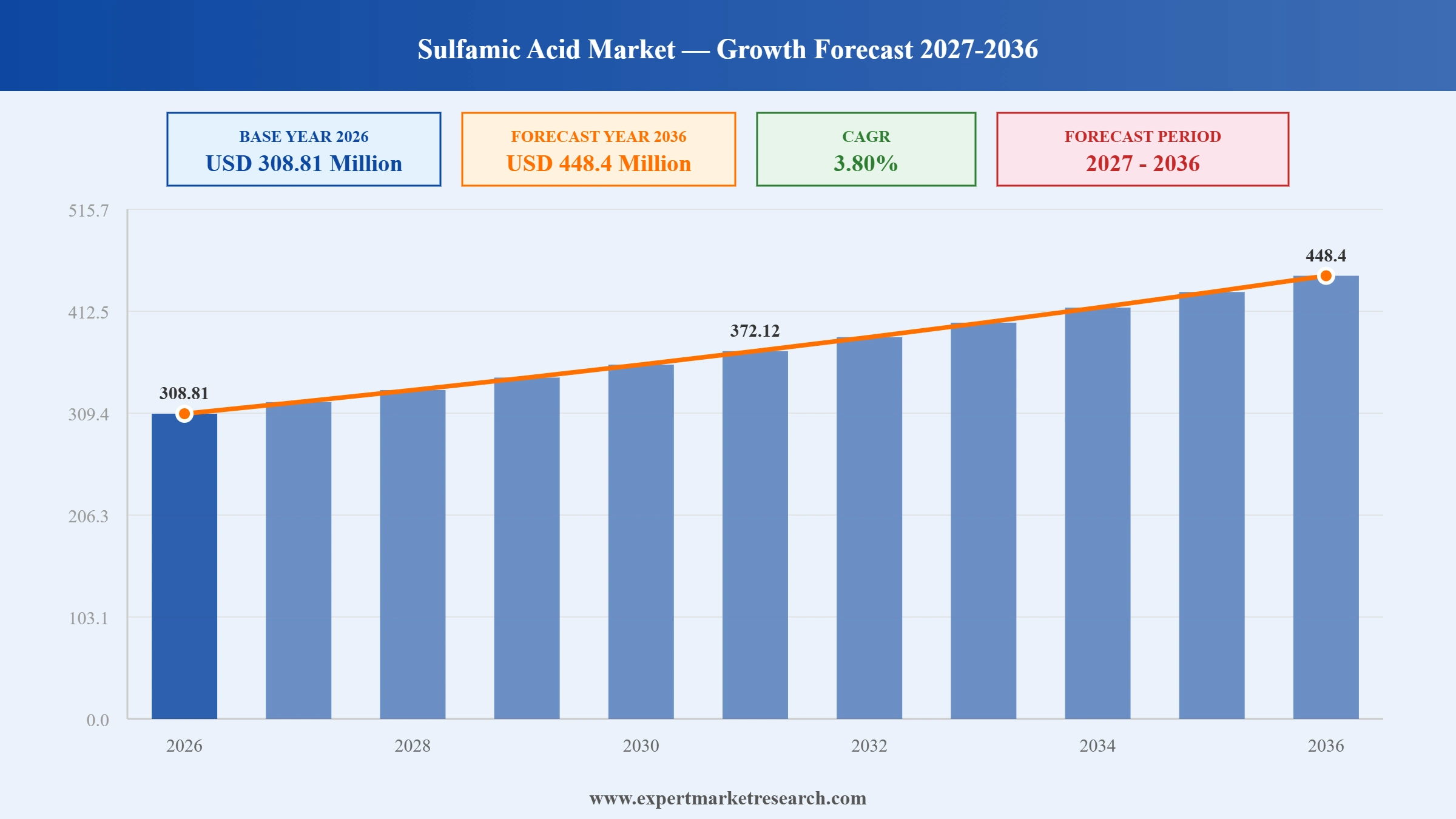
The sulfamic acid market was valued at USD 297.50 Million in 2025. The market is projected to grow at a CAGR of 3.80% during the forecast period of 2026-2035 to reach a value of USD 431.98 Million by 2035. Tightening chemical safety regulation, steady demand from descaling and metal finishing applications, and expanding high purity grade production for pharmaceutical and food processing customers are collectively driving the market growth.
The current sulfamic acid market landscape reflects steady demand from descaling, metal finishing, and paper bleaching applications, with facility operators favouring the compound over harsher mineral acids for its lower corrosivity and reduced fuming during handling. In November 2025, Nippon Chemical Industrial signed a basic agreement with TDK Corporation to establish a joint venture developing electronic component materials, illustrating how diversified Japanese chemical producers are broadening beyond legacy acid and inorganic chemical lines into higher value specialty segments. Regulatory bodies across major producing regions continue to tighten chemical safety and registration requirements, prompting manufacturers to invest in more detailed compliance documentation than was previously standard for bulk industrial acid products.
Manufacturers are also adjusting commercial strategies as textile processing and dye manufacturing activity expands across South and Southeast Asia, prompting several Asian producers to add dedicated sulfamic acid capacity alongside existing sulfuric acid and chlor-alkali operations. In March 2026, DyStar achieved ISO 14001 environmental management accreditation at its Gabus production facility, reflecting how textile dye manufacturers serving Asian markets are prioritising sustainability credentials alongside capacity investment. Companies including Nissan Chemical Corporation continue to list sulfamic acid within their basic chemicals’ portfolio alongside sulfuric acid and ammonia derivatives, reflecting the compound's role as a byproduct-adjacent specialty chemical rather than a standalone product line for most large, diversified producers.
Read more about this report - REQUEST FREE SAMPLE COPY IN PDF
|
Sulfamic Acid Market Report Summary |
Description |
Value |
|
Base Year |
USD Million |
2025 |
|
Historical Period |
USD Million |
2019-2025 |
|
Forecast Period |
USD Million |
2026-2035 |
|
Market Size 2025 |
USD Million |
297.50 |
|
Market Size 2035 |
USD Million |
431.98 |
|
CAGR 2019-2025 |
Percentage |
XX% |
|
CAGR 2026-2035 |
Percentage |
3.80% |
|
CAGR 2026-2035 |
Asia Pacific |
4.4% |
|
CAGR 2026-2035 |
Liquid |
4.3% |
|
CAGR 2026-2035 |
Water Treatment |
4.6% |
|
2025 Market Share by Region |
Asia Pacific |
38.5% |
The sulfamic acid market continues to be shaped by regulatory transitions affecting chemical compliance documentation, steady expansion of descaling and metal finishing applications, and producers broadening into higher purity grades for pharmaceutical and food processing customers. These structural shifts are pushing established chemical manufacturers to reassess product positioning across both bulk industrial and specialty end uses.
BASF inaugurated a fully modernized plant for acid chlorides and chloroformates at its Ludwigshafen Verbund site, expanding its Intermediates division capacity and reinforcing the specialty acid chemistry platform from which its sulfamic acid offerings are produced today. Companies across the sulfamic acid market operating adjacent acid lines can treat this as a model for pairing capacity growth with sustainability commitments across their broader manufacturing operations.
Hydrite Chemical Co. announced plans to expand its operations in Laurens, South Carolina, with the purchase of a 43-acre property to be developed into a new facility supporting its integrated chemicals and related services business across the region. Regional distributors across the sulfamic acid market can treat this expansion as a signal that domestic capacity investment remains active amid broader industry cost pressure today.
The European Chemicals Agency began migrating sulfamic acid REACH registration and Classification and Labelling records to its new ECHA CHEM database, requiring manufacturers and formulators supplying the European Union market to track the transition for ongoing filings ahead of schedule. Producers with multiple registered substances can treat this as a prompt to audit compliance documentation across their full product portfolio.
Mitsubishi Gas Chemical signed an agreement with Transition Industries for the purchase and sale of ultra-low carbon methanol, extending the company's specialty and green chemicals platform that also supplies sulfamic acid customers directly across multiple regions overall. Diversified chemical producers across the sulfamic acid market can treat this agreement as a template for securing lower carbon feedstock commitments ahead of tightening emissions requirements overall.
Sulfamic acid manufacturers across the sulfamic acid market are increasingly qualifying high purity, pharmaceutical and food contact grade material alongside standard industrial grades, reflecting tighter impurity tolerances demanded by regulated end customers compared with bulk descaling and cleaning applications today. In April 2025, Tosoh Corporation formed a collaboration with Keio University aimed at accelerating commercialisation of novel high purity photonics polymers, reflecting how diversified acid and specialty chemical producers are widening research partnerships to support higher margin, tightly specified material grades beyond bulk industrial output.
Regulatory bodies across major producing and consuming regions are periodically revising hazardous chemical inventory and reporting requirements, adding administrative burden for manufacturers and distributors handling industrial acids including sulfamic acid across multiple overlapping jurisdictions and regulatory frameworks worldwide. In November 2025, the United States Environmental Protection Agency amended its hazardous chemical inventory reporting requirements to align with OSHA hazard communication updates, requiring suppliers to review and update safety data documentation across their entire industrial acid product lines nationwide without delay.
Regional chemical producers across the sulfamic acid market are increasingly diversifying distribution channels to reach smaller industrial cleaning and maintenance customers that larger bulk suppliers often overlook in their core account strategies overall. In December 2025, Brenntag signed an agreement to acquire the Airedale Group, a UK based chemical distributor, adding blending, formulation, and dilution capabilities that extend its distribution network deeper into smaller specialty accounts across the United Kingdom, illustrating how distributors are consolidating value added services to serve fragmented industrial demand more efficiently.
Water treatment and industrial maintenance operators across the sulfamic acid market are increasingly specifying sulfamic acid over hydrochloric acid for boiler and cooling tower descaling because of its lower fuming and reduced equipment corrosion during routine maintenance cycles across most large industrial facilities. In March 2026, Donau Chemie published an analysis of used activated carbon recycling covering safety and transparency in its water treatment operations, illustrating how specialty acid and water treatment chemical producers keep investing in cleaner processing methods across Central and Eastern Europe.
Chemical manufacturers and distributors across the sulfamic acid market are increasingly investing in dedicated regulatory affairs capacity to manage overlapping compliance regimes across multiple jurisdictions where sulfamic acid is registered, manufactured, and sold to customers worldwide. In June 2026, the European Chemicals Agency published its five-year REACH and CLP Regulations Operation Report, concluding that data quality and enforcement coordination remain ongoing challenges, a finding that is pushing suppliers to maintain more detailed, audit ready documentation trails than older paper-based filing systems previously required.
The Expert Market Research's report titled “Sulfamic Acid Market Report and Forecast 2026-2035” offers a detailed analysis of the market based on the following segments:
Market Breakup by Form
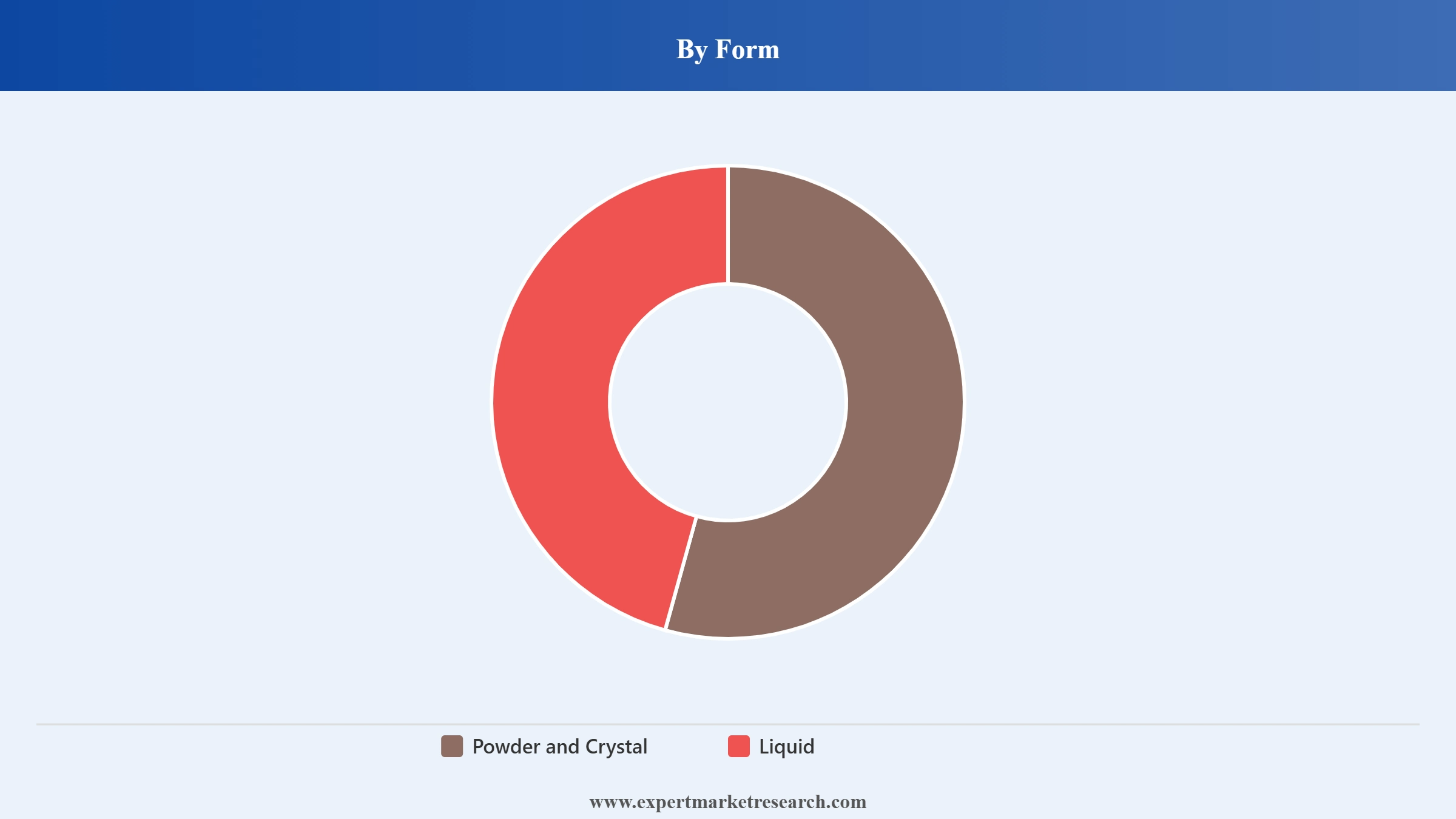
Key Insight: Powder and Crystal accounts for the largest share of the sulfamic acid market by form, reflecting the compound's stability, ease of handling, and extended shelf life relative to liquid concentrates, which makes it the preferred choice for bulk industrial cleaning, descaling, and metal finishing operations where storage duration and transport cost matter. Liquid formulations are gaining traction in water treatment and specialty cleaning applications where operators prefer pre-dissolved, ready to use solutions that reduce on-site handling of solid acid. The Others category includes blended and stabilised sulfamic acid formulations for niche technical applications.
Market Breakup by Application
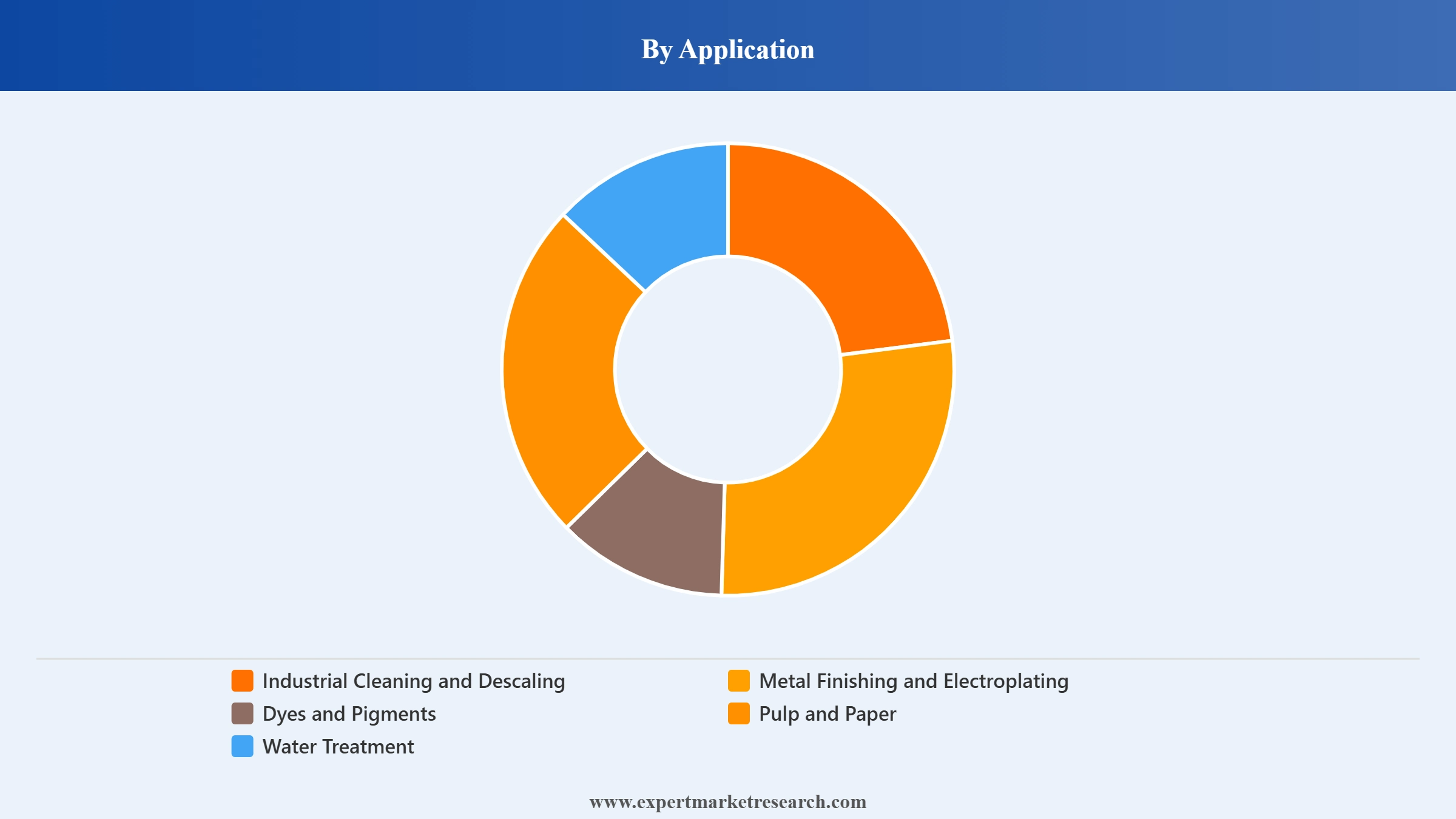
Key Insight: Industrial Cleaning and Descaling accounts for the largest share of the sulfamic acid market by application, driven by the compound's effectiveness at removing limescale, rust, and mineral deposits from boilers, heat exchangers, and industrial equipment while remaining less corrosive than hydrochloric acid. Metal Finishing and Electroplating is a significant application as sulfamic acid serves as an electrolyte additive and surface preparation agent ahead of plating processes. Dyes and Pigments and Pulp and Paper applications rely on sulfamic acid for its role in bleaching stabilisation and chlorine neutralisation during processing. Water Treatment is an expanding application as operators adopt sulfamic acid for boiler and cooling tower descaling in place of harsher mineral acids. The Others category includes herbicide intermediate and specialty catalyst uses.
Market Breakup by Region
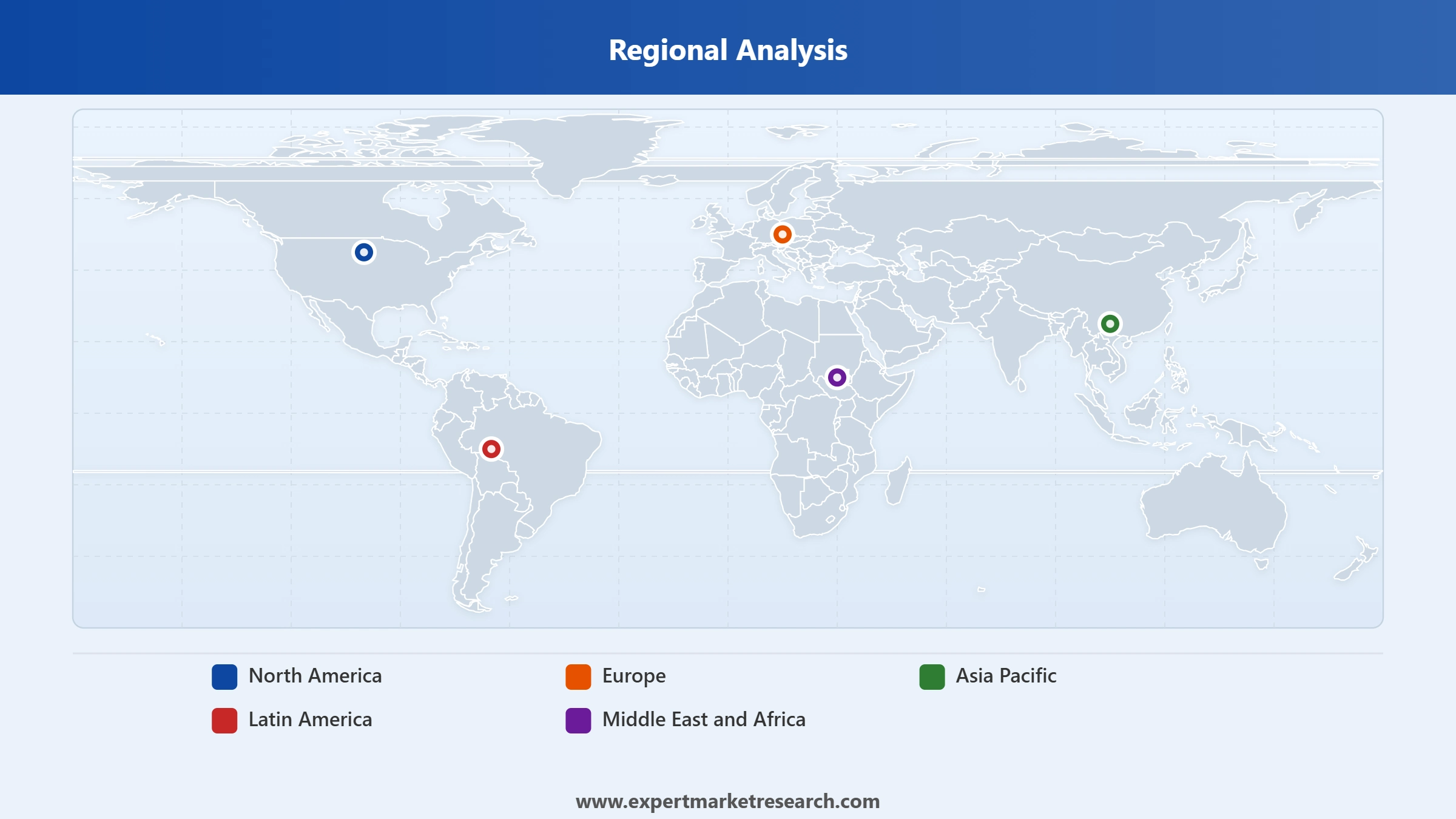
Key Insight: North America dominates the sulfamic acid market, supported by substantial demand from glass manufacturing, industrial cleaning, and chemical processing industries. In September 2025, Colonial Chemical announced the addition of two new reactors at its South Pittsburg, Tennessee facility, increasing specialty chemical production capacity and illustrating continued domestic manufacturing investment across the region. Europe maintains steady demand tied to established industrial cleaning practices and a well-developed base of specialty and fine chemical manufacturers serving both domestic and export customers. Asia Pacific is the fastest-growing region as extensive chemical manufacturing capacity in China and India, established textile and paper processing industries, and comparatively lower production costs attract both domestic consumption and export-oriented supply. Latin America and the Middle East and Africa remain smaller markets tied to expanding industrial activity and infrastructure development, with water treatment and construction related demand gradually broadening the regional customer base for sulfamic acid.
Read more about this report - REQUEST FREE SAMPLE COPY IN PDF
Powder and Crystal grade sulfamic acid leads the market because of its extended shelf life and lower transport cost relative to liquid concentrates, making it the default choice for most industrial operations. In January 2026, ChemCeed LLC, a specialty chemical supplier that stocks sulfamic acid among its core product lines, announced a partnership with PMI to expand its rubber and polymer compounding portfolio, reflecting how established sulfamic acid distributors continue broadening their wider specialty chemical offerings to serve industrial customers.
Read more about this report - REQUEST FREE SAMPLE COPY IN PDF
Liquid is the fastest-growing form as water treatment and specialty cleaning operators increasingly prefer pre-dissolved liquid solutions that reduce on-site handling risk and eliminate the need for separate dissolution equipment at smaller maintenance sites across the wider industry today. This sulfamic acid market growth in liquid formats is most pronounced among smaller industrial maintenance contractors and municipal water treatment operators that favour ready to use descaling products over bulk solid material requiring on-site mixing and dedicated storage facilities on premises.
Industrial Cleaning and Descaling dominates sulfamic acid demand because the compound effectively removes limescale, rust, and mineral deposits from boilers, heat exchangers, and processing equipment while remaining considerably less corrosive than hydrochloric acid across most industrial cleaning settings today. In September 2025, GFS Chemicals, a supplier that stocks sulfamic acid within its specialty and bulk inorganic acid portfolio, launched a new high purity acid product line, reflecting continued innovation investment among established acid manufacturers serving industrial and analytical customers nationwide.
Read more about this report - REQUEST FREE SAMPLE COPY IN PDF
Water Treatment is the fastest-growing application as municipal and industrial operators increasingly specify sulfamic acid for boiler and cooling tower descaling in place of hydrochloric acid, valuing its notably lower fuming and reduced equipment corrosion during routine annual maintenance cycles today overall. This sulfamic acid market growth in water treatment is most visible among facility maintenance contractors and municipal utilities seeking safer handling profiles for on-site descaling crews working in enclosed mechanical spaces across large industrial and municipal facilities nationwide.
North America dominates the sulfamic acid market, supported by substantial demand from glass manufacturing, industrial cleaning, and chemical processing industries concentrated in the United States alongside established domestic distribution infrastructure serving industrial customers across the wider region today overall too. In September 2026, EMCO Chemical Distributors agreed to acquire Pride Chemical Solutions, a founder-owned industrial chemical distributor serving the northeastern United States, reinforcing the growing depth of domestic chemical distribution and blending capacity supporting regional demand across the country overall.
Read more about this report - REQUEST FREE SAMPLE COPY IN PDF
Asia Pacific is the fastest-growing region as extensive integrated chemical manufacturing infrastructure across China and India, proximity to urea and sulfuric acid feedstock supply, and well-established export logistics continue to further accelerate regional consumption today overall. In April 2026, China announced it would halt sulfuric acid exports starting in May 2026 to prioritise domestic phosphate fertiliser production, a feedstock policy shifts that regional sulfamic acid producers dependent on sulfuric acid inputs are now closely monitoring for potential cost impacts.
|
CAGR 2026-2035 |
Region |
|
North America |
3.4% |
|
Europe |
3.1% |
|
Asia Pacific |
4.4% |
|
Latin America |
3.6% |
|
Middle East and Africa |
3.3% |
The global sulfamic acid companies feature a moderately consolidated competitive structure led by large diversified chemical manufacturers with integrated acid production spanning multiple derivative product lines, alongside specialty producers focused on regional distribution and niche purity grades. Manufacturers including BASF SE and Mitsubishi Gas Chemical Company compete primarily through large scale integrated production, while producers including Tosoh Corporation and Solvay S.A. differentiate through specialty chemical platforms and regional distribution reach.
Leading sulfamic acid market players are focusing on expanding high purity production capacity, investing in integrated Verbund style manufacturing sites, and pursuing regional distribution partnerships to broaden market access across fragmented industrial customer segments. Increasing emphasis on tighter chemical safety compliance, sustainable production practices, and diversification into higher margin specialty grades is also enabling manufacturers and distributors to strengthen customer relationships while supporting long-term market growth.
BASF SE, founded in 1865 and headquartered in Ludwigshafen, Germany, is a globally diversified chemical company producing sulfamic acid alongside a broad range of acid and specialty chemical products serving cleaning, industrial, and pharmaceutical customers worldwide. The company operates one of the world's largest integrated chemical production networks, spanning multiple continents.
Mitsubishi Gas Chemical Company, Inc., founded in 1951 and headquartered in Tokyo, Japan, manufactures sulfamic acid as part of its broader specialty and basic chemicals portfolio, supplying industrial cleaning, electroplating, and paper processing customers across the Asia Pacific region. The company leverages integrated production alongside related sulfur based chemical lines.
Tosoh Corporation, founded in 1935 and headquartered in Tokyo, Japan, is a diversified chemical manufacturer producing sulfamic acid alongside chlor-alkali and specialty chemical products, serving industrial cleaning and chemical processing customers across Japan and export markets. The company operates integrated production complexes combining acid and derivative chemical output.
Solvay S.A., founded in 1863 and headquartered in Brussels, Belgium, produces sulfamic acid and related specialty acid chemicals for industrial cleaning, water treatment, and chemical processing customers across Europe and international export markets. The company draws on its long-established position in soda ash and inorganic chemical manufacturing.
Other key players in the market report include Nippon Chemical Industrial Co., Ltd., Donau Chemie AG, Nissan Chemical Corporation, Laizhou Jinxing Chemical Co., Ltd., and Shandong Mingda Chemical Co., Ltd., among others.
*Please note that this is only a partial list; the complete list of key players is available in the full report. Additionally, the list of key players can be customized to better suit your needs.*
Explore the latest trends shaping the sulfamic acid market 2026-2035 with our in-depth report. Gain strategic insights, future forecasts, and key market developments that can help you stay competitive. Download a free sample report or contact our team for customised consultation on the market trends 2026.


Upto 15% Off
USD
$2499 $2249
$3999 $3599
$4999 $4249
$5999 $5099


*While we strive to always give you current and accurate information, the numbers depicted on the website are indicative and may differ from the actual numbers in the main report. At Expert Market Research, we aim to bring you the latest insights and trends in the market. Using our analyses and forecasts, stakeholders can understand the market dynamics, navigate challenges, and capitalize on opportunities to make data-driven strategic decisions.*
In 2025, the sulfamic acid market reached an approximate value of USD 297.50 Million.
The market is projected to grow at a CAGR of 3.80% between 2026 and 2035.
The key players in the market include BASF SE, Mitsubishi Gas Chemical Company, Tosoh Corporation, Solvay S.A., Nippon Chemical Industrial Co., Ltd., Donau Chemie AG, Nissan Chemical Corporation, Laizhou Jinxing Chemical Co., Ltd., and Shandong Mingda Chemical Co., Ltd.
Producers are expanding high purity grades, co-locating production within integrated acid sites, and pursuing regional distribution partnerships to broaden market access.
Challenges include feedstock price volatility, evolving REACH compliance requirements, and competition from lower cost regional producers in Asia Pacific.
Explore our key highlights of the report and gain a concise overview of key findings, trends, and actionable insights that will empower your strategic decisions.
|
Report Features |
Details |
|
Base Year |
2025 |
|
Historical Period |
2019-2025 |
|
Forecast Period |
2026-2035 |
|
Scope of the Report |
Historical and Forecast Trends, Industry Drivers and Constraints, Competitive Landscape
|
|
Breakup by Form |
|
|
Breakup by Application |
|
|
Breakup by Region |
|
|
Market Dynamics |
|
|
Competitive Landscape |
|
|
Companies Covered |
|
Datasheet
One User
USD 2,499
USD 2,249
tax inclusive*
Single User License
One User
USD 3,999
USD 3,599
tax inclusive*
Five User License
Five User
USD 4,999
USD 4,249
tax inclusive*
Corporate License
Unlimited Users
USD 5,999
USD 5,099
tax inclusive*
*Please note that the prices mentioned below are starting prices for each bundle type. Kindly contact our team for further details.*
Flash Bundle
Small Business Bundle
Growth Bundle
Enterprise Bundle
*Please note that the prices mentioned below are starting prices for each bundle type. Kindly contact our team for further details.*
Flash Bundle
Number of Reports: 3
20%
tax inclusive*
Small Business Bundle
Number of Reports: 5
25%
tax inclusive*
Growth Bundle
Number of Reports: 8
30%
tax inclusive*
Enterprise Bundle
Number of Reports: 10
35%
tax inclusive*
How To Order

Select License Type
Choose the right license for your needs and access rights.

Click on ‘Buy Now’
Add the report to your cart with one click and proceed to register.

Select Mode of Payment
Choose a payment option for a secure checkout. You will be redirected accordingly.
Strategic Solutions for Informed Decision-Making
Gain insights to stay ahead and seize opportunities.

Get insights & trends for a competitive edge.

Track prices with detailed trend reports.

Analyse trade data for supply chain insights.

Leverage cost reports for smart savings

Enhance supply chain with partnerships.

Connect For More Information
Our expert team of analysts will offer full support and resolve any queries regarding the report, before and after the purchase.
Our expert team of analysts will offer full support and resolve any queries regarding the report, before and after the purchase.
We employ meticulous research methods, blending advanced analytics and expert insights to deliver accurate, actionable industry intelligence, staying ahead of competitors.
Our skilled analysts offer unparalleled competitive advantage with detailed insights on current and emerging markets, ensuring your strategic edge.
We offer an in-depth yet simplified presentation of industry insights and analysis to meet your specific requirements effectively.




