

Consumer Insights
Uncover trends and behaviors shaping consumer choices today
Procurement Insights
Optimize your sourcing strategy with key market data
Industry Stats
Stay ahead with the latest trends and market analysis.
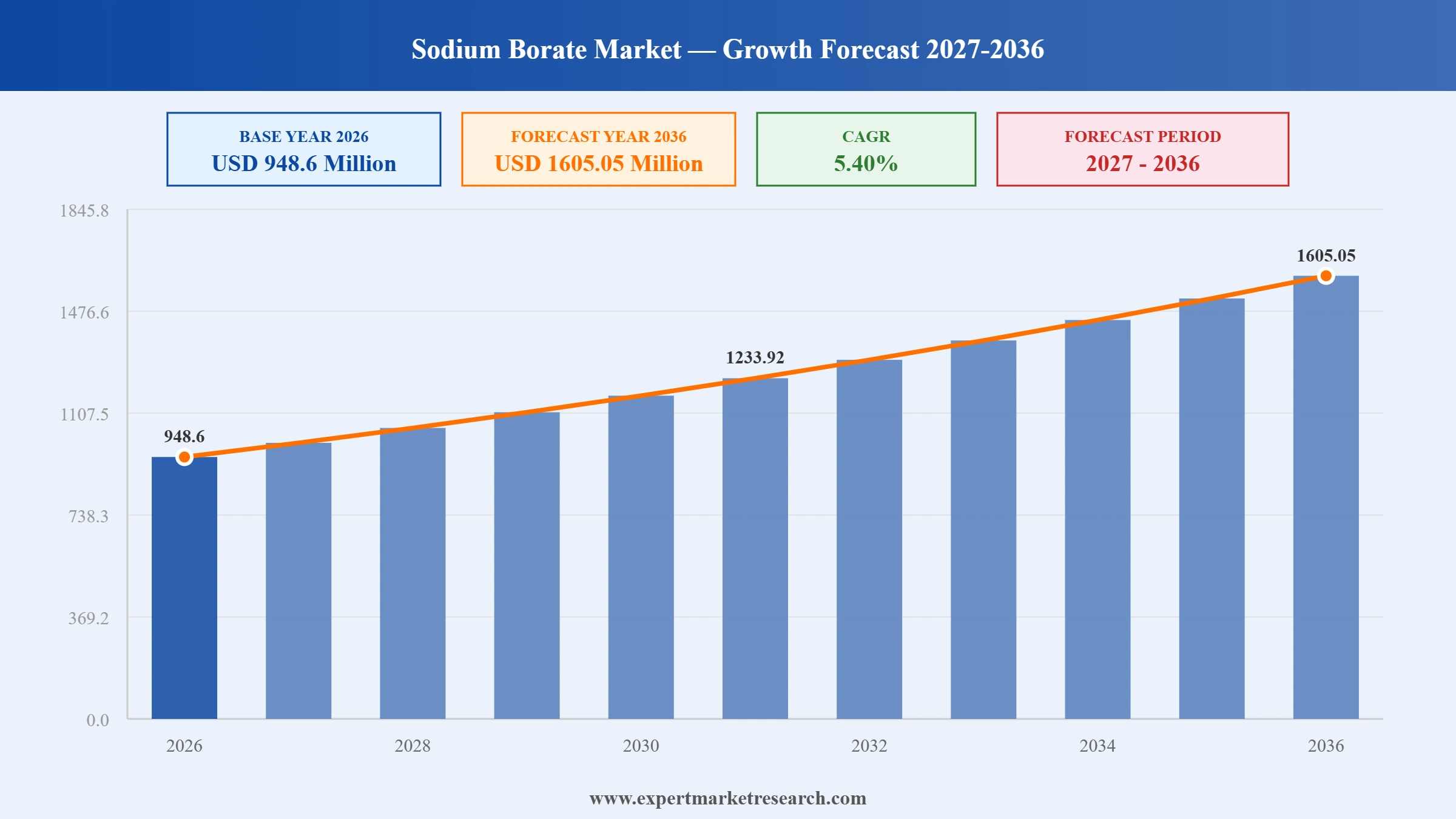
The sodium borate market was valued at USD 900.00 Million in 2025. The market is expected to grow at a CAGR of 5.40% during the forecast period of 2026-2035 to reach a value of USD 1522.82 Million by 2035. Sustained demand from glass manufacturing, detergent formulation, and agricultural micronutrient applications, combined with recent critical mineral policy support, are collectively driving value growth in the sodium borate market worldwide.
The current sodium borate market dynamics reflect growing government support for domestic supply chains, as recent critical mineral policy designations reshape investment priorities across producing regions while established producers navigate energy cost volatility and tightening environmental compliance requirements. This structural shift has encouraged both incumbent producers and mining companies to evaluate new capacity, with buyers across glass, detergent, and agricultural end markets watching supply developments closely as demand continues expanding. In June 2025, Eti Maden advanced expansion of its Kirka processing facility in Turkey to add 200,000 tonnes of annual boric acid output, targeting high value segments through investment in advanced purification systems supporting continued export growth.
The overall sodium borate industry through 2026 continues to be shaped by tightening environmental compliance requirements, as regulators across major producing jurisdictions impose stricter tailings management and water recycling standards that raise capital intensity for producers competing on cost, even as new domestic entrants attempt to qualify their material with global customers for the first time. Established producers are simultaneously evaluating adjacent critical mineral opportunities from existing mining and processing infrastructure, unlocking new revenue streams from previously uneconomic byproduct and tailings resources without requiring entirely new permitting processes across most established operating sites. In August and October 2025, 5E Advanced Materials shipped boric acid produced at its Fort Cady small scale facility to a global specialty glass manufacturer in Taiwan and for domestic boron carbide production, key qualification milestones ahead of a planned 130,000 short ton per annum commercial plant.
Read more about this report - REQUEST FREE SAMPLE COPY IN PDF
|
Sodium Borate Market Report Summary |
Description |
Value |
|
Base Year |
USD Million |
2025 |
|
Historical Period |
USD Million |
2019-2025 |
|
Forecast Period |
USD Million |
2026-2035 |
|
Market Size 2025 |
USD Million |
900.00 |
|
Market Size 2035 |
USD Million |
1522.82 |
|
CAGR 2019-2025 |
Percentage |
XX% |
|
CAGR 2026-2035 |
Percentage |
5.40% |
|
CAGR 2026-2035 - Market by Region |
Asia Pacific |
6.2% |
|
CAGR 2026-2035 - Market by Product Type |
Borax Decahydrate |
5.8% |
|
CAGR 2026-2035 - Market by Application |
Agriculture |
6.8% |
|
2025 Market Share by Region |
North America |
34.2% |
The sodium borate market is being reshaped by critical mineral policy designations, expanding agricultural subsidy support, and continued cost pressure on domestic refiners amid tightening environmental compliance requirements. Producers across established mining regions are responding by diversifying their resource base, pursuing adjacent byproduct opportunities, and investing in higher purity processing capacity to serve glass, detergent, and specialty chemical customers.
Quiborax signed Chile's first Special Lithium Operating Contract granted to a fully private company in September 2026, a 70-million-dollar agreement to recover lithium from decades of ulexite processing waste stored at its El Aguila boric acid plant. Idle tailings at older sites could unlock fresh government contracts for mineral processors across the sodium borate market willing to pursue byproduct recovery alongside core production.
In January 2026, India revised its Nutrient Based Subsidy scheme to formally include boron fortified fertilizers, extending government support to micronutrient blends containing sodium borate compounds used to correct widespread soil boron deficiency nationwide. Where deficiency is comparably widespread, subsidy expansions like this one tend to speed up farmer adoption, giving blenders a much faster route to market penetration overall.
In November 2025, Rio Tinto initiated a formal sale process for its entire US Borax California asset base, comprising the Boron mine and processing facility, the Port of Los Angeles refinery, and the Owens Lake mining operation. A fully developed platform of this scale rarely comes up for sale, making the divestment notable for any company across the sodium borate market seeking rapid market entry.
The United States Geological Survey confirmed in November 2025 that boron had been officially designated a federal critical mineral, prompting increased domestic supply chain investment and intensified audits of import dependent industrial users nationwide. Streamlined permitting and stronger policy backing typically follow such designations, so producers weighing new capacity outside traditional regions across the sodium borate market may well find this window favourable starting now.
Sodium borate producers across the sodium borate market are increasingly expanding boric acid conversion capacity rather than solely relying on raw ore extraction, reflecting rising downstream demand for purified derivatives across glass and specialty chemical applications that command higher margins than unprocessed borate minerals across most producing regions. In March 2026, a United States federal court upheld the approval of ioneer's Rhyolite Ridge Lithium-Boron Project mine plan in Nevada, clearing a key legal challenge and advancing a project expected to add domestic boric acid output.
Regulators across major borate producing jurisdictions are increasingly tightening environmental compliance requirements for tailings management and water recycling at mining and refining operations, reflecting broader efforts to reduce the ecological footprint of resource extraction while raising overall capital intensity for producers competing today. Chile introduced a stricter critical minerals strategy in January 2026 imposing tougher tailings standards on operations at Salar de Surire and Salar de Atacama, where boric acid is produced as a coproduct alongside lithium and potassium salts.
Mining companies across the sodium borate market are increasingly evaluating polymetallic and rare earth deposits outside traditional borate producing regions of Turkey, the United States, and Chile, reflecting growing government support following critical mineral designations that streamline permitting and unlock development financing for previously uneconomic projects worldwide. In March 2025, Critical Metals Corp released an independent economic assessment for its Tanbreez project in southern Greenland, valuing the polymetallic deposit at approximately 3 billion dollars with a phased development strategy targeting multiple critical mineral byproduct streams.
Trade authorities across the sodium borate market in major consuming regions are increasingly maintaining protective duties on ceramic products from lower cost exporting countries, reflecting continued efforts to shield domestic ceramics manufacturers that rely on sodium borate for glaze and enamel formulations from underpriced imports across most affected markets today. In February 2026, the United States Department of Commerce continued antidumping and countervailing duty orders on ceramic tile from China, extending protection first put in place in 2020 following a scheduled five-year sunset review.
Fertilizer blenders across the sodium borate market are increasingly formulating boron enriched micronutrient products specifically targeting regions with documented soil boron deficiency, reflecting growing agronomic recognition that even modest boron supplementation can meaningfully improve yields in high value crops sensitive to micronutrient shortfalls today overall too. In November 2025, Coromandel International, India's pioneering leader in specialty and micronutrient fertilizers, signed a non-binding agreement with the Andhra Pradesh Economic Development Board to explore investments of up to 2,000 crore rupees expanding its nutrient manufacturing footprint.
The Expert Market Research's report titled “Sodium Borate Market Report and Forecast 2026-2035” offers a detailed analysis of the market based on the following segments:
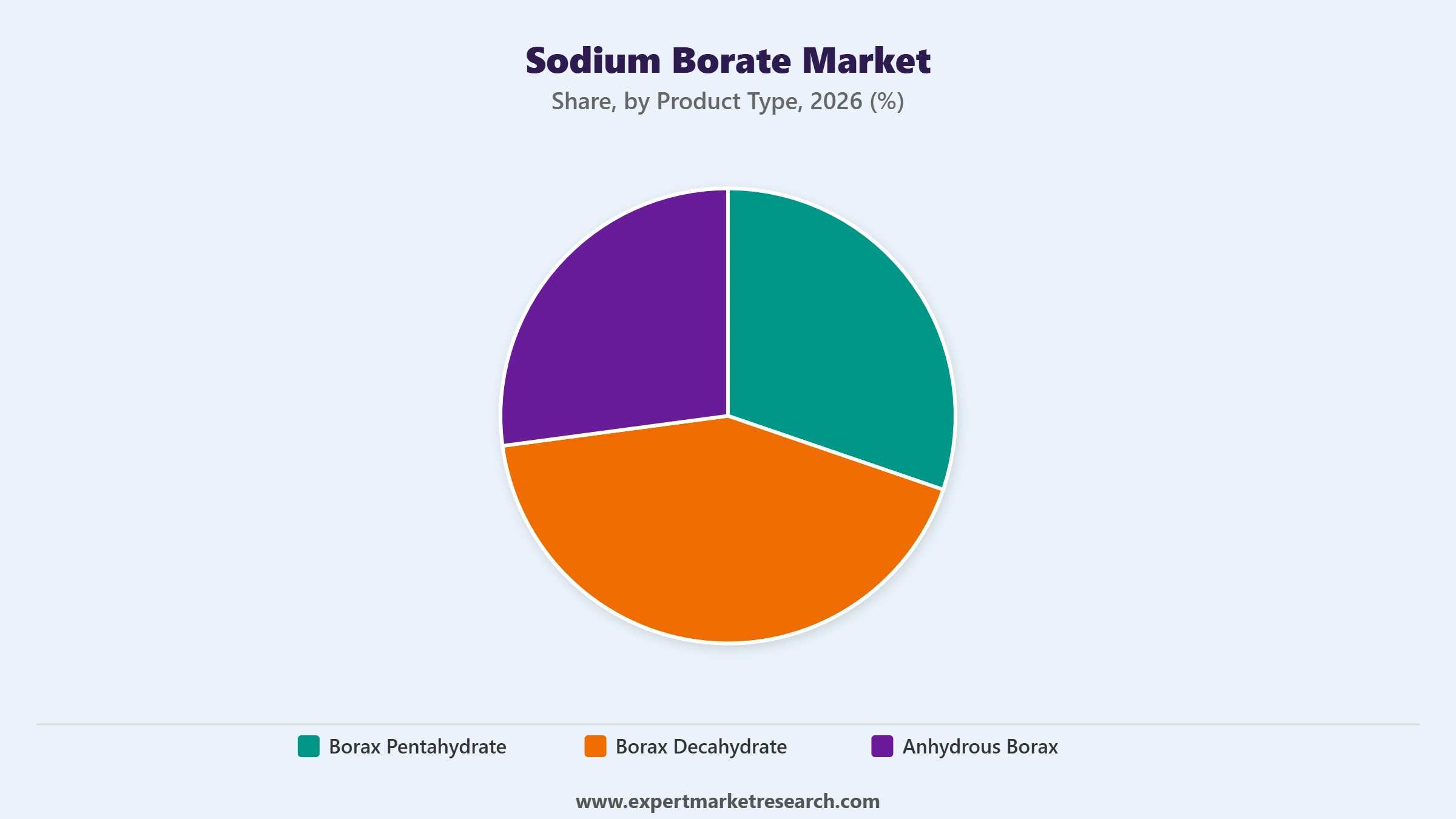
Market Breakup by Product Type
Key Insight: Borax Pentahydrate accounts for the largest share of the sodium borate market by product type, valued for its optimal balance of solubility, stability, and cost effectiveness across glass manufacturing and detergent formulation. In July 2026, Saint-Gobain entered a definitive agreement to acquire Nippon Electric Glass's Lexington, North Carolina glass fiber operations, reinforcing domestic downstream capacity for products that rely on refined borate feedstock. Borax Decahydrate is the fastest-growing product type as household and industrial cleaning manufacturers increasingly specify its water softening and fluxing properties. Anhydrous Borax serves applications requiring concentrated boron content with minimal water of crystallisation. The Others category includes specialty hydrate forms and blended borate compounds for niche industrial applications.
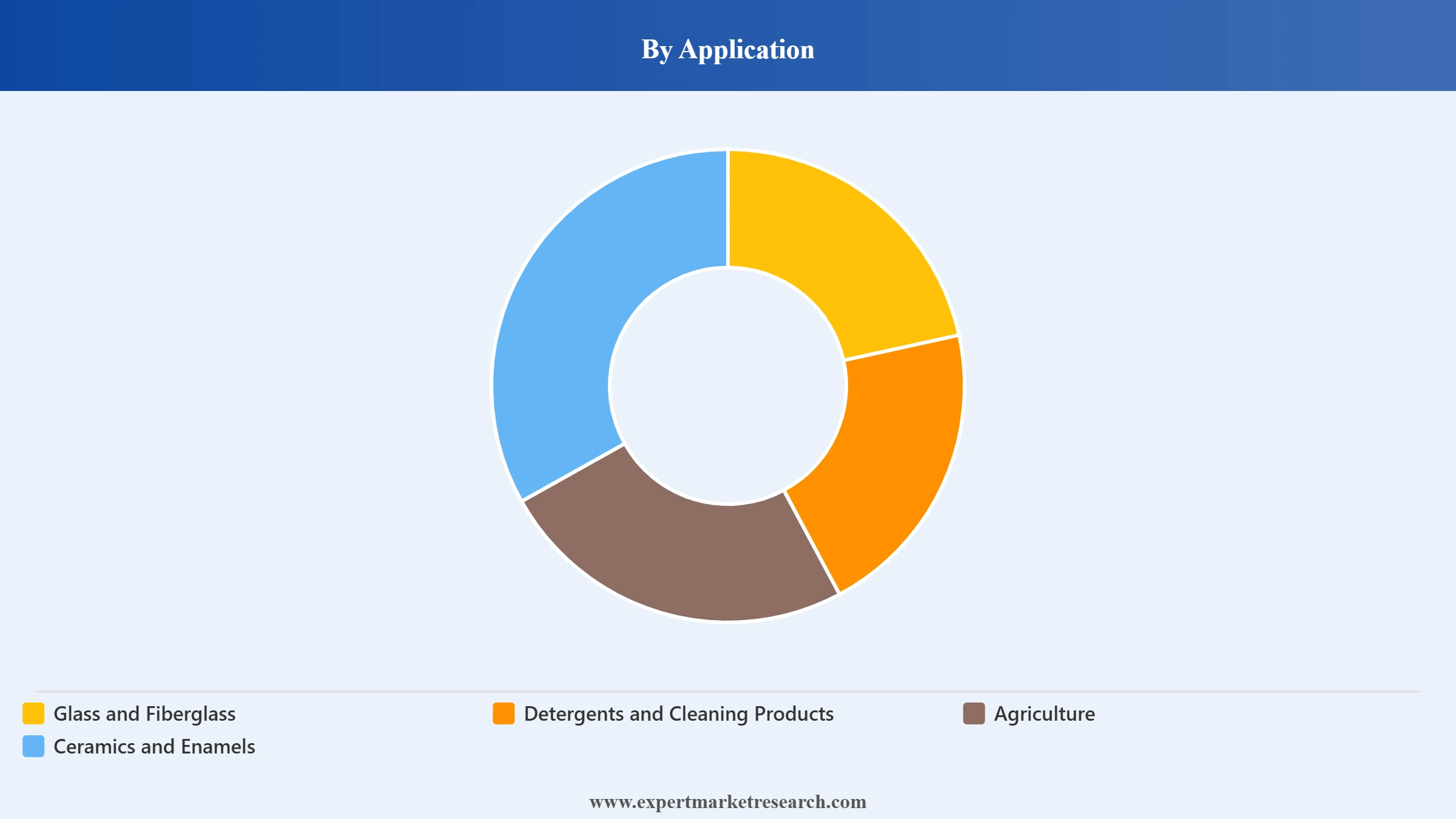
Market Breakup by Application
Key Insight: Glass and Fiberglass accounts for the largest share of the sodium borate market by application, reflecting the compound's role in enhancing thermal resistance and chemical stability across construction and renewable energy glass products. Agriculture is the fastest-growing application as expanding recognition of soil boron deficiency drives fertilizer blenders toward micronutrient formulations. Detergents and Cleaning Products rely on sodium borate for water softening and cleaning boost properties. Ceramics and Enamels use sodium borate to improve glaze thermal resistance. The Others category includes metallurgical flux and industrial chemical applications.
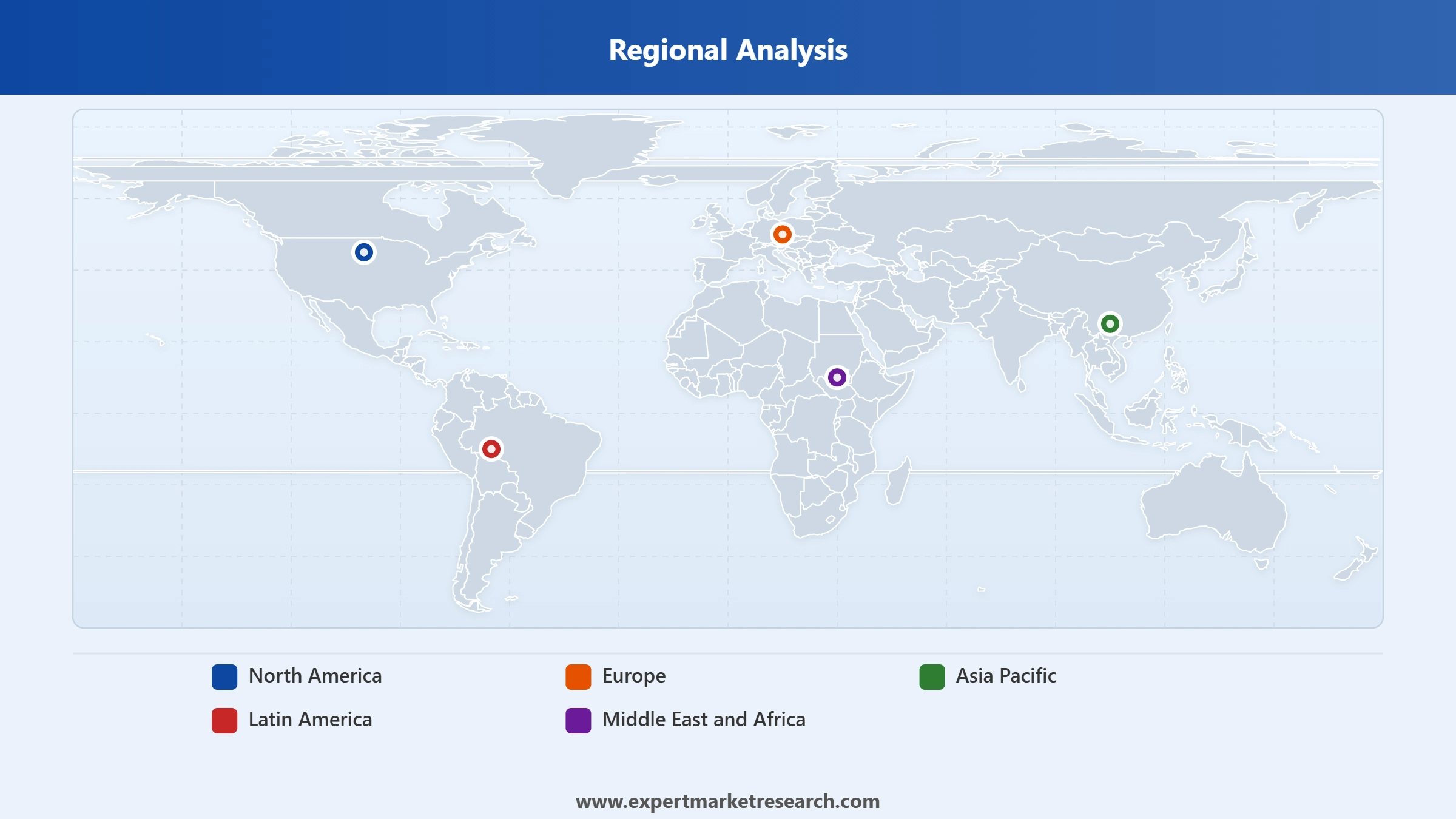
Market Breakup by Region
Key Insight: North America dominates the sodium borate market, driven by substantial demand from glass manufacturing and chemical industries alongside established domestic mining and refining capacity in the United States. Asia Pacific is expected to grow steadily as expanding agricultural micronutrient adoption and rising construction sector demand lift regional consumption. Europe maintains significant demand through its established glass and ceramics manufacturing base. Latin America hosts South America's only integrated borate producer in Salta province, Argentina, serving agricultural, ceramics, and glass customers across the region. The Middle East and Africa remain a smaller market tied to broader industrial sector investment.
Read more about this report - REQUEST FREE SAMPLE COPY IN PDF
By product type, borax pentahydrate dominates the market due to its optimal balance of solubility, stability, and cost effectiveness
Borax Pentahydrate accounts for the largest share of the sodium borate market by product type, valued for its balance of solubility, stability, and cost effectiveness, keeping it the preferred grade across glass manufacturing, detergent formulation, and agricultural micronutrient applications. In May 2026, China Jushi announced a 653-million-dollar investment to add a new production line in Huai'an, Jiangsu province, with annual capacity for 50,000 tons of electronic grade glass fibers and 320 million meters of electronic cloth for customers.
Read more about this report - REQUEST FREE SAMPLE COPY IN PDF
Borax Decahydrate is the fastest-growing product type as detergent and household cleaning manufacturers increasingly specify its water softening and fluxing properties, with formulators favoring its stable performance over less consistent alternatives across demanding industrial cleaning applications. In August 2026, Procter and Gamble's annual report described Tide evo, its biggest laundry innovation in over two decades, using a proprietary fiber spinning process to eliminate plastic bottles, illustrating how actively detergent formulators continue reworking cleaning products that traditionally rely on borate ingredients.
By application, glass and fiberglass dominates the market due to sodium borate's role in enhancing thermal resistance and chemical stability
Glass and Fiberglass accounts for the largest share of the sodium borate market by application, reflecting the compound's role in enhancing thermal resistance, durability, and chemical stability, properties that construction, automotive, and renewable energy manufacturers increasingly specify for demanding structural glass products. In March 2026, IKO North America opened new fiberglass and glass mat manufacturing facilities in Chester County, South Carolina, representing an investment of more than 500 million dollars supporting expanding domestic building materials demand across the wider region.
Read more about this report - REQUEST FREE SAMPLE COPY IN PDF
Agriculture is the fastest-growing application as expanding recognition of widespread soil boron deficiency drives fertilizer blenders toward micronutrient formulations containing sodium borate compounds, a shift steadily broadening demand beyond the crop producing regions where deficiency was first documented. In April 2026, EuroChem allocated 36 million dollars to double its specialty micronutrient blend storage capacity across Brazil's North and Northeast terminals, ensuring faster in season availability of boron and other trace element products for soybean and corn growers across the country.
North America dominates the market due to substantial demand from glass manufacturing and chemical industries
North America dominates the sodium borate market, driven by substantial demand from glass manufacturing and chemical industries concentrated in the United States, supported by domestic mining and refining capacity that continues to serve industrial customers across the wider region. In November 2025, Vitro Architectural Glass entered an exclusive long-term agreement with VIG Technologies and LandVac to produce vacuum insulating glass units in North America, reinforcing domestic borosilicate glass manufacturing capacity as the region shifts toward high efficiency building facades.
Read more about this report - REQUEST FREE SAMPLE COPY IN PDF
Asia Pacific is also expected to grow steadily as expanding agricultural micronutrient adoption and rising construction sector demand continue to lift regional sodium borate consumption, with key national markets accelerating investment in downstream glass and fertilizer manufacturing capacity. Borosil Renewables' board approved a revised expansion plan to add 600 tonnes per day of solar glass capacity at its Bharuch, Gujarat facility, an investment of roughly 950 crore rupees with commissioning targeted for December 2026, reinforcing India's borosilicate glass manufacturing base.
|
CAGR 2026-2035 - Market by |
Region |
|
North America |
5.0% |
|
Europe |
4.6% |
|
Asia Pacific |
6.2% |
|
Latin America |
5.3% |
|
Middle East and Africa |
5.1% |
The global sodium borate companies feature a moderately consolidated competitive structure, with a small number of integrated mining and refining companies controlling most of the global refined borate output. Manufacturers including Rio Tinto and Eti Maden compete primarily through large scale integrated mining to refining operations, while producers including Searles Valley Minerals and Quiborax differentiate through regional specialisation and downstream product diversification.
Leading sodium borate market players are focusing on expanding boric acid conversion capacity, investing in advanced purification systems for high value segments, and evaluating adjacent critical mineral opportunities from existing mining infrastructure. Increasing government critical mineral designations and expanding agricultural subsidy support are also shaping strategy across the industry.
Rio Tinto Group, founded in 1873 and headquartered in London, United Kingdom, is a global leader in industrial mineral supply, with its Boron division ranking among the world's largest producers of refined borate products serving glass, ceramics, and agricultural customers worldwide. The company operates an integrated open pit mining and refining complex in California, combining mineral extraction with downstream processing under a single site.
Eti Maden, founded in 1935 and headquartered in Ankara, Turkey, is a state-owned corporation holding a government monopoly on borate mineral mining in Turkey, which possesses 73 percent of the world's known deposits. The company markets refined boron products through overseas subsidiaries covering Scandinavia, Eastern Europe, and the Americas, positioning itself as the self-described World Boron Leader.
Searles Valley Minerals Inc., founded in 1913 and headquartered in Trona, California, United States, is a long-established domestic producer of sodium borate and related specialty chemicals extracted from the Searles Lake brine deposit, one of only two operating borate production complexes in the United States. The company's integrated infrastructure includes on site processing facilities and a dedicated short line railroad connecting to the national rail network.
Quiborax S.A., founded in 1986 and controlled by the Fosk family, is headquartered in Arica, Chile, and is one of the world's largest producers of boric acid, operating its El Aguila plant fed by ulexite mined at the Salar de Surire in northern Chile. The company markets its refined borate products to glass, ceramics, and agricultural customers across international export markets from its integrated Chilean operations.
Other key players in the market report include Sociedad Quimica y Minera de Chile S.A., Borax Argentina S.A., American Borate Company, Wego Chemical Group Inc., and Ereztech LLC, among others.
*Please note that this is only a partial list; the complete list of key players is available in the full report. Additionally, the list of key players can be customized to better suit your needs.*
Explore the latest trends shaping the sodium borate market 2026-2035 with our in-depth report. Gain strategic insights, future forecasts, and key market developments that can help you stay competitive. Download a free sample report or contact our team for customised consultation on the market trends 2026.


Upto 15% Off
USD
$2499 $2249
$3999 $3599
$4999 $4249
$5999 $5099


*While we strive to always give you current and accurate information, the numbers depicted on the website are indicative and may differ from the actual numbers in the main report. At Expert Market Research, we aim to bring you the latest insights and trends in the market. Using our analyses and forecasts, stakeholders can understand the market dynamics, navigate challenges, and capitalize on opportunities to make data-driven strategic decisions.*
In 2025, the sodium borate market reached an approximate value of USD 900.00 Million.
The market is projected to grow at a CAGR of 5.40% between 2026 and 2035.
The key players in the market include Rio Tinto Group, Eti Maden, Searles Valley Minerals Inc., Quiborax S.A., Sociedad Quimica y Minera de Chile S.A., Borax Argentina S.A., American Borate Company, Wego Chemical Group Inc., and Ereztech LLC, among others.
Leading producers are focusing on expanding boric acid conversion capacity, investing in advanced purification systems for high value segments, and evaluating adjacent critical mineral opportunities from existing mining infrastructure.
Key challenges include volatile energy prices affecting domestic refining costs, tightening environmental compliance requirements for tailings management, and intensifying competition from lower cost overseas producers.
Explore our key highlights of the report and gain a concise overview of key findings, trends, and actionable insights that will empower your strategic decisions.
|
Report Features |
Details |
|
Base Year |
2025 |
|
Historical Period |
2019-2025 |
|
Forecast Period |
2026-2035 |
|
Scope of the Report |
Historical and Forecast Trends, Industry Drivers and Constraints, Historical and Forecast Market Analysis by Segment:
|
|
Breakup by Product Type |
|
|
Breakup by Application |
|
|
Breakup by Region |
|
|
Market Dynamics |
|
|
Competitive Landscape |
|
|
Companies Covered |
|
Datasheet
One User
USD 2,499
USD 2,249
tax inclusive*
Single User License
One User
USD 3,999
USD 3,599
tax inclusive*
Five User License
Five User
USD 4,999
USD 4,249
tax inclusive*
Corporate License
Unlimited Users
USD 5,999
USD 5,099
tax inclusive*
*Please note that the prices mentioned below are starting prices for each bundle type. Kindly contact our team for further details.*
Flash Bundle
Small Business Bundle
Growth Bundle
Enterprise Bundle
*Please note that the prices mentioned below are starting prices for each bundle type. Kindly contact our team for further details.*
Flash Bundle
Number of Reports: 3
20%
tax inclusive*
Small Business Bundle
Number of Reports: 5
25%
tax inclusive*
Growth Bundle
Number of Reports: 8
30%
tax inclusive*
Enterprise Bundle
Number of Reports: 10
35%
tax inclusive*
How To Order

Select License Type
Choose the right license for your needs and access rights.

Click on ‘Buy Now’
Add the report to your cart with one click and proceed to register.

Select Mode of Payment
Choose a payment option for a secure checkout. You will be redirected accordingly.
Strategic Solutions for Informed Decision-Making
Gain insights to stay ahead and seize opportunities.

Get insights & trends for a competitive edge.

Track prices with detailed trend reports.

Analyse trade data for supply chain insights.

Leverage cost reports for smart savings

Enhance supply chain with partnerships.

Connect For More Information
Our expert team of analysts will offer full support and resolve any queries regarding the report, before and after the purchase.
Our expert team of analysts will offer full support and resolve any queries regarding the report, before and after the purchase.
We employ meticulous research methods, blending advanced analytics and expert insights to deliver accurate, actionable industry intelligence, staying ahead of competitors.
Our skilled analysts offer unparalleled competitive advantage with detailed insights on current and emerging markets, ensuring your strategic edge.
We offer an in-depth yet simplified presentation of industry insights and analysis to meet your specific requirements effectively.




