

Consumer Insights
Uncover trends and behaviors shaping consumer choices today
Procurement Insights
Optimize your sourcing strategy with key market data
Industry Stats
Stay ahead with the latest trends and market analysis.
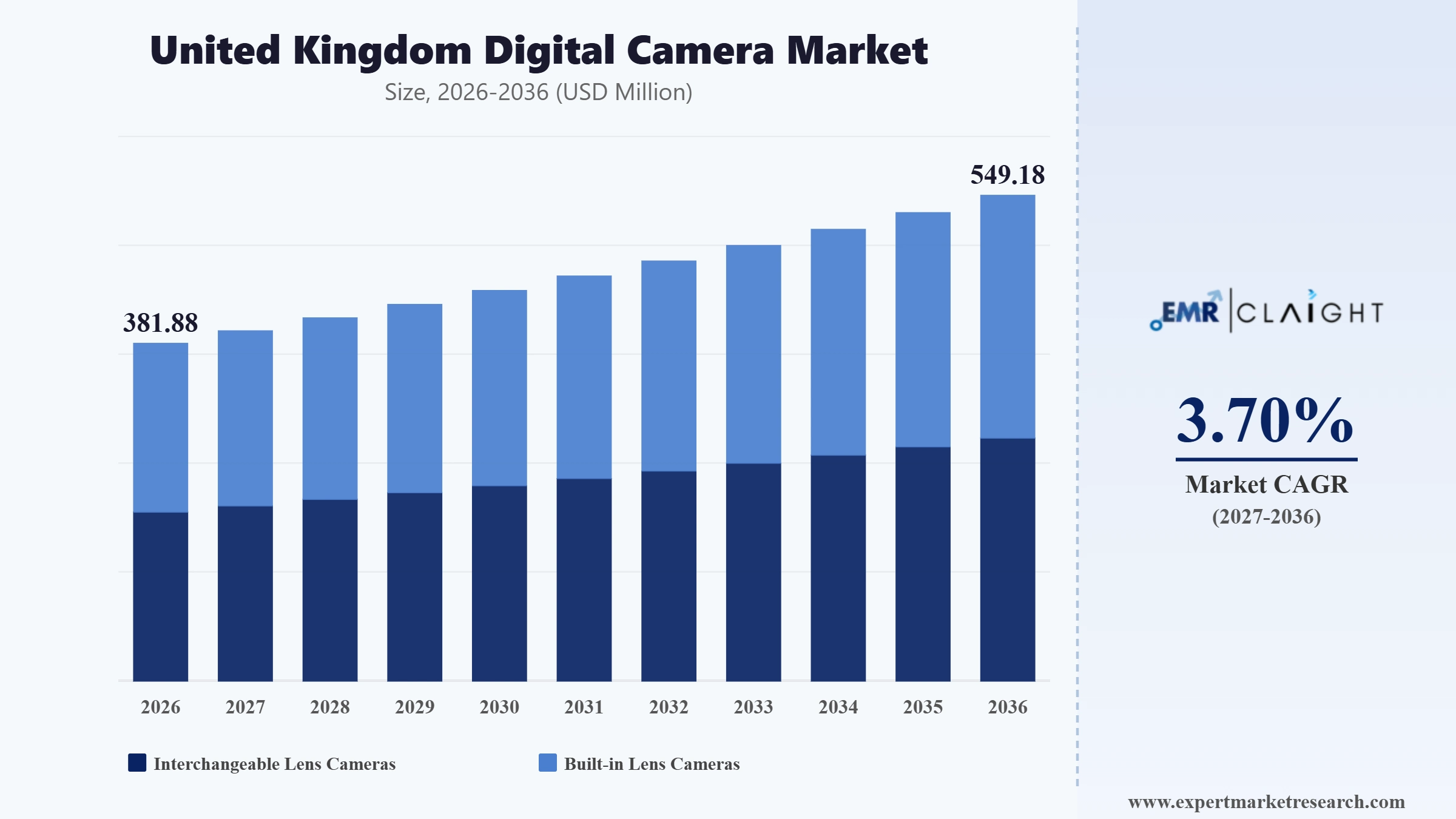
The United Kingdom digital camera market attained a value of USD 368.25 Million in 2025 and is projected to expand at a CAGR of 3.70% through 2035. The market is further expected to achieve USD 529.58 Million by 2035. Dedicated-camera demand is increasingly being shaped by hybrid content production rather than photography alone. CIPA recorded 6.31 million mirrorless shipments in 2025, up 12.5% year on year, while built-in-lens cameras increased 29.6% to 2.44 million units. The convergence of stills, video, AI autofocus, travel imaging, and lightweight optical systems is therefore expanding addressable applications beyond traditional photography.
The demand is becoming more associated with hybrid photo-video solutions, mostly amongst professionals, advertising agencies, broadcasting companies, sports organizations, and production enterprises. The new devices include both high-resolution photo capabilities and advanced video features, which means that the same device can be used for multiple purposes. The second important trend includes the revival of high-end pocket and fixed lens cameras. CIPA reported built-in-lens camera shipments of 2.44 million units in 2025, representing 129.6% of the previous year's volume, while its 2026 outlook anticipates another 13.6% increase to 2.77 million units. This shift creates opportunities for UK distributors and retailers to target customers seeking portability without abandoning dedicated-camera image quality, thereby boosting the United Kingdom digital camera market value.
The application of AI in autofocus and subject detection is improving the functionality of dedicated cameras. The latest digital cameras feature AI processors that are able to detect humans, animals, cars, birds, and many more, enabling the camera’s autofocus system to anticipate the subject’s motion. This innovation is highly useful in the field of wildlife, sports, events, and action photography due to the unpredictable motion of the subjects in question. Manufacturers are also adding intelligent autofocus alongside real-time tracking, better exposure management, and computational imaging to dedicated cameras. These capabilities help dedicated cameras offer a more automated shooting experience while retaining manual controls expected by professional users. For the UK market, continued integration of AI into camera hardware can broaden adoption among enthusiasts and creators who want sophisticated results without extensive manual focusing or post-production adjustments.
High prices of the equipment could prevent the wide acceptance of advanced digital cameras. Camera bodies, various lenses, telephoto lenses, batteries, memory cards, and other accessories required to create the entire system could become rather expensive especially since people are interested in purchasing not just a single camera but a whole system of equipment. In some cases, premium lenses could become as expensive as the camera bodies. For occasional photographers, smartphones and existing camera equipment may therefore remain sufficient for everyday imaging needs. In the UK, retailers and manufacturers must also address replacement cycles, as users may retain cameras for several years when existing equipment continues to meet their requirements. Consequently, technological improvements need to provide sufficiently meaningful benefits to encourage upgrades and justify higher system costs, thereby boosting the United Kingdom digital camera market developments.
Read more about this report - REQUEST FREE SAMPLE COPY IN PDF
Sony announced new 400mm and 600mm G Master super-telephoto prime lenses on 15 September 2026, describing them as the world’s lightest lenses in their respective classes. The products expand Sony’s professional telephoto portfolio for wildlife, sports, aviation and outdoor photography. The development strengthens demand for high-end interchangeable-lens systems in the UK by adding specialist optics that complement Sony’s Alpha camera bodies and support professional users requiring long reach with improved portability.
Sony launched the FX5 on 22 July 2026, introducing a full-frame stacked CMOS sensor, 15+ stops of dynamic range, Open Gate recording and internal X-OCN RAW. The camera supports 5K recording at up to 60fps, 4K at up to 120fps and Full HD at up to 240fps. UK pricing was set at £4,700 for the body and £5,200 with the XLR handle. The launch expands Sony’s presence in professional video and supports demand from UK production companies, agencies and independent filmmakers seeking compact cinema equipment.
Sony announced the RX10 V on 9 July 2026, combining a 1-inch stacked CMOS sensor with approximately 20.1 effective megapixels, a 24–600mm equivalent 25x optical zoom, AI-powered Real-time Recognition AF and continuous shooting of up to 30fps with AF/AE tracking. The camera also supports 4K 120p video and carries a UK pre-order price of £2,200. The product reinforces the premium built-in-lens segment in the UK by offering high zoom, advanced autofocus and video capabilities without requiring interchangeable lenses.
Nikon showcased its Z-series cameras and ZR cinema camera at The Photography & Video Show in Birmingham in March 2026, giving visitors hands-on access to its imaging portfolio. The event provided opportunities to explore mirrorless photography, cinema workflows and specialist lenses. Nikon’s current UK promotional activity also covers full-frame Z-series cameras and multiple NIKKOR Z lenses. Nikon’s direct engagement with photographers and videographers supports product awareness and creates opportunities for camera-body upgrades, lens purchases and broader mirrorless ecosystem adoption in the UK.
Mirrorless cameras are enhancing the professional to enthusiast chain, with users looking for devices that can cope with photography and videography. CIPA estimated shipments of 6.31 million units of mirrorless cameras in 2025, which is equivalent to 112.5% of the shipment in 2024. CIPA also expects 6.82 million units of interchangeable lens cameras in 2026, which is 97.4% of the previous year. The camera ecosystem for UK distributors ranges from cameras to lenses, batteries, memory cards, grips, monitors, and software. Mirrorless systems are particularly relevant to professionals, enthusiasts, and creators seeking compact bodies, interchangeable optics, advanced autofocus, and strong video capabilities, supporting recurring accessory demand.
Compact cameras are returning to consumer attention through higher-value specifications rather than competing primarily on entry-level pricing. CIPA reported 2.44 million built-in-lens camera shipments globally in 2025, while its 2026 forecast places shipments at 2.77 million units, equivalent to 113.6% of the 2025 level. Panasonic’s LUMIX TZ300, introduced in March 2026, demonstrates this shift with a 1-inch BSI CMOS sensor, approximately 20.1 megapixels, 15x optical zoom and a 24–360 mm equivalent focal range. It also weighs approximately 337 grams and includes Bluetooth, Wi-Fi, USB-C charging and 4K video. Such specifications strengthen compact cameras’ appeal for travel, everyday creators, and distant-subject photography.
Dedicated cameras are increasingly being positioned as professional production tools rather than equipment limited to conventional photography. Sony’s FX5, launched in July 2026, features a full-frame stacked CMOS sensor, more than 15 stops of dynamic range, Dual Gain Shooting, three base ISO settings, Open Gate recording, and internal X-OCN RAW recording. The camera supports 5K recording at up to 60 frames per second, 4K at up to 120 frames per second, and Full HD at up to 240 frames per second. AI-based subject recognition and real-time eye autofocus further support production workflows. For UK agencies, filmmakers, and freelance creators, these capabilities can support stills, advertising, social content, documentaries, and commercial video from one compact platform, thereby boosting the demand of the United Kingdom digital camera market.
Portability of the telephoto camera is leading to specialist offerings in the areas of wildlife, sports, aviation, and outdoor photography. Sony launched the FE 100-400mm F5.6-8 OSS lens in August 2026 with a 100-400 mm range and weighs around 654 grams. The telephoto lens features optical image stabilization, fast autofocus, two ED lenses, and two aspherical lenses for improved image quality and subject tracking. Using the teleconverter, it is possible for the lens to achieve 800 mm, while in the APS-C mode, it is possible for the lens to achieve up to 1,200 mm. According to Sony, the price of the lens in the UK is around £800. Sony lists UK pricing at approximately £800. These specifications create opportunities for specialist UK packages targeting wildlife, aviation, motorsport, sports, and outdoor enthusiasts.
The professional imaging industry in the UK is progressively getting experience-led, as manufacturers utilize demonstrations, education, creator sessions, and hands-on experiences to connect with potential consumers. The Photography & Video Show 2026, which took place at the NEC Birmingham on 14-17 March, had 250+ companies and 500+ talks and demonstrations, offering people the chance to try out cameras, lenses, and accessories. Sony exhibited the Alpha 7V and RX1R III cameras, in addition to sessions on hybrid photography, wildlife photography, videography, and creator workflow. Nikon exhibited its Z-series cameras and videography gear, among them the ZR camera. Such hands-on engagement can help UK brands demonstrate complex features and strengthen relationships with professional photographers, videographers, and creators.
The Expert Market Research’s report titled "United Kingdom Digital Camera Market Report and Forecast 2026-2035” offers a detailed analysis of the market based on the following segments:
Market Breakup by Type
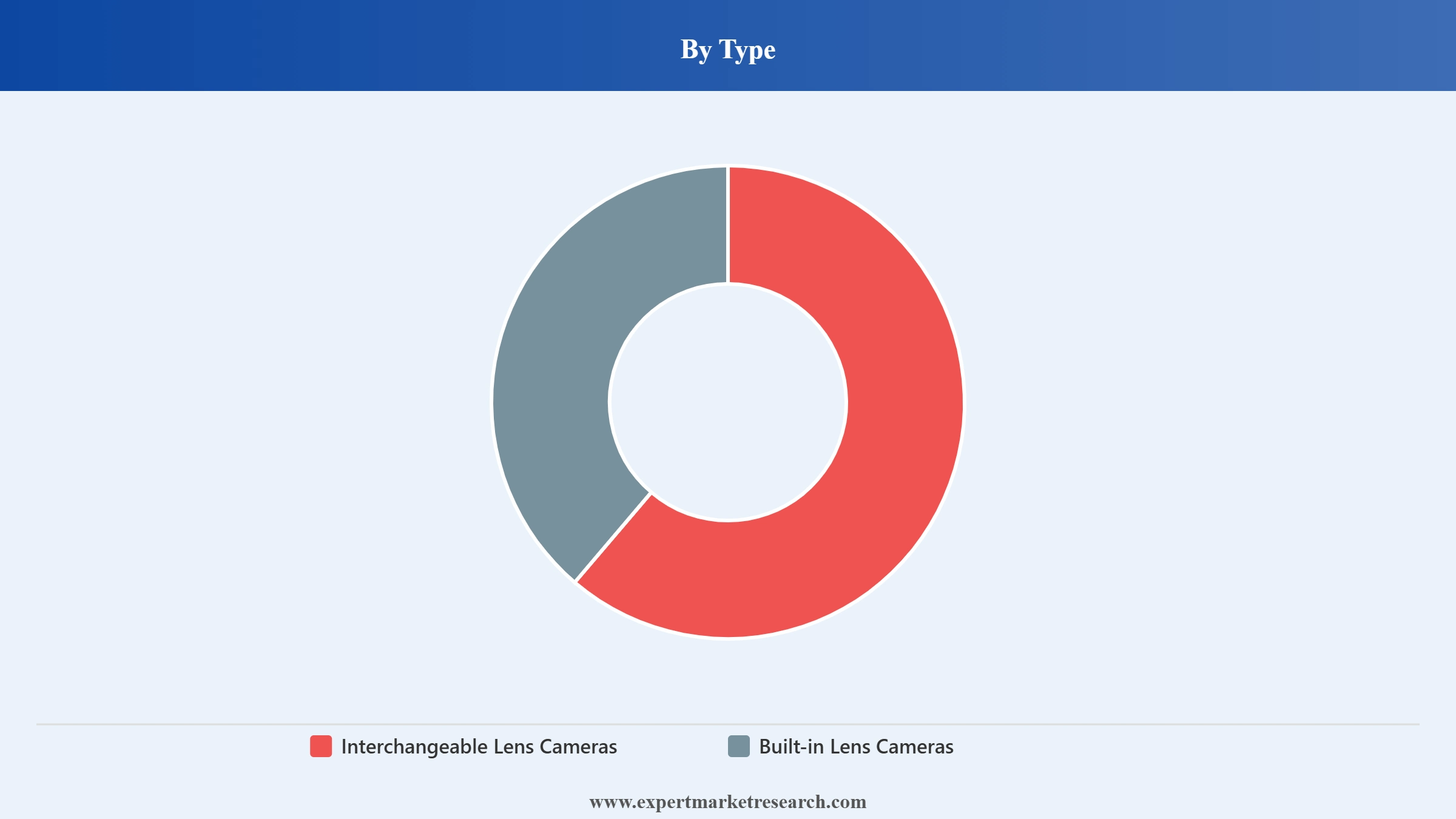
Key Insight: The UK market spans both interchangeable-lens platforms and built-in-lens products, with each addressing different procurement requirements. Interchangeable-lens cameras remain central to professional and enthusiast workflows because users can configure systems around lenses, lighting, stabilization, and video accessories. Within this category, mirrorless technology is reshaping the product mix, while traditional SLR systems retain installed-base relevance. Built-in-lens cameras, meanwhile, are gaining renewed commercial attention as manufacturers introduce larger sensors, long zoom ranges, and advanced autofocus. CIPA's global data reinforces this structural shift: interchangeable-lens cameras reached 7.00 million shipments in 2025, while built-in-lens models increased to 2.44 million. UK businesses can therefore address the market through differentiated product portfolios rather than a single camera format.
Market Breakup by Region
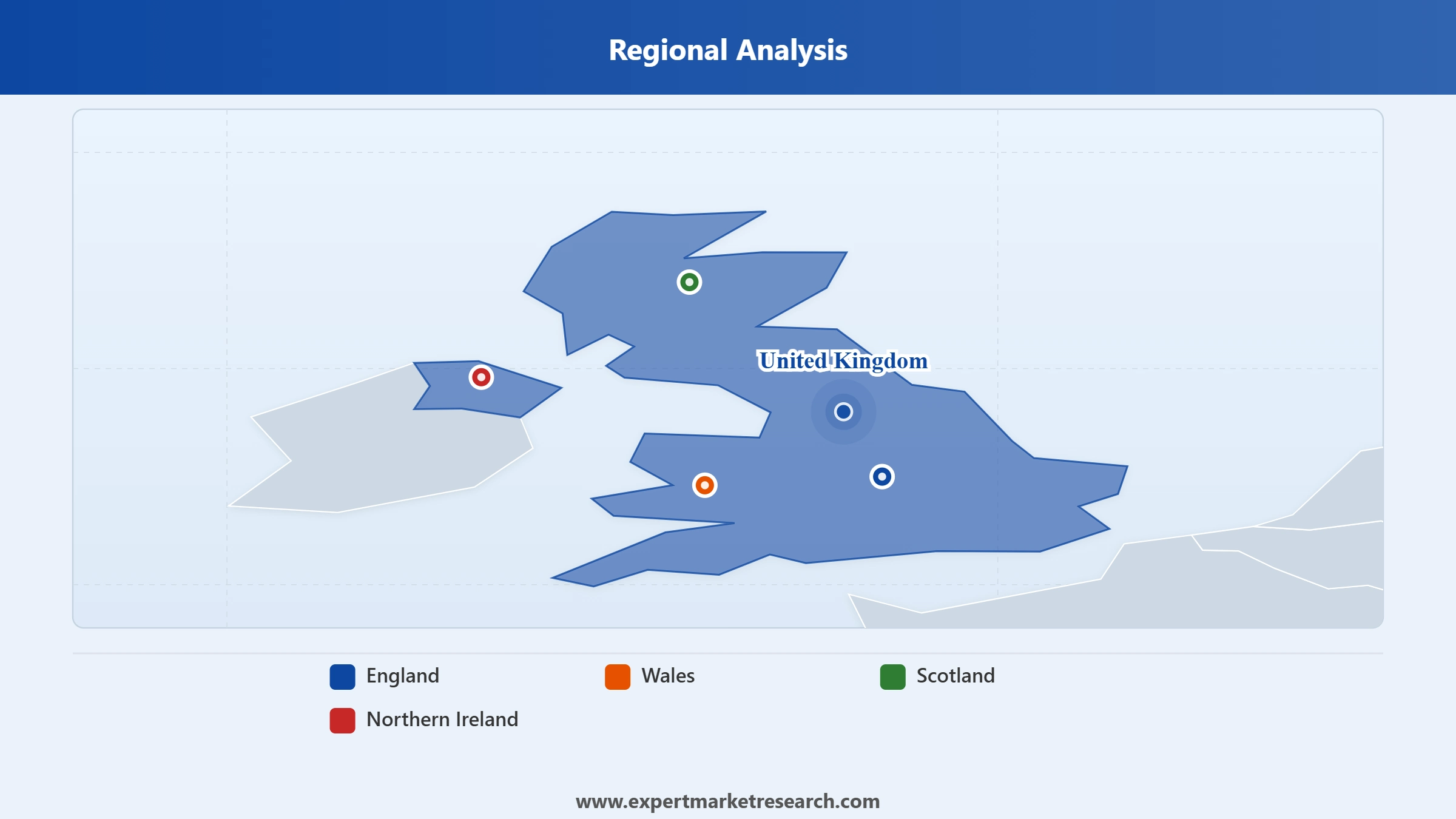
Key Insight: Regional demand reflects differences in population scale, tourism, professional media activity, creative industries, and outdoor photography. England represents the largest addressable market because of its population concentration and concentration of commercial, media, retail, and event activity. England and Wales together had an estimated 62.0 million residents at mid-2025, with population increasing 0.4% over the preceding year. Scotland represented another important specialist market, reaching 5.55 million people in mid-2025, with positive net migration of 17,900 during the year. Wales and Northern Ireland remain smaller but provide targeted opportunities in tourism, landscape, wildlife, and enthusiast photography, thus driving the demand in the United Kingdom digital camera market.
Read more about this report - REQUEST FREE SAMPLE COPY IN PDF
Interchangeable-lens cameras remain the dominant broad type because they serve professional photography, commercial content production, events, sports, wildlife, and advanced enthusiast applications. CIPA recorded 7.00 million interchangeable-lens camera shipments in 2025, equivalent to roughly three-quarters of global digital-camera shipments. Mirrorless cameras represented 6.31 million of those units, indicating that the majority of interchangeable-lens demand is now concentrated in mirrorless platforms. For UK suppliers, the segment also generates recurring demand for lenses and accessories; CIPA recorded 10.60 million interchangeable lenses shipped globally in 2025. Such developments will thus boost United Kingdom digital camera market trends in the long run.
Read more about this report - REQUEST FREE SAMPLE COPY IN PDF
Built-in-lens cameras recorded the strongest broad-format growth in the latest CIPA data, with global shipments rising 29.6% in 2025 to 2.44 million units, substantially exceeding the growth of interchangeable-lens cameras. CIPA’s 2026 outlook projects shipments to reach 2.77 million units, representing a further 13.6% increase. This growth reflects renewed demand for compact cameras that combine convenience with advanced imaging capabilities. Panasonic’s 2026 TZ300 and Sony’s RX10 V illustrate the segment’s evolution toward high-zoom systems, improved image quality, sophisticated autofocus, AI-assisted features, and enhanced connectivity. These developments are expanding built-in-lens cameras beyond traditional entry-level point-and-shoot applications among consumers and enthusiasts.
England remains the largest addressable market within the United Kingdom digital camera industry, supported by its population scale and concentration of commercial activity. ONS estimated the combined population of England and Wales at 62.0 million in mid-2025, with the total increasing 0.4% year on year. England's dense network of creative agencies, broadcasters, professional photographers, retailers, universities, sports organizations, and events provides multiple B2B routes to market. The Photography & Video Show's return to Birmingham's NEC in March 2026 further demonstrates the importance of England as a national demonstration and distribution hub, bringing manufacturers and imaging professionals together around new equipment and workflows, thereby directly boosting the United Kingdom digital camera market regional growth.
Read more about this report - REQUEST FREE SAMPLE COPY IN PDF
Scotland presents a more specialized opportunity, particularly for wildlife, landscape, outdoor, and travel imaging. Its population reached 5.55 million at mid-2025, while net migration contributed 17,900 people to population change. Wales, with approximately 3.18 million residents, experienced a 0.1% population decline in the year to mid-2025, although Newport increased 0.7%, creating localized opportunities rather than uniform national expansion. Northern Ireland's latest available official estimate placed its population at 1.93 million in mid-2024, up 0.4% year on year. Regional suppliers can therefore differentiate portfolios according to application. Professional production in England, outdoor and wildlife systems in Scotland and Wales, and compact, enthusiast-oriented equipment in smaller regional markets.
Competition in the United Kingdom digital camera market is increasingly centered on ecosystem depth rather than camera-body specifications alone. Manufacturers are extending portfolios across bodies, lenses, accessories, software, video equipment, and creator services. Sony's 2026 portfolio, for example, spans Alpha interchangeable-lens cameras, premium compact products, Cinema Line equipment, and specialist lenses. Nikon is similarly positioning its Z ecosystem across full-frame mirrorless bodies, lenses, cinema equipment, and professional creator experiences, including demonstrations at The Photography & Video Show.
United Kingdom digital camera companies are also using product segmentation and experiential retail to reach different purchasing groups. Premium telephoto products target specialist photographers, compact cameras target travelers and everyday creators, and cinema-oriented systems target production companies. This enables suppliers to increase revenue per customer through accessories, optics, upgrades, and complementary equipment rather than relying solely on replacement camera-body demand. The breadth of 2026 product announcements indicates that manufacturers are treating still photography, video production, travel imaging, and specialist photography as interconnected commercial categories.
Established in 1937, Canon is headquartered in Tokyo, Japan. Its imaging portfolio includes EOS mirrorless cameras, professional and enthusiast lenses, compact cameras, and related imaging equipment. Canon's strength lies in its broad optical and camera ecosystem, enabling customers to build systems around different professional applications. The company also operates an extensive global distribution and support structure, making its products relevant to commercial photography, content creation, events, and professional production workflows.
Founded in 1946 and headquartered in Tokyo, Sony operates across imaging, sensing, entertainment technology, and other businesses. Its digital-imaging offering includes Alpha mirrorless cameras, RX premium compact cameras, Cinema Line products, and an extensive E-mount lens portfolio. In 2026, Sony expanded its offering across high-resolution photography, superzoom, telephoto, and cinema production, strengthening its ability to serve both professional photographers and hybrid creators.
Nikon was established in 1917 and is headquartered in Tokyo, Japan. The company supplies Z-series mirrorless cameras, DSLR cameras, NIKKOR lenses, compact cameras, and cinema products. Its UK portfolio includes the Z9, Z8, Z6III, Z5II, Z50II, COOLPIX P1100, and ZR cinema camera. Nikon is also expanding customer engagement through hands-on events, product demonstrations, educational programming, and professional ambassador activity.
Panasonic's origins date to 1918, with its current corporate headquarters in Tokyo following its 2026 corporate restructuring. Its LUMIX portfolio covers full-frame mirrorless, Micro Four Thirds, compact cameras, and hybrid photo-video products. In 2026, Panasonic added the LUMIX L10 fixed-lens camera and TZ300 travel compact while continuing to expand the LUMIX S ecosystem. This gives the company exposure across both interchangeable- and built-in-lens applications.
Other key players in the United Kingdom digital camera market include FUJIFILM Holdings Corporation, Samsung Electronics Co. Ltd., OM Digital Solutions Corporation, Eastman Kodak Company, Sigma Corporation, and Leica Camera AG, among others.
*Please note that this is only a partial list; the complete list of key players is available in the full report. Additionally, the list of key players can be customized to better suit your needs.*
Explore the United Kingdom Digital Camera Market trends 2026 and assess the industry's evolving product, regional, and competitive landscape. The report provides structured insights into the United Kingdom Digital Camera Market forecast 2026-2035, segment opportunities, technology developments, and key players. Download the sample report to understand market dynamics, identify emerging opportunities, and support informed product, distribution, and investment strategies.


Upto 15% Off
USD
$2499 $2249
$3999 $3599
$4999 $4249
$5999 $5099


*While we strive to always give you current and accurate information, the numbers depicted on the website are indicative and may differ from the actual numbers in the main report. At Expert Market Research, we aim to bring you the latest insights and trends in the market. Using our analyses and forecasts, stakeholders can understand the market dynamics, navigate challenges, and capitalize on opportunities to make data-driven strategic decisions.*
In 2025, the market reached an approximate value of USD 368.25 Million.
The market is projected to grow at a CAGR of 3.70% between 2026 and 2035.
The market is estimated to witness a healthy growth in the forecast period of 2026-2035 to reach USD 529.58 Million by 2035.
The market is being driven due to availability of wide range of digital cameras in the market, increasing demand for lightweight and high-quality digital cameras, and growing number of photography enthusiasts.
Key trends aiding the market expansion include the popularity of social media platforms, rise of influencers and content creators, region's vibrant tourism industry, and demand for digital cameras among travellers and photography enthusiasts.
Regions considered in the market are England, Wales, Scotland, and Northern Ireland, among others.
Based on type, the market segmentations include interchangeable lens cameras, such as digital single lens reflex (SLR) cameras, digital rangefinders, line-scan camera system, mirrorless camera and built-in lens cameras, such as bridge cameras and compact digital cameras.
Key players in the market are Canon Inc., Sony Group Corporation, Nikon Corporation, Panasonic Corporation, FUJIFILM Holdings Corporation, Samsung Electronics Co. Ltd., OM Digital Solutions Corporation, Eastman Kodak Company, Sigma Corporation, and Leica Camera AG, among others.
Key strategies include developing advanced imaging technologies, enhancing autofocus and low-light performance, integrating wireless connectivity, expanding mirrorless camera portfolios, offering interchangeable lenses and accessories, targeting professional and enthusiast segments, strengthening retail and online distribution, and using product innovation to differentiate brands.
Explore our key highlights of the report and gain a concise overview of key findings, trends, and actionable insights that will empower your strategic decisions.
| REPORT FEATURES | DETAILS |
| Base Year | 2025 |
| Historical Period | 2019-2025 |
| Forecast Period | 2026-2035 |
| Scope of the Report |
Historical and Forecast Trends, Industry Drivers and Constraints, Historical and Forecast Market Analysis by Segment:
|
| Breakup by Type |
|
| Breakup by Region |
|
| Market Dynamics |
|
| Competitive Landscape |
|
| Companies Covered |
|
Datasheet
One User
USD 2,499
USD 2,249
tax inclusive*
Single User License
One User
USD 3,999
USD 3,599
tax inclusive*
Five User License
Five User
USD 4,999
USD 4,249
tax inclusive*
Corporate License
Unlimited Users
USD 5,999
USD 5,099
tax inclusive*
*Please note that the prices mentioned below are starting prices for each bundle type. Kindly contact our team for further details.*
Flash Bundle
Small Business Bundle
Growth Bundle
Enterprise Bundle
*Please note that the prices mentioned below are starting prices for each bundle type. Kindly contact our team for further details.*
Flash Bundle
Number of Reports: 3
20%
tax inclusive*
Small Business Bundle
Number of Reports: 5
25%
tax inclusive*
Growth Bundle
Number of Reports: 8
30%
tax inclusive*
Enterprise Bundle
Number of Reports: 10
35%
tax inclusive*
How To Order

Select License Type
Choose the right license for your needs and access rights.

Click on ‘Buy Now’
Add the report to your cart with one click and proceed to register.

Select Mode of Payment
Choose a payment option for a secure checkout. You will be redirected accordingly.
Strategic Solutions for Informed Decision-Making
Gain insights to stay ahead and seize opportunities.

Get insights & trends for a competitive edge.

Track prices with detailed trend reports.

Analyse trade data for supply chain insights.

Leverage cost reports for smart savings

Enhance supply chain with partnerships.

Connect For More Information
Our expert team of analysts will offer full support and resolve any queries regarding the report, before and after the purchase.
Our expert team of analysts will offer full support and resolve any queries regarding the report, before and after the purchase.
We employ meticulous research methods, blending advanced analytics and expert insights to deliver accurate, actionable industry intelligence, staying ahead of competitors.
Our skilled analysts offer unparalleled competitive advantage with detailed insights on current and emerging markets, ensuring your strategic edge.
We offer an in-depth yet simplified presentation of industry insights and analysis to meet your specific requirements effectively.




