

Consumer Insights
Uncover trends and behaviors shaping consumer choices today
Procurement Insights
Optimize your sourcing strategy with key market data
Industry Stats
Stay ahead with the latest trends and market analysis.
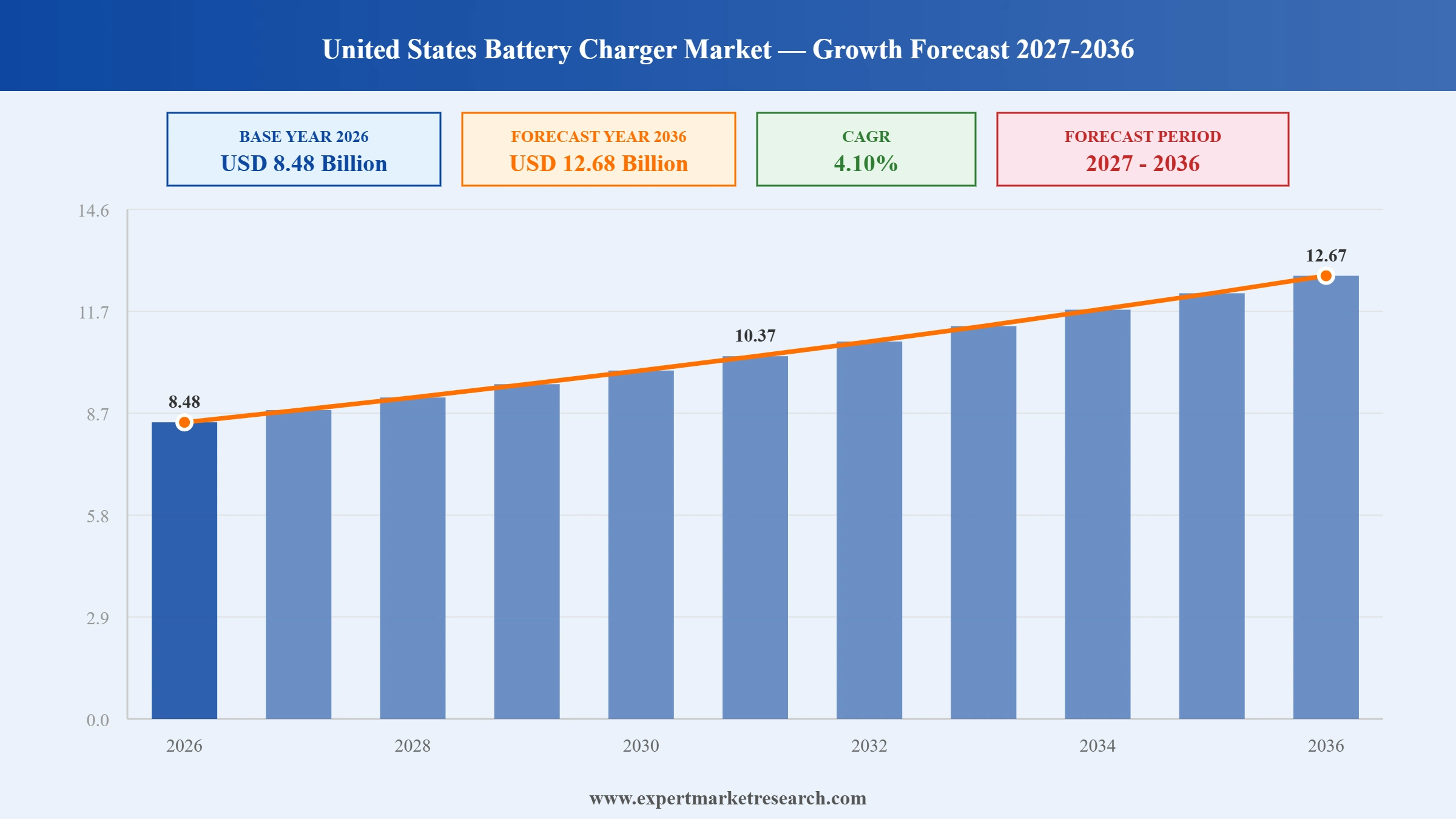
The United States battery charger market attained a value of USD 8.15 Billion in 2025 and is projected to expand at a CAGR of 4.10% through 2035. The market is further expected to achieve USD 12.18 Billion by 2035. The increasing use of electric material handling equipment is leading to an increased demand for programmable chargers that improve battery condition, increase availability, and accommodate different types of batteries in warehouse fleets and automated facilities.
The growing adoption of fleets of electric vehicles is leading to an increased demand for high power chargers at logistics and distribution centers and commercial depots due to the need for reduced charge times for optimal vehicle utilization, accelerating the United States battery charger market value. On the other hand, integration with battery management systems is leading to increased demand by charger manufacturers for smarter platforms with diagnostics and remote monitoring functionalities. This allows the chargers to be configured based on the condition and usage of the batteries.
Domestic manufacturing and advanced charging technologies are reshaping the dynamics of the United States battery charger market, with manufacturers focusing on reliable, application-specific solutions. In August 2025, Lester Electrical enhanced the industrial charging market in the United States with the introduction of the TT-650W, a 650-watt battery charger that was developed and made in Lincoln, Nebraska. The new product was built based on the themes of domestic engineering, reliable performance, and applications from electrical tools to industrial vehicles. The Ascendrix family represents the company’s more recent innovation, the charger that incorporates the technologies of switch-mode charging and vehicle communication, pointing at the direction of OEM charger integration.
Rising demand for high-power and flexible EV charging infrastructure is encouraging companies in the United States battery charger market to develop scalable systems that support multiple vehicles and energy-management applications. The Express Solo charger of 600 kW from ChargePoint was launched in April 2026 and represented the new generation architecture of the company. The system has an ability to supply 600 kW to a single vehicle or to spread the power between four vehicles, while co-development with Eaton company allows for bidirectional charging and battery storage capabilities. The infrastructure investments are also impressive. In January 2025, the Department of Transportation invested USD 635 million in the projects, which will be able to deploy over 11,500 EV charging ports in 27 states, tribes, and Washington, D.C.
Read more about this report - Request a Free Sample
Elevated Materials received USD 50 million from DOE to increase lithium films production for fast-charging batteries. Manufacturers in the United States battery charger market can work on developing high-power battery chargers that can be used for new batteries in the future and build strong alliances in the domestic battery manufacturing supply chain.
IEB Americas announced the establishment of a USD 1.5 million North Charleston facility for industrial charging systems, testing, warehousing, servicing, training, and manufacturing. The facility will enable manufacturers to localize manufacturing, servicing, training, and technical assistance to cater to United States industrial fleets.
CATL introduced the Tectrans II, which is an 8C battery that reaches 80% capacity in 6 minutes, 48 seconds for light duty commercial vehicles. Companies can develop ultra-fast charging for logistics fleet vehicles, commercial vehicles, and applications that benefit from reduced charging downtime, accelerating the United States battery charger market value.
CTEK introduced CS ONE Gen 2 with Wi-Fi, connectivity, adaptive charging, monitoring, updates, and charging history features. Companies can integrate connectivity, adaptive charging, diagnostics, and monitoring into their charger design to develop smart battery management products.
Electrifying the commercial fleet drives the need for higher power charger solutions to minimize vehicle dwell time in depots, ports, and distribution centers, boosting growth in the United States battery charger market. As part of the SuperTruck Charge program announced in January 2025, the Department of Energy is committing USD 68 million towards demonstration projects that build large-scale charging facilities for medium- and heavy-duty electric vehicles adjacent to ports, distribution hubs, and major freight corridors. The initiative is driving interest in higher power density, advanced load management, and increased grid resilience capabilities in chargers among suppliers. Such projects present opportunities for manufacturers of modular DC chargers, power sharing units, and charging infrastructure for commercial fleets.
Bidirectional charging represents an important product development opportunity in the United States battery charger market led by utilities' and fleet owners' interest in vehicle batteries as flexible grid assets. In January 2025, the Department of Energy made a conditional commitment of up to USD 705.1 million to support Zum Services' Project Marigold, which involves construction of 17 electric-bus charging lots, bidirectional chargers, and charge management software for at least 13 school districts in eight states. Charger suppliers are therefore targeting hardware capable of vehicle-to-grid operation, automated energy management, and utility coordination. For example, in January 2025, Nuvve launched 20-360 kW bidirectional and unidirectional chargers supporting fleets, public infrastructure, microgrids, and V2G applications.
The rapid rollout of publicly available charging infrastructure is leading to growing demand for DC fast chargers, power sharing solutions, and charging infrastructure designed to serve multiple vehicles at once. In December 2024, DOE issued a USD 1.25 billion loan guarantee to support EVgo in deploying around 7,500 chargers at 1,100 stations using dual-port 350-kW DC fast charging technology. Such projects incentivize manufacturers to develop chargers that have higher throughput and uptime, as well as scalable station designs, creating new United States battery charger market opportunities. In June 2026, Walmart rapidly expanded its branded EV charging network, opening 46 high-speed stations with 380 cords.
Domestic manufacturing is becoming an increasingly important differentiator among battery charger suppliers competing in the federal EV infrastructure market. In February 2026, the Federal Highway Administration introduced a proposal to extend Buy America requirements to all publicly funded EV chargers, raising the requirement for domestic content from 55% to 100%. Such measures aim at supporting domestic manufacturing and improving supply chain resiliency, accelerating the overall United States battery charger market development. This legislative trend encourages charger manufacturers to assemble their products, manufacture power electronics, and source components domestically while developing networks of domestic suppliers. In September 2026, NOVONIX partnered with ACP Technologies to develop domestic synthetic graphite anode materials, supporting faster charging and battery supply-chain resilience.
The makers of charger components are increasingly adopting the features of software, diagnostics, communication, and energy management due to the demands of consumers for improved insight into their charging efficiency. The Department of Energy predicts that there will be a need for 28 million charging ports by 2030 for about 33 million electric vehicles, with approximately 92 percent being private level 1 and 2 ports in individual households. The anticipated magnitude is motivating manufacturers in the United States battery charger market to design smarter chargers that allow them to adjust charging times based on power costs and work in harmony with renewable energy sources. In April 2026, XCharge North America and JOJO Superfast EV Charging launched new Midwest charging infrastructure, expanding access to high-power EV charging.
The Expert Market Research's report titled “United States Battery Charger Market Report and Forecast 2026-2035” offers a detailed analysis of the market based on the following segments:
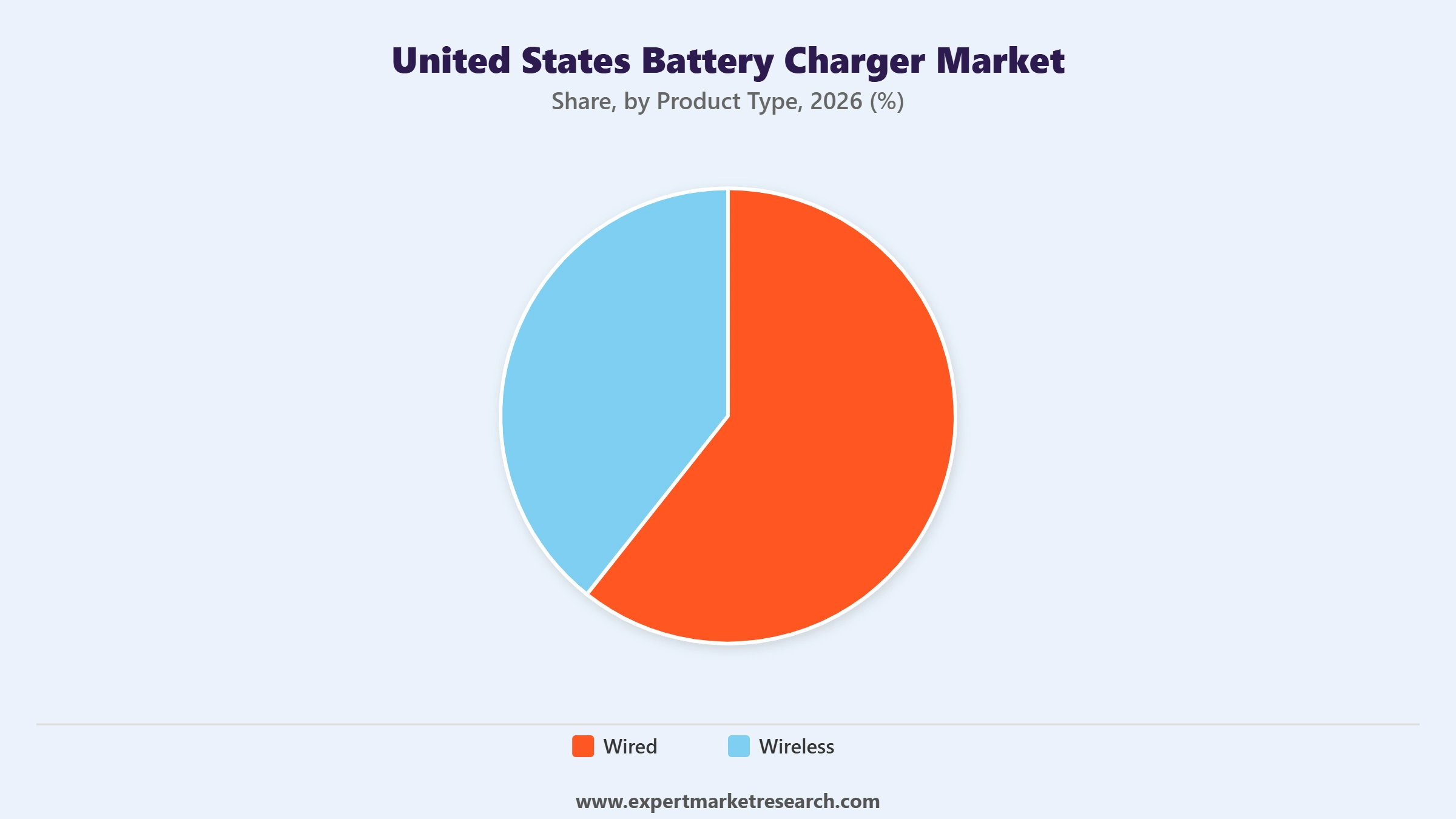
Market Breakup by Product Type
Key Insight: Wired chargers continue to play an integral role in the design of smartphones, laptops, tablets, digital cameras, electric vehicles, and other electrical devices since standard ports help in providing efficient and reliable power supply and enable better procurement of fleets. On the other hand, wireless chargers become important components in smartphones and specialized devices since their use makes things convenient, durable, and industrial in nature, strengthening demand in the United States battery charger market. In the wireless domain, automatic devices and gadgets are being considered for development.
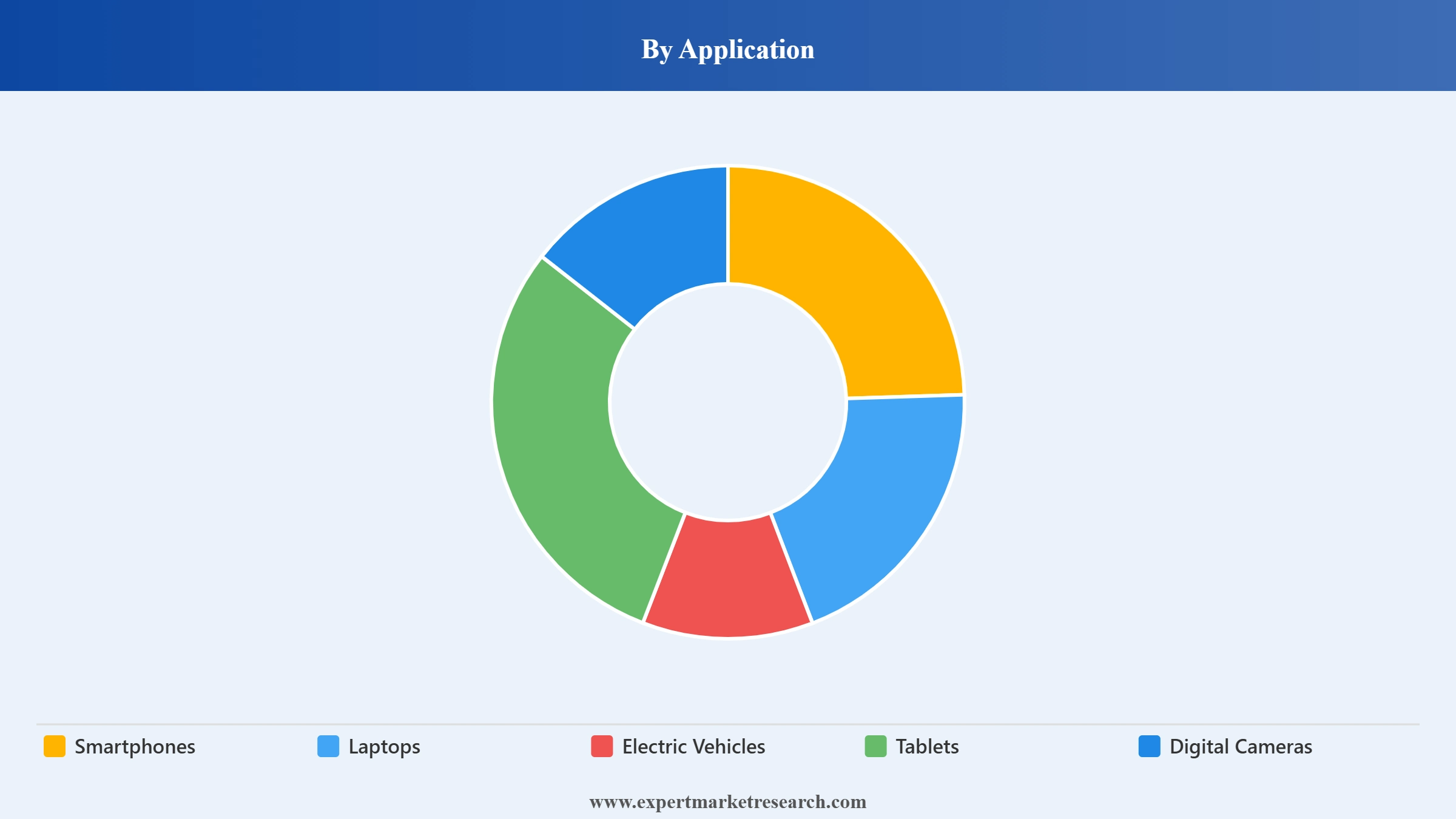
Market Breakup by Application
Key Insight: Smartphones sustain high demand in the United States battery charger market via quick device turnover rate, fast charging, and usage of multiple devices. High wattage and good thermal efficiency and USB-C compatibility are necessary for laptops, while there is a rise in demands for powerful and smart charging solutions for EVs due to their power management needs. In April 2026, Magnachip launched 12V BatteryFETs delivering ultra-low resistance, higher current density, and improved efficiency for next-generation smartphone charging. Tablets gain advantages in the form of mobility charging and multi-device ecosystems, whereas digital cameras rely on portable charging and battery-related solutions. The remaining category includes wearables, industrial electronics, robotics, and other devices with specific charging profiles.
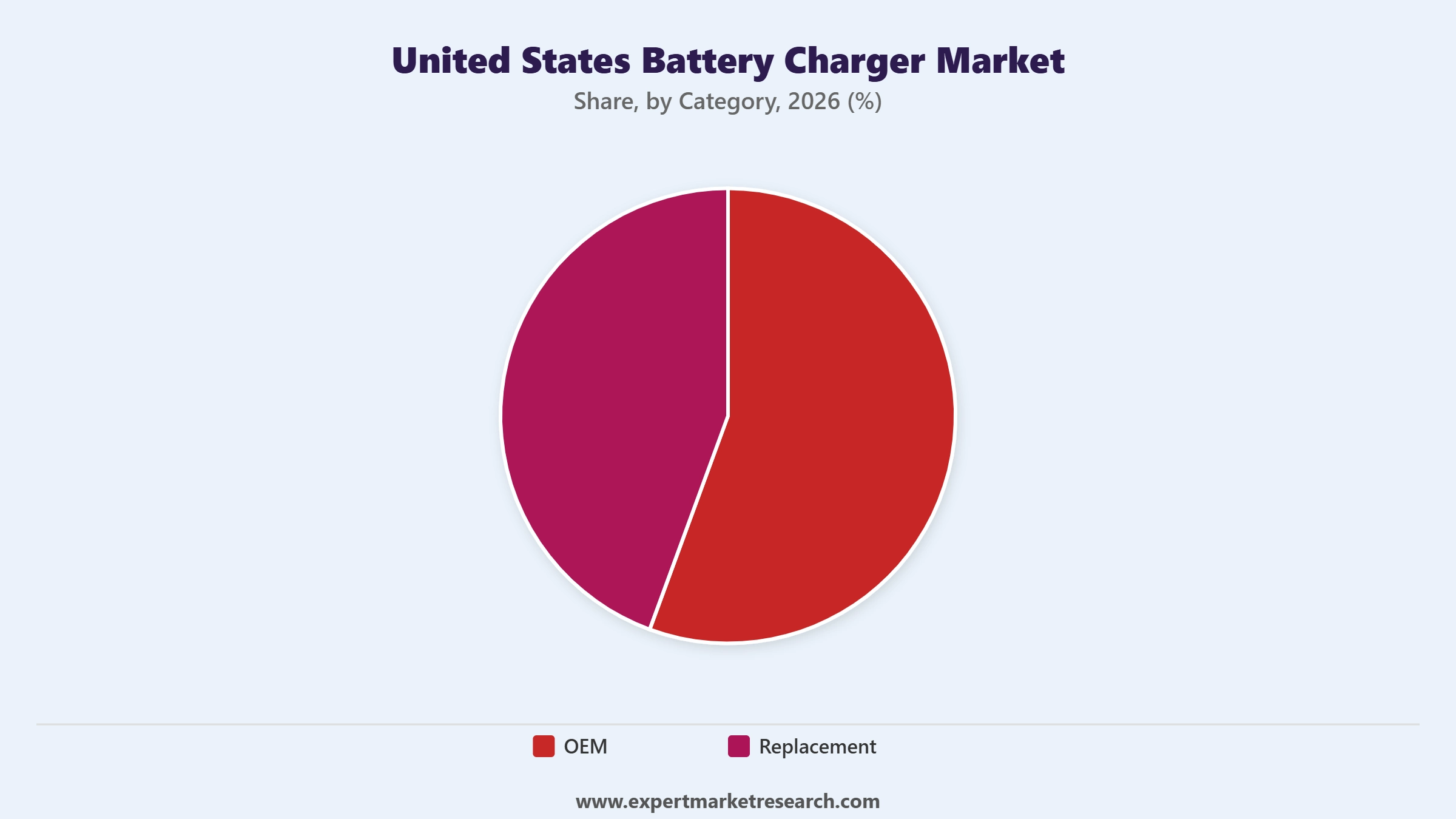
Market Breakup by Category
Key Insight: The OEM chargers continue to dominate across the United States battery charger market scope due to the need by manufacturers for optimal integration of charging technology with battery technology, thermal design, and the end-product design. This applies to smartphones, laptop computers, tablets, cameras, and even electric vehicles through the creation of charger specifications according to applications during product development. There is an increasing popularity of replacement chargers through aging equipment, change of connections, broken connectors, and better performance needs. In May 2025, Battery Tender launched two-in-one chargers and jump starters combining smart charging, maintenance, and emergency starting for multiple vehicle applications.
Market Breakup by Region
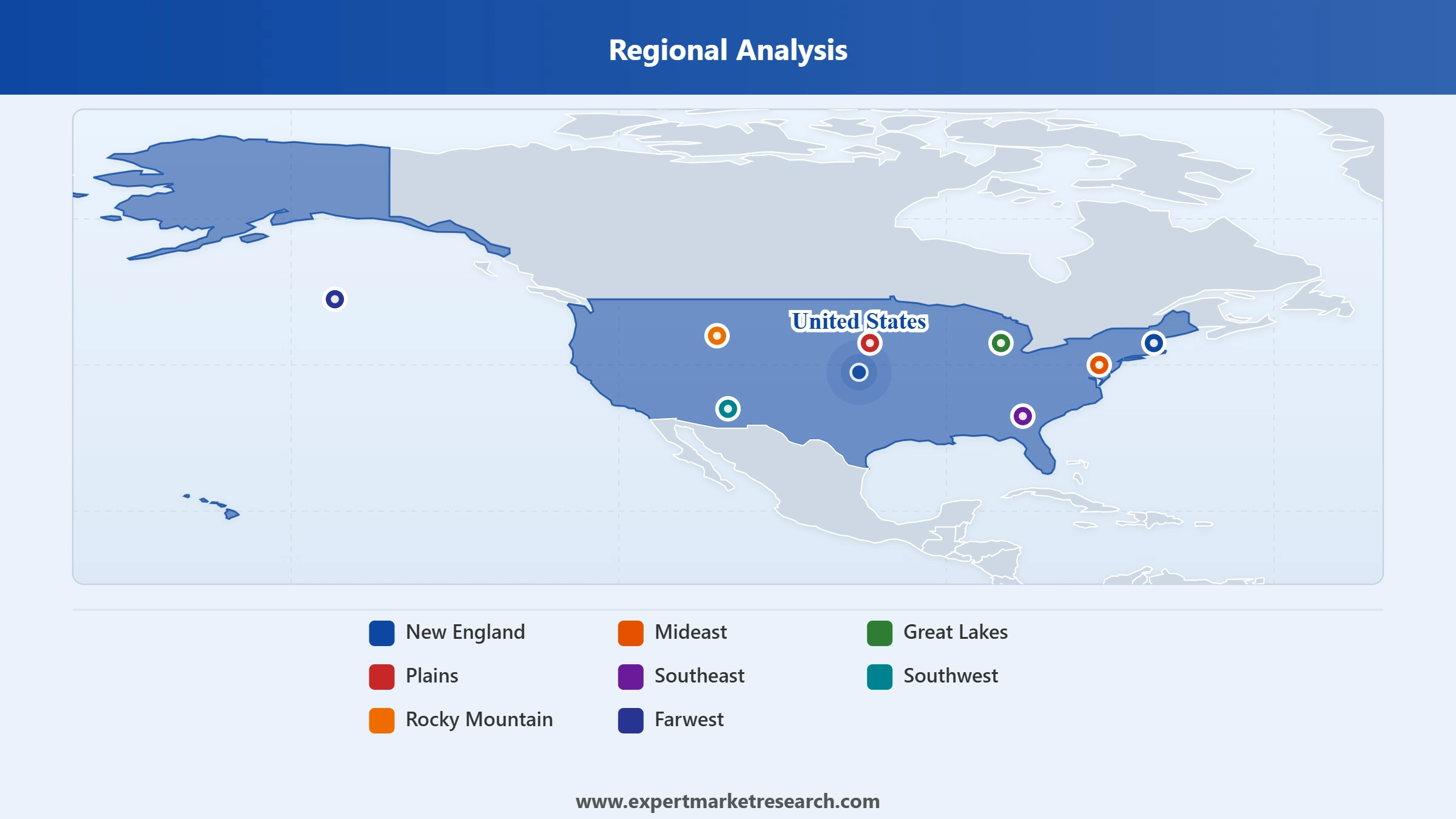
Key Insight: Regional dynamics in the United States battery charger market indicates that the Farwest region dominates because of the implementation of high technology, electronics, and electric mobility, which necessitate the wide use of charging stations. In the case of the Southeast, rapid growth occurs due to manufacturing activities in the automotive industry, logistics, industrial electrification, and commercial fleet demands. The Mideast experiences growth in demand as a result of heavy business and consumer electronics demand. Meanwhile, New England favors special technology and institutional uses. In the case of Great Lakes, demand arises due to manufacturing and automotive activities. On the other hand, the Plains market is impacted by commercial transportation and industrial facilities.
Wired battery chargers lead growth in the market due to reliability, compatibility, and established charging infrastructure
Wired battery chargers continue to be preferred as manufacturers offer reliable power transmission, compatibility, and easy integration within OEM equipment, accelerating growth in the United States battery charger market. These are highly desirable when charging reliability and uninterrupted use of equipment is required such as industrial electronics, laptops, smartphones, and electric cars. In addition, standardization of connectors makes it easier to procure and replace fleets of companies. Manufacturers of chargers are trying to develop higher power density, thermal solutions, robustness of cables, and adaptive charging controls that would be needed in the light of more complex battery design. In March 2026, MED-EL U.S. launched two rechargeable battery options offering up to 23 hours of hearing for SONNET 3 audio processors.
Read more about this report - Request a Free Sample
Wireless battery chargers are becoming popular as the equipment manufacturers pay attention to user convenience, waterproof design, and less strain on connectors. This type of charger is becoming increasingly important when it comes to smartphones, wearables, automated guided vehicles, robotics, and specific industrial machinery where elimination of physical contacts is desirable to increase usability and uninterrupted equipment functioning. Manufacturers are developing resonant charging architecture, improved tolerance for alignment, and increased efficiency of power transmission that has been traditionally considered a challenge for wireless battery chargers. Demonstrating this trend in the United States battery charger market, in September 2026, Porsche introduced an 11-kW wireless charging system for Cayenne Electric, enabling cable-free charging through an inductive floor-mounted pad.
By application, smartphones lead the overall battery charger demand growth due to replacement cycles, fast charging, and broad device penetration
Smartphone chargers continue to be the largest segment in the United States battery charger market because of the existing installed base, frequent device upgrades, and increased demand for fast charging capacity. Charger manufacturers are meeting the demand through high-wattage compact adapters, USB-C compatibility, multi-device charger platforms, and power management technology that maintains the efficiency of charging while regulating heat generation. High-end smartphones demand charger solutions that support fast charging without shortening the lifespan of the battery, which provides a business opportunity for companies with gallium nitride technology.
Read more about this report - Request a Free Sample
Electric cars significantly add to the overall United States battery charger market value since they need chargers that can handle large batteries and shorter time periods to charge. There is a greater demand for fast charging technology that is high powered, smart in managing the power supply, modularity, and communication of charging devices that can interact with the battery management system in the car. Commercial fleets need reliable chargers that can be managed based on the availability of electric vehicles and available power. For example, Mitsubishi’s Eclipse Sportback, launched in July 2026, supports native NACS and J1772 charging, enabling Level 1, 2, and 3 charging without adapters.
OEM battery chargers dominate the market due to integrated design requirements and manufacturer-specific compatibility
OEM chargers represent the largest share of the United States battery charger market revenue due to the fact that charger specifications are developed in parallel with those of batteries and other systems, and with complete electronic devices. It allows for optimizing the charging process according to specific battery type, temperature conditions, and so on. It is especially vital for electric cars, laptops, smartphones, and industrial equipment whose functionality depends on charging properties. Thus, charger providers targeting OEMs pay much attention to customization, communication features, safety compliance, and compactness of chargers. In December 2025, GMG unveiled graphene aluminum-ion battery technology targeting full charging in under six minutes, supporting high-power applications.
Read more about this report - Request a Free Sample
Replacement chargers are becoming a fast-growing market due to old chargers, change in the connector types, charging equipment damage, and device upgrade, which create opportunities for United States battery charger market growth. The growing demand for replacement chargers stems from consumers and companies' desire to acquire devices that will provide faster charging, be certified in terms of safety, have wider compatibility, and offer better energy efficiency compared to the initial one. Replacement chargers may also be purchased by companies to unify their equipment or use new battery types.
Read more about this report - Request a Free Sample
The Farwest region accounts for the leading market position due to technology adoption and accelerating electric mobility infrastructure
The Farwest region is dominating the United States battery charger market due to advanced adoption of technology, developed electronic systems, and developed electric mobility systems. Demand for chargers will span consumer electronics, enterprise devices, electric vehicles, and specialized industrial equipment, creating opportunities across diverse end-use applications. Technology companies and EV ecosystem players are prompting charger manufacturers to consider designing small power electronics, quick chargers, connectivity, and smart energy management systems. In August 2026, California allocated USD 95.2 million for EV charging, hydrogen refueling, workforce training, and medium-heavy-duty infrastructure projects.
The Southeast United States battery charger market exhibits high potential for growth due to automotive manufacturing expansion, logistics operations, population growth, and electrification programs increasing the need for battery chargers. The growth of the demand for the charger will be in electric cars, industrial machines, consumer electronics, and commercial fleets. Growth in investment in automotive and batteries manufacturing is creating opportunities for manufacturers to make high-power chargers, warehouse chargers, and machines that can accommodate advanced battery systems.
Read more about this report - Request a Free Sample
The market is expected to move towards technology-based competition that includes high power conversion, load management, bi-directional charging, small form factor architecture, and application-specific solutions. Key United States battery charger market players like Eaton are bolstering their charging infrastructure through collaboration, while making intelligent residential and commercial charging solutions with built-in load management.
Most opportunities for United States battery charger companies exist in integrated power electronics, connectivity, diagnostics, thermal management, and interoperability. Domestic production, fleet charging, integration with energy management systems, and compatibility with evolving battery chemistry are other areas being explored by the players. Supplier companies can leverage alliances with utilities, vehicle OEMs, infrastructure providers, and industrial machinery makers to secure contracts and expedite product qualifications.
Eaton Corporation plc, formed in 1911, is based in Dublin, Ireland. The company supports the market with the provision of integrated power management and eMobility products. These products consist of high-power DC chargers, Level 2 chargers, smart breaker chargers, and power distribution products.
Schneider Electric SE, formed in 1836, is based in Rueil-Malmaison, France. For the United States, Schneider combines EV charging solutions with electrical infrastructure and energy management. The company's Schneider Charge and Charge Pro offer solutions for residential, workplace, multi-family, destination, and fleet charging using intelligent load management without electrical improvements.
Phihong Technology Co. Ltd. was founded in 1972 and operates out of Taoyuan City, Taiwan. It manufactures lithium-ion and lead acid battery chargers for American customers in capacities varying from 1W to 1kW and catering to power tools, consumer electronics, robotics, mobility solutions, e-bikes, wheelchairs, motorcycles, and special OEM applications worldwide.
Ultralife Corporation was founded in 1991 and is based in Newark, New York, United States. It offers rechargeable batteries, charging systems, and power solutions to customers in government, defense, medical, safety, security, energy, and industrial segments. Its business model is centered around application engineering, tough power solutions, and battery charger solutions.
Other key players in the market include Yuasa Battery, Inc., Panasonic Holdings Corp., Schumacher Electric Corporation, Exide Technologies, LLC, Associated Equipment Corp., Charging Technologies Inc., and HindlePower, Inc., among others.
*Please note that this is only a partial list; the complete list of key players is available in the full report. Additionally, the list of key players can be customized to better suit your needs.*
Unlock the latest insights with our United States battery charger market trends 2026 report. Discover regional growth patterns, consumer preferences, and key industry players. Stay ahead of competition with trusted data and expert analysis. Download your free sample report today and drive informed decisions in the market.
North America Battery Charger Market


Upto 15% Off
USD
$2499 $2249
$3999 $3599
$4999 $4249
$5999 $5099


*While we strive to always give you current and accurate information, the numbers depicted on the website are indicative and may differ from the actual numbers in the main report. At Expert Market Research, we aim to bring you the latest insights and trends in the market. Using our analyses and forecasts, stakeholders can understand the market dynamics, navigate challenges, and capitalize on opportunities to make data-driven strategic decisions.*
The market is projected to grow at a CAGR of 4.10% between 2026 and 2035.
Stakeholders are developing high-efficiency chargers, expanding domestic sourcing, integrating diagnostics, forming utility partnerships, targeting fleet customers, improving interoperability, and combining charging hardware with intelligent energy-management platforms.
The key trends aiding the market include the rising prevalence of lithium-ion batteries and the adoption of renewable energy sources, specifically solar power, in battery charging solutions.
Regions considered in the market are New England, Mideast, Great Lakes, Plains, Southeast, Southwest, Rocky Mountain, and Farwest.
Based on product type, market segmentations include wired and wireless.
Different applications are smartphones, laptops, electric vehicles, tablets, and digital cameras, among others.
The key players in the market include Eaton Corporation Plc, Schneider Electric SE, Phihong Technology Co. Ltd., Ultralife Corp., Yuasa Battery, Inc., Panasonic Holdings Corp., Schumacher Electric Corporation, Exide Technologies, LLC, Associated Equipment Corp., Charging Technologies Inc., and HindlePower, Inc., among others.
In 2025, the market reached an approximate value of USD 8.15 Billion.
The market is estimated to witness a healthy growth in the forecast period of 2026-2035 to reach about USD 12.18 Billion by 2035.
Companies face high power-electronics costs, complex certification requirements, battery-chemistry changes, interoperability gaps, grid constraints, supply-chain risks, cybersecurity exposure, intense pricing pressure, and demanding uptime expectations from commercial customers.
Explore our key highlights of the report and gain a concise overview of key findings, trends, and actionable insights that will empower your strategic decisions.
| REPORT FEATURES | DETAILS |
| Base Year | 2025 |
| Historical Period | 2019-2025 |
| Forecast Period | 2026-2035 |
| Scope of the Report |
Historical and Forecast Trends, Industry Drivers and Constraints, Historical and Forecast Market Analysis by Segment:
|
| Breakup by Product Type |
|
| Breakup by Application |
|
| Breakup by Category |
|
| Breakup by Region |
|
| Market Dynamics |
|
| Competitive Landscape |
|
| Companies Covered |
|
Datasheet
One User
USD 2,499
USD 2,249
tax inclusive*
Single User License
One User
USD 3,999
USD 3,599
tax inclusive*
Five User License
Five User
USD 4,999
USD 4,249
tax inclusive*
Corporate License
Unlimited Users
USD 5,999
USD 5,099
tax inclusive*
*Please note that the prices mentioned below are starting prices for each bundle type. Kindly contact our team for further details.*
Flash Bundle
Small Business Bundle
Growth Bundle
Enterprise Bundle
*Please note that the prices mentioned below are starting prices for each bundle type. Kindly contact our team for further details.*
Flash Bundle
Number of Reports: 3
20%
tax inclusive*
Small Business Bundle
Number of Reports: 5
25%
tax inclusive*
Growth Bundle
Number of Reports: 8
30%
tax inclusive*
Enterprise Bundle
Number of Reports: 10
35%
tax inclusive*
How To Order

Select License Type
Choose the right license for your needs and access rights.

Click on ‘Buy Now’
Add the report to your cart with one click and proceed to register.

Select Mode of Payment
Choose a payment option for a secure checkout. You will be redirected accordingly.
Strategic Solutions for Informed Decision-Making
Gain insights to stay ahead and seize opportunities.

Get insights & trends for a competitive edge.

Track prices with detailed trend reports.

Analyse trade data for supply chain insights.

Leverage cost reports for smart savings

Enhance supply chain with partnerships.

Connect For More Information
Our expert team of analysts will offer full support and resolve any queries regarding the report, before and after the purchase.
Our expert team of analysts will offer full support and resolve any queries regarding the report, before and after the purchase.
We employ meticulous research methods, blending advanced analytics and expert insights to deliver accurate, actionable industry intelligence, staying ahead of competitors.
Our skilled analysts offer unparalleled competitive advantage with detailed insights on current and emerging markets, ensuring your strategic edge.
We offer an in-depth yet simplified presentation of industry insights and analysis to meet your specific requirements effectively.




