

Consumer Insights
Uncover trends and behaviors shaping consumer choices today
Procurement Insights
Optimize your sourcing strategy with key market data
Industry Stats
Stay ahead with the latest trends and market analysis.
The United States flooring market was valued at USD 23.19 Billion in 2025. The market is expected to grow at a CAGR of 4.10% during the forecast period of 2026-2035 to reach a value of USD 34.66 Billion by 2035. Growing renovation activities in the United States housing sector are propelling flooring demand, as homeowners increasingly opt for cost-efficient yet durable flooring upgrades across kitchens, basements, and living spaces.
The market is undergoing a major transition, driven largely by sustainability-focused construction and consumer preference for eco-certified products. A pivotal driving factor has been the rising adoption of low-VOC (volatile organic compounds) flooring materials, which aligns with stricter indoor air quality regulations set by the Environmental Protection Agency (EPA). According to the United States flooring market analysis, investment in residential construction shot up 1.5%, with outlays on new single-family projects rising 0.8% in October 2024, creating heightened demand for sustainable flooring solutions across both urban and suburban development projects.
Another strong influence comes from federal and state-level sustainability programs. For instance, the United States Green Building Council’s LEED certification continues to encourage builders to adopt flooring products that minimize carbon emissions during production. Additionally, the Infrastructure Investment and Jobs Act, allocating USD 1.2 trillion, is indirectly boosting non-residential flooring needs, particularly in public infrastructure like schools and healthcare centers, boosting growth in the United States flooring market. Simultaneously, companies are investing in circular economy models, such as Tarkett’s flooring recycling initiative in the United States, highlighting innovation that appeals to B2B buyers looking to align with ESG goals.
Compound Annual Growth Rate
4.1%
Value in USD Billion
2026-2035
Armstrong Flooring® TimberTones® Densified Hardwood, a ground-breaking flooring innovation designed to satisfy the exacting requirements of contemporary business environments, was introduced by AHF Products. This enhances commercial market competitiveness with densified hardwood built for durability and modern business aesthetics.
With its Home Floor AdvantageTM, a reimagined in-home purchasing experience, Empire Today, LLC, a pioneer in direct-to-consumer flooring, established a new benchmark for home flooring projects. This elevates residential flooring adoption through an innovative in-home shopping experience tailored to consumer convenience.
The first-ever carbon negative Nora® rubber flooring prototype was unveiled by Interface, Inc., a global flooring solutions firm and sustainability leader. This advances sustainability leadership by setting a benchmark for carbon-negative materials in the United States flooring market.
With assistance from Shaw Industries, USA Flooring announced the launch of a cutting-edge Partner Rewards Loyalty program created by The Incentive Group for professional clients. This development strengthens B2B relationships by rewarding professional clients and boosting brand loyalty within the market.
The momentum around LEED and WELL certifications has amplified demand for eco-friendly flooring materials. Manufacturers are rethinking supply chains to incorporate recycled vinyl, reclaimed wood, and bio-based resins. According to the United States Green Building Council, over 46,000 projects were LEED-certified, as of July 2024, many incorporating green flooring systems to meet certification standards, accelerating demand in the United States flooring market. B2B buyers, especially real estate developers, are prioritizing flooring solutions that reduce embodied carbon. For instance, Interface Inc. expanded its carbon-negative carpet tile lines, launched in October 2020, tapping into this growing need for sustainability compliance.
The Infrastructure Investment and Jobs Act continues to unlock opportunities for flooring suppliers in the institutional and commercial space. With a USD 550 billion allocation specifically for new projects till 2027, flooring demand is increasing across public facilities like airports, schools, and government offices. Projects such as the modernization of JFK Airport in New York highlight how large-scale flooring contracts can benefit manufacturers with resilient product portfolios, propelling the United States flooring market opportunities. Companies that offer low-maintenance and high-durability flooring, like ceramic tiles or commercial vinyl, are being increasingly favored for government contracts.
The adoption of sensor-embedded smart flooring is no longer considered uncommon. Corporate offices and healthcare facilities have started adopting modular flooring with IoT-enabled capabilities for energy management and foot traffic analytics. Shaw Industries, for example, introduced modular flooring solutions designed for fast replacement in July 2023, aligning with office space reconfiguration trends. B2B clients are now evaluating flooring not just as a design element but also as a functional infrastructure tool, fueling investments into R&D around modular smart floors.
Luxury vinyl tile has outperformed traditional flooring options in recent years due to its balance of affordability, aesthetics, and durability. The resilient nature of LVT makes it suitable for high-traffic commercial zones as well as residential renovations. This United States flooring market trend is particularly supported by technological upgrades like 3D printing, enabling wood- and stone-look finishes at a fraction of the cost. Commercial buyers, especially in hospitality and retail, prefer LVT for quick installations that minimize operational downtime.
Geopolitical instability and supply chain disruptions have accelerated demand for domestically produced flooring in the United States. Manufacturers are emphasizing local sourcing of raw materials such as hardwood and engineered wood to ensure supply reliability. Brands like Armstrong Flooring are leveraging this shift by marketing their products as “Made in America,” appealing to B2B buyers concerned about lead times and compliance with trade policies.
Read more about this report - REQUEST FREE SAMPLE COPY IN PDF
The EMR’s report titled “United States Flooring Market Report and Forecast 2026-2035” offers a detailed analysis of the market based on the following segments:
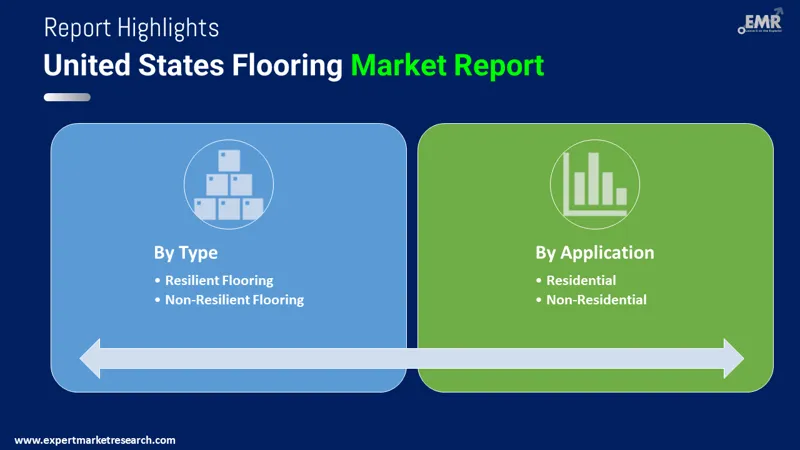
Market Breakup by Type
Key Insight: The United States flooring industry spans across resilient flooring, valued for cost efficiency, durability, and versatility; non-resilient flooring, admired for its premium aesthetics and long-term appeal; and carpets and rugs, chosen for comfort, warmth, and acoustic benefits, especially in residential projects. Their combined presence highlights a market shaped by evolving lifestyles, sustainability demands, and modernization trends.
Market Breakup by Application
Key Insight: The United States flooring market, categorized by application, is dominated by residential flooring, driven by strong remodeling activity and rising homeowner investments in modern upgrades. Non-residential flooring is expanding its market share rapidly, fueled by growth in commercial spaces, healthcare, and institutional projects requiring durability and compliance with building standards. Meanwhile, industrial flooring remains a niche category, but it plays an essential role in supporting manufacturing resilience, with demand concentrated in sectors that prioritize heavy-duty performance, safety, and long-term operational efficiency across facilities.
Read more about this report - REQUEST FREE SAMPLE COPY IN PDF
By type, resilient flooring secures the largest share due to durability and versatility
Resilient flooring, especially vinyl and LVT, dominates the market due to its cost-effectiveness, durability, and customization potential. Commercial establishments such as hospitals, schools, and retail outlets prefer resilient solutions because of their ability to withstand heavy foot traffic while maintaining a polished appearance. Furthermore, resilient flooring benefits from technological innovations like waterproof cores and antimicrobial coatings, which increase its relevance for healthcare facilities. The rising trend of open-plan office spaces and multi-family housing units has further fueled demand in the United States flooring market.
Non-resilient flooring, which includes hardwood, ceramic tiles, and natural stones, is experiencing robust growth, particularly in upscale residential construction and luxury commercial projects. Demand is strongly influenced by consumer preference for long-lasting and visually distinctive materials that enhance property value. Hardwood flooring, supported by engineered wood innovations, is gaining traction among environmentally conscious homeowners seeking renewable options.
By application, residential flooring accounts for the largest share owing to renovation and remodeling trends
Residential applications continue to lead the market, underpinned by a booming renovation culture and rising disposable income levels in the country. According to the United States flooring market analysis, home improvement expenditures reached USD 485 billion in 2024, with flooring upgrades being one of the largest growth motivators. Consumers are prioritizing modern yet affordable flooring materials like LVT and engineered hardwood, which balance style with practicality. Energy-efficient and eco-certified flooring solutions are gaining preference, particularly among younger homeowners.
The non-residential application is witnessing accelerated growth due to investments in commercial real estate, healthcare, and education infrastructure. Flooring in these environments requires both durability and compliance with stringent building standards. For example, healthcare flooring must incorporate anti-slip properties and antimicrobial protection. Growing office remodeling projects also favor modular flooring solutions that reduce downtime during renovations. Additionally, United States flooring demand is supported by government-led investments in public spaces, transportation hubs, and green-certified buildings.
The competitive landscape of the market is shaped by innovation, sustainability, and technology-driven solutions. Leading United States flooring companies are focusing on eco-friendly materials, sensor-embedded flooring, and modular systems to address shifting consumer and B2B preferences. Opportunities lie in the rising demand for luxury vinyl tiles (LVT), rapid residential renovation activities, and non-residential projects supported by federal infrastructure funding.
With the growing importance of domestic sourcing, United States flooring market players are strengthening localized production to minimize global supply chain risks. Investments in recycling programs, AI-enabled design tools, and digital platforms for customer engagement are opening new revenue streams. Partnerships with construction firms and expansion into niche areas like antimicrobial healthcare flooring and smart office solutions are offering companies strong differentiation in a highly competitive yet opportunity-rich market.
Founded in 1878 and headquartered in New York, United States, Mohawk Industries has become one of the world’s largest flooring manufacturers. The company focuses on innovative products such as carbon-neutral ceramic tiles and advanced waterproof vinyl solutions. Mohawk also emphasizes recycling initiatives, reclaiming billions of plastic bottles annually to produce eco-friendly carpets.
Established in 1946 and based in the United States, Shaw Industries is recognized for its strong commitment to sustainable flooring solutions. The company offers innovative products like Cradle to Cradle Certified carpets and recyclable resilient flooring. Shaw has pioneered digital tools that help businesses and homeowners visualize flooring designs in real time.
Headquartered in Lancaster, Pennsylvania, and founded in 2016, Armstrong Flooring has a legacy of producing durable and design-forward flooring solutions. The company specializes in resilient flooring such as LVT and vinyl sheet, with recent emphasis on low-VOC and phthalate-free products to meet health-conscious demands.
Established in 2009 and headquartered in Dalton, United States, Engineered Floors has rapidly grown by focusing on advanced carpet and resilient flooring technologies. The company’s PureColor solution-dyed fiber technology delivers fade-resistant and eco-conscious carpets, reducing water and energy use during production.
*Please note that this is only a partial list; the complete list of key players is available in the full report. Additionally, the list of key players can be customized to better suit your needs.*
Other key players in the market are Mannington Mills, Inc., The Dixie Group, Inc., and Tarkett Group, among others.
Explore the latest trends shaping the United States flooring market 2026-2035 with our in-depth report. Gain strategic insights, future forecasts, and key market developments that can help you stay competitive. Download a free sample report or contact our team for customized consultation on United States flooring market trends 2026.


Upto 15% Off
USD
$2499 $2249
$3999 $3599
$4999 $4249
$5999 $5099


*While we strive to always give you current and accurate information, the numbers depicted on the website are indicative and may differ from the actual numbers in the main report. At Expert Market Research, we aim to bring you the latest insights and trends in the market. Using our analyses and forecasts, stakeholders can understand the market dynamics, navigate challenges, and capitalize on opportunities to make data-driven strategic decisions.*
The market is projected to grow at a CAGR of 4.10% between 2026 and 2035.
Companies are expanding recycling initiatives, investing in modular smart floors, strengthening United States-based supply chains, forming partnerships with builders, and adopting digital tools to improve customer engagement and speed of installation.
The key market trends guiding the growth of the industry include the increasing R&D investments and the growing e-commerce industry.
The significant types of the product include resilient flooring and non-resilient flooring.
The different applications of the product are residential and non-residential.
The key players in the market include Mohawk Industries, Inc., Shaw Industries Group, Inc., Armstrong Flooring, Inc., Engineered Floor, LLC, Mannington Mills, Inc., The Dixie Group, Inc., and Tarkett Group, among others.
In 2025, the United States flooring market reached an approximate value of USD 23.19 Billion.
Companies face challenges from volatile raw material costs, labor shortages, rising compliance demands, and the need to continuously invest in digital and sustainable innovations to remain competitive in the evolving United States flooring market.
Explore our key highlights of the report and gain a concise overview of key findings, trends, and actionable insights that will empower your strategic decisions.
| REPORT FEATURES | DETAILS |
| Base Year | 2025 |
| Historical Period | 2019-2025 |
| Forecast Period | 2026-2035 |
| Scope of the Report |
Historical and Forecast Trends, Industry Drivers and Constraints, Historical and Forecast Market Analysis by Segment:
|
| Breakup by Type |
|
| Breakup by Application |
|
| Market Dynamics |
|
| Competitive Landscape |
|
| Companies Covered |
|
| Report Price and Purchase Option | Explore our purchase options that are best suited to your resources and industry needs. |
| Delivery Format | Delivered as an attached PDF and Excel through email, with an option of receiving an editable PPT, according to the purchase option. |
Datasheet
One User
USD 2,499
USD 2,249
tax inclusive*
Single User License
One User
USD 3,999
USD 3,599
tax inclusive*
Five User License
Five User
USD 4,999
USD 4,249
tax inclusive*
Corporate License
Unlimited Users
USD 5,999
USD 5,099
tax inclusive*
*Please note that the prices mentioned below are starting prices for each bundle type. Kindly contact our team for further details.*
Flash Bundle
Small Business Bundle
Growth Bundle
Enterprise Bundle
*Please note that the prices mentioned below are starting prices for each bundle type. Kindly contact our team for further details.*
Flash Bundle
Number of Reports: 3
20%
tax inclusive*
Small Business Bundle
Number of Reports: 5
25%
tax inclusive*
Growth Bundle
Number of Reports: 8
30%
tax inclusive*
Enterprise Bundle
Number of Reports: 10
35%
tax inclusive*
How To Order

Select License Type
Choose the right license for your needs and access rights.

Click on ‘Buy Now’
Add the report to your cart with one click and proceed to register.

Select Mode of Payment
Choose a payment option for a secure checkout. You will be redirected accordingly.
Strategic Solutions for Informed Decision-Making
Gain insights to stay ahead and seize opportunities.

Get insights & trends for a competitive edge.

Track prices with detailed trend reports.

Analyse trade data for supply chain insights.

Leverage cost reports for smart savings

Enhance supply chain with partnerships.

Connect For More Information
Our expert team of analysts will offer full support and resolve any queries regarding the report, before and after the purchase.
Our expert team of analysts will offer full support and resolve any queries regarding the report, before and after the purchase.
We employ meticulous research methods, blending advanced analytics and expert insights to deliver accurate, actionable industry intelligence, staying ahead of competitors.
Our skilled analysts offer unparalleled competitive advantage with detailed insights on current and emerging markets, ensuring your strategic edge.
We offer an in-depth yet simplified presentation of industry insights and analysis to meet your specific requirements effectively.




