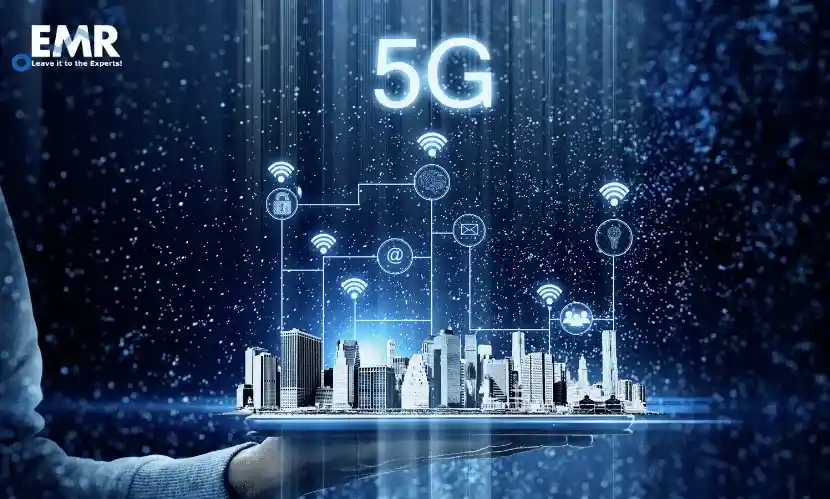
The global 5G infrastructure market was valued at nearly USD 16.50 Billion in 2025 and is projected to expand at a CAGR of 44.70% from 2026 to 2035, reaching USD 664.00 Billion by 2035.
Radio Access Network (RAN), backhaul and transport, and the core network, make up the majority of the 5G infrastructure. In the backhaul and transport network, microwave or fibre optic antennas may be used. It is anticipated that the growing demand for higher bandwidth connectivity with low latency for a variety of mission-critical applications, such as drone connectivity and vehicle-to-everything (V2X), will propel the growth of the 5G infrastructure industry.
Looking for Market Size, Pricing & Forecast: Get Free Sample Report
The user experience for a number of use cases, including Ultra-high Definition (UHD) video, Virtual Reality (VR) and Augmented Reality (AR) gaming, and seamless video calling, is anticipated to be improved by the 5G technology market. Several industrial facilities are focusing on technology changes to boost their total productivity, operational efficiency, and cost-cutting in an effort to survive in a highly competitive industry.
The demand for the 5G IoT market is anticipated to be driven by the growing usage of LPWAN, 5G, Long Range Wide Area Network (LoRaWAN), Internet Protocol version 6 (IPv6), and wireless sensor networks, which will support market expansion of 5G infrastructure.
Additionally, the expansion of the 5G testing equipment market is also expected due to the easier deployment of 5G technology, supported by the increasing availability of huge data centres. High-speed internet services are becoming more necessary due to the growing work-from-home culture in the post-COVID era, which will further accelerate industry growth over the forecast period.
Asia Pacific accounts for a significant share in the global 5G infrastructure industry and is anticipated to remain dominant in the forecast period as well. This growth can be attributed to the aggressive deployment of new 5G radio infrastructure by key communication service providers. The growing emphasis on adopting sub-6 GHz 5G networks by China, South Korea, and Japan is accelerating the continent's expansion even more in the 5G network market.
Latest Industry Updates on Global 5G Infrastructure Players (2026)
July 2026: Nokia launched what it described as the industry’s first commercial AI-native RAN platform, combining its anyRAN software with NVIDIA’s Aerial platform and targeting more than 100% spectral-efficiency gains by 2028.
July 2026: Ericsson, AT&T and MediaTek completed North America’s first in-field trial of Layer 1/Layer 2 Triggered Mobility for 5G-Advanced, demonstrating up to a 40% reduction in handover interruption time.
July 2026: Huawei and rain South Africa began scaling the world’s first multi-thousand-site sub-1 GHz Massive MIMO 5G network, delivering up to three times the capacity of conventional 4T4R equipment.
June 2026: Ericsson introduced its commercially scalable AI in RAN software subscription, offering AI-powered scheduling, beamforming and network optimisation with reported throughput improvements of up to 20%.
March 2026: ZTE and China Telecom unveiled the AI-powered Differentiation-driven Generative Network solution, integrating distributed MIMO and native intelligence to deliver differentiated 5G-Advanced connectivity for consumer and industrial applications.
Top 15 Global 5G Infrastructure Companies:
1. Huawei Technologies Co. Ltd.
| Headquarters: |
Guangdong, China |
| Establishment: |
1987 |
| Website: |
https://www.huawei.com/en/ |
| CEO/Leadership: |
Ren Zhengfei (Founder & CEO); Eric Xu, Ken Hu & Sabrina Meng (Rotating Chairs) |
| Key 5G Products/Solutions: |
5G-Advanced (5G-A) RAN, MetaAAU antennas, U6 GHz products, Autonomous Driving Network (ADN), SuperPoD cluster |
| Major 5G Clients/Deployments: |
China Mobile, China Telecom, China Unicom, UAE's du, Vietnam operators, 500,000+ sites globally |
Huawei Technologies Co., Ltd. offers telecommunications and networking products. The corporation conducts research and develops servers, security, storage, and other networking solutions in addition to internet access and transmission networks. Huawei's operations span across carrier networks, enterprise business, cloud computing, and consumer electronics, with a strong focus on research and innovation. The company is renowned for its wide range of products, including smartphones, tablets, laptops, 5G infrastructure, data centres, routers, and artificial intelligence (AI) solutions. Huawei invests heavily in R&D, with over half of its workforce involved in research initiatives and several global R&D centres. In July 2026, Huawei and China Unicom launched the world’s largest commercial 5G-Advanced 100 MHz GigaUplink network in Beijing, covering key areas through more than 10,000 base stations.
2. Samsung Electronics Co. Ltd
| Headquarters: |
Suwon-si, South Korea |
| Establishment: |
1969 |
| Website: |
https://www.samsung.com/us/ |
| CEO/Leadership: |
Jong-Hee (JH) Han (Vice Chairman & CEO); Young Hyun Jun (Co-CEO) |
| Key 5G Products/Solutions: |
Massive MIMO radios, vRAN, 5G Core, Open RAN solutions, 5G automotive modems |
| Major 5G Clients/Deployments: |
Verizon (USD 6.64 bn deal), Vodafone UK & Germany, Tesla (5G auto modems, 2026), KDDI Japan, Telus Canada |
A Samsung Group company, Samsung Electronics Co Ltd is a producer of information technology, device solutions, consumer electronics, and mobile communications. The company's product line includes digital cameras, printers, monitors, computers, network systems, refrigerators, washing machines, air conditioners, medical devices, and televisions. Samsung has made significant strides in 5G infrastructure, IoT devices, and AI-powered solutions, and is now a primary RAN supplier to Verizon and Vodafone's Open RAN rollouts in the UK and Germany. In July 2026, Samsung and KDDI completed an AI-powered optimisation trial on a commercial 5G Standalone network in Japan, improving downlink throughput by up to 52%.
3. Nokia Corporation
| Headquarters: |
Espoo, Finland |
| Establishment: |
1865 |
| Website: |
https://www.nokia.com/ |
| CEO/Leadership: |
Justin Hotard (President & CEO, since April 2025) |
| Key 5G Products/Solutions: |
AirScale RAN, Cloud RAN, anyRAN, 5G Core, Network Infrastructure, Bell Labs innovations |
| Major 5G Clients/Deployments: |
Deutsche Telekom, Virgin Media O2, T-Mobile US, Orange, Telefónica, Bharti Airtel |
Nokia Corp. specialises in network infrastructure and cutting-edge technologies. It provides services for 5G, IoT, IP routing, fixed networks, subscriber data management, mobile phones, Wi-Fi systems, and network construction and modernisation. Nokia operates through key business segments such as Mobile Networks, Network Infrastructure, Cloud and Network Services, and Nokia Technologies. Under new CEO Justin Hotard (former Intel Data Center & AI head), Nokia is repositioning its strategy toward AI infrastructure, data centres, and private wireless while navigating RAN market contraction. The company is currently executing the acquisition of Infinera and expanding into defence networks alongside traditional 5G telecom.
4. Qualcomm Technologies, Inc.
| Headquarters: |
California, United States |
| Establishment: |
1985 |
| Website: |
https://www.qualcomm.com/ |
| CEO/Leadership: |
Cristiano Amon (President & CEO) |
| Key 5G Products/Solutions: |
Snapdragon X-series 5G modems, Snapdragon processors, 5G RF front-end, Open RAN platforms |
| Major 5G Clients/Deployments: |
Vodafone, NTT Docomo, Reliance Jio, Samsung (extended license to 2030), Apple (partial) |
Qualcomm creates, produces, and sells equipment and services for digital wireless telecommunications. It is one of the major wireless technology innovators in the world and an impetus behind the creation, introduction, and growth of 5G. Qualcomm Technologies plays a vital role in powering smartphones, tablets, IoT devices, automotive systems, and network infrastructure through its Snapdragon processors and modem solutions. In March 2026, Qualcomm introduced the X105 Modem-RF, a 3GPP Release 19-ready 5G-Advanced platform offering peak download speeds of 14.8 Gbps and integrated satellite connectivity.
Read more about this report - REQUEST FREE SAMPLE COPY IN PDF
5. LG Electronics Inc.
| Headquarters: |
Seoul, South Korea |
| Establishment: |
1958 |
| Website: |
https://www.lg.com |
| CEO/Leadership: |
William Cho (CEO); Shin Moon-soon (CFO) |
| Key 5G Products/Solutions: |
5G smartphones (historical, exited 2021), 5G patents portfolio, 5G automotive (LG Magna), IoT & smart home 5G connectivity |
| Major 5G Clients/Deployments: |
LG Uplus (Korea), in-vehicle 5G connectivity partners, smart home ecosystems |
LG Electronics Inc. manufactures and markets digital display equipment and home appliances. The company manufactures and sells telecommunications devices such as smart phones and tablets, in addition to flat panel televisions, A/V appliances, refrigerators, washing machines, and air conditioners. LG maintains a strong international presence with manufacturing facilities, R&D centres, and sales operations in over 100 countries. While LG exited the smartphone business in 2021, the company continues to play a prominent role in the 5G automotive connectivity space through its LG Vehicle Component Solutions division and holds a substantial 5G patent portfolio. It has also focused on enhancing its smart home ecosystem, integrating 5G IoT capabilities with AI-powered appliances. In April 2026, LG Electronics showcased its Hybrid eCall solution supporting emergency communication across 2G to 5G networks and aligned with Europe’s next-generation eCall requirements.
6. ZTE Corporation
| Headquarters: |
Shenzhen, China |
| Establishment: |
1985 |
| Website: |
https://www.zte.com.cn/global/ |
| CEO/Leadership: |
Li Zixue (Chairman); Xu Ziyang (Executive Director & President) |
| Key 5G Products/Solutions: |
UniSite 5G base stations, UniCore 5G Core, 5G-A solutions, Ambient IoT, AI-native networks |
| Major 5G Clients/Deployments: |
China Mobile, China Telecom, China Unicom, Vietnam operators (2025), Middle East carriers |
ZTE Corporation is the world's foremost supplier of information and communication technology solutions. The company provides a wide range of products and services, including wireless, wireline, devices, and professional telecom solutions. With operations in over 160 countries, ZTE serves telecom operators, governments, and enterprise clients. At MWC Barcelona 2025, ZTE and China Mobile introduced the "Communication-Sensing-Computing-Intelligence" framework and Ambient IoT solutions -positioning ZTE at the forefront of AI-powered 5G-Advanced technologies. The company also secured fresh 5G deals in Vietnam in late 2025 as US-China trade dynamics reshaped supply chains. In June 2026, ZTE showcased Agentic AI-powered Level-4 autonomous network solutions, demonstrating improvements in fault management, 5G slicing and cross-domain network operations.
7. Intel Corporation
| Headquarters: |
California, United States |
| Establishment: |
1968 |
| Website: |
https://www.intel.com/ |
| CEO/Leadership: |
Lip-Bu Tan (CEO, since March 2025) |
| Key 5G Products/Solutions: |
Xeon processors for vRAN, FlexRAN reference architecture, 5G infrastructure silicon, edge compute chips |
| Major 5G Clients/Deployments: |
Ericsson, Nokia, Samsung Networks, Dish Network, Verizon Cloud RAN |
Intel is a market leader developing technology that transforms the world. Intel's product portfolio includes central processing units (CPUs), graphics processing units (GPUs), chipsets, memory, storage, and network interface controllers. It also focuses on artificial intelligence (AI), autonomous driving technologies through Mobileye, and Internet of Things (IoT) solutions. Under new CEO Lip-Bu Tan (since March 2025), Intel is pushing its FlexRAN and Xeon-based vRAN platforms as the silicon backbone of Open RAN deployments globally. The company aims to deliver cutting-edge semiconductor technologies while ensuring security, performance, and sustainability -with strong ties to all major Western RAN vendors. In July 2026, Intel, Dell and Samsung validated an end-to-end Cloud RAN solution using Intel-powered telecom infrastructure to improve network flexibility, performance and deployment efficiency.
8. Telefonaktiebolaget LM Ericsson
| Headquarters: |
Stockholm, Sweden |
| Establishment: |
1876 |
| Website: |
https://www.ericsson.com/en |
| CEO/Leadership: |
Börje Ekholm (President & CEO) |
| Key 5G Products/Solutions: |
Ericsson Radio System, Cloud RAN, 5G SA Core, Ericsson Intelligent Automation Platform (EIAP) |
| Major 5G Clients/Deployments: |
AT&T (USD 14 bn Open RAN deal), Verizon (USD 8.3 bn), Virgin Media O2 (UK), T-Mobile, KDDI, operators in 180+ countries |
Telefonaktiebolaget LM Ericsson is a supplier of integrated telecommunications technology and services. In the areas of mobility, internet, and cloud, it provides services, software, and infrastructure that allow telecom carriers and other enterprises to increase operational efficiency. The company is a major contributor to the development and rollout of 5G networks, offering a complete portfolio that includes radio access networks (RAN), core networks, cloud infrastructure, and network services. Ericsson supports mobile network operators in over 180 countries and serves billions of subscribers. In July 2026, Ericsson, AT&T and MediaTek completed North America’s first in-field 5G-Advanced mobility trial, achieving up to a 40% reduction in network handover interruption time.
9. Oracle Corporation
| Headquarters: |
Texas, United States |
| Establishment: |
1977 |
| Website: |
https://www.oracle.com/ |
| CEO/Leadership: |
Larry Ellison (Chairman & CTO) |
| Key 5G Products/Solutions: |
Oracle Communications 5G Cloud Native Core, OCI Dedicated Region, network slicing, unified data management |
| Major 5G Clients/Deployments: |
NTT Transatel (5G SA core, Nov 2025), Vodafone, Telefónica, global CSPs |
Oracle provides its database management systems and cloud-engineering services and solutions through four primary business sectors: cloud and licence, hardware, and services. With best-in-class, micro-services-based network functions (NFs), flexible deployment choices, and support for 5G network slicing, Oracle's cloud native 5G core enables operators to construct a solid and scalable core. In May 2026, Oracle Communications was selected by Ishan Technologies to modernise its charging and billing systems, creating a unified digital platform for faster telecom service launches. The company has made significant investments in artificial intelligence, machine learning, and autonomous database technology to support telco cloud transformation.
10. Cisco Systems, Inc.
| Headquarters: |
California, United States |
| Establishment: |
1984 |
| Website: |
https://www.cisco.com/ |
| CEO/Leadership: |
Chuck Robbins (Chair & CEO) |
| Key 5G Products/Solutions: |
Cisco Mobility Services Platform, Converged Core, IoT Control Center, Private 5G-as-a-Service, Catalyst wireless |
| Major 5G Clients/Deployments: |
AT&T (5G SA IoT platform, Feb 2026), NTT Data (eSIM integration), Rakuten, Dish Network |
Cisco Systems, Inc., headquartered in California, is a global leader in networking, cybersecurity, and IT infrastructure. The company has grown into one of the most influential technology companies, providing a wide range of hardware, software, and services that power the internet and enterprise digital infrastructure. The company is best known for its high-performance routers, switches, wireless systems, and cybersecurity solutions, which support the seamless connectivity of businesses and governments worldwide. Cisco has played a vital role in shaping the modern internet and remains a key player in driving digital transformation. Its portfolio extends into cloud computing, data centre management, collaboration tools such as Webex, and advanced technologies including IoT, 5G, and artificial intelligence. Cisco’s software-defined networking (SDN) and automation platforms help organisations manage complex networks more efficiently and securely. In February 2026, Cisco and AT&T commercially activated a 5G Standalone-native IoT platform supporting network slicing, edge computing and automated enterprise device management. The company follows a strong innovation strategy, investing heavily in research and development, and regularly acquiring technology firms to enhance its capabilities.
11. AT&T Inc.
| Headquarters: |
Texas, United States |
| Establishment: |
1983 |
| Website: |
https://www.att.com/ |
| CEO/Leadership: |
John Stankey (Chairman & CEO) |
| Key 5G Products/Solutions: |
AT&T 5G+ (mmWave), 5G Standalone (nationwide), Open RAN architecture, Multi-Access Edge Compute, FirstNet |
| Major 5G Clients/Deployments: |
USD 14 bn Ericsson Open RAN deal; Cisco partnership (Feb 2026); Enterprise IoT; 70% Open RAN target by late 2026 |
AT&T Inc. provides media, technology, and telecommunications services. The company offers local and long-distance telephone services, managed networking, telecommunications products, wireless communications, data/broadband, and internet services, and wholesale services. In high traffic regions, including portions of more than 45 cities and more than 45 stadiums and venues, AT&T 5G+ employing millimetre wave spectrum offers unheard -of before speeds and performances. AT&T is widely recognised for its nationwide 5G network and advanced fibre internet services. It has played a key role in the digital transformation of businesses through secure connectivity and cloud-based solutions. The company also provides IP-based services, cybersecurity, and voice solutions for large enterprises and government entities. AT&T has consistently invested in network upgrades, including 5G expansion and edge computing capabilities, to meet growing data demands. Following the spin-off of WarnerMedia and its merger with Discovery, AT&T refocused its strategy on core telecommunications services, strengthening its financial structure and enhancing customer experience. In July 2026, AT&T and Ericsson demonstrated drone detection and movement tracking over a commercial 5G network outside AT&T Stadium, highlighting future network-sensing applications for critical infrastructure.
12. NEC Corporation
| Headquarters: |
Tokyo, Japan |
| Establishment: |
1899 |
| Website: |
https://www.nec.com/ |
| CEO/Leadership: |
Takayuki Morita (President & CEO) |
| Key 5G Products/Solutions: |
Open RAN radios, 5G Core, massive MIMO, biometric-integrated network solutions, AI-driven operations |
| Major 5G Clients/Deployments: |
Vodafone UK (Open RAN), NTT Docomo, Deutsche Telekom, Telefónica O2 |
With more than 100 years of experience in technological innovation, NEC is a leader in the integration of network and IT technologies. It offers solutions for enabling individuals, organisations, and society. NEC provides advanced IT solutions such as artificial intelligence (AI), biometric authentication, cloud computing, and cybersecurity, with a strong presence in smart city development, telecommunications, and government digitisation projects. However, in January 2026, NEC reportedly classified its existing 4G/5G base station business as "non-core," signalling a strategic pivot as the global RAN market contracted and competition from scale players tightened margins. NEC nonetheless continues to support Open RAN deployments in Europe and Japan. NEC and NTT DOCOMO launched Japan’s first commercial 5G core network on AWS, supported by AI-automated network construction and cloud-native operations.
13. Dell Technologies
| Headquarters: |
Texas, United States |
| Establishment: |
1984 |
| Website: |
https://www.dell.com/ |
| CEO/Leadership: |
Michael Dell (Chairman & CEO); Jeff Clarke (Vice Chairman & COO) |
| Key 5G Products/Solutions: |
PowerEdge servers for vRAN/Open RAN, Dell NativeEdge, telecom cloud infrastructure, bare-metal orchestration |
| Major 5G Clients/Deployments: |
Vodafone UK (Open RAN with Samsung), Dish Network, Verizon Cloud RAN, Indian telcos |
Dell Technologies Inc. sells desktop computers, software, and accessories. The business creates, develops, produces, distributes, and supports information technology infrastructure, including mobile devices, laptops, desktops, storage devices, workstations, software, and cloud solutions. Dell Technologies has developed software-driven storage advancements that offer intelligent insights, security, and increased productivity for Indian organisations. The company is especially known for its innovation in cloud computing, data centre infrastructure, and cybersecurity, and is a key infrastructure partner in Vodafone UK's Open RAN rollout with Samsung, Wind River, and NEC -targeting 2,500 sites by 2027. In February 2026, Dell Technologies introduced the PowerEdge XR9700, an outdoor liquid-cooled server designed to support Cloud RAN, Open RAN and edge AI workloads.
14. Microsoft Corporation
| Headquarters: |
Washington, United States |
| Establishment: |
1975 |
| Website: |
https://www.microsoft.com/en-in |
| CEO/Leadership: |
Satya Nadella (Chairman & CEO) |
| Key 5G Products/Solutions: |
Azure for Operators, Azure Private 5G Core, Azure Operator Nexus, AI-powered network automation |
| Major 5G Clients/Deployments: |
AT&T (5G Core on Azure), Lumen Technologies, Telefónica, NTT, Vodafone Idea |
Microsoft Corporation is a global technology leader known for its wide range of software, hardware, and cloud-based services. Over the years, Microsoft has diversified its portfolio to include cloud computing through Microsoft Azure, gaming via Xbox, enterprise solutions like Microsoft Dynamics, and collaboration tools such as Teams and SharePoint. The company has also invested heavily in artificial intelligence and cybersecurity to drive innovation and digital transformation. Microsoft's Azure for Operators platform continues to be a leading hyperscaler choice for telecom cloud, with AT&T running its 5G Mobile Core on Azure and several global CSPs relying on Azure Private 5G for enterprise and industrial deployments. In June 2026, Microsoft highlighted production-scale telecom AI developments at DTW Ignite 2026, focusing on trusted autonomous network operations and measurable returns from AI deployments.
15. Mavenir Systems, Inc
| Headquarters: |
Texas, United States |
| Establishment: |
2017 |
| Website: |
https://www.mavenir.com/ |
| CEO/Leadership: |
Pardeep Kohli (President & CEO) |
| Key 5G Products/Solutions: |
Open vRAN, OpenRAN, Multi-access Edge Compute (MEC), 5G Core, mobile service software |
| Major 5G Clients/Deployments: |
Bharti Airtel (2,500 rural sites), Deutsche Telekom, Dish Network, 250+ CSPs in 120+ countries |
Mavenir Systems, Inc. is a telecommunications software company formed through the merger of Xura, Ranzure Networks, and Mitel Mobile, aiming to accelerate software network transformation for communications service providers (CSPs). The company specializes in developing end-to-end, cloud-native network solutions that support 5G and intelligent, automated, programmable networks. In January 2026, Mavenir launched an AI-driven O-RAN orchestration platform designed to reduce operational costs and improve network efficiency. Serving over 250 CSPs across more than 120 countries, Mavenir continues to play a major role in the global Open RAN ecosystem, even as the broader Open RAN market consolidates. Mavenir launched an Agentic Service Assurance Framework that uses multi-agent AI to detect, diagnose and resolve faults across multi-vendor 5G and cloud-native networks.









Share