

Consumer Insights
Uncover trends and behaviors shaping consumer choices today
Procurement Insights
Optimize your sourcing strategy with key market data
Industry Stats
Stay ahead with the latest trends and market analysis.
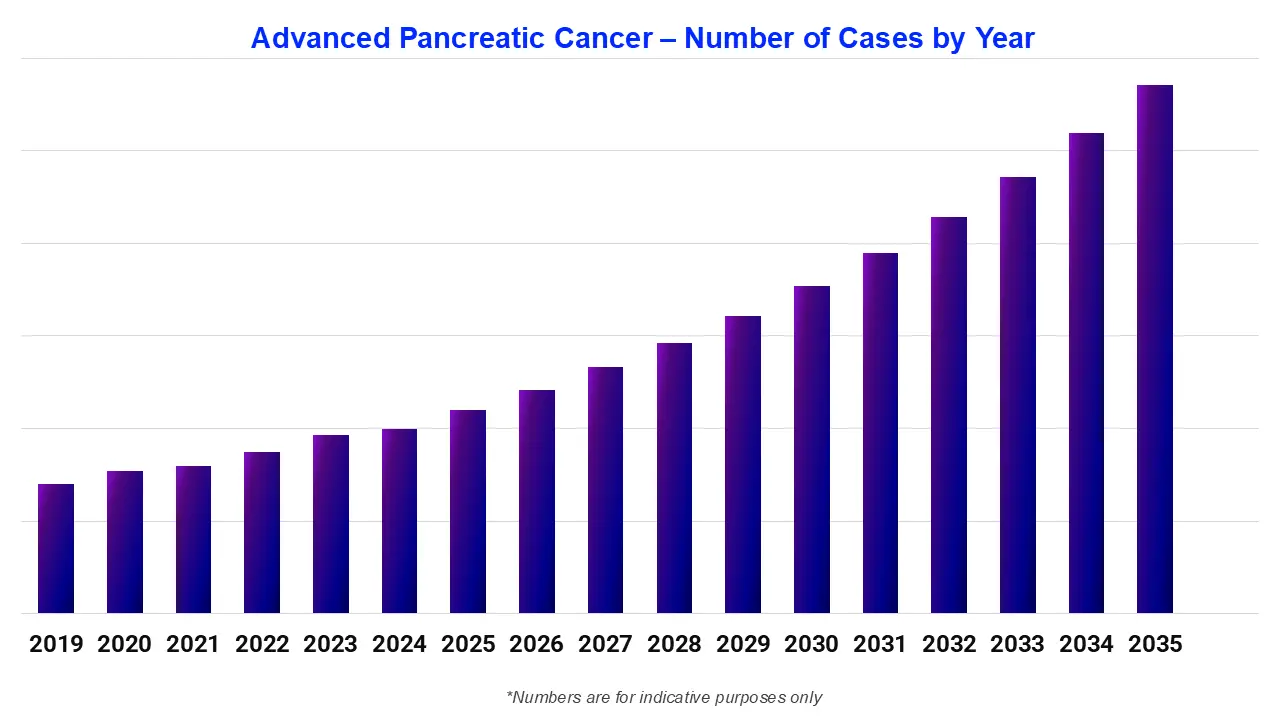
Advanced pancreatic cancer remains a serious and highly aggressive malignancy associated with substantial morbidity and mortality, particularly among patients with unresectable or metastatic disease. According to the advanced pancreatic cancer epidemiology forecast by Expert Market Research, approximately 50% of patients with pancreatic ductal adenocarcinoma present with metastatic disease. According to Jonah M. Levine et al. (2024), their analysis of 56,757 patients with stage-IV PDAC demonstrated a median overall survival of 4.6 months among patients with liver-only metastases and 8.1 months among those with lung-only metastases.
Base Year
Historical Period
Forecast Period
Read more about this report - REQUEST FREE SAMPLE COPY IN PDF
Expert Market Research's “Advanced Pancreatic Cancer Epidemiology Forecast Report 2026-2035” offers comprehensive information on the prevalence and demographics of Advanced Pancreatic Cancer. It projects the future incidence and prevalence rates of Advanced Pancreatic Cancer cases across various populations. The study covers age, gender, and type as major determinants of the Advanced Pancreatic Cancer population. The report highlights patterns in the prevalence of Advanced Pancreatic Cancer overtime and projects future trends based on multiple variables.
The report provides a comprehensive overview of the disease, as well as historical and projected data on the epidemiology of Advanced Pancreatic Cancer in the 8 major markets.
Regions Covered
Advanced pancreatic cancer is a highly aggressive malignancy, predominantly pancreatic ductal adenocarcinoma (PDAC), characterized by locally unresectable or metastatic disease. Most patients are diagnosed at an advanced stage, limiting the feasibility of curative surgical resection. The disease exhibits marked biological heterogeneity, rapid progression, and frequent metastasis, particularly to the liver, peritoneum, regional lymph nodes, and lungs. Its dense stromal microenvironment, molecular complexity, and intrinsic resistance to systemic therapy contribute to poor long-term outcomes.
|
Parameter |
Insight |
|
Largest Patient Pool |
United States |
|
Fastest Growing Country |
Japan |
|
High-Risk Population |
Older adults, particularly individuals aged ≥65 years |
|
Key Diagnostic Method |
Contrast-enhanced CT and MRI/MRCP |
|
Major Risk Factor |
Cigarette smoking |
|
Major gap in the market |
Limited effectiveness of systemic therapies in advanced disease and persistent late diagnosis |
The advanced pancreatic cancer epidemiology division offers information on the patient pool from history to the present as well as the projected trend for each of the 8 major markets. Expert Market Research provides both current and predicted trends for the Advanced Pancreatic Cancer epidemiology scenario by examining a wide range of studies. Additionally, the report covers the diagnosed patient pool for Advanced Pancreatic Cancer and their trends. The data is broken down into specific categories, such as total prevalent cases in males and females, and total diagnosed cases across different age groups and patient pools.
|
Epidemiology Segment |
Key Insights |
|
Diagnosed Prevalent Cases of the Disease |
According to Jonah M. Levine et al. (2024), approximately 50% of PDAC patients present with metastatic disease. In a study of 56,757 stage-IV PDAC patients, median overall survival ranged from 4.6 months for liver-only metastases to 8.1 months for lung-only metastases, highlighting the substantial burden and poor prognosis of advanced pancreatic cancer. |
|
Gender-Specific Cases of the Disease |
According to Esther N. Pijnappel et al. (2022), among 7,470 patients with metastatic pancreatic cancer, 3,884 (52.0%) were men and 3,586 (48.0%) were women. The Netherlands Cancer Registry study covered patients diagnosed with synchronous metastatic pancreatic cancer between 2015 and 2019, indicating a modest male predominance rather than a major sex disparity. |
|
Age-Specific Cases of the Disease |
According to Liu et al. (2021), among 10,784 patients with metastatic pancreatic cancer, 7,103 (65.9%) were aged ≥65 years, including 4,415 aged 65–79 years and 2,688 aged ≥80 years. In a separate registry of 422 patients with locally advanced pancreatic cancer, 43% were aged 65–74 years, 38% were <65 years, and 19% were ≥75 years, demonstrating a concentration of advanced disease among older adults. |
|
Ethnicity-Wise Cases of the Disease |
According to Al-Hawary et al. (2025), Black patients with metastatic PDAC experienced a longer interval between diagnosis and systemic treatment initiation than White patients, although no significant differences were observed in guideline-concordant first-line treatment or overall survival. Khalaf et al. (2024) reported that Black patients were 19% more likely to present with late-stage disease and 25% less likely to undergo surgical resection; excess mortality disappeared after adjustment for stage and treatment. |
|
Mortality and Survival Analysis of the Disease |
According to Levine et al. (2024), approximately 50% of PDAC patients present with metastatic disease, with median overall survival of 4.6 months for liver-only and 8.1 months for lung-only metastases. More recent 2025 real-world evidence reported median overall survival of 7.9 months for liver-only metastatic disease and 4.5 months for multisite metastases, highlighting the substantial mortality burden of advanced pancreatic cancer. |
|
Disease Type |
Prevalence |
|
Pancreatic Ductal Adenocarcinoma (PDAC) |
PDAC is the predominant histological subtype of pancreatic cancer, accounting for approximately 90% of cases and frequently presenting as unresectable or metastatic disease. The 90% figure refers to pancreatic cancers overall, not specifically advanced disease. |
|
Pancreatic Neuroendocrine Tumors (PanNETs) |
PanNETs are uncommon but clinically important in advanced pancreatic malignancy. In a 2023 cohort of 662 patients receiving antitumoral therapy, 85% had stage IV disease, 89.0% had liver metastases, and 93.1% were inoperable, demonstrating the substantial advanced-disease burden among treated patients. |
|
Acinar Cell Carcinoma |
Acinar cell carcinoma is rare, representing approximately 0.2–4.3% of pancreatic neoplasms. In a multicenter series of 66 patients, 42% had metastatic disease at diagnosis. Another series of 45 patients reported 11.1% locally advanced and 35.6% metastatic disease, meaning 46.7% had advanced disease at presentation. |
|
Other Pancreatic Malignancies and Histological Variants |
Other rare malignancies include pancreatic neuroendocrine carcinoma, adenosquamous carcinoma, undifferentiated carcinoma, colloid carcinoma, signet-ring cell carcinoma, medullary carcinoma, and mixed acinar-neuroendocrine neoplasms. In poorly differentiated pancreatic neuroendocrine carcinoma, 88% had nodal or distant metastases at presentation, with another 7% developing metastases during follow-up. |
Read more about this report - REQUEST FREE SAMPLE COPY IN PDF
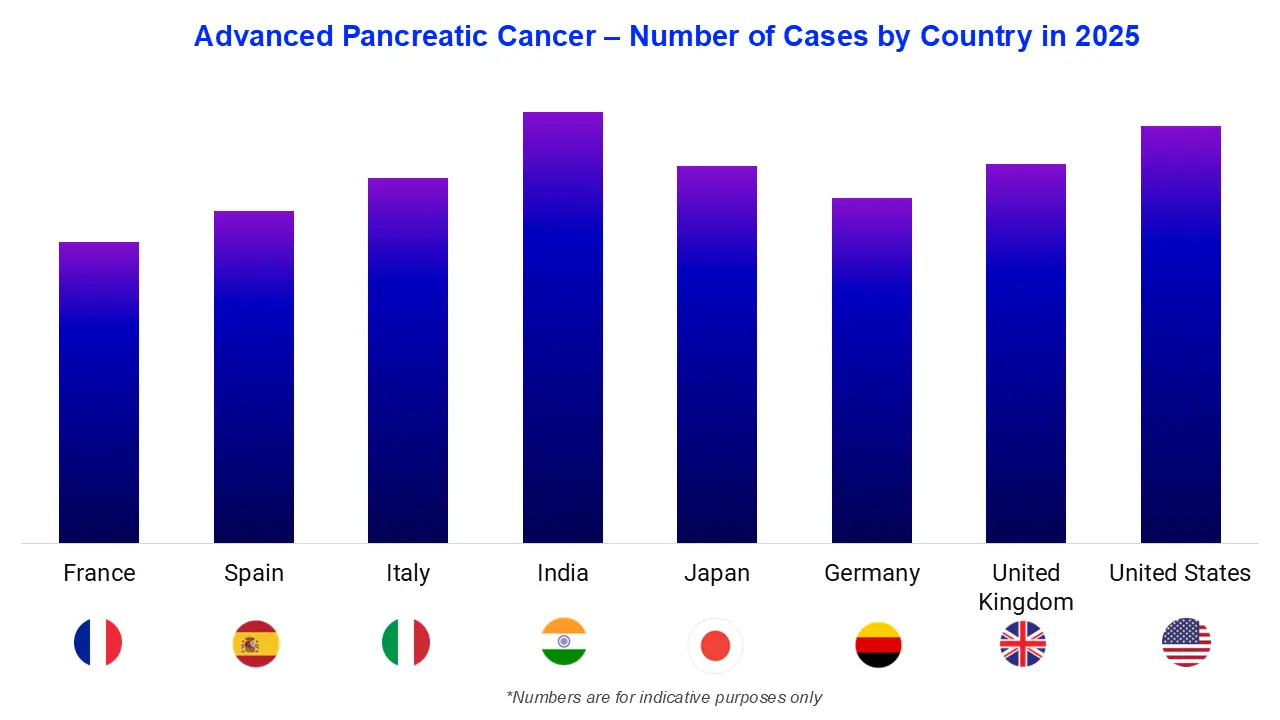
The Advanced Pancreatic Cancer epidemiology data and findings for the United States, Germany, Spain, Italy, France, the United Kingdom, Japan, and India are also provided in the epidemiology section.
|
Country |
Key Insights |
|
United States |
Advanced pancreatic cancer represents the majority of pancreatic cancer diagnosed in the United States. Current SEER data indicate that approximately 51% of pancreatic cancers are diagnosed with distant metastatic disease, while a further 28% are diagnosed with regional disease. Distant-stage pancreatic cancer has a 5-year relative survival of only 3.4%, compared with 43.6% for localized disease. Thus, approximately four-fifths of cases present with either regional or distant spread, making advanced disease the principal contributor to the U.S. pancreatic cancer treatment burden. |
|
Germany |
Advanced presentation is particularly prominent in Germany. A multicenter analysis of the German Cancer Consortium's clinical communication platform found that pancreatic cancer was most frequently diagnosed at an advanced stage: 45.9% of cases were UICC stage IV, with a further 11.8% at stage III. Consequently, approximately 57.7% of cases were stage III–IV at diagnosis in this registry population. These data demonstrate the substantial German burden of locally advanced and metastatic disease and the corresponding need for systemic and multidisciplinary management. |
|
France |
Advanced pancreatic cancer constitutes a major component of the French pancreatic cancer burden. A 2024 French review of metastatic pancreatic adenocarcinoma reported that more than 50% of newly diagnosed pancreatic adenocarcinomas are discovered at an advanced stage. Only approximately 20% of newly diagnosed patients have a tumor considered immediately resectable, while more than two-thirds of patients who undergo initial surgery subsequently relapse, most often with metastatic disease. These findings highlight the predominance of unresectable and metastatic disease in French clinical practice. |
|
Italy |
Italy recorded approximately 15,710 new pancreatic cancer cases in 2022, with an ASR of 8.0 per 100,000, while approximately 14,903 deaths were reported. More recent Italian estimates from I Numeri del Cancro in Italia 2024 indicate around 13,585 new diagnoses in 2024, approximately 14,900 deaths in 2022, and only 11–12% five-year net survival, highlighting the disease's poor prognosis and continuing clinical burden. |
|
Spain |
Advanced disease is predominant in Spain, where only approximately 10–15% of patients present with a localized, potentially curable tumor, while approximately 50% present with stage IV systemic disease and a further 30–35% present with borderline-resectable or locally advanced disease. Thus, approximately 80–85% of patients present with disease that is not straightforwardly resectable at diagnosis, with metastatic disease alone accounting for approximately half of presentations. These figures emphasize the importance of systemic therapy and multidisciplinary management in the Spanish advanced pancreatic cancer population. |
|
United Kingdom |
The United Kingdom has a particularly well-defined late-stage burden. Northern Ireland population-based data for 2017–2021 showed that 49.7% of pancreatic cancer cases were diagnosed at stage IV, rising to 55.5% among cases with a known stage. Only 15.7% of all cases were diagnosed at stage I. More recent national reporting also demonstrates the poor prognosis associated with stage IV disease: in England, among patients diagnosed with exocrine pancreatic cancer during 2021–2022, 7,745 were stage IV, with only 10% surviving one year after diagnosis. |
|
Japan |
Japan has one of the clearest contemporary stage-specific datasets. According to Cancer Statistics in Japan 2025, pancreatic cancer cases were distributed as 6.2% stage I, 25.4% stage II, 17.7% stage III, 47.4% stage IV, and 3.3% unknown stage. Therefore, nearly half (47.4%) of pancreatic cancers were already metastatic at diagnosis, while approximately 65.1% were stage III or IV. This demonstrates a substantial advanced-disease burden despite Japan's extensive cancer-screening and specialist-care infrastructure. |
|
India |
India has a substantial advanced pancreatic cancer burden despite a comparatively low age-standardized incidence rate. The ICMR consensus document reports that only approximately 10–20% of patients have resectable pancreatic cancer at presentation, indicating that approximately 80–90% present with locally advanced or metastatic/unresectable disease. The same source attributes poor outcomes partly to the fact that pancreatic cancer is frequently asymptomatic until it becomes locally advanced or metastatic. Accordingly, the advanced-disease population represents the clinically dominant segment of pancreatic cancer in India, although a recent nationwide stage-specific registry estimate remains limited. |
Significant gaps remain in the epidemiological characterization and earlier detection of advanced pancreatic cancer, particularly PDAC, as most cases are incurable at presentation. Population-wide screening is not currently recommended, while nonspecific early symptoms and limited biomarkers remain major barriers. Emerging approaches include high-risk surveillance using MRI/MRCP and EUS, multimodal imaging, liquid biopsy, circulating tumor DNA, and AI-assisted detection. In the CAPS5 study, 7 of 9 surveillance-detected PDAC cases (77.8%) were stage I, supporting structured surveillance in high-risk populations. In January 2026, an NIH-supported study identified ANPEP and PIGR as promising blood biomarkers; combined with CA19-9 and THBS2, the four-marker panel achieved 91.9% accuracy at a 5% false-positive rate. Prospective validation remains necessary.
The management of advanced pancreatic cancer primarily aims to control tumor progression, prolong survival, alleviate cancer-related symptoms, and preserve quality of life, with systemic therapy forming the cornerstone of treatment for unresectable locally advanced and metastatic pancreatic ductal adenocarcinoma (PDAC). Treatment selection is determined by disease extent, performance status, comorbidities, organ function, patient preferences, and, increasingly, tumor molecular characteristics. According to the 2025 ESMO Clinical Practice Guideline Express Update, NALIRIFOX is a recommended first-line treatment option for patients with metastatic PDAC whose candidates for combination chemotherapy are, alongside established regimens including FOLFIRINOX or modified FOLFIRINOX and gemcitabine plus nab-paclitaxel. The phase III NAPOLI-3 trial demonstrated a median overall survival of 11.1 months with NALIRIFOX compared with 9.2 months with gemcitabine plus nab-paclitaxel, with corresponding improvements in progression-free survival. For patients who are not suitable for intensive combination chemotherapy, gemcitabine-based approaches or fluoropyrimidine-based treatment may be considered according to clinical fitness and treatment objectives.


Upto 15% Off
USD
$2699 $2429
$4299 $3869
$5799 $4949
$6999 $5949


*While we strive to always give you current and accurate information, the numbers depicted on the website are indicative and may differ from the actual numbers in the main report. At Expert Market Research, we aim to bring you the latest insights and trends in the market. Using our analyses and forecasts, stakeholders can understand the market dynamics, navigate challenges, and capitalize on opportunities to make data-driven strategic decisions.*
Explore our key highlights of the report and gain a concise overview of key findings, trends, and actionable insights that will empower your strategic decisions.
|
Report Features |
Details |
|
Base Year |
2025 |
|
Historical Period |
2019-2025 |
|
Forecast Period |
2026-2035 |
|
Epidemiology Statistics Provided |
|
|
Segmentation Provided |
|
|
Geographies Covered |
|
Datasheet
One User
USD 2,699
USD 2,429
tax inclusive*
Single User License
One User
USD 4,299
USD 3,869
tax inclusive*
Five User License
Five User
USD 5,799
USD 4,949
tax inclusive*
Corporate License
Unlimited Users
USD 6,999
USD 5,949
tax inclusive*
*Please note that the prices mentioned below are starting prices for each bundle type. Kindly contact our team for further details.*
Flash Bundle
Small Business Bundle
Growth Bundle
Enterprise Bundle
*Please note that the prices mentioned below are starting prices for each bundle type. Kindly contact our team for further details.*
Flash Bundle
Number of Reports: 3
20%
tax inclusive*
Small Business Bundle
Number of Reports: 5
25%
tax inclusive*
Growth Bundle
Number of Reports: 8
30%
tax inclusive*
Enterprise Bundle
Number of Reports: 10
35%
tax inclusive*
How To Order

Select License Type
Choose the right license for your needs and access rights.

Click on ‘Buy Now’
Add the report to your cart with one click and proceed to register.

Select Mode of Payment
Choose a payment option for a secure checkout. You will be redirected accordingly.
Strategic Solutions for Informed Decision-Making
Gain insights to stay ahead and seize opportunities.

Get insights & trends for a competitive edge.

Track prices with detailed trend reports.

Analyse trade data for supply chain insights.

Leverage cost reports for smart savings

Enhance supply chain with partnerships.

Connect For More Information
Our expert team of analysts will offer full support and resolve any queries regarding the report, before and after the purchase.
Our expert team of analysts will offer full support and resolve any queries regarding the report, before and after the purchase.
We employ meticulous research methods, blending advanced analytics and expert insights to deliver accurate, actionable industry intelligence, staying ahead of competitors.
Our skilled analysts offer unparalleled competitive advantage with detailed insights on current and emerging markets, ensuring your strategic edge.
We offer an in-depth yet simplified presentation of industry insights and analysis to meet your specific requirements effectively.




