

Consumer Insights
Uncover trends and behaviors shaping consumer choices today
Procurement Insights
Optimize your sourcing strategy with key market data
Industry Stats
Stay ahead with the latest trends and market analysis.
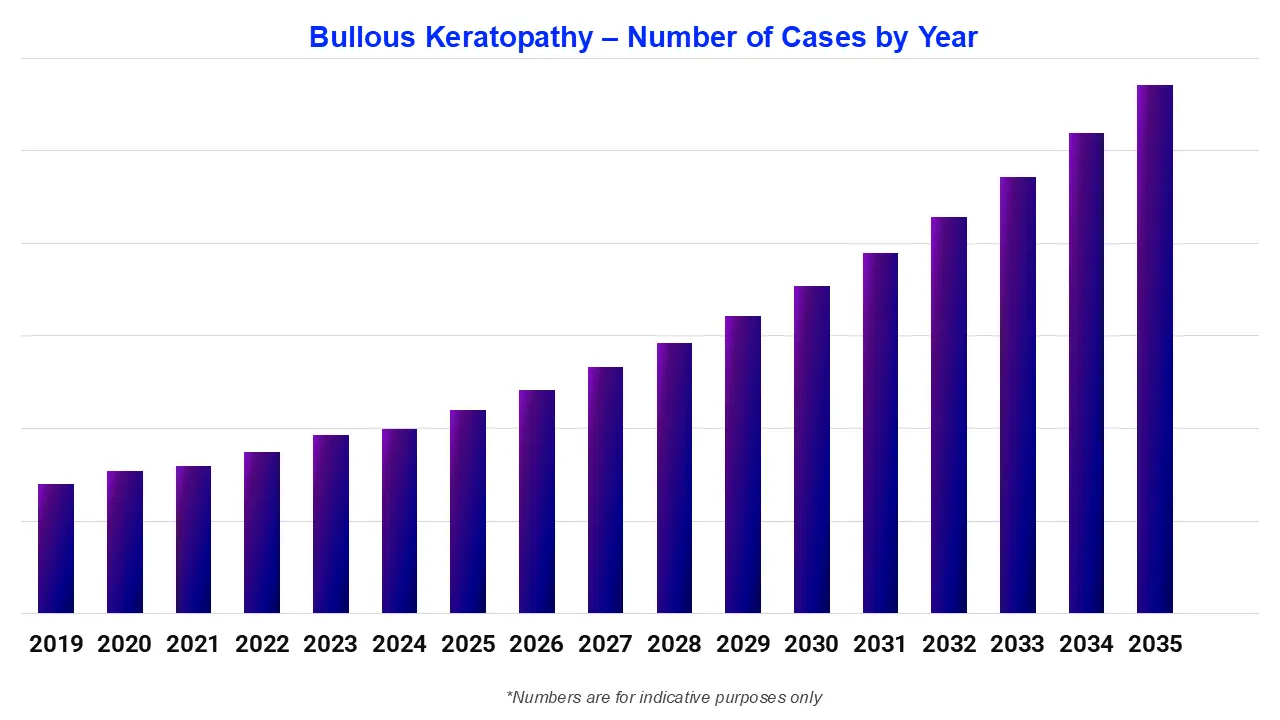
Bullous keratopathy is a vision-threatening corneal disorder characterized by corneal endothelial dysfunction, resulting in stromal edema and painful epithelial bullae. The increasing prevalence of the condition, particularly following cataract surgery, continues to drive the demand for effective therapeutic interventions. According to MD Searchlight, pseudophakic bullous keratopathy (PBK) has a reported prevalence of 0.1% in the United States, highlighting the persistent clinical burden of the disease. As per bullous keratopathy epidemiology forecast by Expert Market Research, the disease burden is expected to remain clinically significant, underscoring the need for improved treatment strategies, earlier diagnosis, and continued advancements in corneal endothelial therapies.
Base Year
Historical Period
Forecast Period
Read more about this report - Request a Free Sample
Expert Market Research's “Bullous Keratopathy Epidemiology Forecast Report 2026-2035” offers comprehensive information on the prevalence and demographics of bullous keratopathy. It projects the future incidence and prevalence rates of bullous keratopathy cases across various populations. The study covers age, gender, and type as major determinants of the bullous keratopathy population. The report highlights patterns in the prevalence of bullous keratopathy over time and projects future trends based on multiple variables.
The report provides a comprehensive overview of the disease, as well as historical and projected data on the epidemiology of bullous keratopathy in the 8 major markets.
Regions Covered
Bullous keratopathy is a progressive corneal disorder characterized by the formation of fluid-filled epithelial bullae due to corneal endothelial cell dysfunction, leading to stromal edema, pain, blurred vision, and increased sensitivity to light. The condition commonly develops following cataract surgery, corneal trauma, or endothelial dystrophies such as Fuchs endothelial corneal dystrophy. Rising demand for advanced corneal transplantation procedures and endothelial preservation strategies is driving clinical research and innovation aimed at restoring corneal clarity and improving long-term visual outcomes.
|
Parameter |
Insight |
|
Largest Patient Pool |
United States |
|
Fastest Growing Region |
India |
|
High-Risk Population |
Patients with diabetes, immunocompromised individuals, and the elderly |
|
Key Diagnostic Method |
Clinical assessment with CT/MRI and microbiological culture |
|
Major Risk Factor |
Diabetes mellitus and severe bacterial infections |
|
Major gap in the Market |
Delayed diagnosis due to nonspecific early symptoms |
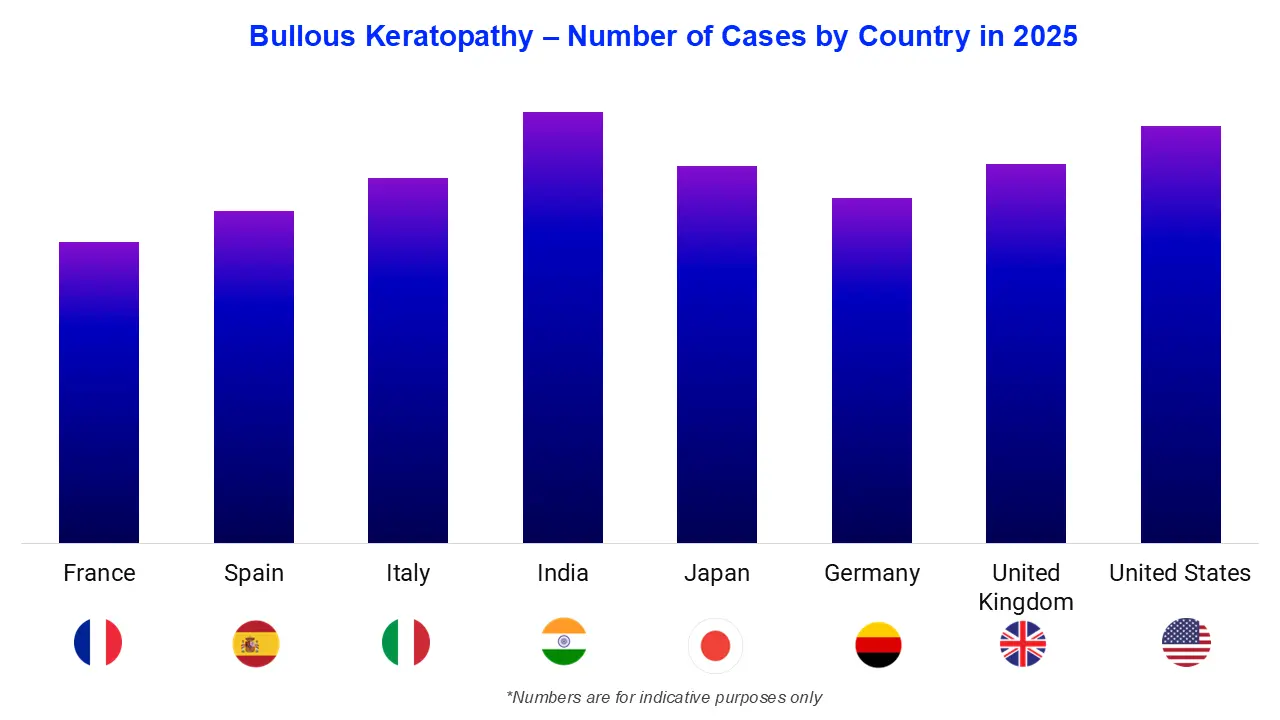
The bullous keratopathy epidemiology division offers information on the patient pool from history to the present as well as the projected trend for each of the 8 major markets. Expert Market Research provides both current and predicted trends for the bullous keratopathy epidemiology scenario by examining a wide range of studies. Additionally, the report covers the diagnosed patient pool for bullous keratopathy and their trends. The data is broken down into specific categories, such as total prevalent cases in males and females, and total diagnosed cases across different age groups and patient pools.
|
Epidemiology Segment |
Key Insights |
|
Diagnosed Prevalent Cases of the Disease |
As per MD SearchLight, pseudophakic bullous keratopathy (PBK) is reported at a prevalence of 0.1% in the United States. According to EyeWiki, 1-2% of individuals undergoing cataract surgery develop persistent postoperative corneal edema, contributing to the burden of PBK. |
|
Gender-Specific Cases of the Disease |
Findings from Afshan Kounser et al., 2022, showed that among 318 patients with corneal blindness, 52.5% were female and 47.5% were male. As per EyeWiki, pseudophakic bullous keratopathy demonstrates no racial or sex predilection, indicating a broadly comparable distribution across patient populations. |
|
Age-Specific Cases of the Disease |
According to Merck & Co., Inc., Fuchs dystrophy is a progressive genetic disorder that may lead to symptomatic bullous keratopathy between 50 and 60 years of age. As reported by Afshan Kounser et al., 2022, 48.8% of corneal blindness cases occurred among individuals aged 31-50 years. |
|
Ethnicity-Wise Cases of the Disease |
According to MD SearchLight, PBK occurred in 0.06% of patients after intraocular lens implantation, 1.2% following anterior chamber lenses, and 1.5% after iris-fixated lenses, while long-term incidence reached 15%. As per EyeWiki, endothelial cell loss and surgical trauma remain important contributing factors. |
|
Mortality and Survival Analysis of the Disease |
According to Zun Zheng Ong et al. 2023 the estimated 5-year graft survival rate following post-keratoplasty infectious keratitis was 55.9%. Deep anterior lamellar keratoplasty demonstrated the highest survival (63.6%), followed by endothelial keratoplasty (57.1%) and penetrating keratoplasty (52.7%), reflecting long-term graft outcome patterns. |
Read more about this report - Request a Free Sample
The bullous keratopathy epidemiology data and findings for the United States, Germany, Spain, Italy, France, the United Kingdom, Japan, and India are also provided in the epidemiology section.
|
Country |
Key Insights |
|
United States |
According to MD SearchLight, PBK has a reported prevalence of 0.1% in the United States, with a long-term incidence of 15%. As per EyeWiki, 1-2% of patients undergoing cataract surgery develop persistent postoperative corneal edema. According to Akira Kobayashi et al., 89.9% of patients with corneal endothelial dysfunction underwent DSAEK or DMEK by 2022. |
|
Germany |
According to Akira Kobayashi et al., 2024, endothelial keratoplasty represented approximately 60% of all keratoplasty procedures performed in Germany in 2016, with 92% of these procedures utilizing Descemet membrane endothelial keratoplasty, highlighting broad adoption of advanced endothelial transplantation techniques. |
|
France |
Epidemiological assessment in France primarily focuses on monitoring disease burden, prevalence trends, patient characteristics, and outcomes associated with corneal endothelial disorders and bullous keratopathy to support effective clinical management and healthcare planning. |
|
Italy |
Epidemiological evaluation in Italy emphasizes disease occurrence, patient demographics, prevalence patterns, and transplantation-related outcomes to improve understanding of bullous keratopathy and related corneal endothelial disorders across healthcare settings. |
|
Spain |
As reported by Sana Qureshi et al., 2024 studies from Spain involving more than 10,000 penetrating keratoplasties identified bullous keratopathy among the leading indications for transplantation. Reported graft survival rates reached 85% at 1 year, 71% at 3 years, 67% at 5 years, and 65% at 10 years. |
|
United Kingdom |
Epidemiological studies in the United Kingdom generally evaluate disease burden, patient demographics, prevalence patterns, and corneal transplantation outcomes to improve understanding of bullous keratopathy and optimize long-term ophthalmic care strategies. |
|
Japan |
According to Dr. Samabesh Swain et al., 2024 glaucoma surgery accounted for 5.3% of bullous keratopathy cases in Japan, following cataract surgery (44.4%) and laser iridotomy (23.4%), indicating the contribution of previous ocular procedures to disease occurrence. |
|
India |
According to Afshan Kounser et al., 2022, bullous keratopathy accounted for 17.30% of corneal blindness cases among 318 patients at a tertiary care center in Kashmir. The study also identified infectious keratitis as the leading cause of corneal blindness, reflecting a considerable regional disease burden. |
Despite significant progress in disease surveillance across many regions, major gaps remain in standardized epidemiological data collection, particularly for rare diseases, underserved populations, and rural communities. Variations in diagnostic practices, reporting systems, and healthcare infrastructure continue to limit accurate disease burden assessments. Emerging opportunities include the integration of artificial intelligence, real-world evidence, digital health platforms, and genomic surveillance to strengthen epidemiological research. Expanding cross-border data-sharing initiatives, improving national disease registries, and increasing investments in population-based studies are expected to enhance disease monitoring, support evidence-based healthcare planning, and drive more effective public health interventions across the region.
The treatment of bullous keratopathy focuses on relieving symptoms, reducing corneal edema, and restoring vision based on disease severity. Conservative management includes hypertonic saline drops, lubricants, bandage contact lenses, and pain control, while definitive treatment often involves endothelial replacement procedures such as Descemet membrane endothelial keratoplasty (DMEK) or Descemet stripping automated endothelial keratoplasty (DSAEK). Increasing adoption of endothelial keratoplasty has significantly improved visual recovery, reduced postoperative complications, and enhanced long-term graft survival compared with traditional full-thickness corneal transplantation.


Upto 15% Off
USD
$1999 $1799
$2999 $2699
$4399 $3739
$5799 $4929


*While we strive to always give you current and accurate information, the numbers depicted on the website are indicative and may differ from the actual numbers in the main report. At Expert Market Research, we aim to bring you the latest insights and trends in the market. Using our analyses and forecasts, stakeholders can understand the market dynamics, navigate challenges, and capitalize on opportunities to make data-driven strategic decisions.*
Explore our key highlights of the report and gain a concise overview of key findings, trends, and actionable insights that will empower your strategic decisions.
|
Report Features |
Details |
|
Base Year |
2025 |
|
Historical Period |
2019-2025 |
|
Forecast Period |
2026-2035 |
|
Epidemiology Statistics Provided |
|
|
Segmentation Provided |
|
|
Geographies Covered |
|
Datasheet
One User
USD 1,999
USD 1,799
tax inclusive*
Single User License
One User
USD 2,999
USD 2,699
tax inclusive*
Five User License
Five User
USD 4,399
USD 3,739
tax inclusive*
Corporate License
Unlimited Users
USD 5,799
USD 4,929
tax inclusive*
*Please note that the prices mentioned below are starting prices for each bundle type. Kindly contact our team for further details.*
Flash Bundle
Small Business Bundle
Growth Bundle
Enterprise Bundle
*Please note that the prices mentioned below are starting prices for each bundle type. Kindly contact our team for further details.*
Flash Bundle
Number of Reports: 3
20%
tax inclusive*
Small Business Bundle
Number of Reports: 5
25%
tax inclusive*
Growth Bundle
Number of Reports: 8
30%
tax inclusive*
Enterprise Bundle
Number of Reports: 10
35%
tax inclusive*
How To Order

Select License Type
Choose the right license for your needs and access rights.

Click on ‘Buy Now’
Add the report to your cart with one click and proceed to register.

Select Mode of Payment
Choose a payment option for a secure checkout. You will be redirected accordingly.
Strategic Solutions for Informed Decision-Making
Gain insights to stay ahead and seize opportunities.

Get insights & trends for a competitive edge.

Track prices with detailed trend reports.

Analyse trade data for supply chain insights.

Leverage cost reports for smart savings

Enhance supply chain with partnerships.

Connect For More Information
Our expert team of analysts will offer full support and resolve any queries regarding the report, before and after the purchase.
Our expert team of analysts will offer full support and resolve any queries regarding the report, before and after the purchase.
We employ meticulous research methods, blending advanced analytics and expert insights to deliver accurate, actionable industry intelligence, staying ahead of competitors.
Our skilled analysts offer unparalleled competitive advantage with detailed insights on current and emerging markets, ensuring your strategic edge.
We offer an in-depth yet simplified presentation of industry insights and analysis to meet your specific requirements effectively.




