

Consumer Insights
Uncover trends and behaviors shaping consumer choices today
Procurement Insights
Optimize your sourcing strategy with key market data
Industry Stats
Stay ahead with the latest trends and market analysis.
Diffuse large B-cell lymphoma (DLBCL) remains a serious and aggressive B-cell non-Hodgkin lymphoma characterized by rapidly proliferating mature B lymphocytes and substantial biological, molecular, and clinical heterogeneity. A 2023 epidemiological review by Sophia S. Wang et al. reported that DLBCL generally represents approximately 20-50% of NHL across countries and regions, reflecting substantial geographical heterogeneity. According to the Diffuse Large B-Cell Lymphoma Epidemiology Forecast by Expert Market Research, the disease continues to represent a substantial clinical and healthcare burden because of its aggressive natural history, older age at diagnosis, molecular heterogeneity, treatment-resistant disease, relapse after frontline therapy, need for intensive salvage treatment and increasing use of high-cost cellular and immune-based therapies.
Base Year
Historical Period
Forecast Period
Read more about this report - Request a Free Sample
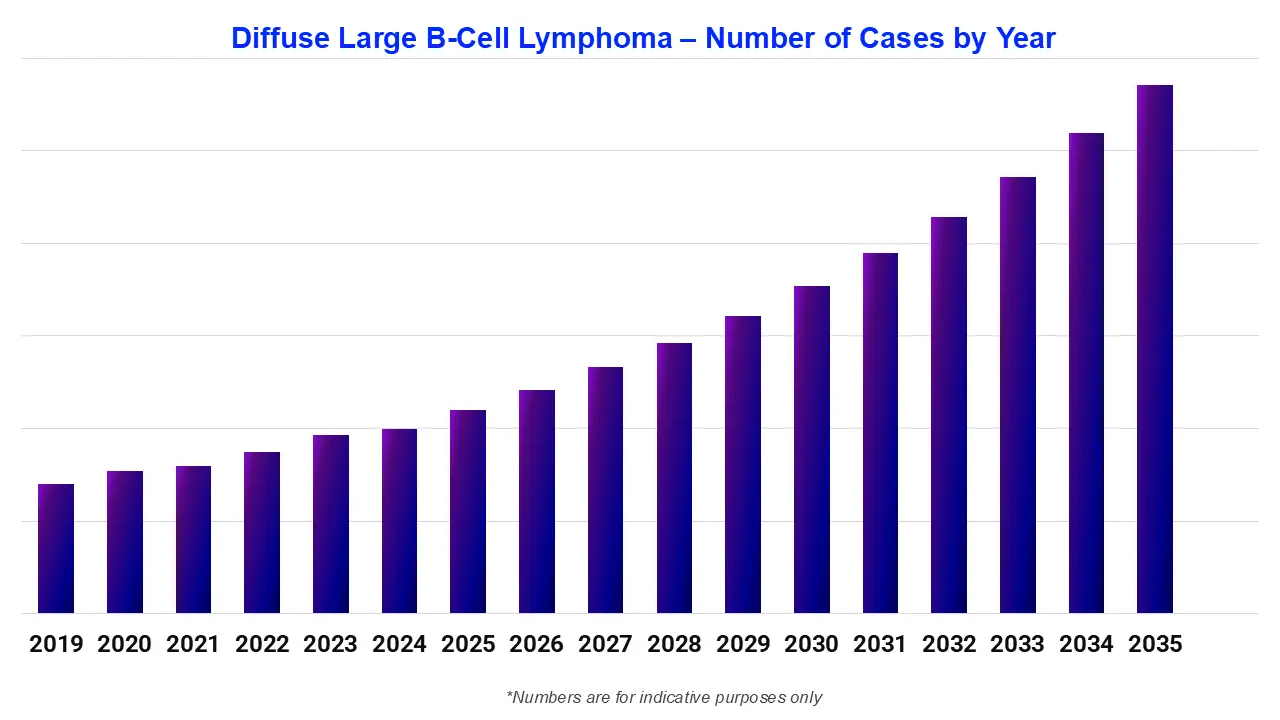
Expert Market Research's “Diffuse Large B-Cell Lymphoma Epidemiology Forecast Report 2026-2035” offers comprehensive information on the prevalence and demographics of Diffuse Large B-Cell Lymphoma. It projects the future incidence and prevalence rates of Diffuse Large B-Cell Lymphoma cases across various populations. The study covers age, gender, and type as major determinants of the Diffuse Large B-Cell Lymphoma population. The report highlights patterns in the prevalence of Diffuse Large B-Cell Lymphoma overtime and projects future trends based on multiple variables.
The report provides a comprehensive overview of the disease, as well as historical and projected data on the epidemiology of Diffuse Large B-Cell Lymphoma in the 8 major markets.
Regions Covered
Diffuse large B-cell lymphoma (DLBCL) remains a serious and aggressive B-cell non-Hodgkin lymphoma characterized by rapidly proliferating mature B lymphocytes and substantial biological, molecular, and clinical heterogeneity. DLBCL is the most common histological subtype of non-Hodgkin lymphoma and accounts for approximately one-third of NHL globally, although its proportional contribution varies considerably between populations. The disease predominantly affects older adults, although younger patients can develop biologically aggressive disease, including high-grade molecular subtypes. Contemporary disease classification increasingly incorporates cell-of-origin biology, genetic alterations, MYC/BCL2 status, molecular subgroups, extranodal involvement and International Prognostic Index characteristics rather than relying exclusively on morphology.
|
Parameter |
Insight |
|
Largest Patient Pool |
United States |
|
Fastest Growing Region |
Japan |
|
High-Risk Population |
Older adults, patients with advanced-stage disease, high International Prognostic Index scores, primary refractory disease, early relapse, double-hit or other genetically high-risk disease, and patients with significant extranodal involvement |
|
Key Diagnostic Method |
Excisional or incisional lymph-node biopsy with expert hematopathological evaluation |
|
Major Risk Factor |
Increasing age and immune dysregulation |
|
Major gap in the market |
Primary refractory disease, early relapse, treatment-resistant DLBCL, limited access to CAR-T therapy, toxicity associated with cellular therapies, antigen escape, treatment sequencing and persistent unmet need among transplant- and CAR-T-ineligible patients |
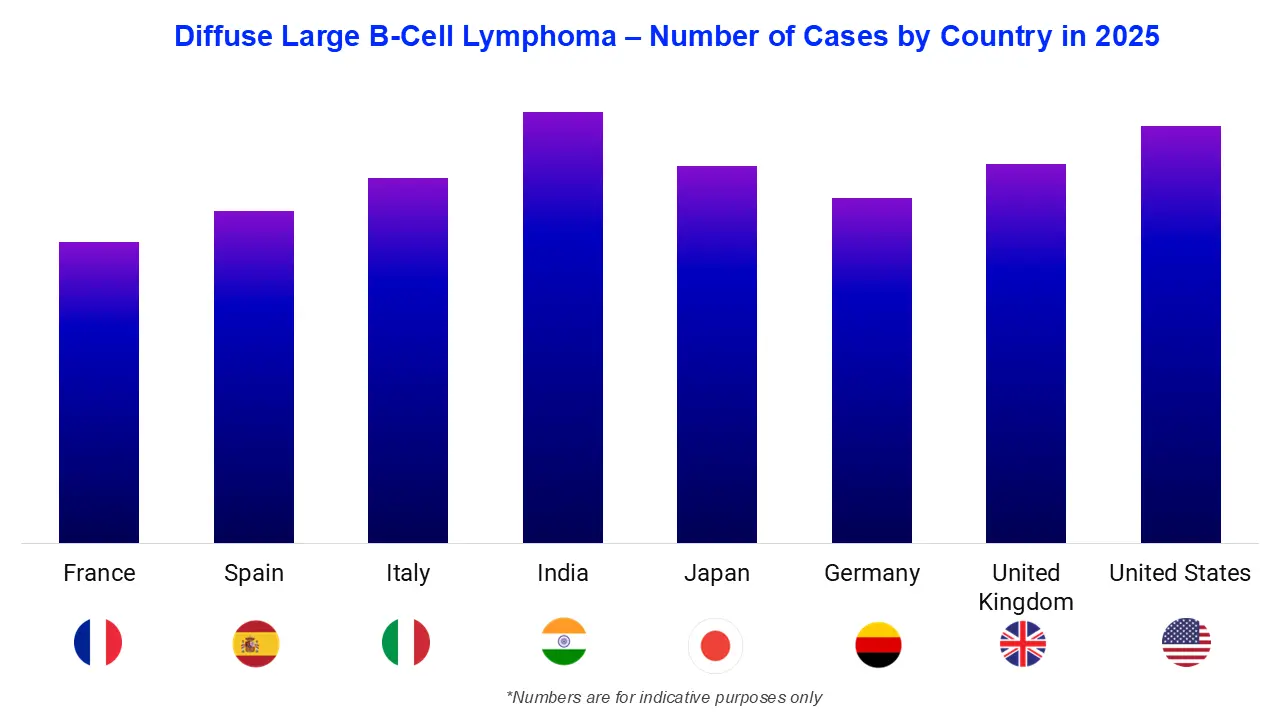
The Diffuse Large B-Cell Lymphoma epidemiology division offers information on the patient pool from history to the present as well as the projected trend for each of the 8 major markets. Expert Market Research provides both current and predicted trends for the Diffuse Large B-Cell Lymphoma epidemiology scenario by examining a wide range of studies. Additionally, the report covers the diagnosed patient pool for Diffuse Large B-Cell Lymphoma and their trends. The data is broken down into specific categories, such as total prevalent cases in males and females, and total diagnosed cases across different age groups and patient pools.
|
Epidemiology Segment |
Key Insights |
|
Diagnosed Prevalent Cases of the Disease |
A 2025 U.S. epidemiological model estimated approximately 199,368 prevalent DLBCL cases in 2023, with the number projected to rise to 238,862 by 2032. The same model estimated 33,120 treatment-eligible first-line patients in 2023, with additional eligible populations of approximately 9,243 in second line, 4,466 in third line and 2,163 in fourth line. A separate 2025 cure-adjusted model estimated 233,904 prevalent U.S. patients in 2025 before accounting for patients considered cured. |
|
Gender-Specific Cases of the Disease |
DLBCL demonstrates a male predominance. Contemporary epidemiological literature continues to report higher incidence in males than females, with incidence increasing with age in both sexes. Current U.S. surveillance similarly demonstrates a higher age-adjusted incidence among males than females. |
|
Age-Specific Cases of the Disease |
DLBCL is predominantly a disease of older adults. Current SEER data identify 67 years as the median age at diagnosis, while the largest proportion of newly diagnosed patients occurs in the 65–74-year age group. Advanced age is clinically important because frailty, organ dysfunction, treatment tolerance and comorbidity increasingly influence therapeutic selection. |
|
Ethnicity-Wise Cases of the Disease |
Contemporary U.S. surveillance demonstrates meaningful racial and ethnic variation in DLBCL incidence. Current SEER data show higher incidence among Hispanic and non-Hispanic White populations than among non-Hispanic Black populations, although differences in age structure, socioeconomic conditions, healthcare access, disease biology and ascertainment may contribute to the observed pattern. |
|
Mortality and Survival Analysis of the Disease |
DLBCL remains potentially curable, but outcomes vary by age, disease stage, molecular subtype, IPI risk, treatment response and relapse status. U.S. surveillance reports a 5-year relative survival of 64.8%, while a 2025 French DESCAR-T analysis found a median overall survival of 4.4 months after late CAR-T failure, highlighting the poor prognosis of treatment-resistant disease. |
|
Disease Type |
Prevalence |
|
DLBCL, Not Otherwise Specified (DLBCL-NOS) |
DLBCL-NOS constitutes the principal clinical category and encompasses biologically heterogeneous tumors that do not meet criteria for more specifically defined large B-cell lymphoma entities. Modern diagnosis increasingly incorporates cell-of-origin classification, MYC/BCL2 expression and genomic characterization to improve prognostic and therapeutic stratification. |
|
Germinal Centre B-Cell-Like DLBCL |
GCB DLBCL represents a molecularly defined cell-of-origin subgroup derived from germinal-centre B cells. It generally exhibits a distinct genetic profile from activated B-cell-like disease and may demonstrate different treatment responses and prognostic characteristics. Molecular profiling is increasingly relevant for identifying targetable alterations and high-risk biology. |
|
Activated B-Cell-Like DLBCL |
ABC DLBCL is characterized by a distinct molecular programme associated with chronic active B-cell receptor and NF-κB signalling. Contemporary clinical research continues to investigate molecularly targeted strategies for this subgroup, although no universal biomarker-directed frontline strategy has replaced standard immunochemotherapy. |
|
High-Grade B-Cell Lymphoma / Genetically High-Risk Disease |
High-grade B-cell lymphomas with MYC and BCL2 and/or BCL6 abnormalities represent an important aggressive segment with distinctive molecular biology and adverse clinical behavior. These patients require detailed FISH and molecular evaluation because conventional DLBCL classification alone may not adequately characterize disease risk. |
Read more about this report - Request a Free Sample
The Diffuse Large B-Cell Lymphoma epidemiology data and findings for the United States, Germany, Spain, Italy, France, the United Kingdom, Japan, and India are also provided in the epidemiology section.
|
Country |
Key Insights |
|
United States |
The United States represents one of the largest and most commercially developed DLBCL markets. A 2025 contemporary modelling analysis estimated 199,368 prevalent DLBCL cases in 2023 and projected a rise to 238,862 by 2032. The number of treatment-eligible patients was estimated at 33,120 in first line, 9,243 in second line, 4,466 in third line and 2,163 in fourth line in 2023. The United States is also a leading market for CD19 CAR-T therapies, bispecific antibodies and antibody-drug conjugates. |
|
Germany |
Germany represents a mature European DLBCL market with extensive hematology and cellular-therapy infrastructure. A contemporary 2025 German claims analysis demonstrated substantial use of multiple treatment lines and identified high hospitalization and complication burdens, particularly among patients requiring later-line treatment. Because the underlying claims cohort extends to 2022, historical numerical incidence estimates are deliberately excluded to comply with the 2023–2026 data restriction. |
|
France |
France represents an important European DLBCL market with strong national real-world evidence infrastructure and rapidly expanding cellular-therapy use. The French DESCAR-T registry provides contemporary evidence regarding outcomes after CAR-T therapy, including treatment failure through March 2024. Among patients experiencing late CAR-T failure, 68.8% had DLBCL and median overall survival following failure was only 4.4 months, highlighting the continuing unmet need in treatment-resistant disease. |
|
Italy |
Italy represents a significant European DLBCL market with established national healthcare and hematology infrastructure. Contemporary Italian administrative-data research confirms persistent relapse and refractory disease as major clinical problems and demonstrates substantial treatment-line transitions and healthcare expenditure. The study used patients diagnosed during 2018–2021, so historical incidence figures have not been reproduced here. The principal contemporary opportunities include CAR-T access, bispecific antibodies, molecular diagnosis and improved treatment sequencing. |
|
Spain |
Spain represents an important European DLBCL treatment market with established hematology and cellular-therapy capabilities. The 2025 SEOM-GOTEL clinical guideline identifies DLBCL as the most frequent histological subtype of non-Hodgkin lymphoma and emphasizes continuing evolution of relapse treatment through CAR-T therapy, polatuzumab vedotin, tafasitamab and CD20/CD3 bispecific antibodies. A nationally representative 2023–2026 incidence estimate was not identified in the reviewed recent literature and therefore no unsupported numerical estimate is provided. |
|
United Kingdom |
The United Kingdom represents a mature DLBCL healthcare market supported by centralized NHS hematology services and increasing adoption of cellular immunotherapy. Contemporary treatment practice is increasingly influenced by second-line CAR-T evidence and emerging bispecific-antibody strategies. A current national DLBCL incidence estimate restricted exclusively to 2023–2026 observations was not identified in the reviewed literature; therefore, no historical incidence number is inserted. |
|
Japan |
Japan represents one of the most important Asia-Pacific DLBCL markets. Contemporary Japanese literature describes a highly standardized treatment environment in which novel modalities including polatuzumab vedotin, CAR-T-cell therapy and bispecific antibodies are available through universal healthcare coverage. A 2024 National Cancer Registry analysis identified DLBCL-NOS as the most frequently recorded hematological cancer subtype in the analyzed Japanese registry dataset, with an incidence rate of 11.07 per 100,000. |
|
India |
India represents a high-growth DLBCL market because of its large population, expanding oncology infrastructure and increasing availability of rituximab-based therapy, cellular therapy and targeted agents. A 2025 Indian tertiary-care analysis included 580 DLBCL patients diagnosed during 2016–2023 and demonstrated substantial stage IV disease and clinically meaningful differences between GCB and ABC disease; however, because the cohort spans years before 2023, historical numerical outcomes are not used as 2023–2026 epidemiological estimates. |
According to contemporary 2023–2026 evidence, significant gaps remain in the epidemiological characterization, molecular classification, treatment access and long-term management of diffuse large B-cell lymphoma. Unlike many solid tumors, DLBCL cannot be adequately characterized by incidence alone because the disease is potentially curable and the size of the prevalent population depends heavily on whether successfully treated patients are considered cured. A 2025 U.S. modelling analysis estimated 199,368 prevalent patients in 2023, while a separate model estimated 233,904 patients living with DLBCL in 2025 before cure assumptions were applied. The difference illustrates the importance of distinguishing total prevalence from active or treatment-eligible disease.
The management of diffuse large B-cell lymphoma primarily focuses on achieving complete metabolic remission with curative intent, preventing relapse, minimizing treatment-related toxicity and rapidly introducing salvage therapy in patients with primary refractory or recurrent disease. Treatment selection is determined by disease stage, International Prognostic Index risk, age, frailty, comorbidities, cell-of-origin biology, molecular abnormalities, CNS risk, treatment response and timing of relapse. For newly diagnosed DLBCL, immunochemotherapy remains the foundation of treatment. The five-year POLARIX analysis published in 2025 demonstrated sustained progression-free-survival benefit for Pola-R-CHP compared with R-CHOP, with a five-year PFS of 64.9% versus 59.1% and a hazard ratio for progression or death of 0.77. Overall survival was numerically favourable but did not reach statistical significance.


Upto 15% Off
USD
$2699 $2429
$4299 $3869
$5799 $4949
$6999 $5949


*While we strive to always give you current and accurate information, the numbers depicted on the website are indicative and may differ from the actual numbers in the main report. At Expert Market Research, we aim to bring you the latest insights and trends in the market. Using our analyses and forecasts, stakeholders can understand the market dynamics, navigate challenges, and capitalize on opportunities to make data-driven strategic decisions.*
Explore our key highlights of the report and gain a concise overview of key findings, trends, and actionable insights that will empower your strategic decisions.
|
Report Features |
Details |
|
Base Year |
2025 |
|
Historical Period |
2019-2025 |
|
Forecast Period |
2026-2035 |
|
Epidemiology Statistics Provided |
|
|
Segmentation Provided |
|
|
Geographies Covered |
|
Datasheet
One User
USD 2,699
USD 2,429
tax inclusive*
Single User License
One User
USD 4,299
USD 3,869
tax inclusive*
Five User License
Five User
USD 5,799
USD 4,949
tax inclusive*
Corporate License
Unlimited Users
USD 6,999
USD 5,949
tax inclusive*
*Please note that the prices mentioned below are starting prices for each bundle type. Kindly contact our team for further details.*
Flash Bundle
Small Business Bundle
Growth Bundle
Enterprise Bundle
*Please note that the prices mentioned below are starting prices for each bundle type. Kindly contact our team for further details.*
Flash Bundle
Number of Reports: 3
20%
tax inclusive*
Small Business Bundle
Number of Reports: 5
25%
tax inclusive*
Growth Bundle
Number of Reports: 8
30%
tax inclusive*
Enterprise Bundle
Number of Reports: 10
35%
tax inclusive*
How To Order

Select License Type
Choose the right license for your needs and access rights.

Click on ‘Buy Now’
Add the report to your cart with one click and proceed to register.

Select Mode of Payment
Choose a payment option for a secure checkout. You will be redirected accordingly.
Strategic Solutions for Informed Decision-Making
Gain insights to stay ahead and seize opportunities.

Get insights & trends for a competitive edge.

Track prices with detailed trend reports.

Analyse trade data for supply chain insights.

Leverage cost reports for smart savings

Enhance supply chain with partnerships.

Connect For More Information
Our expert team of analysts will offer full support and resolve any queries regarding the report, before and after the purchase.
Our expert team of analysts will offer full support and resolve any queries regarding the report, before and after the purchase.
We employ meticulous research methods, blending advanced analytics and expert insights to deliver accurate, actionable industry intelligence, staying ahead of competitors.
Our skilled analysts offer unparalleled competitive advantage with detailed insights on current and emerging markets, ensuring your strategic edge.
We offer an in-depth yet simplified presentation of industry insights and analysis to meet your specific requirements effectively.




