

Consumer Insights
Uncover trends and behaviors shaping consumer choices today
Procurement Insights
Optimize your sourcing strategy with key market data
Industry Stats
Stay ahead with the latest trends and market analysis.
Gastric cancer (GC) remains a major and potentially fatal malignancy of the stomach, comprising predominantly adenocarcinomas and characterized by substantial geographic variation, heterogeneous molecular biology, and considerable mortality, particularly when diagnosed at an advanced stage. According to Patel et al., in a 2026 review, gastric cancer remains one of the world's most frequently diagnosed and fatal malignancies, with 968,350 new cases and 659,853 deaths estimated globally in 2022; although these are historical burden estimates, the review was published in 2026 and confirms the continuing magnitude of the disease. According to the Gastric Cancer Epidemiology Forecast by Expert Market Research, gastric cancer continues to represent a substantial oncology burden because of its high incidence in East Asia and other high-risk regions, late presentation in many healthcare systems, persistent H. pylori-associated carcinogenesis, and the limited long-term survival associated with metastatic disease.
Base Year
Historical Period
Forecast Period
Read more about this report - Request a Free Sample
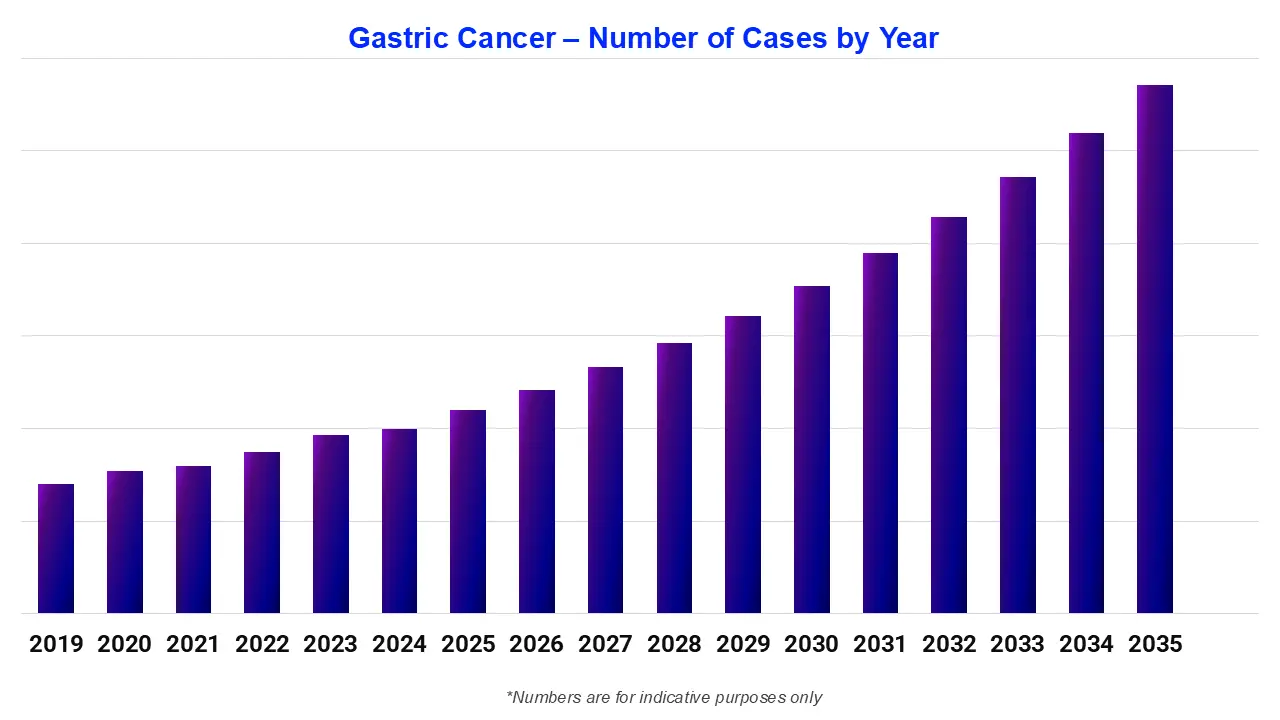
Expert Market Research's “Gastric Cancer Epidemiology Forecast Report 2026-2035” offers comprehensive information on the prevalence and demographics of Gastric Cancer. It projects the future incidence and prevalence rates of Gastric Cancer cases across various populations. The study covers age, gender, and type as major determinants of the Gastric Cancer population. The report highlights patterns in the prevalence of Gastric Cancer overtime and projects future trends based on multiple variables.
The report provides a comprehensive overview of the disease, as well as historical and projected data on the epidemiology of Gastric Cancer in the 8 major markets.
Regions Covered
Gastric cancer (GC) remains a major and potentially fatal malignancy of the stomach, comprising predominantly adenocarcinomas and characterized by substantial geographic variation, heterogeneous molecular biology, and considerable mortality, particularly when diagnosed at an advanced stage. Contemporary literature identifies Helicobacter pylori infection, tobacco exposure, high-salt dietary patterns, alcohol consumption, obesity, premalignant gastric conditions, and inherited susceptibility among important determinants of disease risk. Gastric cancer is also increasingly recognized as a biologically heterogeneous disease involving distinct molecular and histopathological subgroups, with clinically actionable biomarkers including HER2, PD-L1, microsatellite instability/mismatch-repair status, and Claudin-18 isoform 2 (CLDN18.2).
|
Parameter |
Insight |
|
Largest Patient Pool |
United States |
|
Fastest Growing Country |
India |
|
High-Risk Population |
Older adults, men, individuals infected with H. pylori, smokers, people with high dietary salt exposure, heavy alcohol consumption, obesity, atrophic gastritis or intestinal metaplasia, and individuals with hereditary gastric-cancer susceptibility |
|
Key Diagnostic Method |
Upper gastrointestinal endoscopy with histopathological biopsy |
|
Major Risk Factor |
Helicobacter pylori infection |
|
Major gap in the market |
Late diagnosis, inadequate population-level screening outside high-incidence countries, molecular heterogeneity, resistance to systemic therapy, limited treatment durability in metastatic disease, inconsistent biomarker testing, and the need for more effective perioperative and subsequent-line therapies |
The Gastric Cancer epidemiology division offers information on the patient pool from history to the present as well as the projected trend for each of the 8 major markets. Expert Market Research provides both current and predicted trends for the Gastric Cancer epidemiology scenario by examining a wide range of studies. Additionally, the report covers the diagnosed patient pool for Gastric Cancer and their trends. The data is broken down into specific categories, such as total prevalent cases in males and females, and total diagnosed cases across different age groups and patient pools.
|
Epidemiology Segment |
Key Insights |
|
Diagnosed Prevalent Cases of the Disease |
According to the 2026 GBD-based analysis by recent investigators of gastric cancer in China, 1,363,127 prevalent gastric cancer cases were estimated in China in 2023, alongside 575,712 incident cases and 381,500 deaths. This represents one of the largest contemporary country-specific datasets available for gastric cancer and illustrates the substantial prevalence generated by the combination of high incidence and improving survival. |
|
Gender-Specific Cases of the Disease |
Gastric cancer continues to demonstrate a clear male predominance. According to Patel et al., the disease is more common in men, consistent with contemporary epidemiological evidence. The 2026 China GBD analysis similarly found that males carried the higher incidence, mortality and prevalence burden. Sex differences are biologically and epidemiologically multifactorial and may reflect differential exposure to smoking, alcohol, occupational factors, hormonal influences and other environmental determinants. |
|
Age-Specific Cases of the Disease |
Gastric cancer predominantly affects older adults, with risk increasing substantially with age. Patel et al. reported a median age at diagnosis of approximately 68 years. The contemporary Chinese GBD analysis found that individuals aged 75 years or older carried the highest burden and demonstrated slower reductions in disease rates than younger age groups. |
|
Ethnicity-Wise Cases of the Disease |
Gastric cancer demonstrates pronounced geographical and population-level heterogeneity, with substantially higher incidence in East Asian populations and selected regions of Eastern Europe and South America than in many Western populations. Contemporary U.S. SEER data also demonstrate marked racial and ethnic differences: for 2019–2023, the age-adjusted incidence was higher among Hispanic and non-Hispanic Asian/Pacific Islander populations than among non-Hispanic White populations. |
|
Mortality and Survival Analysis of the Disease |
Gastric cancer remains associated with substantial mortality because many patients present with locally advanced or metastatic disease. The latest GLOBOCAN 2024 estimates identify stomach cancer as responsible for 6.6% of global cancer deaths, making it one of the leading causes of cancer mortality worldwide. In the United States, contemporary SEER data report a 39.8% five-year relative survival for stomach cancer based on 2016–2022 survival data, while survival remains strongly dependent on stage. |
|
Disease Type |
Prevalence |
|
Early / Localized Gastric Cancer |
Early gastric cancer is confined to mucosa or submucosa irrespective of lymph-node status and represents an important target for curative treatment. In high-incidence countries with established endoscopic screening, a large proportion of surgically treated cases can be detected at an early stage. The 2023 nationwide Korean Gastric Cancer Association survey reported 63.1% early gastric cancer among 12,751 surgically treated patients |
|
Locally Advanced Gastric Cancer |
Locally advanced disease generally involves deeper gastric-wall invasion and/or regional lymph-node involvement without distant metastasis. Multimodal treatment is central to management. Contemporary European guidance continues to identify perioperative FLOT: 5-fluorouracil, leucovorin, oxaliplatin and docetaxel, as a standard regimen for appropriate resectable disease. |
|
Metastatic / Unresectable Gastric Cancer |
Metastatic disease constitutes the major high-burden therapeutic population and generally requires systemic treatment rather than curative surgery. Contemporary treatment selection is increasingly biomarker-driven according to HER2, PD-L1, CLDN18.2 and MSI/dMMR status. The 2026 ASCO guideline update recommends biomarker-guided incorporation of immunotherapy and targeted therapies into first-line treatment. |
|
HER2-Positive Gastric Cancer |
HER2-positive gastric adenocarcinoma represents a clinically actionable molecular subgroup. Trastuzumab combined with platinum-fluoropyrimidine chemotherapy remains a foundational targeted approach, with pembrolizumab added in appropriate PD-L1-positive disease according to contemporary guideline recommendations. |
Read more about this report - Request a Free Sample
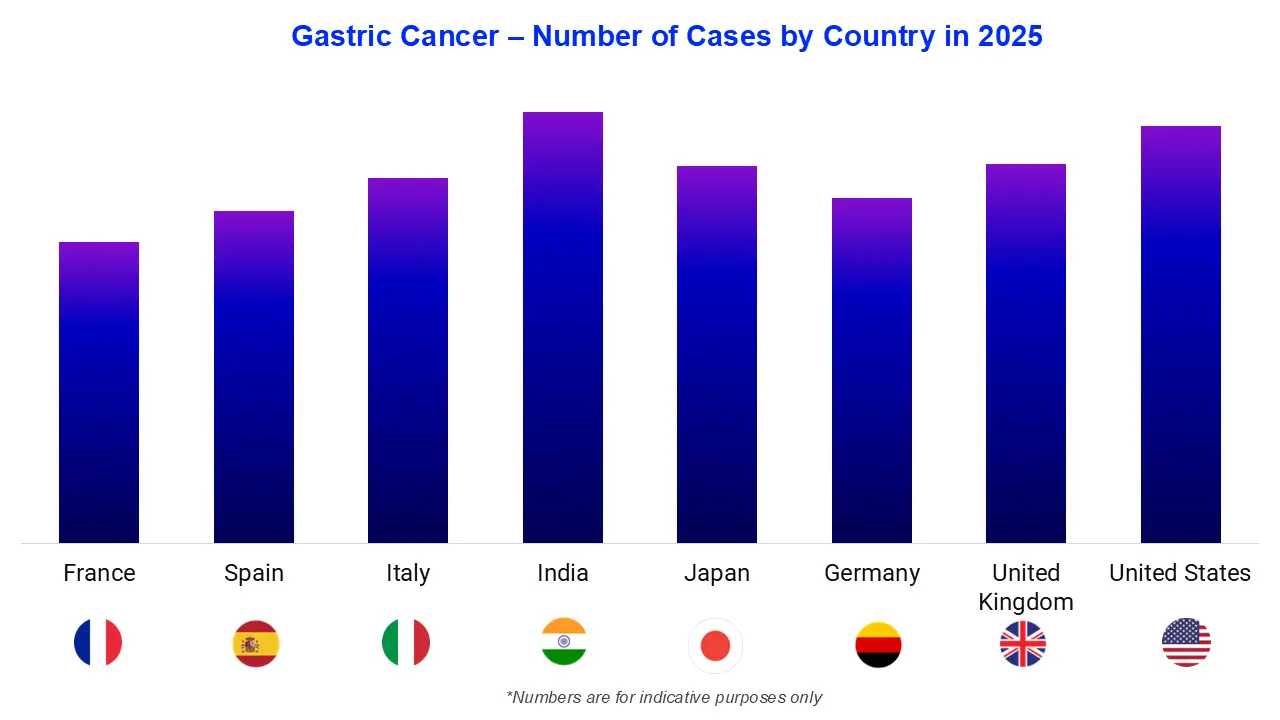
The Gastric Cancer epidemiology data and findings for the United States, Germany, Spain, Italy, France, the United Kingdom, Japan, and India are also provided in the epidemiology section.
|
Country |
Key Insights |
|
United States |
Contemporary U.S. SEER data provide robust recent surveillance. The age-adjusted stomach-cancer incidence rate was 7.29 per 100,000 in 2023, while the U.S. mortality rate was 2.60 per 100,000 in 2024. SEER currently estimates 31,510 new stomach-cancer cases and 10,740 deaths in 2026. The 2023 incidence rate is based on official SEER incidence data, while the 2026 case and death figures are modelled estimates. |
|
Germany |
Germany remains an important European gastric-cancer market with established endoscopic, surgical and systemic-oncology infrastructure. A 2026 clinical review reports that gastric carcinoma ranks tenth in cancer incidence in Germany, and the contemporary German treatment framework incorporates endoscopic diagnosis, surgical resection, perioperative chemotherapy and biomarker-guided systemic therapy. |
|
France |
France has a mature gastric-cancer treatment system and contemporary national clinical guidance covering diagnosis, staging, perioperative treatment and biomarker-guided systemic therapy. The 2026 French intergroup guideline recommends endoscopy and CT for staging, with endoscopic ultrasonography and laparoscopy used selectively, while perioperative FLOT remains the standard for locally advanced resectable disease. |
|
Italy |
Italy remains an important European gastric-cancer market because of its established gastrointestinal oncology and surgical infrastructure. Contemporary European practice continues to emphasize endoscopic diagnosis, pathological staging, perioperative chemotherapy and biomarker-driven systemic treatment. Recent evidence evaluating perioperative FLOT in patients treated between 2020 and 2024 found CLDN18.2 positivity in 30.2% of evaluated resectable gastric/GEJ adenocarcinomas, while HER2 positivity was 7.8%; the findings underscore the potential importance of biomarker testing in Italian and broader European practice, although the cohort was not a national epidemiological sample |
|
Spain |
Spain represents a significant European gastric-cancer treatment market with established endoscopic, surgical and systemic-oncology capabilities. Contemporary Spanish practice is increasingly influenced by biomarker-directed treatment, particularly HER2, PD-L1, MSI/dMMR and CLDN18.2 testing. The latest European evidence supports perioperative FLOT for locally advanced resectable disease and biomarker-guided systemic treatment for metastatic disease. |
|
United Kingdom |
The United Kingdom represents a mature gastric-cancer market with established endoscopic diagnostic pathways, gastrectomy services, chemotherapy, radiotherapy and immunotherapy. Contemporary treatment is increasingly individualized according to HER2, PD-L1, MSI/dMMR and CLDN18.2 status. Recent international guidance supports biomarker-directed immunotherapy and targeted therapy in advanced gastric/GEJ adenocarcinoma. A sufficiently recent nationally representative incidence estimate restricted to 2023–2026 was not identified in the reviewed literature and has therefore not been replaced with an older estimate |
|
Japan |
Japan remains one of the world's most important gastric-cancer markets and a major source of contemporary epidemiological and clinical evidence. The 2023 nationwide Korean survey provides a useful regional comparator, demonstrating that 63.1% of surgically treated Korean gastric cancers were early-stage in 2023, while Japan similarly maintains intensive endoscopic detection programs. Contemporary reviews identify routine endoscopic screening in Japan as an important contributor to earlier diagnosis and improved survival. |
|
India |
India has a substantial gastric-cancer burden with marked geographical heterogeneity and generally lower population-level screening intensity than Japan or South Korea. Contemporary Indian-authored epidemiological literature continues to identify H. pylori, dietary exposures, smoking, alcohol and premalignant gastric conditions as important risk determinants. |
According to contemporary studies, significant gaps remain in the epidemiological characterization, prevention, early diagnosis, molecular stratification and long-term management of gastric cancer, particularly across countries without organized endoscopic screening or comprehensive Helicobacter pylori control programs. The latest GLOBOCAN 2024 estimates published in 2026 identify stomach cancer as responsible for 4.7% of global incident cancers and 6.6% of cancer deaths, confirming that the disease remains one of the world's major oncological burdens. Contemporary Chinese GBD 2023 estimates further demonstrate the scale of the burden in high-incidence Asia, with 575,712 incident cases, 381,500 deaths and 1,363,127 prevalent cases in 2023. A major opportunity therefore exists in primary prevention and risk-stratified surveillance, particularly through H. pylori detection and eradication, smoking cessation, dietary modification and surveillance of premalignant gastric lesions such as atrophic gastritis and intestinal metaplasia.
The management of gastric cancer primarily focuses on achieving complete oncological resection in potentially curable disease, controlling locoregional and metastatic progression, prolonging survival, reducing cancer-related symptoms, preserving nutritional status and maintaining quality of life. Contemporary treatment selection depends on anatomical stage, resectability, histological subtype, performance status, comorbidities and an expanding panel of predictive biomarkers. For very early gastric cancer, endoscopic resection can be appropriate for carefully selected cT1N0 lesions meeting established pathological and technical criteria. For locally advanced resectable disease, surgery is generally integrated with perioperative systemic treatment. The 2026 French intergroup guideline identifies perioperative FLOT: 5-fluorouracil, leucovorin, oxaliplatin and docetaxel: as the standard approach for ≥cT2 and/or node-positive resectable gastric cancer, with endoscopic ultrasound and diagnostic laparoscopy used selectively for staging.


Upto 15% Off
USD
$2699 $2429
$4299 $3869
$5799 $4949
$6999 $5949


*While we strive to always give you current and accurate information, the numbers depicted on the website are indicative and may differ from the actual numbers in the main report. At Expert Market Research, we aim to bring you the latest insights and trends in the market. Using our analyses and forecasts, stakeholders can understand the market dynamics, navigate challenges, and capitalize on opportunities to make data-driven strategic decisions.*
Explore our key highlights of the report and gain a concise overview of key findings, trends, and actionable insights that will empower your strategic decisions.
|
Report Features |
Details |
|
Base Year |
2025 |
|
Historical Period |
2019-2025 |
|
Forecast Period |
2026-2035 |
|
Epidemiology Statistics Provided |
|
|
Segmentation Provided |
|
|
Geographies Covered |
|
Datasheet
One User
USD 2,699
USD 2,429
tax inclusive*
Single User License
One User
USD 4,299
USD 3,869
tax inclusive*
Five User License
Five User
USD 5,799
USD 4,949
tax inclusive*
Corporate License
Unlimited Users
USD 6,999
USD 5,949
tax inclusive*
*Please note that the prices mentioned below are starting prices for each bundle type. Kindly contact our team for further details.*
Flash Bundle
Small Business Bundle
Growth Bundle
Enterprise Bundle
*Please note that the prices mentioned below are starting prices for each bundle type. Kindly contact our team for further details.*
Flash Bundle
Number of Reports: 3
20%
tax inclusive*
Small Business Bundle
Number of Reports: 5
25%
tax inclusive*
Growth Bundle
Number of Reports: 8
30%
tax inclusive*
Enterprise Bundle
Number of Reports: 10
35%
tax inclusive*
How To Order

Select License Type
Choose the right license for your needs and access rights.

Click on ‘Buy Now’
Add the report to your cart with one click and proceed to register.

Select Mode of Payment
Choose a payment option for a secure checkout. You will be redirected accordingly.
Strategic Solutions for Informed Decision-Making
Gain insights to stay ahead and seize opportunities.

Get insights & trends for a competitive edge.

Track prices with detailed trend reports.

Analyse trade data for supply chain insights.

Leverage cost reports for smart savings

Enhance supply chain with partnerships.

Connect For More Information
Our expert team of analysts will offer full support and resolve any queries regarding the report, before and after the purchase.
Our expert team of analysts will offer full support and resolve any queries regarding the report, before and after the purchase.
We employ meticulous research methods, blending advanced analytics and expert insights to deliver accurate, actionable industry intelligence, staying ahead of competitors.
Our skilled analysts offer unparalleled competitive advantage with detailed insights on current and emerging markets, ensuring your strategic edge.
We offer an in-depth yet simplified presentation of industry insights and analysis to meet your specific requirements effectively.




