

Consumer Insights
Uncover trends and behaviors shaping consumer choices today
Procurement Insights
Optimize your sourcing strategy with key market data
Industry Stats
Stay ahead with the latest trends and market analysis.
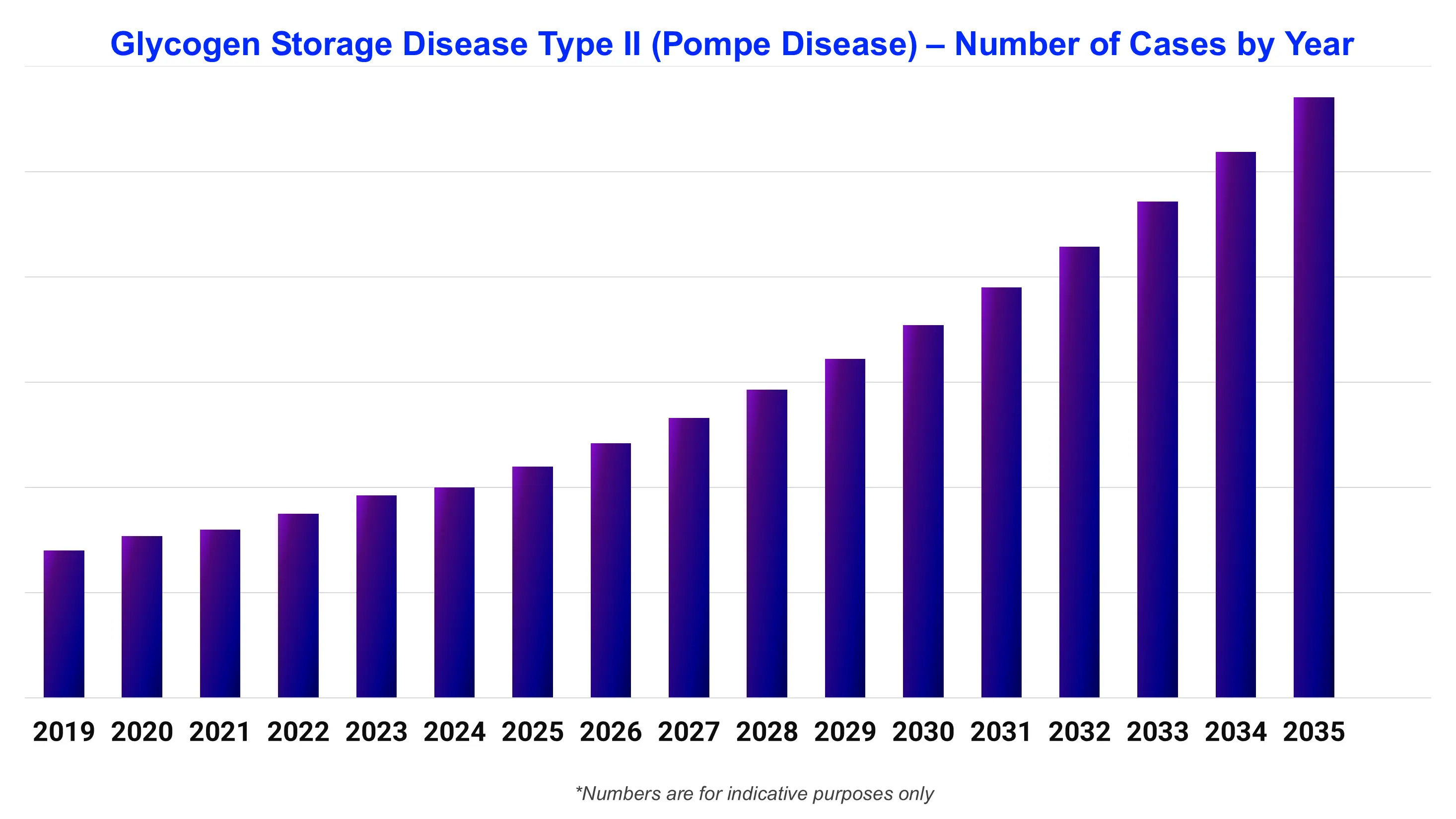
Glycogen Storage Disease Type II (Pompe Disease) is a rare, progressive lysosomal storage disorder caused by deficient acid alpha-glucosidase (GAA) activity, resulting in lysosomal glycogen accumulation and predominantly affecting skeletal, respiratory and cardiac muscle. The estimated incidence of Pompe disease is approximately 1 in 40,000 live births, although incidence varies substantially across populations and disease phenotypes. According to Glycogen Storage Disease Type II (Pompe Disease) Epidemiology Forecast by Expert Market Research (EMR), Pompe disease remains an underdiagnosed inherited metabolic disorder, with increasing clinical recognition, newborn screening, molecular diagnosis and development of enzyme replacement and next-generation therapies shaping the evolving disease landscape.
Base Year
Historical Period
Forecast Period
Read more about this report - Request a Free Sample
Expert Market Research's “Glycogen Storage Disease Type II (Pompe Disease) Epidemiology Forecast Report 2026-2035” offers comprehensive information on the prevalence and demographics of Glycogen Storage Disease Type II (Pompe Disease). It projects the future incidence and prevalence rates of Glycogen Storage Disease Type II (Pompe Disease) cases across various populations. The study covers age, gender, and type as major determinants of the Glycogen Storage Disease Type II (Pompe Disease) population. The report highlights patterns in the prevalence of Glycogen Storage Disease Type II (Pompe Disease) over time and projects future trends based on multiple variables.
The report provides a comprehensive overview of the disease, as well as historical and projected data on the epidemiology of Glycogen Storage Disease Type II (Pompe Disease) in the 8 major markets.
Regions Covered
Pompe disease, also known as glycogen storage disease type II (GSD II), acid maltase deficiency, or acid alpha-glucosidase (GAA) deficiency, is a rare inherited lysosomal storage disorder caused by pathogenic variants in the GAA gene. The disease follows an autosomal recessive inheritance pattern and results from deficient activity of lysosomal acid alpha-glucosidase, the enzyme responsible for hydrolyzing glycogen within lysosomes. Insufficient GAA activity leads to progressive intralysosomal glycogen accumulation, particularly in skeletal muscle, cardiac muscle, and respiratory muscle, ultimately causing cellular dysfunction and tissue damage.
|
Parameter |
Insight |
|
Largest Patient Pool |
United States |
|
Fastest Growing Country |
France |
|
High-Risk Population |
Infants and children born to two carriers of pathogenic GAA variants, particularly those from families with a previous child affected by Pompe disease, constitute the highest-risk population. |
|
Key Diagnostic Method |
Acid alpha-glucosidase (GAA) enzyme activity assay, typically initiated using a dried blood spot (DBS) test and confirmed by enzyme testing in leukocytes/lymphocytes and/or molecular genetic testing of the GAA gene. |
|
Major Risk Factor |
Inheritance of pathogenic biallelic GAA variants: Pompe disease is an autosomal recessive disorder, and disease develops when an individual inherits pathogenic variants in both copies of the GAA gene. |
|
Major gap in the market |
Delayed diagnosis and limited access to comprehensive newborn screening. |
The Glycogen Storage Disease Type II (Pompe Disease) epidemiology division offers information on the patient pool from history to the present as well as the projected trend for each of the 8 major markets. Expert Market Research provides both current and predicted trends for the Glycogen Storage Disease Type II (Pompe Disease) epidemiology scenario by examining a wide range of studies. Additionally, the report covers the diagnosed patient pool for Glycogen Storage Disease Type II (Pompe Disease) and their trends. The data is broken down into specific categories, such as total prevalent cases in males and females, and total diagnosed cases across different age groups and patient pools.
|
Epidemiology Segment |
Key Insights |
|
Diagnosed Prevalent Cases of the Disease |
Pompe disease has an estimated global prevalence of approximately 1 in 40,000 people, although population-based newborn-screening studies have reported substantially higher frequencies, reflecting previously undiagnosed infantile- and late-onset cases. Diagnosed prevalence therefore remains lower than the likely underlying prevalence because of delayed recognition and incomplete case ascertainment. Recent screening studies have reported birth prevalences around 1 in 18,000–20,000 births in some populations. |
|
Gender-Specific Cases of the Disease |
Pompe disease is an autosomal recessive disorder and is expected to affect males and females at approximately equal frequencies. Large registry data support this pattern: among 1,079 patients in the international Pompe Registry, 527 (48.8%) were male and 552 (51.2%) were female, indicating no meaningful overall sex predominance. |
|
Age-Specific Cases of the Disease |
Pompe disease can present at any age, but cases are broadly distributed between infantile-onset and late-onset disease. In the international Pompe Registry, classic infantile-onset disease was defined by symptom onset within the first 12 months with cardiomyopathy; these patients had a mean symptom-onset age of 0.2 years (2.4 months) and mean diagnosis age of 0.3 years (3.5 months). Patients with childhood/juvenile onset had a mean symptom-onset age of 4.0 years, whereas those with onset after 12 years had a mean symptom-onset age of 36.5 years and mean diagnosis age of 42.8 years. |
|
Ethnicity-Wise Cases of the Disease |
A large population-genomic analysis estimated the highest predicted genetic prevalence in East Asian populations (approximately 1 in 12,125), followed by Non-Finnish Europeans (1 in 13,756), Ashkenazi Jewish populations (1 in 22,851), African/African-American populations (1 in 26,560), Latino/Admixed American populations (1 in 57,620), South Asian populations (1 in 93,087), and Finnish populations (1 in 1,056,444). |
|
Mortality and Survival Analysis of the Disease |
The prognosis of late-onset Pompe disease (LOPD) is considerably more heterogeneous and generally more prolonged. Progressive respiratory muscle weakness is a major determinant of morbidity and mortality. In the 2023 French Pompe Registry analysis, 35 of 210 adult patients died during follow-up; their mean age at death was 66.0 years, and 60% of recorded deaths were attributed to respiratory failure. Most deceased patients required ventilatory assistance, highlighting respiratory insufficiency as the principal disease-related determinant of mortality. |
|
Disease Type |
Prevalence |
|
Infantile-Onset Pompe Disease (IOPD) |
Pompe disease presenting during infancy. Classic IOPD is characterized by onset within the first year of life, profound hypotonia and muscle weakness, and hypertrophic cardiomyopathy/cardiac involvement. A non-classic infantile phenotype can present during infancy without the severe cardiomyopathy of classic IOPD. |
|
Late-Onset Pompe Disease (LOPD) |
Pompe disease presenting after infancy, including childhood, juvenile, adolescent and adult-onset disease. It is predominantly characterized by progressive skeletal and respiratory muscle weakness, with cardiac involvement generally less prominent than in classic IOPD. |
Read more about this report - Request a Free Sample
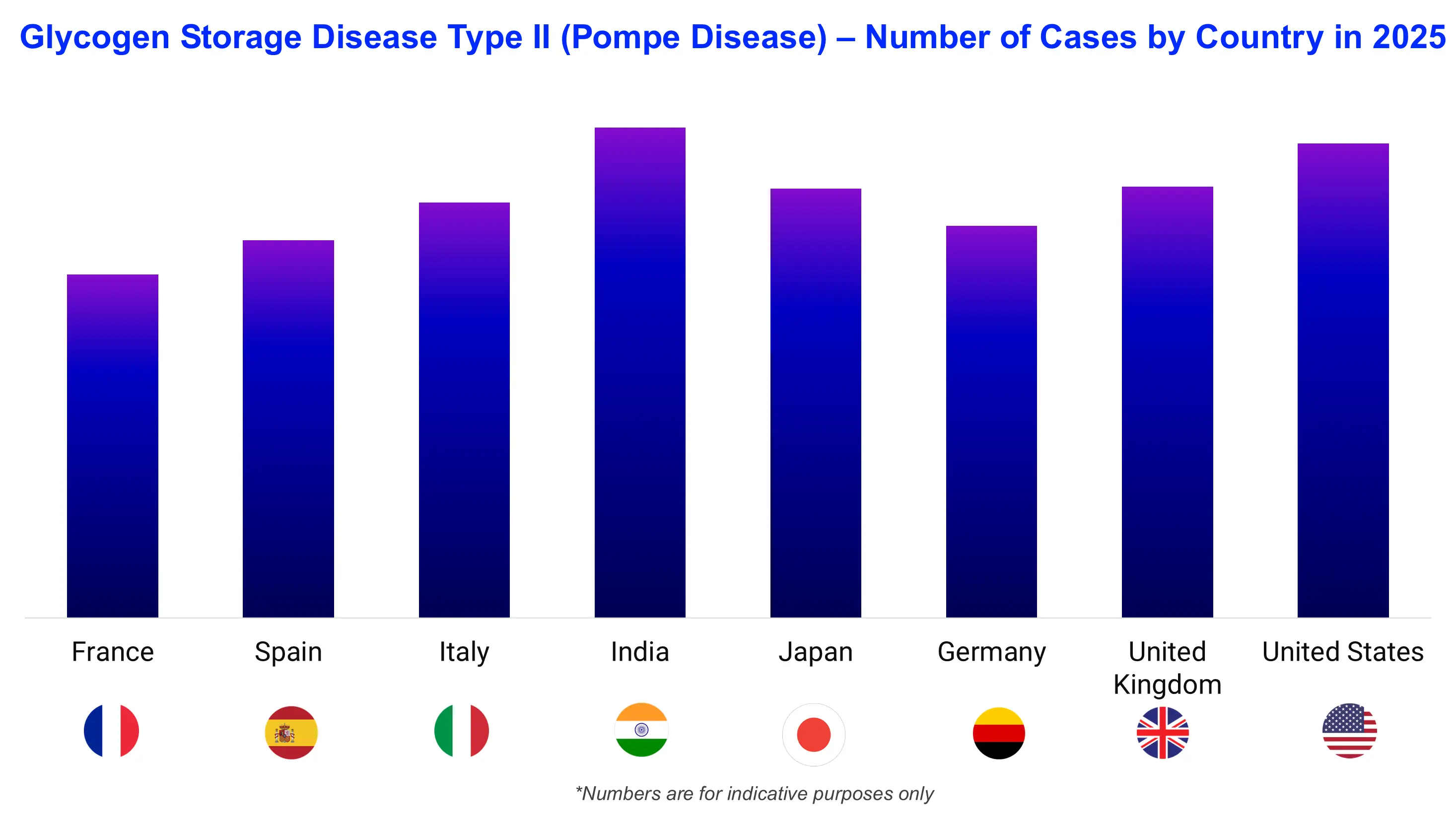
The Glycogen Storage Disease Type II (Pompe Disease) epidemiology data and findings for the United States, Germany, Spain, Italy, France, the United Kingdom, Japan, and India are also provided in the epidemiology section.
|
Country |
Key Insights |
|
United States |
The most appropriate current U.S. epidemiological estimate comes from newborn-screening data rather than extrapolating the older 1 in 40,000 estimate. An analysis covering 9,794,141 U.S. newborns screened across 22 states from 2010-2022 identified 522 confirmed Pompe disease cases, corresponding to a birth prevalence of approximately 1 in 18,763 births. Of these, 63 were classified as infantile-onset Pompe disease (IOPD) and 459 as late-onset Pompe disease (LOPD). |
|
Germany |
Germany’s routine newborn-screening programme does not currently provide a nationwide Pompe-specific prevalence figure comparable with the U.S. dataset. Recent German NBS research has evaluated Pompe among candidate conditions, but the available publications do not establish a national Pompe birth prevalence. |
|
France |
The strongest France-specific epidemiological evidence is therefore the French National Pompe Registry. A recent analysis of the registry reported 246 genetically characterized Pompe patients, with late-onset Pompe disease (LOPD) diagnoses increasing from 2.6 per year before 2001 to 10.6/year during 2001-2010 and 12.8/year during 2011-2015, demonstrating substantial expansion of case ascertainment rather than providing a population prevalence denominator. |
|
Italy |
Italy has one of the stronger country-specific Pompe epidemiology datasets among the 8MM because of regional newborn-screening programmes. The best established estimate is from North-East Italy, where 206,741 newborns were screened over seven years. The study identified an overall Pompe disease incidence of 1 in 18,795 births, comprising 1 in 68,914 for infantile-onset Pompe disease (IOPD) and 1 in 25,843 for late-onset Pompe disease (LOPD). |
|
Spain |
A 2024 publication analyzing the Spanish Pompe Registry included 122 genetically characterized patients: 9 with infantile-onset Pompe disease (IOPD) and 113 with late-onset Pompe disease (LOPD). The authors estimated the prevalence of diagnosed Pompe disease in Spain at approximately 3.1 cases per million inhabitants (3.1/1,000,000). They also reported substantial regional variation, with the highest prevalence observed in Andalusia. |
|
United Kingdom |
For the United Kingdom, the best recent country-specific estimate is approximately 1 in 40,000 people for Pompe disease prevalence. This figure is cited in the first UK-specific clinical consensus review published in 2025. The same review estimates that 35-40 children in the UK are living with infantile-onset Pompe disease (IOPD). |
|
Japan |
Approximately 1 in 37,094 live births, based on Japanese newborn-screening data from 296,759 births; IOPD was detected at approximately 1 in 296,759 births, while additional potential LOPD cases were identified. The estimate is based on regional/participating screening programmes rather than nationwide population surveillance. |
|
India |
A 2024 study from an Indian tertiary genetic centre identified 78 biochemically diagnosed Pompe patients, including only 3 adult-onset cases; this is a centre-based case series and cannot be converted into national prevalence. There is also a prospective Indian study of 45 clinically suspected high-risk children, in which genetically confirmed Pompe disease was identified in approximately 8.8%. However, this is a high-risk clinical cohort, not population prevalence, and therefore should not be reported as India's prevalence. |
The Pompe disease epidemiology landscape across the 8MM remains constrained by substantial underdiagnosis, delayed recognition of late-onset disease, and uneven access to confirmatory GAA enzyme and molecular testing. The absence of universal newborn screening in several countries, particularly India and France, limits early identification of affected infants and presymptomatic patients. Expansion of newborn screening standardized diagnostic algorithms, genetic testing, and specialist referral pathways represents a major opportunity to increase case detection. Growing recognition of late-onset Pompe disease among adults with unexplained proximal muscle weakness or respiratory insufficiency is also expected to expand the diagnosed patient pool. In parallel, improved national registries and cross-border epidemiological surveillance could address the current scarcity of reliable country-specific prevalence data, particularly in India, Germany, France, and Spain.
The cornerstone of Pompe disease treatment is lifelong enzyme replacement therapy (ERT), which supplies recombinant acid alpha-glucosidase (GAA) to reduce lysosomal glycogen accumulation. Alglucosidase alfa was the first approved ERT and remains an established treatment, particularly for infantile-onset Pompe disease (IOPD). Avalglucosidase alfa, a next-generation ERT with enhanced mannose-6-phosphate receptor targeting, is also approved and can improve or stabilize motor and respiratory function. Cipaglucosidase alfa combined with miglustat provides another ERT option for late-onset Pompe disease (LOPD) in jurisdictions where approved.


Upto 15% Off
USD
$2699 $2429
$4299 $3869
$5799 $4949
$6999 $5949


*While we strive to always give you current and accurate information, the numbers depicted on the website are indicative and may differ from the actual numbers in the main report. At Expert Market Research, we aim to bring you the latest insights and trends in the market. Using our analyses and forecasts, stakeholders can understand the market dynamics, navigate challenges, and capitalize on opportunities to make data-driven strategic decisions.*
Explore our key highlights of the report and gain a concise overview of key findings, trends, and actionable insights that will empower your strategic decisions.
|
Report Features |
Details |
|
Base Year |
2025 |
|
Historical Period |
2019-2025 |
|
Forecast Period |
2026-2035 |
|
Epidemiology Statistics Provided |
|
|
Segmentation Provided |
|
|
Geographies Covered |
|
Datasheet
One User
USD 2,699
USD 2,429
tax inclusive*
Single User License
One User
USD 4,299
USD 3,869
tax inclusive*
Five User License
Five User
USD 5,799
USD 4,949
tax inclusive*
Corporate License
Unlimited Users
USD 6,999
USD 5,949
tax inclusive*
*Please note that the prices mentioned below are starting prices for each bundle type. Kindly contact our team for further details.*
Flash Bundle
Small Business Bundle
Growth Bundle
Enterprise Bundle
*Please note that the prices mentioned below are starting prices for each bundle type. Kindly contact our team for further details.*
Flash Bundle
Number of Reports: 3
20%
tax inclusive*
Small Business Bundle
Number of Reports: 5
25%
tax inclusive*
Growth Bundle
Number of Reports: 8
30%
tax inclusive*
Enterprise Bundle
Number of Reports: 10
35%
tax inclusive*
How To Order

Select License Type
Choose the right license for your needs and access rights.

Click on ‘Buy Now’
Add the report to your cart with one click and proceed to register.

Select Mode of Payment
Choose a payment option for a secure checkout. You will be redirected accordingly.
Strategic Solutions for Informed Decision-Making
Gain insights to stay ahead and seize opportunities.

Get insights & trends for a competitive edge.

Track prices with detailed trend reports.

Analyse trade data for supply chain insights.

Leverage cost reports for smart savings

Enhance supply chain with partnerships.

Connect For More Information
Our expert team of analysts will offer full support and resolve any queries regarding the report, before and after the purchase.
Our expert team of analysts will offer full support and resolve any queries regarding the report, before and after the purchase.
We employ meticulous research methods, blending advanced analytics and expert insights to deliver accurate, actionable industry intelligence, staying ahead of competitors.
Our skilled analysts offer unparalleled competitive advantage with detailed insights on current and emerging markets, ensuring your strategic edge.
We offer an in-depth yet simplified presentation of industry insights and analysis to meet your specific requirements effectively.




