

Consumer Insights
Uncover trends and behaviors shaping consumer choices today
Procurement Insights
Optimize your sourcing strategy with key market data
Industry Stats
Stay ahead with the latest trends and market analysis.
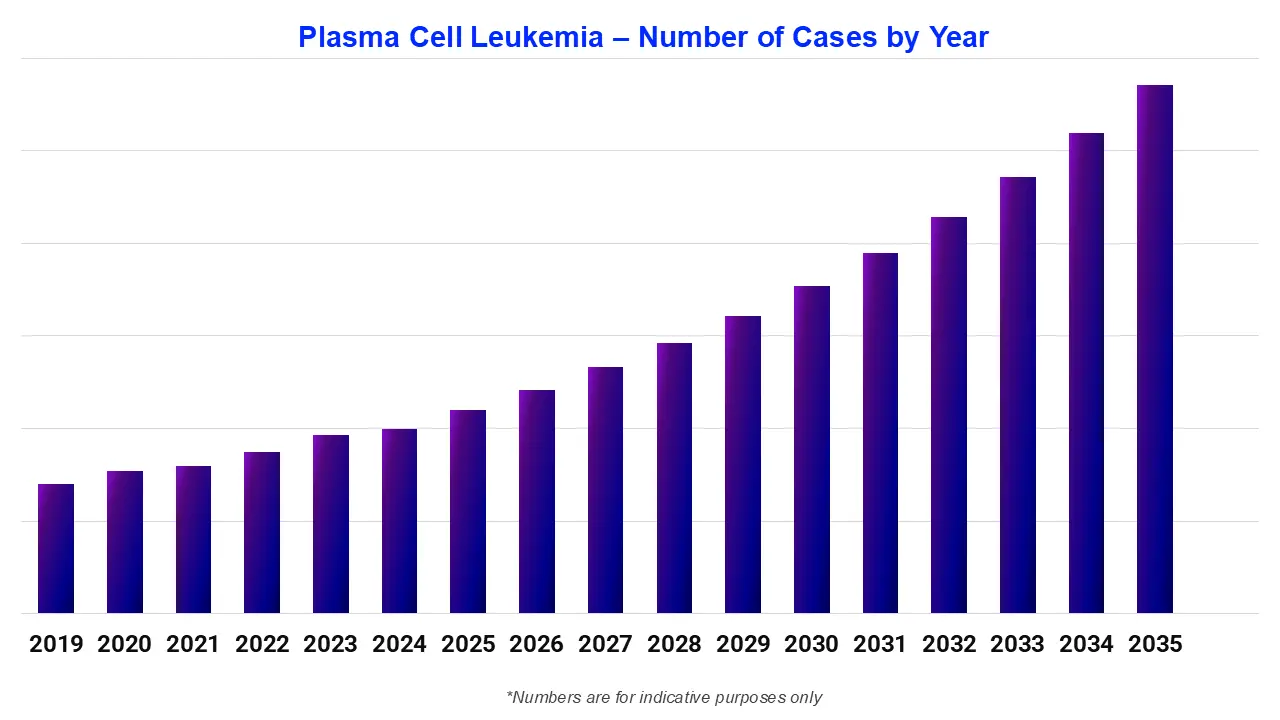
Plasma cell leukemia is a rare and aggressive hematologic malignancy characterized by the presence of malignant plasma cells in peripheral blood and bone marrow. It accounts for approximately 0.1–0.6% of plasma cell disorders in the United States, according to Shagun Singh et al., 2025. According to plasma cell leukemia epidemiology forecast by Expert Market Research, hematologic malignancy burden remains significant due to poor prognosis and rapid disease progression globally.
Base Year
Historical Period
Forecast Period
Read more about this report - Request a Free Sample
Expert Market Research's “Plasma Cell Leukemia Epidemiology Forecast Report 2026-2035” offers comprehensive information on the prevalence and demographics of plasma cell leukemia. It projects the future incidence and prevalence rates of plasma cell leukemia cases across various populations. The study covers age, gender, and type as major determinants of the plasma cell leukemia population. The report highlights patterns in the prevalence of plasma cell leukemia over time and projects future trends based on multiple variables.
The report provides a comprehensive overview of the disease, as well as historical and projected data on the epidemiology of plasma cell leukemia in the 8 major markets.
Regions Covered
Plasma cell leukemia is an ultra-rare and highly aggressive plasma cell disorder in which abnormal plasma cells circulate in the peripheral blood and infiltrate the bone marrow. It typically presents in two forms: primary plasma cell leukemia, which develops de novo, and secondary plasma cell leukemia, which evolves from pre-existing multiple myeloma. The disease is driven by genetic and cytogenetic abnormalities leading to uncontrolled plasma cell proliferation. It is a plasma cell disorder with rapid progression and high mortality.
|
Parameter |
Insight |
|
Largest Patient Pool |
United States |
|
Fastest Growing Region |
India |
|
High-Risk Population |
Elderly patients |
|
Key Diagnostic Method |
Peripheral blood smear, flow cytometry, and bone marrow biopsy |
|
Major Risk Factor |
Progression from multiple myeloma and high-risk cytogenetic abnormalities |
|
Major gap in the market |
Underdiagnosis due to rarity and lack of standardized early screening criteria |
The plasma cell leukemia epidemiology division offers information on the patient pool from history to the present as well as the projected trend for each of the 8 major markets. Expert Market Research provides both current and predicted trends for the plasma cell leukemia epidemiology scenario by examining a wide range of studies. Additionally, the report covers the diagnosed patient pool for plasma cell leukemia and their trends. The data is broken down into specific categories, such as total prevalent cases in males and females, and total diagnosed cases across different age groups and patient pools.
|
Epidemiology Segment |
Key Insights |
|
Diagnosed Prevalent Cases of the Disease |
According to Shagun Singh et al., 2025, Plasma Cell Leukemia accounts for nearly 0.1–0.6% of plasma cell disorders in the United States, highlighting its extreme rarity and frequent underdiagnosis at the global level. |
|
Gender-Specific Cases of the Disease |
As per Shammas Bajwa et al., 2025, the disease shows a near-balanced distribution with 48% male and 52% female patients, indicating minimal gender-based incidence variation across reported cohorts. |
|
Age-Specific Cases of the Disease |
As per clinical evidence reported in 2025 studies, Plasma Cell Leukemia primarily affects elderly individuals, with a median age of diagnosis around 66 years, and most cases occurring after 60 years of age. |
|
Ethnicity-Wise Cases of the Disease |
According to Shammas Bajwa et al., 2025 (SEER data), cases are predominantly reported in White populations (63.7%), followed by Black (20.67%), Hispanic (10.67%), and other minority groups. |
|
Mortality and Survival Analysis of the Disease |
As per Shammas Bajwa et al., 2025, Plasma Cell Leukemia demonstrates extremely poor outcomes with a median survival of ~6 months, 1-year survival of 37.9%, and 5-year survival of only 11%, reflecting its aggressive clinical course. |
|
Disease Type |
Prevalence |
|
Primary Plasma Cell Leukemia |
Accounts for approximately 1–2% of newly diagnosed multiple myeloma cases; characterized by de novo onset and rapid disease progression. |
|
Secondary Plasma Cell Leukemia |
Develops from relapsed or refractory multiple myeloma; rarer in occurrence but associated with extremely poor prognosis and treatment resistance. |
Read more about this report - Request a Free Sample
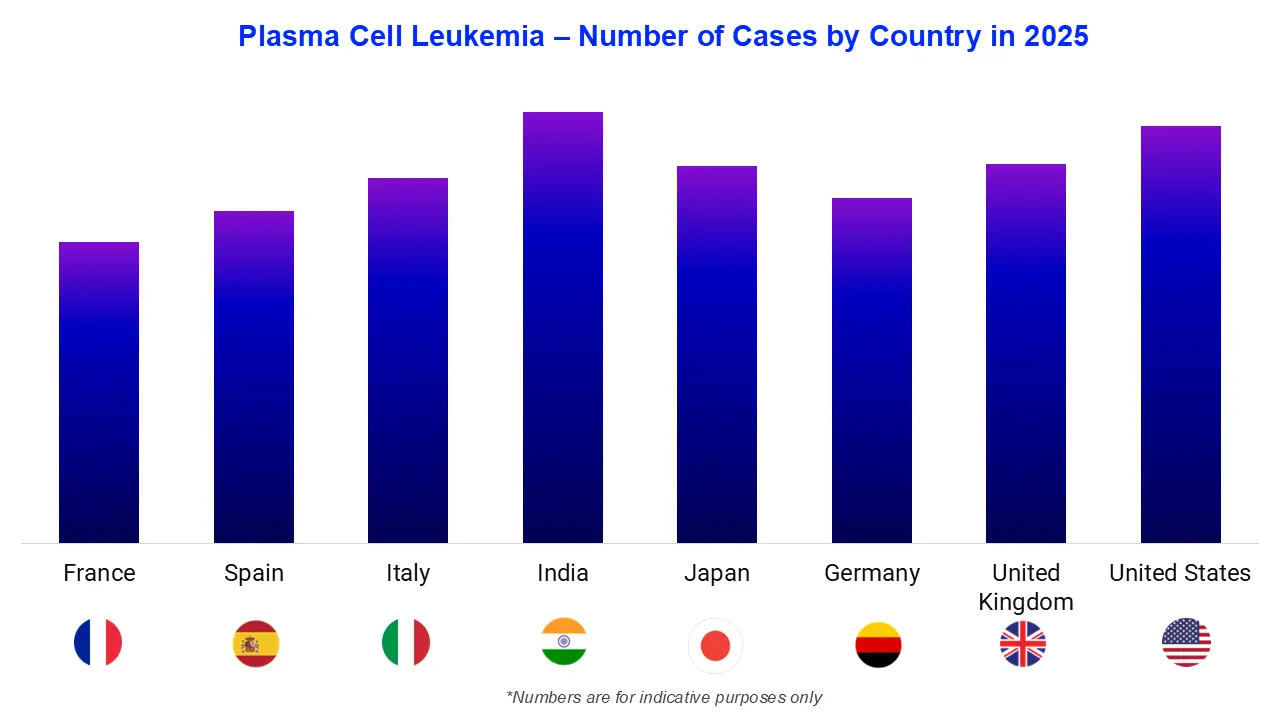
The plasma cell leukemia epidemiology data and findings for the United States, Germany, Spain, Italy, France, the United Kingdom, Japan, and India are also provided in the epidemiology section.
|
Country |
Key Insights |
|
United States |
According to Shagun Singh et al., 2025, plasma cell leukemia accounts for approximately 0.1–0.6% of plasma cell disorders in the United States. Epidemiologically, its distribution aligns with the national multiple myeloma burden, which serves as the primary precursor population for plasma cell leukemia cases, reflecting its presence across established plasma cell neoplasm registries. |
|
Germany |
According to Klaus Martin Kortüm et al., 2026, multiple myeloma in Germany shows age-standardized mortality rates of 1.8 per 100,000 females and 2.9 per 100,000 males. Plasma cell leukemia is documented within national hematologic malignancy records as part of the plasma cell neoplasm continuum, contributing a minimal proportion to overall disease distribution. |
|
France |
According to European cohort data cited by Hira Mian et al., 2024, Plasma Cell Leukemia cases are identified within multiple myeloma cohorts, including those with cytogenetic patterns such as t(14;16). Its epidemiological distribution is recorded within specialized plasma cell disorder studies across France and surrounding European populations. |
|
Italy |
In Italy, multiple myeloma constitutes a significant component of hematologic malignancy reporting. Plasma Cell Leukemia is captured within plasma cell neoplasm surveillance frameworks, representing advanced disease spectrum observations in clinical and registry-based datasets. |
|
Spain |
Spain follows the European multiple myeloma incidence range of approximately 4.5–6.0 cases per 100,000 persons annually. Plasma cell leukemia is represented within national hematology datasets as part of advanced plasma cell disorder progression patterns documented in clinical registries. |
|
United Kingdom |
According to Pfizer, around 6,000 multiple myeloma cases are diagnosed annually in the United Kingdom, representing the foundational disease pool associated with plasma cell leukemia epidemiology. Recorded cases of Plasma Cell Leukemia are observed within advanced plasma cell disorder datasets, consistent with the broader Multiple Myeloma disease spectrum. |
|
Japan |
According to GSK, Japan reports over 7,200 new multiple myeloma cases annually. Plasma cell leukemia cases are recorded within national hematologic cancer datasets as part of the broader Multiple Myeloma disease continuum, reflecting established clinical reporting patterns. |
|
India |
According to Nupur Das et al., 2024, multiple myeloma incidence in India is approximately 1 per 100,000 individuals, with an increasing urban trend. Plasma cell leukemia is documented within tertiary care and registry-based hematology data as part of plasma cell disorder reporting in the country. |
The epidemiological understanding of plasma cell leukemia remains limited due to its extreme rarity and lack of standardized diagnostic screening protocols. A major gap exists in early detection, particularly among high-risk multiple myeloma patients who progress to leukemic transformation. In many regions, especially low- and middle-income countries, underreporting and limited registry infrastructure further obscure true disease burden. Emerging opportunities include advanced flow cytometry-based screening, genomic risk stratification, and integration of real-world evidence databases. Expansion of rare cancer registries and improved global surveillance systems represent key unmet needs in this epidemiological landscape.
Management of plasma cell leukemia requires intensive combination therapy due to its highly aggressive nature. Standard treatment includes proteasome inhibitors, immunomodulatory agents, and monoclonal antibodies to achieve rapid disease control. Eligible patients may undergo autologous stem cell transplantation to improve survival outcomes. In refractory or relapsed cases, emerging therapies such as CAR-T cell therapy and novel immunotherapeutic combinations are being evaluated. Despite therapeutic advances, relapse remains common, necessitating continuous monitoring and individualized treatment strategies. A key targeted therapy approach plays an important role in improving response rates and extending progression-free survival.


Upto 15% Off
USD
$2699 $2429
$4299 $3869
$5799 $4949
$6999 $5949


*While we strive to always give you current and accurate information, the numbers depicted on the website are indicative and may differ from the actual numbers in the main report. At Expert Market Research, we aim to bring you the latest insights and trends in the market. Using our analyses and forecasts, stakeholders can understand the market dynamics, navigate challenges, and capitalize on opportunities to make data-driven strategic decisions.*
Explore our key highlights of the report and gain a concise overview of key findings, trends, and actionable insights that will empower your strategic decisions.
|
Report Features |
Details |
|
Base Year |
2025 |
|
Historical Period |
2019-2025 |
|
Forecast Period |
2026-2035 |
|
Epidemiology Statistics Provided |
|
|
Segmentation Provided |
|
|
Geographies Covered |
|
Datasheet
One User
USD 2,699
USD 2,429
tax inclusive*
Single User License
One User
USD 4,299
USD 3,869
tax inclusive*
Five User License
Five User
USD 5,799
USD 4,949
tax inclusive*
Corporate License
Unlimited Users
USD 6,999
USD 5,949
tax inclusive*
*Please note that the prices mentioned below are starting prices for each bundle type. Kindly contact our team for further details.*
Flash Bundle
Small Business Bundle
Growth Bundle
Enterprise Bundle
*Please note that the prices mentioned below are starting prices for each bundle type. Kindly contact our team for further details.*
Flash Bundle
Number of Reports: 3
20%
tax inclusive*
Small Business Bundle
Number of Reports: 5
25%
tax inclusive*
Growth Bundle
Number of Reports: 8
30%
tax inclusive*
Enterprise Bundle
Number of Reports: 10
35%
tax inclusive*
How To Order

Select License Type
Choose the right license for your needs and access rights.

Click on ‘Buy Now’
Add the report to your cart with one click and proceed to register.

Select Mode of Payment
Choose a payment option for a secure checkout. You will be redirected accordingly.
Strategic Solutions for Informed Decision-Making
Gain insights to stay ahead and seize opportunities.

Get insights & trends for a competitive edge.

Track prices with detailed trend reports.

Analyse trade data for supply chain insights.

Leverage cost reports for smart savings

Enhance supply chain with partnerships.

Connect For More Information
Our expert team of analysts will offer full support and resolve any queries regarding the report, before and after the purchase.
Our expert team of analysts will offer full support and resolve any queries regarding the report, before and after the purchase.
We employ meticulous research methods, blending advanced analytics and expert insights to deliver accurate, actionable industry intelligence, staying ahead of competitors.
Our skilled analysts offer unparalleled competitive advantage with detailed insights on current and emerging markets, ensuring your strategic edge.
We offer an in-depth yet simplified presentation of industry insights and analysis to meet your specific requirements effectively.




