

Consumer Insights
Uncover trends and behaviors shaping consumer choices today
Procurement Insights
Optimize your sourcing strategy with key market data
Industry Stats
Stay ahead with the latest trends and market analysis.
Multiple myeloma (MM) remains a serious and generally incurable hematological malignancy characterized by clonal proliferation of abnormal plasma cells, predominantly within the bone marrow. The disease produces a monoclonal immunoglobulin or light-chain protein in most patients and can cause substantial end-organ injury, including anemia, renal dysfunction, hypercalcemia and osteolytic bone disease. According to the latest Global Cancer Statistics 2024, published in 2026, an estimated 196,157 new cases and 119,029 deaths from multiple myeloma occurred globally in 2024, accounting for approximately 1.0% of all new cancer cases and 1.2% of cancer deaths worldwide. According to the Multiple Myeloma Epidemiology Forecast by Expert Market Research, the disease continues to represent a significant clinical and healthcare burden because of its chronic relapsing course, increasing prevalence associated with improved survival, substantial treatment costs, age-associated comorbidities, recurrent disease and the persistent unmet need for durable disease control.
Base Year
Historical Period
Forecast Period
Read more about this report - Request a Free Sample
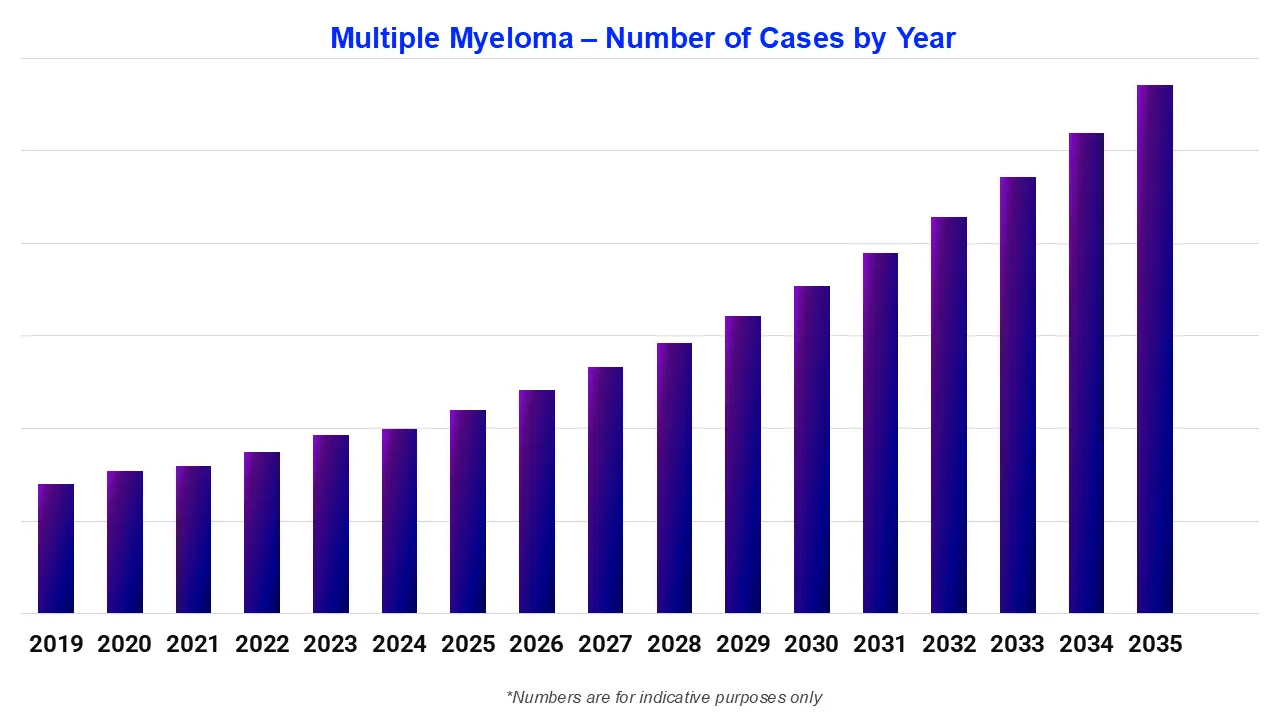
Expert Market Research's “Multiple Myeloma Epidemiology Forecast Report 2026-2035” offers comprehensive information on the prevalence and demographics of Multiple Myeloma. It projects the future incidence and prevalence rates of Multiple Myeloma cases across various populations. The study covers age, gender, and type as major determinants of the Multiple Myeloma population. The report highlights patterns in the prevalence of Multiple Myeloma overtime and projects future trends based on multiple variables.
The report provides a comprehensive overview of the disease, as well as historical and projected data on the epidemiology of Multiple Myeloma in the 8 major markets.
Regions Covered
Multiple myeloma (MM) remains a serious and generally incurable hematological malignancy characterized by clonal proliferation of abnormal plasma cells, predominantly within the bone marrow. The disease produces a monoclonal immunoglobulin or light-chain protein in most patients and can cause substantial end-organ injury, including anemia, renal dysfunction, hypercalcemia and osteolytic bone disease. Multiple myeloma represents a biologically heterogeneous malignancy in which cytogenetic abnormalities, molecular alterations, disease burden, extramedullary involvement and host factors influence prognosis and therapeutic response.
|
Parameter |
Insight |
|
Largest Patient Pool |
United States |
|
Fastest Growing Country |
Japan |
|
High-Risk Population |
Older adults, men, individuals with MGUS or smoldering myeloma, people with a family history of plasma-cell disorders, and populations with obesity and selected metabolic or environmental risk factors |
|
Key Diagnostic Method |
Serum and urine monoclonal-protein assessment combined with serum free-light-chain testing, bone-marrow examination and sensitive imaging |
|
Major Risk Factor |
Increasing age and the presence of a plasma-cell precursor disorder such as MGUS |
|
Major gap in the market |
Relapse and treatment resistance, high-risk cytogenetic disease, extramedullary myeloma, frailty, renal impairment, treatment-related infections, limited access to cellular therapies and high treatment costs |
The Multiple Myeloma epidemiology division offers information on the patient pool from history to the present as well as the projected trend for each of the 8 major markets. Expert Market Research provides both current and predicted trends for the Multiple Myeloma epidemiology scenario by examining a wide range of studies. Additionally, the report covers the diagnosed patient pool for Multiple Myeloma and their trends. The data is broken down into specific categories, such as total prevalent cases in males and females, and total diagnosed cases across different age groups and patient pools.
|
Epidemiology Segment |
Key Insights |
|
Diagnosed Prevalent Cases of the Disease |
According to the 2026 SEER Cancer Stat Facts, approximately 202,793 people were living with myeloma in the United States in 2023, demonstrating the substantial prevalent population created by improving survival and the chronic relapsing nature of the disease. SEER estimates approximately 36,000 new U.S. cases and 10,850 deaths in 2026. |
|
Gender-Specific Cases of the Disease |
Multiple myeloma demonstrates a consistent male predominance. Current U.S. SEER data show an incidence rate of approximately 9.1 per 100,000 in men versus 6.1 per 100,000 in women based on 2019–2023 cases. The disparity is even more pronounced among non-Hispanic Black populations, where the reported rates were 17.9 per 100,000 for men and 13.4 per 100,000 for women. |
|
Age-Specific Cases of the Disease |
Multiple myeloma is predominantly a disease of older adults, with incidence increasing markedly with advancing age. Contemporary U.S. surveillance demonstrates that the majority of newly diagnosed patients occur in older age groups, while recent clinical reviews emphasize that frailty and comorbidity become increasingly important determinants of treatment selection in older patients. |
|
Ethnicity-Wise Cases of the Disease |
Substantial racial and ethnic differences are documented in contemporary U.S. surveillance. Non-Hispanic Black populations experience the highest reported incidence, with SEER 2019–2023 rates of 17.9 per 100,000 in men and 13.4 per 100,000 in women, compared with 8.4 and 5.2 per 100,000 respectively among non-Hispanic White populations. |
|
Mortality and Survival Analysis of the Disease |
Multiple myeloma remains fatal for many patients despite substantial therapeutic progress. Global GLOBOCAN 2024 estimates recorded 119,029 deaths in 2024. In the United States, contemporary SEER data report a 63.7% five-year relative survival based on 2016–2022 follow-up, while survival is strongly influenced by disease biology, stage-related complications, age, cytogenetic risk and access to modern therapies. |
|
Disease Type |
Prevalence |
|
Monoclonal Gammopathy of Undetermined Significance (MGUS) |
MGUS is a premalignant plasma-cell disorder characterized by monoclonal protein without myeloma-defining organ damage. It is clinically important because it represents the principally recognized precursor state for most multiple myeloma cases. Contemporary clinical practice therefore emphasizes longitudinal monitoring of patients with MGUS according to their individual risk profile. |
|
Smoldering Multiple Myeloma |
Smoldering multiple myeloma represents an intermediate plasma-cell disorder with a higher tumor burden than MGUS but without myeloma-defining events. Modern imaging, biomarkers and risk-stratification systems are increasingly used to identify patients at sufficiently high risk of progression who may benefit from early therapeutic intervention or clinical trials. |
|
Newly Diagnosed Multiple Myeloma |
Newly diagnosed multiple myeloma encompasses patients who meet established diagnostic criteria for active disease, including myeloma-defining biomarkers or end-organ damage. Treatment selection is increasingly divided according to transplant eligibility, frailty, cytogenetic risk and disease biology. Anti-CD38-containing quadruplet therapy has become increasingly important in frontline management. The 2025 CEPHEUS trial demonstrated substantially deeper MRD responses with daratumumab-VRd than VRd in transplant-ineligible or transplant-deferred patients. |
|
Transplant-Eligible Multiple Myeloma |
Transplant-eligible disease generally occurs in biologically and physiologically suitable patients who can undergo high-dose therapy followed by autologous stem-cell transplantation. Contemporary evidence supports daratumumab-containing quadruplet induction, stem-cell collection and transplantation followed by consolidation and maintenance in appropriate patients. Long-term 2025 CASSIOPEIA findings further demonstrated durable MRD and progression-free-survival advantages with daratumumab-based therapy. |
Read more about this report - Request a Free Sample
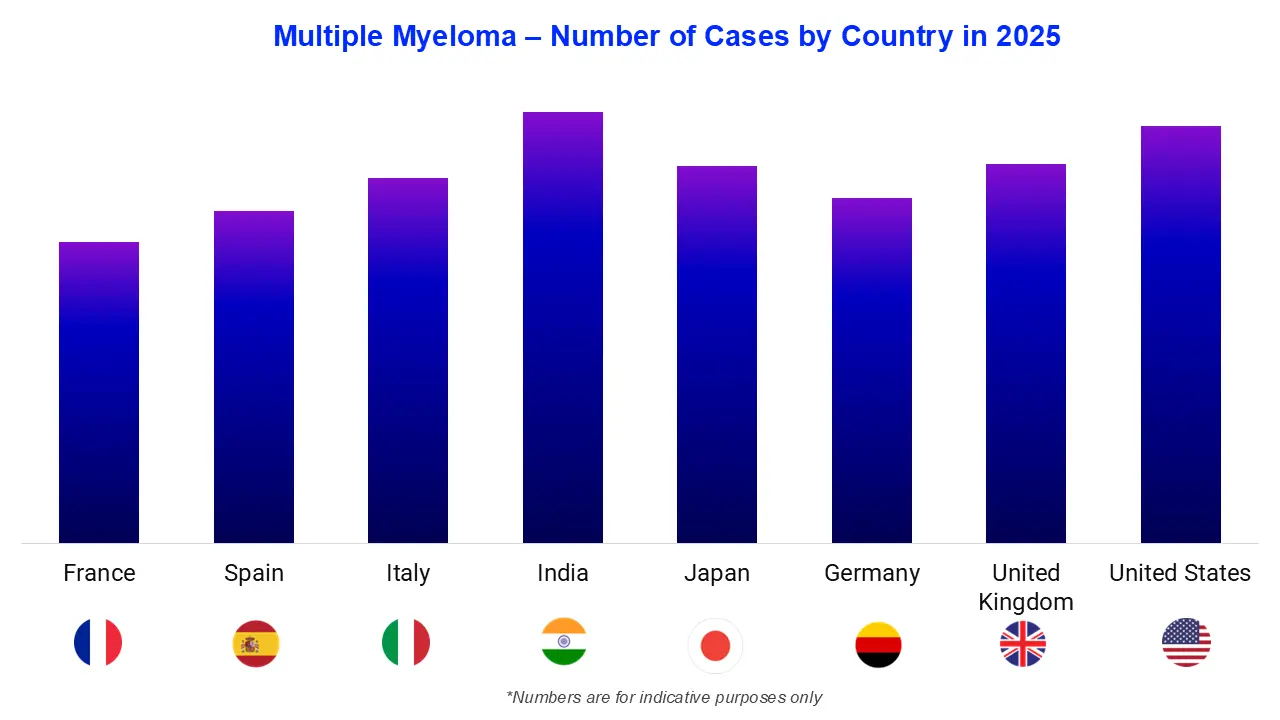
The Multiple Myeloma epidemiology data and findings for the United States, Germany, Spain, Italy, France, the United Kingdom, Japan, and India are also provided in the epidemiology section.
|
Country |
Key Insights |
|
United States |
The United States represents one of the world's largest and most therapeutically advanced multiple-myeloma markets. Contemporary SEER data report 202,793 people living with myeloma in 2023, while the estimated 2026 burden is 36,000 new cases and 10,850 deaths. The 2023 incidence rate was 7.16 per 100,000, and contemporary 2019-2023 data demonstrate particularly high incidence among non-Hispanic Black populations. |
|
Germany |
Germany represents a mature European multiple-myeloma market with established hematology, transplantation and cellular-therapy infrastructure. Recent German evidence published during the 2023-2026 period confirms substantial improvement in myeloma survival over time and increasing importance of long-term complications as patients live longer. |
|
France |
France has one of Europe's strongest national real-world evidence infrastructures for multiple myeloma. A 2025 MYLORD analysis using the French National Health Insurance database provided updated epidemiological indicators and demonstrated an increasing treated prevalence through the contemporary observation period. A 2026 national hospital-discharge analysis covering data through 2023 identified 69,276 patients hospitalized with multiple myeloma across 323 French centers, supporting the substantial scale of the national treatment population. |
|
Italy |
Italy represents a significant European multiple-myeloma market. According to a 2025 GBD 2023 analysis, 6,700 new multiple-myeloma cases and 4,100 deaths occurred in Italy in 2023, with 73,600 DALYs attributed to the disease. The study found broadly stable age-standardized incidence and mortality trends while the mortality-to-incidence ratio improved, consistent with better disease control and survival. A separate 2025 Italian epidemiological model also highlighted the growing number of treated prevalent patients and the increasing importance of treatment-line and refractory-status stratification. |
|
Spain |
Spain has a mature hematological-oncology infrastructure with increasing adoption of anti-CD38 combinations, autologous transplantation, CAR-T-cell therapy and bispecific antibodies. Contemporary European treatment practice increasingly incorporates MRD assessment and molecular risk stratification into therapeutic decision-making. A nationally representative incidence estimate based exclusively on 2023–2026 Spanish observations was not identified in the reviewed recent literature; consequently, older national incidence figures have not been inserted. |
|
United Kingdom |
The United Kingdom represents an important multiple-myeloma treatment market with established NHS hematology services and access to modern systemic therapy and cellular immunotherapy. Recent English real-world evidence has examined national treatment patterns and outcomes, while contemporary treatment developments increasingly involve CAR-T and bispecific antibody sequencing. Because the national English registry study identified in the recent literature contains historical diagnosis cohorts extending before 2023, it has not been used to generate a 2023–2026 incidence number. |
|
Japan |
Japan is a major Asia-Pacific multiple-myeloma market with rapidly evolving use of proteasome inhibitors, immunomodulatory agents, anti-CD38 antibodies and newer immune-based therapies. A contemporary Japanese retrospective cohort published in 2025 evaluated patients treated through June 2023 and documented continuing changes in treatment patterns following the introduction of modern agents. A 2025 real-world survey involving 309 Japanese patients treated between September 2022 and May 2023 found that 77% of the first-line cohort received lenalidomide-based therapy and highlighted persistent quality-of-life burden and extensive retreatment in relapsed disease. |
|
India |
India represents an important emerging multiple-myeloma market because of its large population, expanding diagnostic capacity and increasing availability of modern hematological therapies. Contemporary India-specific epidemiological estimates restricted entirely to 2023–2026 remain comparatively limited, making precise national patient counts difficult to establish without reliance on older registry datasets. The major opportunities are therefore expansion of diagnostic access, standardized serum-free-light-chain and bone-marrow testing, earlier identification of plasma-cell disorders, access to transplantation and broader availability of anti-CD38, CAR-T and bispecific therapies. |
According to contemporary 2023–2026 evidence, significant gaps remain in the epidemiological characterization, early detection, molecular stratification and long-term management of multiple myeloma, particularly in emerging healthcare markets. The latest GLOBOCAN 2024 assessment published in 2026 estimated 196,157 new multiple-myeloma cases and 119,029 deaths globally in 2024, demonstrating that the disease remains a substantial worldwide hematological cancer burden. The epidemiological burden is also becoming increasingly important as survival improves and patients remain within treatment pathways for longer periods. Current U.S. surveillance illustrates this phenomenon, with an estimated 202,793 people living with myeloma in 2023 compared with an estimated 36,000 new cases in 2026. This expanding prevalent population creates opportunities for therapies capable of producing longer treatment-free intervals and durable MRD-negative remission.
The management of multiple myeloma primarily focuses on achieving the deepest possible disease response, prolonging progression-free and overall survival, preventing irreversible end-organ damage, maintaining quality of life and controlling recurrent disease over successive treatment lines. Treatment selection is determined by transplant eligibility, age, frailty, renal function, cytogenetic risk, disease burden, prior therapy and depth of response. Contemporary practice increasingly incorporates measurable residual disease as a high-sensitivity endpoint alongside conventional complete response and biochemical disease markers. For newly diagnosed transplant-eligible multiple myeloma, contemporary treatment increasingly uses an anti-CD38-containing quadruplet built around bortezomib, lenalidomide and dexamethasone. Daratumumab-VRd has demonstrated deeper responses and improved progression-free survival compared with VRd in phase III evidence.


Upto 15% Off
USD
$2699 $2429
$4299 $3869
$5799 $4949
$6999 $5949


*While we strive to always give you current and accurate information, the numbers depicted on the website are indicative and may differ from the actual numbers in the main report. At Expert Market Research, we aim to bring you the latest insights and trends in the market. Using our analyses and forecasts, stakeholders can understand the market dynamics, navigate challenges, and capitalize on opportunities to make data-driven strategic decisions.*
Explore our key highlights of the report and gain a concise overview of key findings, trends, and actionable insights that will empower your strategic decisions.
|
Report Features |
Details |
|
Base Year |
2025 |
|
Historical Period |
2019-2025 |
|
Forecast Period |
2026-2035 |
|
Epidemiology Statistics Provided |
|
|
Segmentation Provided |
|
|
Geographies Covered |
|
Datasheet
One User
USD 2,699
USD 2,429
tax inclusive*
Single User License
One User
USD 4,299
USD 3,869
tax inclusive*
Five User License
Five User
USD 5,799
USD 4,949
tax inclusive*
Corporate License
Unlimited Users
USD 6,999
USD 5,949
tax inclusive*
*Please note that the prices mentioned below are starting prices for each bundle type. Kindly contact our team for further details.*
Flash Bundle
Small Business Bundle
Growth Bundle
Enterprise Bundle
*Please note that the prices mentioned below are starting prices for each bundle type. Kindly contact our team for further details.*
Flash Bundle
Number of Reports: 3
20%
tax inclusive*
Small Business Bundle
Number of Reports: 5
25%
tax inclusive*
Growth Bundle
Number of Reports: 8
30%
tax inclusive*
Enterprise Bundle
Number of Reports: 10
35%
tax inclusive*
How To Order

Select License Type
Choose the right license for your needs and access rights.

Click on ‘Buy Now’
Add the report to your cart with one click and proceed to register.

Select Mode of Payment
Choose a payment option for a secure checkout. You will be redirected accordingly.
Strategic Solutions for Informed Decision-Making
Gain insights to stay ahead and seize opportunities.

Get insights & trends for a competitive edge.

Track prices with detailed trend reports.

Analyse trade data for supply chain insights.

Leverage cost reports for smart savings

Enhance supply chain with partnerships.

Connect For More Information
Our expert team of analysts will offer full support and resolve any queries regarding the report, before and after the purchase.
Our expert team of analysts will offer full support and resolve any queries regarding the report, before and after the purchase.
We employ meticulous research methods, blending advanced analytics and expert insights to deliver accurate, actionable industry intelligence, staying ahead of competitors.
Our skilled analysts offer unparalleled competitive advantage with detailed insights on current and emerging markets, ensuring your strategic edge.
We offer an in-depth yet simplified presentation of industry insights and analysis to meet your specific requirements effectively.




