

Consumer Insights
Uncover trends and behaviors shaping consumer choices today
Procurement Insights
Optimize your sourcing strategy with key market data
Industry Stats
Stay ahead with the latest trends and market analysis.
The bispecific antibody platforms market was valued at USD 14.60 Billion in 2025 and is projected to reach USD 60.10 Billion by 2035, advancing at a CAGR of 15.20%. Growth is supported by a widening set of T-cell engager approvals in hematologic malignancies, demand for off-the-shelf alternatives to cell therapy, the entry of dual checkpoint and pathway blockers into solid tumors, and the spread of the format into ophthalmology and hemophilia.
Patent activity is broad and still rising, with more than 21,000 patent families identified and 80+ patents granted in 2025. Filings cluster in T-cell engagers against CD3 and tumor antigens, asymmetric IgG-like heterodimerisation such as knobs-into-holes and charge pairing, common light chain and assembly-control technologies, dual immune checkpoint blockade, cofactor mimicry and dual pathway blockade outside oncology, and bispecific antibody-drug conjugates. Regulatory validation runs from blinatumomab in 2014 and emicizumab in 2017 to amivantamab in 2021 and tarlatamab in 2024, while China-origin programmes such as cadonilimab and ivonescimab add commercial validation outside the established Western developers.
This Bispecific Antibody Platforms Patent Landscape Analysis Report provides a structured view of filing trends, leading assignees, jurisdictions, technology clusters and competitive positioning across antibodies that bind two different targets or epitopes.
The bispecific antibody platforms market is experiencing strong growth, driven by the expanding approval record of T-cell engagers, demand for off-the-shelf alternatives to chimeric antigen receptor T-cell therapy, and the extension of dual-target designs into solid tumors and non-oncology indications. Seven T-cell engagers received US approval between 2022 and 2024, up from a single approved product at the end of 2014.
Patent activity is accelerating, with 80+ bispecific antibody platforms patents granted in 2025, reflecting strong innovation momentum in T-cell engagers against CD3 and tumor antigens, asymmetric IgG-like heterodimerisation, dual immune checkpoint blockade, and bispecific antibody-drug conjugates.
Top assignees in the bispecific antibody platforms patent landscape include Genentech, Amgen, Regeneron Pharmaceuticals, Janssen Biotech, and Akeso, with the United States, China, and Europe as the dominant patent jurisdictions.
Bispecific antibodies have moved from a niche engineering exercise to a core modality in oncology, helped by the clinical success of molecules that bring T cells into direct contact with tumor cells. Demand is strongest in relapsed or refractory hematologic malignancies, where patients have few remaining options and treatment centres value therapies that can be given from the shelf without the manufacturing delay of cell therapy. Developers are now widening the pipeline toward solid tumors, ophthalmology, hemophilia and autoimmune disease, where binding two targets can replace a combination regimen or mimic a missing cofactor. Manufacturing complexity and specialist administration remain defining commercial characteristics of the modality.
Market growth is driven by the rapid approval cadence of T-cell engagers in lymphoma and multiple myeloma, which turned a single approved product in 2014 into a class with seven US approvals between 2022 and 2024. Multiple myeloma is diagnosed in more than 35,000 people in the United States each year, and the options now spanning B-cell maturation antigen and GPRC5D targets give physicians several choices after prior lines of therapy. Faricimab, approved in 2022 with dosing intervals of up to 16 weeks, showed that the format also carries commercial value in ophthalmology.
Treatment sequencing is the commercial lever that links these data points. Movement of T-cell engagers into earlier lines of myeloma and lymphoma therapy, where trials are under way, would lengthen treatment duration and raise volume per patient. Step-up dosing and premedication manage cytokine release syndrome, the main safety concern, and this explains why a wider group of treatment sites can now administer these products. Hemophilia A affects roughly 1 in 5,000 male births, and emicizumab with maintenance dosing as infrequent as every four weeks reshaped prophylaxis for these patients. In China, the approvals of cadonilimab in 2022 and ivonescimab in 2024 show that regional developers now compete for the dual checkpoint opportunity.
Read more about this report - Request a Free Sample
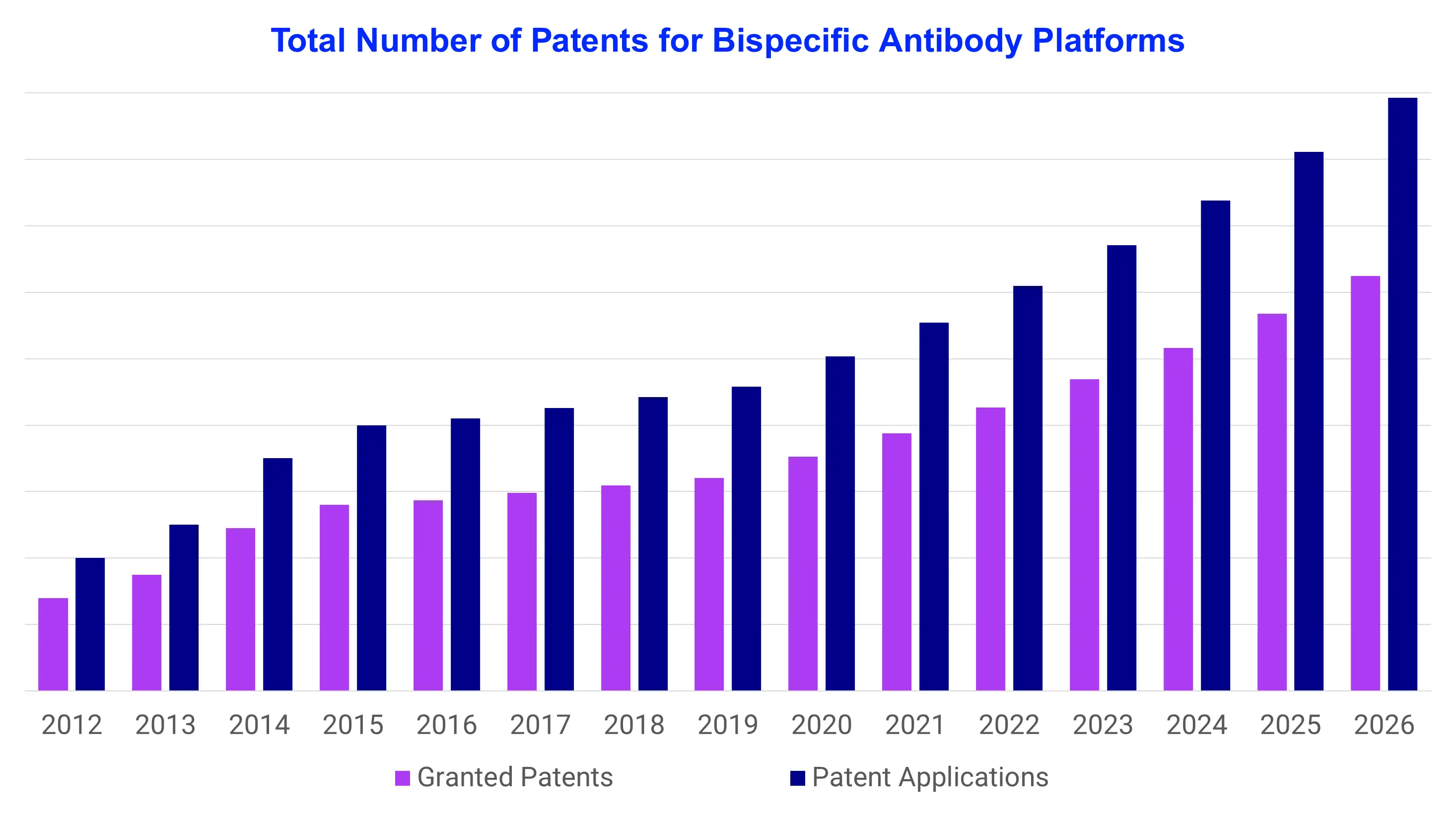
Filing intensity in this field follows commercial validation closely. Each wave of approvals, from blinatumomab in 2014 to the group of T-cell engagers cleared between 2022 and 2024, has been followed by new applications on half-life extension, step-up dosing, target pairs and manufacturing control. Large pharmaceutical groups have backed the area through licensing and acquisition spending, which feeds directly into continuation filings and format-specific claims. Chinese developers have raised the pace further, with domestic programmes in dual checkpoint blockade and bispecific antibody-drug conjugates producing a growing share of new families. More than 80 patents were granted in 2025 alone.
More than 21,000 patent families related to bispecific antibody platforms were identified, covering granted patents and pending applications. Filing activity was strongest in the period from roughly 2019 to 2023, and the most recent years are likely to rise as applications publish after the standard 18-month delay. The main technology clusters are T-cell engagers against CD3 and tumor antigens, asymmetric IgG-like heterodimerisation, common light chain and assembly-control technologies, dual immune checkpoint blockade, cofactor mimicry and dual pathway blockade outside oncology, and bispecific antibody-drug conjugates. Together these clusters account for most of the families in the landscape.
Rising demand for off-the-shelf T-cell engagers and for dual-target biologics in new indications has produced a matching expansion in patent families, as developers protect formats, target pairs and manufacturing methods ahead of late-stage readouts.
This report analyses patent activity and market trends associated with bispecific antibody platforms across the United States, Europe, China, Japan, South Korea, India and international filings through the World Intellectual Property Organization. Granted patents and pending applications are grouped into families so that priority filings and their national equivalents are counted once. The market coverage addresses global demand for approved bispecific products and platform technologies, with regional commentary on oncology-led adoption and the growing role of China-origin developers.
The scope covers bispecific antibody platforms built on asymmetric IgG-like formats, symmetric IgG-like and fusion formats, fragment-based T-cell engagers, common light chain formats, and tandem and dual variable domain formats. Mechanisms examined include T-cell redirection, dual immune checkpoint blockade, dual receptor or pathway blockade, cofactor mimicry and bispecific payload delivery. Therapeutic areas span hematologic malignancies, solid tumors, ophthalmology, hemophilia, and autoimmune and inflammatory diseases. Molecules engaging three or more targets fall under the separate multispecific antibody report and are treated here only as a boundary.
The analysis includes patent activity from large biopharmaceutical companies with approved bispecific products, specialist antibody engineering firms that license formats and platform technologies, and clinical-stage start-ups developing new target pairs. Chinese biotechnology companies form a distinct group because of their activity in dual checkpoint blockade and bispecific antibody-drug conjugates. Academic institutions, university hospitals and cancer centres are included where they hold assigned patents or sponsor early clinical studies. Contract development and manufacturing organizations are considered where they hold process claims on heterodimer assembly and purification.
The report will cover the following sections in detail:
Analysis by Bispecific Format
Analysis by Mechanism of Action
Analysis by Therapeutic Area
Bispecific Antibody Platforms Patent Filing Trend Analysis
Patent activity began with early engineering work on hybrid hybridoma and chemically linked formats in the 1980s and 1990s, followed by heterodimerisation methods such as knobs-into-holes in the mid-1990s. The approvals of blinatumomab in 2014 and emicizumab in 2017 shifted filings from format invention toward clinical differentiation, including half-life extension, safety management and new target pairs. After 2020, filings broadened to include bispecific antibody-drug conjugates, dual checkpoint designs and applications outside oncology.
Patent filings increased at an estimated annual growth rate of approximately 12% between 2020 and 2024. The increase was driven by the 2022 and 2023 run of T-cell engager approvals, which prompted follow-on filings on dosing and formulation, and by the rise of Chinese applicants in dual checkpoint blockade. Bispecific antibody-drug conjugates added a further stream of constructs combining two binding arms with a cytotoxic payload. Growth in granted patents is expected to lag filings slightly because of examination timelines.
Among the players with bispecific antibody platforms patent families, new entrants have been identified, which can be either established companies or startups developing novel technology in the field. Some of the major companies mentioned in this report (a non-exhaustive list) are as follows:
Genentech, a member of the Roche Group, holds one of the most influential bispecific antibody portfolios, including foundational knobs-into-holes heterodimerisation claims and the CrossMab approach to correct light chain pairing. Its commercial products include emicizumab (Hemlibra), approved in 2017 for hemophilia A, faricimab (Vabysmo), approved in 2022 for retinal disease, and the CD20 and CD3 T-cell engagers mosunetuzumab (Lunsumio) and glofitamab (Columvi). The company pairs broad format patents with product-specific claims on antibody sequences, dosing and manufacturing, which gives it protection at both the platform and molecule level. Its position is distinctive because it is active across hematologic malignancies, ophthalmology and hemophilia, rather than being concentrated in a single therapeutic area.‑‑‑
Amgen built its bispecific position around the BiTE platform, a fragment-based T-cell engager format that produced blinatumomab (Blincyto), approved in 2014 for B-cell acute lymphoblastic leukemia, and tarlatamab (Imdelltra), approved in 2024 for small cell lung cancer. The company has extended the platform with half-life extended constructs that use an Fc-based scaffold, which reduces the need for continuous infusion and widens the range of treatable settings. Several further candidates, including a prostate cancer engager, are in clinical development. Its IP strategy combines platform claims on the T-cell engager architecture with target-specific and dosing-regimen claims, and it is positioned as a leading developer of T-cell engagers in both blood cancers and solid tumors.
Other companies include Regeneron Pharmaceuticals, Janssen Biotech, and Akeso.
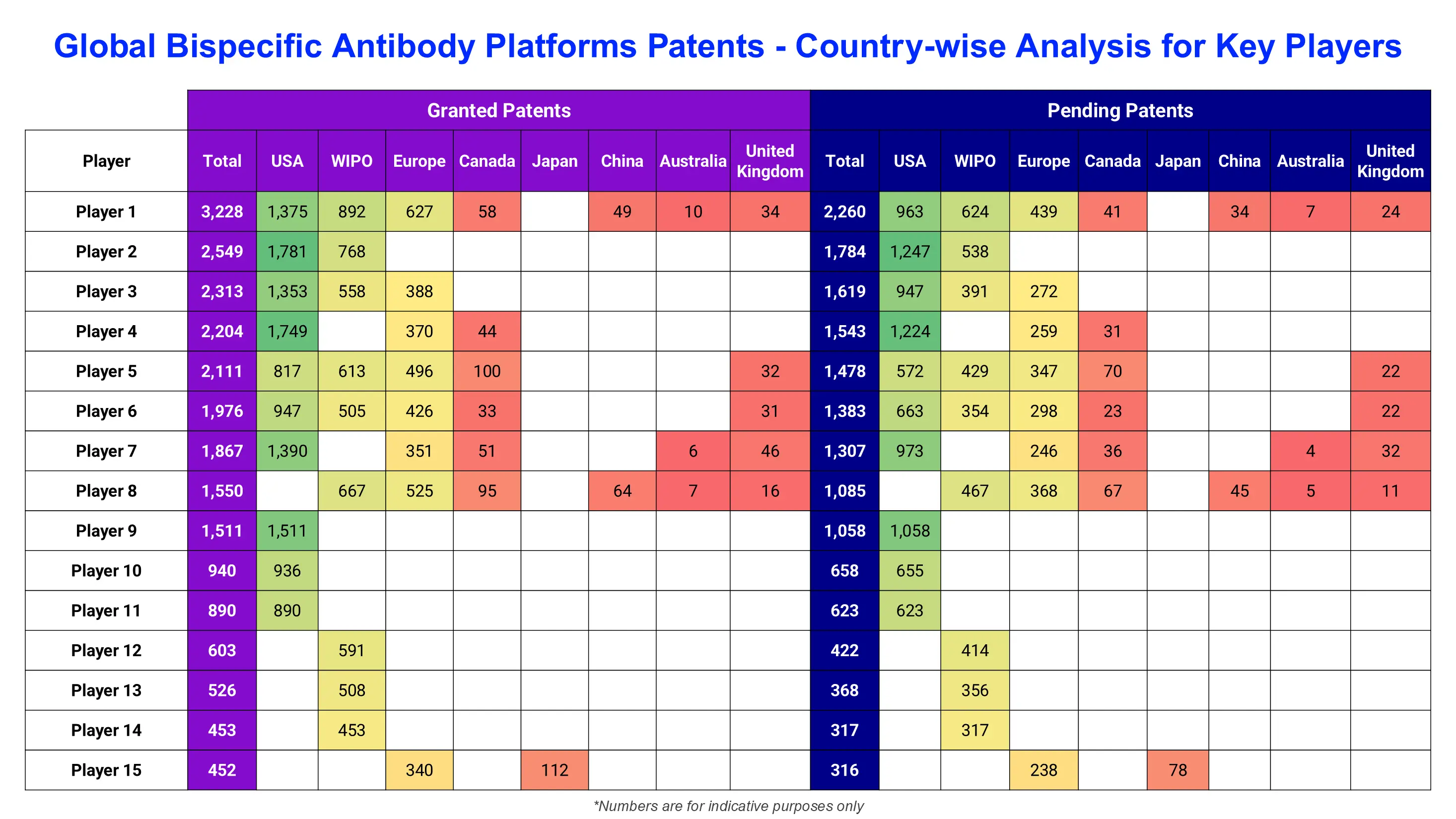
The leading assignees account for a significant share of analysed patent activity, indicating a moderately concentrated landscape. Genentech holds foundational heterodimerisation and light chain pairing claims alongside product-specific protection. Amgen centres its portfolio on the BiTE architecture and half-life extended variants. Regeneron Pharmaceuticals relies on its VelocImmune mouse platform and common light chain designs, with odronextamab and linvoseltamab advancing through regulatory review. Janssen Biotech combines licensed DuoBody technology with claims on amivantamab, teclistamab and talquetamab. Akeso, a Chinese developer, protects tetravalent designs behind cadonilimab and ivonescimab.
*Please note that this is only a partial list; the complete list of key players is available in the full report. Additionally, the list of key players can be customized to better suit your needs.*
The report assesses patent activity across major jurisdictions, including:
The United States remains the largest patent filing hub in the landscape, with 9,400+ patents associated with the jurisdiction, reflecting the base of originator companies and the size of its oncology market. China is the fastest-growing jurisdiction as domestic developers file on dual checkpoint blockade and bispecific antibody-drug conjugates. Europe holds a steady position through European Patent Office filings by multinational groups and specialist engineering firms. South Korea contributes through antibody engineering companies and manufacturers, India shows smaller but rising activity tied to biologics development capacity, and WIPO filings are used widely to preserve rights across several of these markets.
Read more about this report - Request a Free Sample
The patent landscape is segmented by technology categories associated with bispecific antibody platforms, and activity concentrates in five areas:
Asymmetric IgG-like heterodimerisation formats account for the largest share of patent activity, because they underpin most approved products and are claimed across many target pairs and therapeutic areas. T-cell engagers with extended half-life follow closely, supported by the approval record in lymphoma, myeloma and lung cancer. Bispecific antibody-drug conjugate constructs are the smallest segment but are growing the fastest, with a large share of new filings coming from China-based applicants.
The bispecific antibody platforms market is competitive, characterised by a few large originators with approved products and a long tail of specialist firms licensing formats and target pairs. Amgen, Genentech, Janssen Biotech and Regeneron Pharmaceuticals compete mainly in hematologic malignancies, where several products now target the same antigens such as CD20 and B-cell maturation antigen. Competition is intensifying in solid tumors and checkpoint blockade, where Akeso and other China-based companies have reached approval ahead of many Western programmes. Differentiation increasingly rests on dosing convenience, safety profile and manufacturing yield.
Companies are focusing on:
Emerging innovation themes include conditional or masked T-cell engagers designed to limit activity to tumor tissue, combinations of programmed cell death protein 1 blockade with vascular endothelial growth factor inhibition, and bispecific antibody-drug conjugates directed at pairs of tumor antigens. Early clinical studies of CD3-directed engagers in autoimmune disease are creating a new filing stream. Zanidatamab, a HER2-directed biparatopic antibody that received accelerated US approval in 2024 for biliary tract cancer, shows how epitope-level designs are broadening the field.
The bispecific antibody platforms landscape reflects the maturing of a modality that began with a single approved product in 2014 and now supports a broad set of commercial franchises. Patent families are concentrated in a limited number of format families and target pairs, which creates both freedom-to-operate constraints and licensing opportunities. Shifts toward subcutaneous administration, solid tumor indications and non-oncology uses are redirecting filings, and the boundary with multispecific constructs is becoming more relevant for later-stage planning.
The landscape provides actionable intelligence for stakeholders evaluating bispecific antibody platforms, including support for:
The patent landscape for bispecific antibody platforms is developed through structured searches of global patent databases, using keyword strategies and Cooperative Patent Classification codes relevant to multispecific binding proteins, heterodimerisation methods, T-cell engagers and related constructs. Records are retrieved from the United States, Europe, China, Japan, South Korea, India and WIPO collections and consolidated into patent families.
Patent records are screened, refined, categorised and consolidated to ensure relevance to the defined scope. Records that cover only monospecific antibodies, or constructs with three or more specificities, are excluded or assigned to the appropriate boundary category. Remaining families are classified by bispecific format, mechanism of action, therapeutic area and assignee, and assignee names are harmonised across subsidiaries and licensees.
The market analysis is supported through secondary research, including regulatory approval records, company disclosures, clinical trial registries, scientific publications and industry sources. Market size, forecast and growth estimates are cross-checked against product launches and pipeline progression, and patent trends are interpreted alongside these commercial indicators to show where filing activity is supported by clinical and regulatory progress.


Upto 15% Off
USD
$2699 $2429
$4299 $3869
$5799 $4949
$6999 $5949


*While we strive to always give you current and accurate information, the numbers depicted on the website are indicative and may differ from the actual numbers in the main report. At Expert Market Research, we aim to bring you the latest insights and trends in the market. Using our analyses and forecasts, stakeholders can understand the market dynamics, navigate challenges, and capitalize on opportunities to make data-driven strategic decisions.*
EMR's Bispecific Antibody Platforms Patent Landscape Analysis provides a comprehensive assessment of patent filings, innovation clusters, assignee portfolios, and geographic filing patterns across the bispecific antibody platforms landscape. The report identifies 21,000+ patent families, evaluates leading jurisdictions including the United States, China, and Europe, and profiles the top assignees by portfolio size.
The global bispecific antibody platforms market was valued at USD 14.60 Billion in 2025. The market is projected to reach USD 60.10 Billion by 2035, expanding at a CAGR of 15.20% during 2026-2035.
The report analyses approximately 21,000+ patent families related to bispecific antibody platforms. These include filings from the United States, China, Europe, and international WIPO filings.
Key companies operating within the landscape include Genentech, Amgen, Regeneron Pharmaceuticals, Janssen Biotech, and Akeso, among others. These organisations collectively account for a significant portion of patent activity analysed in this report.
The report evaluates patent activity across the United States, Europe, China, Japan, South Korea, India, and international WIPO filings. The United States is the largest single jurisdiction in the landscape, with 9,400+ bispecific antibody platforms patents associated with it, ahead of China and Europe.
Yes. The report scope can be customised based on geography, technology segment, assignee selection, time period, or specific innovation cluster focus. Yes, organisations can contact the EMR team to scope a customised study, with the report adjustable by geography, technology cluster, assignee set or therapeutic area.
Patent landscape analysis helps organisations understand innovation trends, competitive activity, technology whitespace, and IP risk across a defined domain. For bispecific antibody platforms, this report supports strategic decisions in R&D prioritisation, licensing evaluation, competitive benchmarking, and market entry planning.
Explore our key highlights of the report and gain a concise overview of key findings, trends, and actionable insights that will empower your strategic decisions.
|
Scope of the Report |
Details |
|
Analysis by Bispecific Format |
|
|
Analysis by Mechanism of Action |
|
|
Analysis by Therapeutic Area |
|
|
Analysis by End User |
|
|
Key Players Mentioned |
|
|
Geographies Covered |
|
Mini Report
One User
USD 2,699
USD 2,429
tax inclusive*
Single User License
One User
USD 4,299
USD 3,869
tax inclusive*
Five User License
Five User
USD 5,799
USD 4,949
tax inclusive*
Corporate License
Unlimited Users
USD 6,999
USD 5,949
tax inclusive*
*Please note that the prices mentioned below are starting prices for each bundle type. Kindly contact our team for further details.*
Flash Bundle
Small Business Bundle
Growth Bundle
Enterprise Bundle
*Please note that the prices mentioned below are starting prices for each bundle type. Kindly contact our team for further details.*
Flash Bundle
Number of Reports: 3
20%
tax inclusive*
Small Business Bundle
Number of Reports: 5
25%
tax inclusive*
Growth Bundle
Number of Reports: 8
30%
tax inclusive*
Enterprise Bundle
Number of Reports: 10
35%
tax inclusive*
How To Order

Select License Type
Choose the right license for your needs and access rights.

Click on ‘Buy Now’
Add the report to your cart with one click and proceed to register.

Select Mode of Payment
Choose a payment option for a secure checkout. You will be redirected accordingly.
Strategic Solutions for Informed Decision-Making
Gain insights to stay ahead and seize opportunities.

Get insights & trends for a competitive edge.

Track prices with detailed trend reports.

Analyse trade data for supply chain insights.

Leverage cost reports for smart savings

Enhance supply chain with partnerships.

Connect For More Information
Our expert team of analysts will offer full support and resolve any queries regarding the report, before and after the purchase.
Our expert team of analysts will offer full support and resolve any queries regarding the report, before and after the purchase.
We employ meticulous research methods, blending advanced analytics and expert insights to deliver accurate, actionable industry intelligence, staying ahead of competitors.
Our skilled analysts offer unparalleled competitive advantage with detailed insights on current and emerging markets, ensuring your strategic edge.
We offer an in-depth yet simplified presentation of industry insights and analysis to meet your specific requirements effectively.




